Archive
Loyal, Or Disloyal?
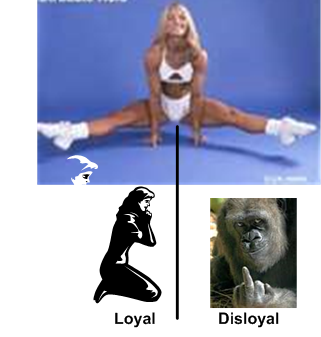
In virtually every organization comprised of a large group of human beings, one individual or sub-group always holds absolute “power over” the members who hold the “power to” get things done. Because of the innate primal human desire to retain power and remain in control, there’s a dangerous fine line that every “power to” member should be acutely aware of.
On one side of the line is “loyalty”. On the other side is “disloyalty”. Those in charge, of course, are the ultimate arbiters of where you stand in relation to line. I like to straddle the line (see below), but it’s not within my power to judge where I stand.
Note: I borrowed the “power over” and “power to” concepts from Russell Ackoff, a true management genius – that everyone in the mainstream ignores, of course.
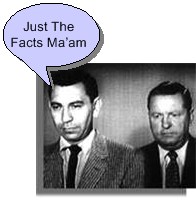
Just The Facts Ma’am
The other day, I had a confrontation with an anointed leader. (Being the insensitive and self-righteous jerk that I am, and supposedly incapable of being a leader myself, that happens a lot). After I made some normally “undiscussable” assertions as to the poor leadership behavior (more like NO leadership behavior) being exhibited by my confrontee, he/she accused me of not having all the facts. My counter was, “You’re absolutely right, but when does anyone have ALL the facts before they make a judgment regarding a FUBAR situation or a person’s behavior?“.
How does one know when ALL the facts have been discovered? Is there such a thing as ALL the facts? Even if ALL the facts can be unearthed, is it a foregone conclusion that every fact will always interpreted the same way by all people? Can words or, for the fellow engineers in the house, equations convey any universal truth, or are they just approximations?
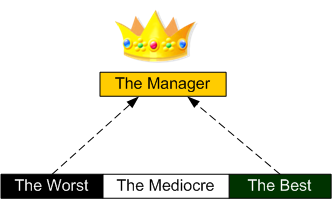
Both Ends Of The Spectrum
Why does it seem that both the best engineers and the worst engineers always gravitate towards becoming managers? Because of a lack of training in the art of humanistic influence and true leadership skills, they usually (but not always) end up turning into STSJ BMs. The real tragedy is the continuous loss of the best engineers into the ranks of corpo elitism. Why? Because the revenue generating products and services they leave in the dust for fame and fortune suffer the consequences of their departure. Thus, the whole company suffers. Bummer.
Incremental Watts
I don’t know which name I like better, Watts Wacker or Soupy Sales, but this post is about Watts. Watts Wacker is a CEO and futurist who uttered one of my favorite quotes:
You can’t increment your way into the future – Watts Wacker
I think this quote is directed toward leaders of cushy, static, and stanky CCH companies who are so afraid of the future that they move by inches at a time in passive response to external changes. The only way to leapfrog your competitors, since they’re just as afraid as you and are inching along like molassess running up hill, is to make a disruptive leap into the future.
It takes revolutionaries to trigger disruptive leaps into the unknown. Someone (actually, two people) with an innocent but assuredly incremental mindset recently said to me: “Revolutionaries are usually lined up in front of a wall and shot“. My response was “that’s why there are so few of them“. Bummer.

Almost Anything Can Work, BUT….
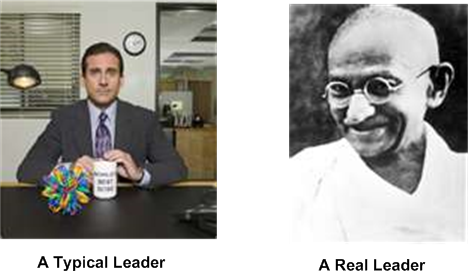
Almost any well known management technique/process for improving corpo performance (e.g. six-sigma, BPR, MBO, task forces, brainstorming, core competencies, SWOT analysis, etc) that was mildly successful in a handful of cases can work. BUT, it takes real leadership to make them work; and that’s why they don’t work.
So WTF is real leadership? I make stuff up and I’m not fit to lead anyone or anything, so don’t ask me :^)
(Dys)functional Managers
IMHO, “functional” engineering managers (e.g. software, hardware, systems, test, etc) should be charged with: developing their people, removing obstacles to their progress, ensuring that tools and training are available, and streamlining bloated processes so that their people can work more efficiently and produce higher quality work outputs. Abdicating these responsibilities makes these dudes (dys)functional bozo managers in my (and maybe only my) eyes.
It really blows my mind when (dys)functional managers are allowed to anoint themselves “chief architect” over and above individual product team functional leads. It’s doubly annoying and counterproductive to an org when these BMs don’t work hands-on with any of the org’s products day-to-day, and they haven’t done any technical design work in this millenium. If I was their next level manager (and not a BM myself so that I could actually see the problem), I’d, as textbook clone managers love to say, “aggressively address” the BM problem by making it crystal clear what their real job is. I’d follow up by periodically polling the BM’s people directly to evaluate how well the BM is performing. Of course, I’m not fit to lead anyone, so you should totally ignore what I say :^)

Culture Adjustment
I think that almost everyone heard about this week’s glitch in the air traffic control system that caused hours of flight delays. Here’s an interesting quote from the government’s GAO (FAA computer failure reflects growing burden on systems — Federal Computer Week):
“However, FAA faces several challenges in fulfilling NextGen’s objectives, including adjusting its culture and business practices, GAO concluded.”
Well, duh. Every mediocre and under performing corpo borg needs to “adjust its culture and business practices”. It’s just that none of them have the competence to do it, regardless of how many titles and credentials that the corpocrats running the show adorn themselves and their sycophants with.
Malcontents
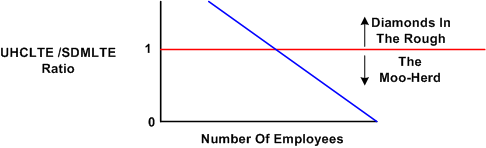
Everyone’s heard of the stereotypical, disgruntled, malcontented, long time employee (SDMLTE) who “can’t wait to retire”. Why is this Dilbertonian image a stereotype? Because it’s so ubiquitous that it’s unquestioningly accepted by the vast majority of people as “that’s the way it is everywhere”. Well, is it? Do you really think that every organization on this earth has a surplus of SDMLTEs? Call me idealistic, but I assert “no”.
I opine that there are few (very, very, very, very, few) companies whose old warhorses, graybeards and bluehairs are uncommon, happy, content, long time employees (UHCLTE). Compared to the moo-herd of corpocracies that litter the land, these scarce diamonds in the rough have a huge UHCLTE to SDMLTE ratio. I’ll also profer that as a company gets larger, its UHCLTE to SDMLTE ratio decreases. That’s because as a company grows in size, bad management increases while great leadership decreases within the citadel walls – regardless of what the corpo stewards repeatedly espouse. Bummer.
Structure And Work
Under the inescapable second law of thermodynamics, fragmentation and dis-integration are natural consequence of organizational growth over time. Real leaders respect and arrest the destructive power of the second law by conscientiously applying structure and work to keep the org intact and aligned toward a higher purpose. All cookie cutter managers know how to design and impose structure. Hell, that’s the easy part because you could look one up in the standard hierarchical patterns handbook (which has only one page and one pattern – the command and control hierarchy where the kahunas at the top rule over the kingdom and ignore input from everyone else).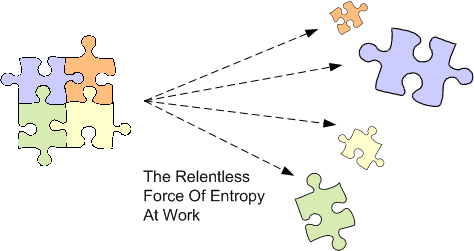
The “work” is the hard part. Unlike leaders, managers hate work and they’ll do anything, no matter how harmful it is to the org, to avoid it while feigning that they’re bustin’ their butt to “get things done”. Thus, after unveiling his/her latest masterpiece corpo structure, which is always an insignificant hierarchical tweak, he/she “abdicates” the day-to-day work of keeping the fragments in harmony to…….. “others”.
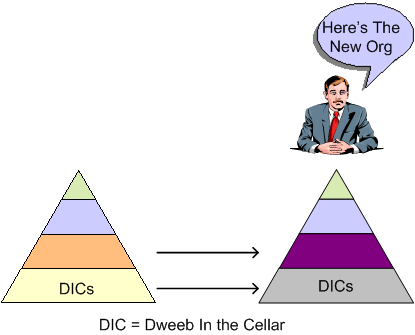
So, what is the “work” part of the powerful, entropy-arresting, work+structure dynamic duo? It’s a continuous and active “sampling the value stream” and a continuous monitoring of the interfaces and interactions between the org fragments to sense signals of disintegration. Without doing the work part, performance will not improve, and of course, it will deteriorate further; triggering yet another round of restructuring to “meet the changing needs of our customers”. Bummer.

Initiative Initiation
Assume that the graph below describes the rise and fall of a hypothetical CCH (Command and Control Hierarchical) business. During the party time phase of increasing profits (whoo hoo!), the CCH corpocrats in charge pat themselves on the back, stuff their pockets, and slowly inflate their heads with bravado and delusions of infallibility.
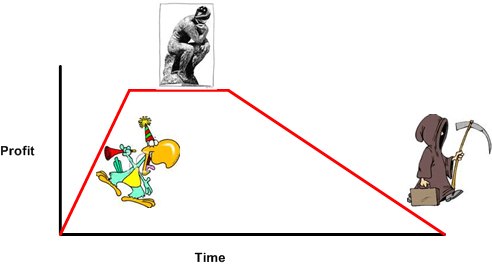
In order to extend the increasing profit trajectory, an undetectable status quo preserving mindset slowly but surely kicks in. Hell, if it ain’t broke, don’t touch the damn thang. Since what the CCH (so-called) leadership is doing is working, any individual or group from within or without the cathedral walls who tries to deviate significantly from the norm is swiftly “dealt with” by the corpocrats in charge. Everthing needs to get approved by a gauntlet of “important” people. However, while the shackles are being tightened and the ability to scale for success is being snuffed, the external environment keeps changing relentlessly in accordance with the second law of thermodynamics. Profit starts eroding and tension starts ratcheting upwards. Out of fear of annihilation, the cuffs are tightened further and the death dive has begun. Bummer.
During the free fall to obscurity, the now brain-dead and immobile corpocrats in charge start “taking aggressive action” to stem the flow of red ink. Platitudes and Matt Foley-like motivational speeches are foisted upon the DICs (Dweebs In the Cellar) in frantic attempts to self-medicate away the pain of stasis and failure. Initiatives with cute and inspiring names are started but never finished (because it takes real hands-on leadership, sweat, and work to follow through). As corposclerosis accelerates, silver-bullet-bearing consultants are brought in and the frequency of initiative initiation increases. Calls for accountability of “them” pervade the corpocracy from the top down and vice versa.
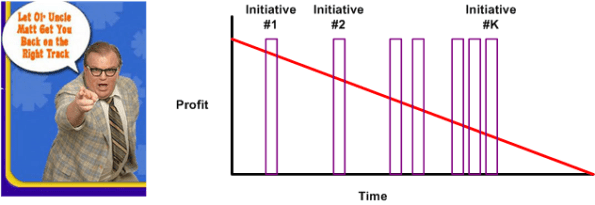
After being hammered by pleas to “improve performance” and being pounded by the endless tsunamis of hollow initiatives, the DICs disconnect and distance themselves from the lunacy being doled out by the omnipotent dudes in the politboro. Since the DICs expect the corpocrats to effect the “turnaround” and the corpocrats expect the DICs to strap on their Nikes and “just do it”, no one takes ownership and nothing of substance changes. As you might surmise, it’s a Shakespearian tragedy with no happy ending. Bummer squared.
Leaderless CCHs deserve what they get; a fearful, disconnected workforce and a roller coaster ride to oblivion.

Why am I here?
WTF?
Meh!
D'oh!

My BTC Address



 Bulldozer00's Blog