Archive
Shocking!
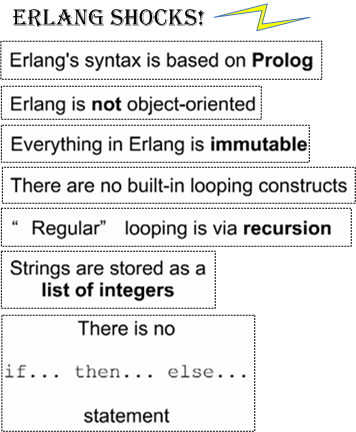
In the brilliant YouTube video, “An Introduction to Erlang (for Python programmers) “, the narrator presents the following facts about Erlang that are shocking to “normal” programmers trained in object-oriented languages:
So, why would anyone want to learn Erlang? Because….
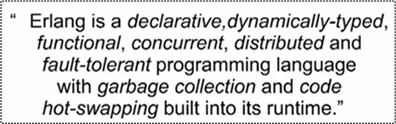
In my case, the fact that concurrency, distribution, fault-tolerance, and hot-swapping are built in to the language make me a huge Erlang fan. On the downside, I’m not a fan of “managed” languages. However, Erlang’s positives far outweigh its negatives. What do you think?
Awhile ago, I started a focused effort to learn how to program idiomatically in Erlang. However, because:
1 I’m a slooow learner.
2 C++/Java are the languages that my company’s products are written in.
3 ……
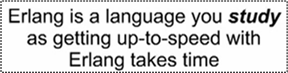
I’ve abandoned the “deep dive” into the language. However, I’m definitely still watching from the periphery because my gut tells me that Erlang will continue its rise into prominence.
My Erlang Learning Status – IV
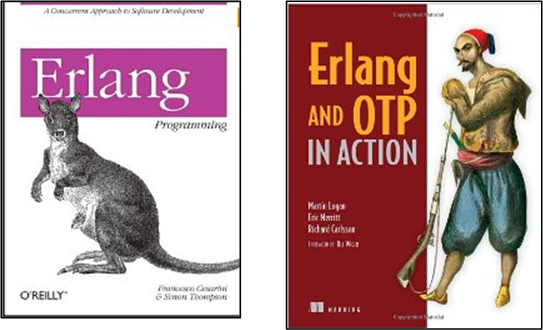
I haven’t progressed forward at all on my previously stated goal of learning how to program idiomatically in Erlang. I’m still at the same point in the two books (“Erlang And OTP In Action“; “Erlang Programming“) that I’m using to learn the language and I’m finding it hard to pick them up and move forward.
I’m still a big fan (from afar) of Erlang and the Erlang community, but my initial excitement over discovering this terrific language has waned quite a bit. I think it’s because:
- I work in C++ everyday
- C++11 is upon us and learning it has moved up to number 1 on my priority list.
- There are no Erlang projects in progress or in the planning stages where I work. Most people don’t even know the language exists.
Because of the excuses, uh, reasons above, I’ve lowered my expectations. I’ve changed my goal from “learning to program idiomatically” in Erlang to finishing reading the two terrific books that I have at my disposal.
Note: If you’re interested in reading my previous Erlang learning status reports, here are the links:
My Erlang Learning Status – III
Since my last status report, I haven’t done much studying or code-writing with Erlang. It’s not because I don’t want to, it’s just that learning a new programming language well enough to write idiomatic code in it is a huge time sink (for me) and there’s just not enough time to “allocate” to the things I want to pursue.
However, that may change now that I have e-access (through my safaribooksonline.com subscription) to a second, terrific, Erlang book: “Erlang And OTP In Action“. Together with the equi-terrific book, “Erlang Programming“, the two different teaching approaches are just what may motivate me to pick up the pace.
When learning a new topic, I like to use multiple sources of authority so that I can learn the subject matter from different points of view. It’s interesting to compare the table of contents for the two books:
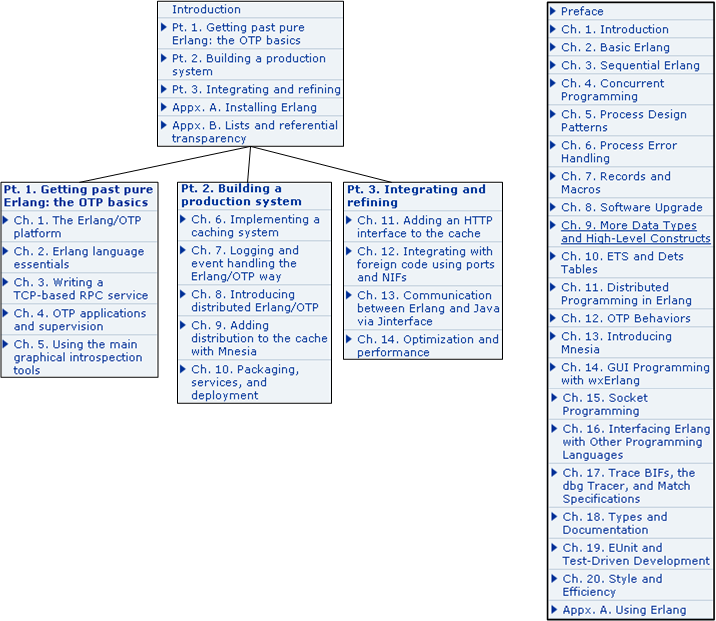
Currently, I’m in chapter 2 of the Erlang/OTP book (left TOC above) and chapter 6 in the Erlang book. As I lurch forward, the going gets slooower because the concepts and language features are getting more advanced. I hate when that happens. 🙂
Note: If you’re interested in reading my first Erlang learning status report, click here. My second one is here.
A Role Model For Change
In the comments section of the Horse And Buggy post, Steve Vinoski was gracious enough to provide links to four IEEE Computer Society columns that he wrote a few years ago on the topic of distributed software systems. For your viewing pleasure, I’ve re-listed them here:
http://steve.vinoski.net/pdf/IEEE-Serendipitous Reuse.pdf
http://steve.vinoski.net/pdf/IEEE-Demystifying_RESTful_Data_Coupling.pdf
http://steve.vinoski.net/pdf/IEEE-Convenience_Over_Correctness.pdf
http://steve.vinoski.net/pdf/IEEE-RPC_and_REST_Dilemma_Disruption_and_Displacement.pdf
Of course, being a Vinoski fan, I read them all. If you choose to read them, and you’re not an RPC (Remote Procedure Call) zealot, I think you’ll enjoy them as much as I did. To view and learn more about distributed software system design from a bunch of Steve Vinoski video interviews, check out the collection of them at InfoQ.com.
I really admire Steve because he made a major leap out of his comfort zone into a brave new world. He transitioned from being a top notch CORBA and C++ proponent to being a REST and Erlang advocate. I think what he did is admirable because it’s tough, especially as one gets older, to radically switch mindsets after investing a lot of time acquiring deep expertise in any technical arena (the tendency is to dig one’s heels in). Add to that the fact that he worked for big gun CORBA vendor Iona Technologies (which no longer exists as an independent company) during the time of his epiphany, and you’ve got a bona fide role model for change, no?

Procedural, Object-Oriented, Functional
In this interesting blog post, Dr Dobbs – Whither F#?, Andrew Binstock explores why he thinks “functional” programming hasn’t displaced “object-oriented” programming in the same way that object-oriented programming started slowly displacing “procedural” programming in the nineties. In a nutshell, Andrew thinks that the Return On Investment (ROI) may not be worth the climb:
“F# intrigued a few programmers who kicked the tires and then went back to their regular work. This is rather like what Haskell did a year earlier, when it was the dernier cri on Reddit and other programming community boards before sinking back into its previous status as an unusual curio. The year before that, Erlang underwent much the same cycle.”
“functional programming is just too much of a divergence from regular programming. ”
“it’s the lack of demonstrable benefit for business solutions — which is where most of us live and work. Erlang, which is probably the closest to showing business benefits across a wide swath of business domains, is still a mostly server-side solution. And most server-side developers know and understand the problems they face.”
So, what do you think? What will eventually usurp the object-oriented way of thinking for programmers and designers in the future? The universe is constantly in flux and nothing stays the same, so the status quo loop modeled by option C below will be broken sometime, somewhere, and somehow. No?

My Erlang Learning Status – II
In my quest to learn the Erlang programming language, I’ve been sloowly making my way through Cesarini and Thompson’s wonderful book: “Erlang Programming“.
In terms of the book’s table of contents, I’ve just finished reading Chapter 4 (twice):
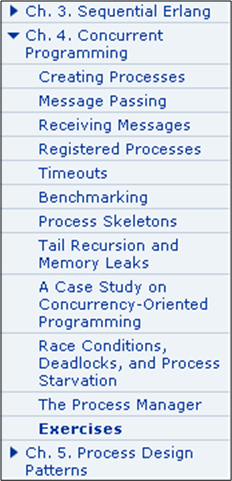
As I expected, programming concurrent software systems in Erlang is stunningly elegant compared to the language I currently love and use, C++. In comparison to C++ and (AFAIK) all the other popularly used programming languages, concurrency was designed into the language from day one. Thus, the amount of code one needs to write to get a program comprised of communicating processes up and running is breathtakingly small.
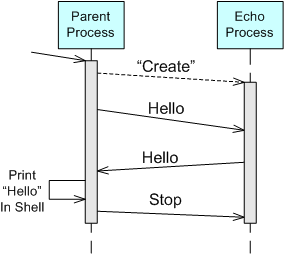
For example, take a look at the “bent” UML sequence diagram of the simple two process “echo” program below. When the parent process is launched by the user, it spawns an “Echo” process. The parent process then asynchronously sends a “Hello” message to the “Echo” process and suspends until it receives a copy of the “Hello” message back from the “Echo” process. Finally, the parent process prints “Hello” in the shell, sends a “Stop” message to the “Echo” process, and self-terminates. Of course, upon receiving the “Stop” message, the “Echo” process is required to self-terminate too.
Here’s an Erlang program module from the book that implements the model:
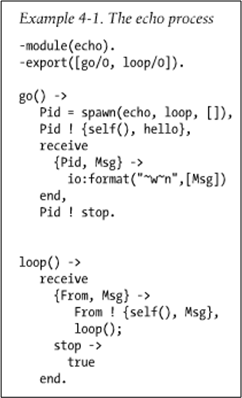
The go() function serves as the “Parent” process and the loop() function maps to the “Echo” process in the UML sequence diagram. When the parent is launched by typing “echo:go().” into the Erlang runtime shell, it should:
- Spawn a new process that executes the loop() function that co-resides in the echo module file with the go() function.
- Send the “Hello” message to the “Echo” process (identified by the process ID bound to the “Pid” variable during the return from the spawn() function call) in the form of a tuple containing the parent’s process ID (returned from the call to self()) and the “hello” atom.
- Suspend (in the receive-end clause) until it receives a message from the “Echo” process.
- Print out the content of the received “Msg” to the console (via the io:format/2 function).
- Issue a “Stop” message to the “Echo” process in the form of the “stop” atom.
- Self-terminate (returning control and the “stop” atom to the shell after the Pid ! stop. expression).
When the loop() function executes, it should:
Suspend in the receive-end clause until it receives a message in the form of either: A) a two argument tuple – from any other running process, or, B) an atom labeled “stop“.
- If the received message is of type A), send a copy of the received Msg tuple argument back to the process whose ID was bound to the From variable upon message reception. In addition to the content of the Msg variable, the transmitted message will contain the loop() process ID returned from the call to self(). After sending the tuple, suspend again and wait for the next message (via the recursive call to loop()).
- If the received message is of type B), self-terminate.
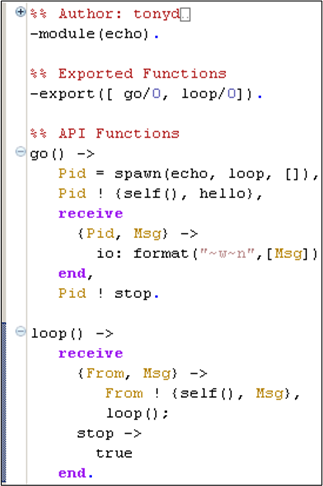
I typed this tiny program into the Eclipse Erlide plugin editor:
After I compiled the code, started the Erlang VM in the Eclipse console view, and ran the program, here’s what I got:
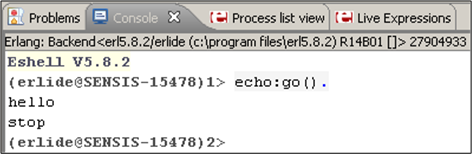
It worked like a charm – Whoo Hoo! Now, imagine what an equivalent, two process, C++ program would look like. For starters, one would have to write, compile, and run two executables that communicate via sockets or some other form of relatively arcane inter-process OS mechanism (pipe, shared memory, etc), no? For a two thread, single process C++ equivalent, a threads library must be used with some form of synchronized inter-thread communication (2 lockless ring buffers, 2 mutex protected FIFO queues, etc).
Note: If you’re interested in reading my first Erlang learning status report, click here.
Firing Up The Eclipse Erlide Plugin
To help me learn and practice writing source code in Erlang, I downloaded and installed the “Erlide” plugin for the Eclipse-Helios IDE. The figure below displays a snapshot of Eclipse with the default Erlang perspective opened up. The set of Erlang specific views that are displayed within the default perspective are: the editor, navigator, process list, and live expressions views. Each Erlang specific view is annotated with this kool little Erlide logo:


As you can see, the editor is showing the content of the “hello.erl” source code file, which contains the definition of the “hello/0” function. The console view at the bottom of the screen shows the result of manually typing in “hello:hello().“, which runs the program on the version 5.8.2 Erlang virtual machine (VM). Upon completion, the VM did what it was told. It printed, duh, : “Hello World!”.
The complete list of Erlide views available to aspiring Erlang programmers is shown below. Since I’m a newbie to the land of Erlang, I have no freakin’ idea what they do yet.
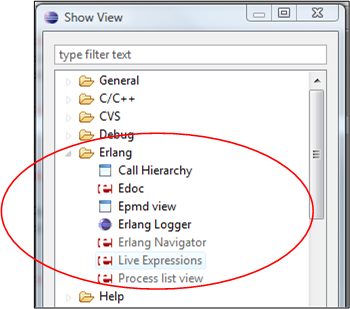
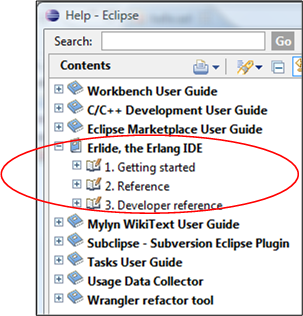
With the aid of the supplied eclipse Erlide help module (see below), I was easily able to configure and link the IDE to my previously downloaded and installed distribution of the Erlang VM.
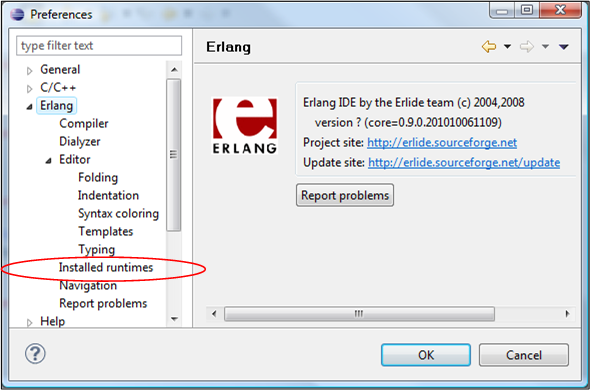
The snapshot below shows the configurability options offered up by Erlide via the eclipse “Preferences” window. I won’t go into the details here, but the “Installed runtimes” option is where you connect up Erlide with your installed Erlang VM(s).
So, C++ programmers, what are you waiting for? Download the latest Erlang distro, the Erlide eclipse plugin (you do use eclipse, right?), buy a good Erlang book, and start exploring this powerful and relatively weird programming language.
Oh, and thanks to the great programmers who designed, wrote, and tested the Erlide Eclipse plugin – most likely on their own time. You guys and gals rock!
My Erlang Learning Status
Check out this slide from Erlang language co-designer Joe Armstrong’s InfoQ lecture: “Erlang – software for a concurrent world“. I’ve circled the features that have drawn me to Erlang because I’m currently developing product software where those qualities are hugely important to my customers. Despite their importance to success, they’re almost always given second class status by programmers and managers because they’re not domain-specific, “glamorous“, features.

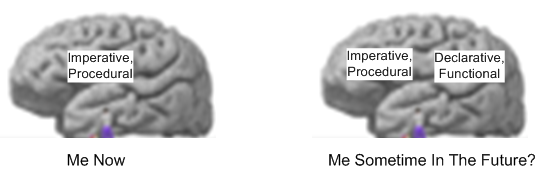
The blue arrow is my sore spot. You see, I’ve been programming imperatively in FORTAN, then C, and then C++, since Jesus was born. Thus, learning the stateless, recursive, functional programming mindset that Erlang is founded upon is a huge hurdle for me to overcome. Nevertheless, as I’ve stated before, I’m half-assedly trying to learn OMOT how to program in Erlang with the aid of this very good book:
Here’s my learning “status” in terms of the book’s table of contents:
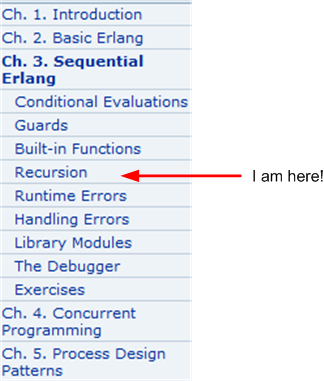
I don’t have an ironclad, micro-scheduled plan or BS risk register pinned on the wall in my war room, so I have no idea when I’ll be 100% done. But who knows, if I don’t abandon the effort:
Note: OMOT = On My Own Time
Remotivated, At Least For Now
After watching former C++ and CORBA guru Steve Vinoski rave about Erlang in this InfoQ video, I’ve been re-motivated to try and learn a dynamically typed (yikes!), functional programming language. After starting to learn CLisp with the “Land Of Lisp” serving as my training reference, I’ve switched gears. I’ve downloaded the Erlang distribution, I’ve downloaded the Erlang Eclipse plugin “Erlide“, and I’m using “Erlang Programming” as my first training book.
The book’s first chapter describes an impressive list of built in features that have drawn me to Erlang like a moth to a flame:
- Erlang was developed to solve the “time-to-market” requirements of distributed, fault-tolerant, massively concurrent, soft real-time systems.
- Erlang concurrency is fast and scalable. Its processes are lightweight in that the Erlang virtual machine does not create an OS thread for every created process.
- Erlang processes communicate with each other through message passing.
- Erlang has distribution incorporated into the language’s syntax and semantics, allowing systems to be built with location transparency in mind. The default distribution mode is based on TCP/IP, allowing a node (or Erlang runtime system) on a heterogeneous network to connect to any other node running on any operating system.
- Global variables don’t exist.
As of now, I’m planning to occasionally blog about my Erlang learning experience as I inch forward into the weird and whacky world of functional programming. But; since I’m doing this on my own time, I’m a slooow learner, I love working in C++, we don’t use Erlang where I work, and my intrinsic motivation may vanish, I may abandon the effort. If I do decide to “bag it“, be sure to call me a quitter.

Imperatively Dysfunctional
I’ve been programming in the C and C++ imperative languages forever. However, it seems that functional languages like Lisp, F#, Erlang, Scheme, Haskell, etc, are generating a lot of buzz these days. Curious as to what all the fuss is about, I tuned into Rebecca Parsons’ “Functional Languages 101” InfoQ video to learn more about these formerly “academic” languages.
OMG! It felt like getting a root canal without novocaine. Since I’m imperatively dysfunctional, I found her lecture to be really tough to follow. The fact that all of Rebecca’s viewgraphs were black and white text-only throwbacks to the 70’s didn’t help – not one conceptual diagram was presented.
One of Rebecca’s opening foils is shown below. As opposed to a statement, which is the fundamental unit of design in imperative languages, the pure “function” is ground zero in the functional language world. Recursion and statelessness are fundamental tenets of functional languages. Problems, even those that are naturally stateful (most real-world problems?), must be morphed into the vocabulary and semantics of functional language land.

The viewgraph below shows one of several Scheme language listings that Rebecca presented. Even after listening to her explanation of how it works, the only thing about the parentheses encoded gibberish that I grasped is that it defines the logic of three recursive functions that do something. D’oh!
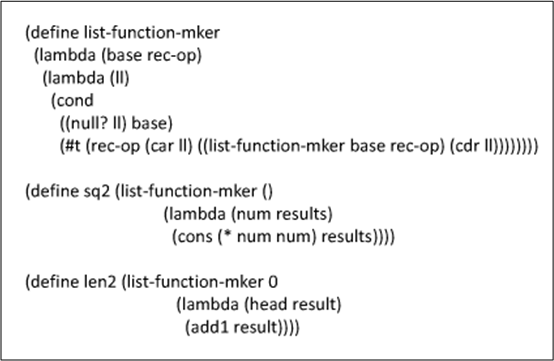
In one of her last viewgraphs (see below), Ms. Parsons addressed the main reason for the rise of functional programming languages. Being a specifier/designer/developer of distributed real-time sensor systems, I’m really keen on her first bullet.
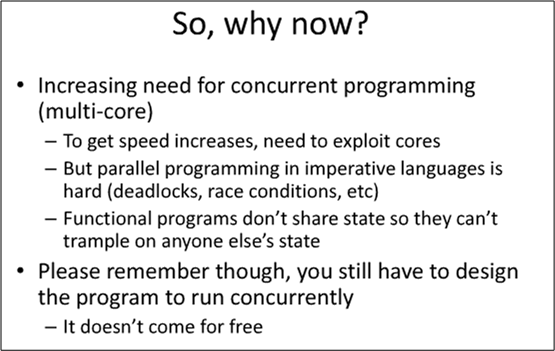
Even though watching Rebecca’s lecture didn’t enlighten me and it made my head spin, I’m going to crack open an Erlang programming book and try to learn more about the subject. Eventually, I just may “get it” and experience the “ah-ha” moment that many others seem to have experienced.


Why am I here?
WTF?
Meh!
D'oh!

My BTC Address



 Bulldozer00's Blog