Archive
Serial Misbehavers Anonymous
Hello everyone. My name is Tony DaSilva, and I’m a serial misbehaver. I repeatedly and relentlessly attack sacred cows in broad daylight and unsuccessfully attempt to discuss the undiscussables both in public (to their faces) and in private (behind their backs). As you all know yourselves, this behavior is extremely counterproductive and it inflicts a considerable amount of psychological pain upon all those people around me, including those who are multiple hops away from the local carnage.

In addition to slam dunking turds into everybody’s punch bowl, this nasty affliction results in a predictable boomerang effect that overflows my own punch bowl with retaliatory grumpies. Often, the next day’s hangover leads to emotional waves of guilt washing over me and intense feelings of isolation. Someone please be my sponsor and help me to STFU during the tough times when the beast within awakens and wants to possess my body and soul yet once again. D’oh!

“Tony’s behavior was explainable, but not excusable” – KW
Open, Closed, Inquiring
“Every man, wherever he goes, is encompassed by a cloud of comforting convictions, which move with him like flies on a summer day.” – Bertrand Russell
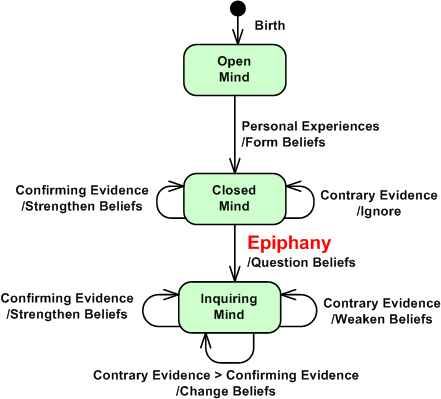
Out of the chute, so to speak, we’re all born with open minds. As we age and accumulate one experience after another, we naturally start forming beliefs based on those experiences. The experiences of other individuals (like our friends and parents) and institutions (like our schools, our corpocracies, and our government) are also impressed upon us. The more similar our new experiences to our previous experiences, the more attached we become to our beliefs. Unknowingly, we’ve started to construct our own very personal “unshakable cognitive burden” (UCB) from the ground up.

As our attachment to (at least some of) those beliefs hardens through exposure to more and more confirming evidence, our minds close up and we start suffering more and more. We tend to conveniently ignore, or violently reject, disconfirming evidence to the contrary in order to preserve our hard earned sense of safety and security. Each subsequent experience causes a nearly instantaneous transition out of, and back into, the closed mind state. Once a core belief (the earth is flat, the sun revolves around the earth, “they” are always right, “—-ism” is infallible) has hardened, intellectual and spiritual growth stops. Stasis sets in. Bummer.

So, how does one break the infinite loop of self-transitions out of, and then back into, the closed UCB mind state? Does another more flexible state exist? I think one may exist- the “Inquiring Mind” state, but I don’t have a clue on how to make the jump to get there. In this state, beliefs still exist but our attachment to them is not absolute. Our level of attachment is fluid and ever changing. As a consequence, our suffering, and more importantly, the suffering of those around us, decreases. The world becomes a kinder and gentler place to live in. We start to recognize our connectedness to all “things” and we empathize with people who still hold fast to their core beliefs.
The state machine below shows one speculative way out of the closed mind state and into the inquiring mind state – the experience of an instantaneous, life-changing epiphany. It’s speculation on my part because I don’t know squat and it’s just a belief that is a brick in my UCB.
Defense Is War
I love Byron Katie because her wisdom never ceases to amaze me. Check out this quote from A Thousand Names For Joy:
Defense is the first act of war. When people used to say, “Katie, you don’t listen,” I would immediately bristle and respond, “Of course I listen! How dare you say that! Who do you think you are? I listen!” I didn’t realize that I was the one making war by defending myself. And I was the one who could end it. It doesn’t take two people to end war; it takes only one.
Like most of what Katie says, this one really hits home with me because I often (waaaay too often) automatically and instinctively flip into defensive mode when someone criticizes me. The problem is that I don’t have a kloo on how to eradicate this pervasively destructive behavior. It’s so ingrained into my being that it would take a miracle to overcome this malady. However, Katie is a beacon of hope. If you read about her 10 year struggle with debilitating depression and her miraculous transformation, you’ll understand what I mean.
Who’s That Masked Man?
I’m very skeptical of management consultants, but the dudes at VitalSmarts are really good. They are responsible for the wonderful “crucial” pair of books:
I’ve read both of these along with Influencer. They’re all very “down to earth” and highly accessible tomes that detail what works and what doesn’t work in terms of leading organizations of people. Their simple and “executable” advice is backed by academic research and, most importantly, their direct experiences from interacting with lots and lots (thousands) of real people in working organizations around the globe.
The following snippet from their latest e-newsletter caught my eye:
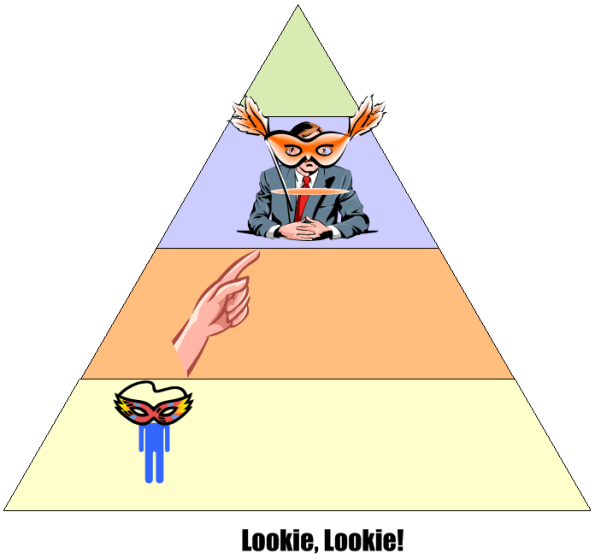
“People are excellent at masking ability problems.”
Man, ain’t that the truth! Along with you, I ‘ve put the “mask ” on many times, both willingly and unwillingly. The question is: “what would cause people to do this?”.
I think the main reason why people try to feign expertise is because they are stuck working in archaic corpo CCHs (Command & Control Hierarchies). All CCH orgs unquestioningly assume that everyone within the pyramid walls is supremely competent, regardless of whether they are or not. In a CCH, anyone who dares to persistently point out “ability” problems is excommunicated, regardless of how much evidence is presented to prove the case so that a beneficial change can be made. Heaven forbid the case where a lower level masked associate points to the huge masks being worn by one or more of the obviously infallible managers entrenched in an upper echelon. Retribution is swift and unambiguous.

Too Late!
As a result of studying the works of many spiritual teachers , I try hard to be consciously aware of my thoughts as they occur in real-time. I try to be simultaneously both the observer and the observee. However, I’m always too late in recognizing self-defeating behaviors triggered by negative thoughts. I have a negative thought, spout out some toxic verbal diarrhea , and then recognize my stupidity after the fact. It almost seems like I’d be better off if I stayed blissfully unconscious and unaware of my thoughts and behavior.
Internal thoughts produce internal feelings, and internal feelings drive external behavior. You can’t control which thoughts magically appear in your head, but if you’re vigilantly aware and awake, you can consciously choose to let hurtful thoughts naturally float away without taking action. The more ego-dominated you are, the less likely you are to release the negative thoughts and preempt stupid behavior. Having said that, I realize that I’m totally dominated by ego. How about you?
A Shift In Perspective
At birth, everyone is egoless. We are pure awareness, a manifestation of universal consciousness. We have no agenda and no desire to make ourselves look good at the expense of others. We don’t get into zero-sum games and our outer purpose is directly synchronized with our inner purpose. When we get labeled with a name, start accumulating “credentials” and “expertise”, and we begin to internalize the human-made concepts of “I” and “me”, our heads expand in order to accommodate ego growth. As ego expands, consciousness contracts and we lose touch of the infinite source of energy that comprises our inner core. Our behaviors and actions become increasingly dominated by the artificial need to selfishly accumulate “things out there” and consume way more than we need. How do I know this? Because like you, I’m a perfect example of ego-domination. Give “me” more, “I” need more, it’s all about “me”, “I’m” smarter than “you”, “I’m” better looking than “you”, “I” have more and nicer things than “you”, “you” should want to be like “me”, to hell with “you” and to heaven with “me”. Duality and separation settle in.

As the lower graph in the above figure shows, some people may, by an unknown and humanly-uncontrollable act of grace, experience a shift in perspective at some point in their lives. The ego starts to deflate, consciousness starts rising, and the artificial mode of good/bad, dual thinking starts dissolving. For some people, the slope of the ego curve instantaneously flips to negative infinity at the point of transition and an “epiphany” occurs. Jill Bolte Taylor, Eckhart Tolle, Byron Katie, Sydney Banks, and the Buddha come to mind as examples of people who’ve experienced epiphanies.
Becoming aware that one is ego-dominated is not enough to trigger a transformation back to our true nature and a realignment of our outer purpose with our inner purpose. How do I know this? Because I’m aware of the fact that I’m dominated by the constraining, finite, and toxic force of the ego. The ego is brilliant in that it can argue with anything at any time and rationalize any action, no matter how horrendous the end result is.
So here “I” am, recognizing the fact that I’m a slave to “my” ego and hoping that an instantaneous shift in perspective will happen to “me”. Since I don’t have a clue on how to trigger the shift, I’m on a constant intellectual search for enlightenment. However, feverishly accumulating intellectual understanding is not the way to realize and experience “the peace that passeth ALL understanding”. Bummer.
System Science And Fat Heads
I recently finished reading John Warfield’s An Introduction To System Science . John asserts that whenever you try to design a system that will involve human beings during its operation (and what non-trivial system doesn’t? ), you must take into account these two universal human characteristics:
- The primal instinct to survive
- Miller’s number: 7 plus or minus 2
If your technical system design doesn’t pay homage to these human frailties, it will most likely fail – big time. The money will be gone, the time will be gone, and the damn thing won’t work. Warfield claims that his generic system design process effectively deals with these issues. In his book, John describes his process and cites several examples of it’s success in the public, private, and educational domains.
Warfield also says that the biggest hurdle to overcome, which he doesn’t have a solution for, is the propensity of high level executives for refusing to accept/acknowledge great ideas founded on firm principles from subordinates. I believe what John says, but in my layman’s mind, I equate this strange and unproductive behavior with egomania. The higher up you go and the more titles that you acquire, the bigger and fatter your head gets. Of course, there are always exceptions to every rule :^)
Filtering And Distortion
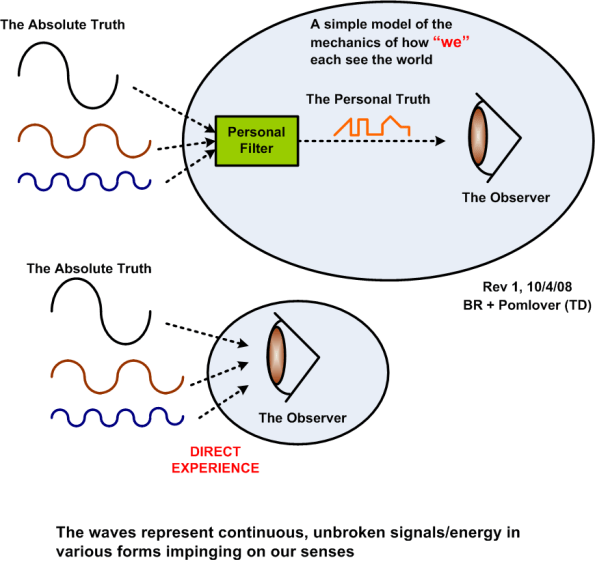
Virtually everyone sees “life” as an integrated, filtered, and distorted stream of continuous analog input. Each filter is person-specific and tends to get narrower as we supposedly grow-up. The designer of the filter is the personal ego and if you’re not aware of this, it can severely degrade and limit your experience of life. My goal is to remove my personal filter so that I can experience the glorious full spectrum of life. I may not attain this goal, but I’m going to try to achieve it until my last breath. Please wish me luck.

Why am I here?
WTF?
Meh!
D'oh!

My BTC Address



 Bulldozer00's Blog