Archive
The Mythical Dual Ladder
The figure below shows a typical skill development timeline. At “t=0” ignorance reigns and learning begins. After a period of learning/applying/practicing, which varies widely from person to person, the status of “Novice” is achieved. After yet another period of learning/applying/practicing, the transition from novice to amateur occurs – and so on up to the level of master and beyond.

The key attribute to focus on in the timeline is the change in length of time required to transition from one level of competence to the next. It doesn’t stay the same or get smaller, it gets longer. Thus, with exceptions of course, the time required to transition from expert to master is greater than the time to transition from amateur to expert.
To remain viable, every product development company requires a critical mass of expertise in the core technologies that comprise the soul of its product portfolio. World class companies actively “nourish and catalyze” the novice-to-expert pipeline via continuous investments in targeted training and conference attendance. Average companies neither nourish or catalyze the pipeline, they “hope for the best” in that their employees will keep up with technology advancements on their own time. In the extreme, CLORGS and DYSCOs unconsciously “toxify and inhibit” the pipeline – if one is even recognized at all. They do this by implicitly encouraging experts to move out of technology and into management via higher compensation and stature for those experts/masters who jump from the mythical technical ladder to the coveted management ladder.

Cribs And Complaints
HCL Technologies CEO Vineet Nayar‘s “Employees First, Customers Second” is one of the most refreshing business books I’ve read in awhile. One of the bold measures the HCLT leadership team considered implementing to meet their goal of “increasing trust through transparency” was to put up an intranet web site called “U & I“. After weighing the pros and (considerable) cons, the HCLT leadership team decided to go for it. Sure enough, the naysayers (Vineet calls naysayers the “Yes, But“s) were right:
The U&I site was clogged with cribs and complaints, harangues and imprecations that the company was wrong about everything. The continents and questions came pouring in and would not stop. Most of what people said was true. Much of it hurt.
However, instead of placing draconian constraints on the type of inputs “allowed“, arbitrarily picking and choosing which questions to answer, or taking the site down, Vineet et al stuck with it and reaped the benefits of throwing themselves into the fire. Here’s one example of a tough question that triggered an insight in the leadership team:
“Why must we spend so much time doing tasks required by the enabling functions? Shouldn’t human resources be supporting me, so I can support customers better? They seem to have an inordinate amount of power, considering the value they add to the customer.”
This question suggested that organizational power should be proportionate to one’s ability to add value, rather than by one’s position on the pyramid. We found that the employees in the value zone were as accountable to finance, human resources, training and development, quality, administration, and other enabling functions as they were to their immediate managers. Although these functions were supposed to be supporting the employees in the value zone, the reality was sometimes different.
That question led to the formation of the Smart Service Desk (SSD), which helped the company improve its operations, morale, and financial performance.
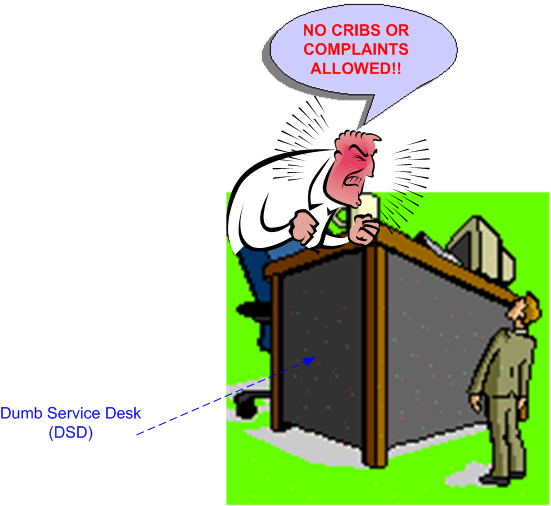
So, how did the SSD work, you ask? It worked like this: SSD. Not like this:
Ooh Ooh, Pick Me, Pick Me!
Quiz time! Who’s this kid….

In “You’re Not So Smart“, David McRaney describes how to overcome the debilitating scourge of “groupthink” in hierarchical organizations:
True groupthink depends on three conditions—a group of people who like one another, isolation, and a deadline for a crucial decision. It turns out, for any plan to work, every team needs at least one asshole who doesn’t give a shit if he or she gets fired or exiled or excommunicated. For a group to make good decisions, they must allow dissent and convince everyone they are free to speak their mind without risk of punishment.
Tome Peters said much the same thing is one of his bazillion books: “Put someone on your staff you don’t like“.
Semi-enlightened orgs hire consultants to fill the asshole role. Even though that’s a viable alternative, it’s only going half-way. The fact that an inside employee (or rotating employees) isn’t (aren’t) placed in the role says as much about the org’s culture as not “allowing” the role at all.
BD00 just had an epiphany! He’s concluded that he was put on this earth to fulfill “The Yes Asshole Rule“, and he’s willing to take job offers from far and near to fulfill his destiny. How many offers do you think will be forthcoming?

Related articles
- You Are Not So Smart: A Field Guide to the Psychology of Our Stupidity (brainpickings.org)
- Clanthink, Groupthink, Spreadthink (bulldozer00.com)
An Epoch Mistake
Let’s start this hypothetical story off with some framing assumptions:
Assume (for a mysterious historical reason nobody knows or cares to explore) that timestamps in a legacy system are always measured in “seconds relative to midnight” instead of “seconds relative to the unix epoch of 1/1/1970“.
Assume that the system computes many time differences at a six figure Hz rate during operation to fulfill it’s mission. Because “seconds relative to midnight” rolls over from 86399 to 0 every 24 hours, the time difference logic has to detect (via a disruptive “if” statement) and compensate for this rollover; lest its output is logically “wrong” once a day.
Assume that the “seconds relative to the unix epoch of 1/1/1970” library (e.g. Boost.Date_Time) satisfies the system’s dynamic range and precision requirements.

Assume that the design of a next generation system is underway and all the time fields in the messages exchanged between the system components are still mysteriously specified as “seconds since midnight” – even though it’s known that the added CPU cycles and annoyance of rollover checking could be avoided with a stroke of the pen.
Assume that the component developers, knowing that they can dispense with the silly rollover checking:
- convert each incoming time field into “seconds since the unix epoch“,
- use the converted values to perform their internal time difference computations without having to check/compensate for midnight rollover,
- convert back to “seconds since midnight” on output as required.
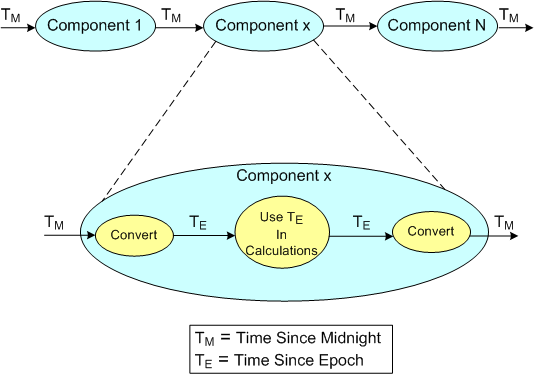
Assume that you know what the next two logical steps are: 1) change the specification of all the time fields in the messages exchanged between the system components from the midnight reference origin to the unix epoch origin, 2) remove the unessential input/output conversions:

Suffice it to say, in orgs where the culture forbids the admittance of mistakes (which implicates most orgs?) because the mistake-maker(s) may “look fallible“, next steps like this are rarely taken. That’s one of the reasons why old product warts are propagated forward and new warts are allowed to sprout up in next generation products.
Concealing Outrage
In “The Progress Principle: Using Small Wins to Ignite Joy, Engagement, and Creativity at Work“, Harvard B-school professor and researcher Theresa Amabile writes:

Did she say “most” orgs ? Thank Allah she didn’t say “all” orgs, no?
If you think Ms. Amabile’s assertion is true, why do you think it is true? Could it be that the culture at those orgs is unintentionally, but irreversibly, toxic? Could it be that “suppression of emotionally strong opinions” is an innate attribute of hierarchically structured orgs? What about your org? If you’ve never seen a test of Theresa’s assertion at your org, why is that? If you have directly seen, indirectly heard about, or have been a participator in a “strong emotional, strong opinion” situation, how did it turn out and how did you feel? What about the “loath to reveal themselves to superiors” assertion? Got any thoughts about that?
Z6
In case you were wondering, Z6 stands for Zappos core value number 6:

I’m a huge Zappos fan and a VIP member (which means free overnight shipping for any purchase!). Thus, I get daily e-mails from zappos.com on special deals. The snippet you see above appeared at the bottom of one of those e-mails.
The joyful reason for this post is that Zappos is (rightfully) tenacious about promoting their 10 core values both internally and externally. CEO Tony Hsieh and his merry band truly understand how difficult it is to sustain and maintain a culture of joy and excellence – which is a pre-requisite to both financial and emotional success. Thus, with every chance they get, which includes the daily e-mail, they spread the word.
How about your company? Do you even know what their core values are, let alone “walk the talk“? Nah, an approach like Zappos’s won’t work there, right? It’s simply auto-assumed that writing down some inarguable altruisms and pontificating about them from time to time does the trick. There are more important issues to tend to, no?
Watch And Learn List
After watching Red Hat CEO Jim Whitehurst talk about “cultivating trust” in this refreshing 5 minute MIX video, I put him on my “watch and learn list“. Here are some priceless sound bytes from Jim’s passionate schpeel:
- You truly have to have no consequences.
- Says easy, does hard.
- The biggest insult is to have somebody throw out a comment or idea, and have nobody respond to it.
- Meritocracy does not equal democracy.
- Being called an idiot is not a bad thing. I encourage it and I celebrate it.
- If the senior leadership team isn’t posting on the site, isn’t responding to comments that are being made, then it’s nothing more than an “HR program“.

So, who’s on your watch and learn list?
Inner Work Life
The premise behind Theresa Amabile’s “The Progress Principle” is that individual performance in the work place is a function of the quality of one’s “Inner Work Life” (IWL). In addition, the greatest effector of a positive IWL is “continuing progress on meaningful work“.
To set the context for her subsequent findings, at the beginning of the book Ms. Amabile describes her research protocol:
“We recruited 238 people in 26 project teams in 7 companies in 3 industries. Some of the companies were small start-ups; some were well established, with marquee names. But all of the teams had one thing in common: they were composed primarily of knowledge workers, professionals whose work required them to solve complex problems creatively. Most of the teams participated in our study throughout the course of a particular project—on average, about four months. Every workday, we e-mailed everyone on the team a diary form that included several questions about that day. Most of those questions asked for numerical ratings about their inner work lives—their perceptions, emotions, and motivations during that day. The most important question allowed our respondents free rein: “Briefly describe one event from today that stands out in your mind. Amazingly, 75 percent of these e-mailed forms came back completed within twenty-four hours, yielding nearly 12,000 individual diary reports.”
The figure below shows the three tightly integrated and inseparable components of IWL and four major external forces that act upon it.
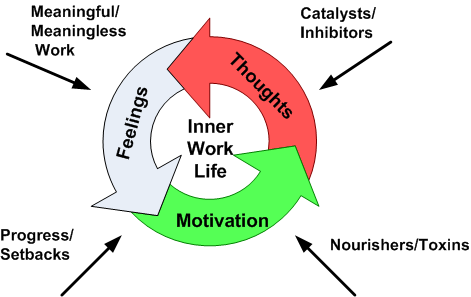
Of course, the quality of IWL can vary from month-to-month, day-to-day, and even hour-to-hour, depending on the presence and magnitude of the external forces acting upon it and the person-specific thoughts/feelings/motivation regarding said forces.
Contributors to an increase in IWL are catalysts, nourishers, meaningful work, and especially, progress on that meaningful work. Detractors are meaningless work, inhibitors, toxins, and setbacks to progress.
In orgs that are setup (either intentionally or unintentionally) as internally competitive command and control hierarchies where “me” is king, inhibitors, toxins, and setbacks abound. In great orgs, which can be structured as collaborative hierarchies or as any other pattern, catalysts, nourishers, and progress are pervasive up and down and across the structure.
Of course, the best parts of Ms. Amabile book are when she exhibits many of the heartfelt entries written by real people from her massive stash of 12,000 diary entries. Read it and weep, or read it and leap for joy, or read it and “meh“.

Related articles
Different Perceptions
In the spirit of reducing costs through the holy grail of “reuse“, this post leverages the (so-called) work done in the recent “One Of Four” post….
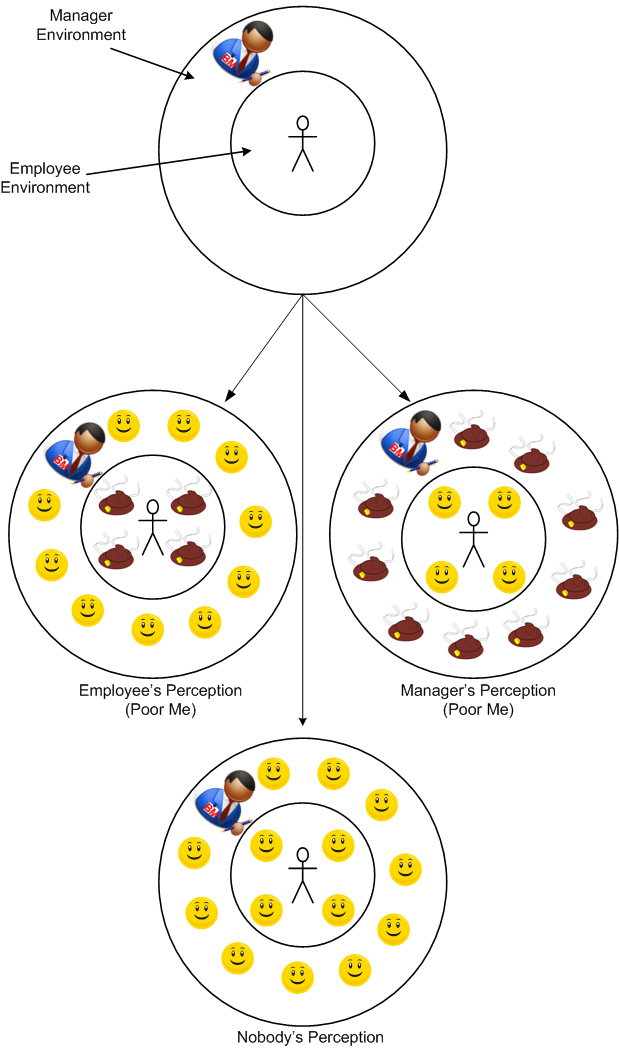
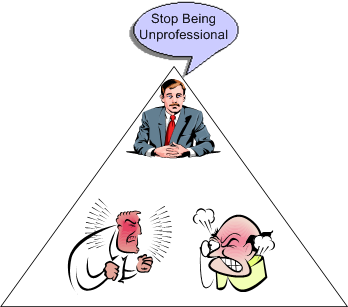
In DYSCOs and CLORGs, this is everybody’s perception:
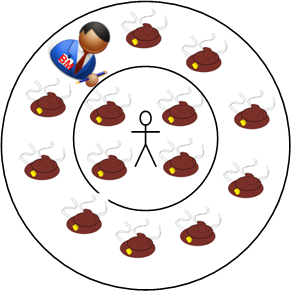
Man, I wish I could cure myself of the addiction to use grumpies in my e-drawings. The practice is unprofessional and childish, but I deploy the putrid piles for the following purposes: 1) to ratchet up the impact, 2) as a differentiating “branding” gimmick, and 3) to coverup the lack of substance in the accompanying words. The acerbic words and sophomoric readme.txt acronyms may already do the trick though, no?
What do you think, dear reader? Should BD00 dispense with all the crap? Do you think BD00 is capable of, and willing to, step into the alien world of respectable discourse?
One Of Four


Why am I here?
WTF?
Meh!
D'oh!

My BTC Address



 Bulldozer00's Blog