Archive
Profound Shift In Focus
The following quote comes from John Hagel via this Peter Vander Auwera blog post: “Corporate Rebels United” – the start of a corporate spring?”:
The key answer that defines the post-digital enterprise is to shift attention from the cost side to the value side. Rather than treating employees as cost items that need to be managed wherever possible, why not view them as assets capable of delivering ever-increasing value to the marketplace? This is a profound shift in focus. For one thing, it moves us from a game of diminishing returns to an opportunity for increasing returns. There is little, if any, limit to the additional value that people can deliver if given the appropriate tools and skill development. – John Hagel
For big, established companies who can’t even remember what it was like to focus on value, “profoundly shifting” from a cost mindset back to a value mindset is a tall order indeed.
As the state machine based figure below illustrates, successful startups are totally “value focused” in the sun-up phase of their life. But over time, as they obsessively grow and misguidedly try to become more efficient by adding layers upon layers of cost watchers, the vast majority of them (with few Apple-like exceptions) morph into “cost focused” borgs.

Once a formerly vibrant org has moved into the sundown phase of its life, the borgdom hardens. It’s cost-focus till death, with no memory of any prior, value-focused behavior.

Behind The Scenes
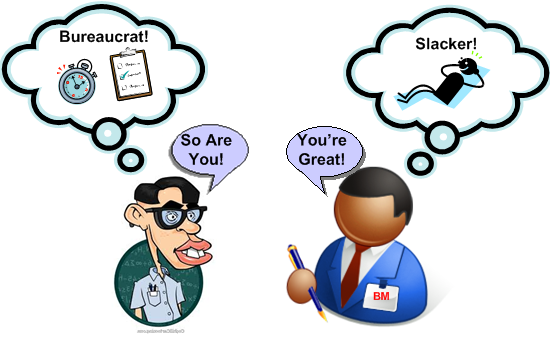
In really dysfunctional orgs, do you think much of this goes on……?
Four Attributes
Assume that every commercial enterprise can be “objectively” (LOL!) characterized by the following four discrete attributes:
- Trustworthiness [untrustful | trustful]
- Transparency [closed | open]
- Fairness [unfair | fair]
- Product_Quality [crappy | meh | excellent]
If I did the math right, there are 2*2*2*3 = 24 attribute combos. At one end of the spectrum, we have orgs that are untrustful, closed, unfair producers of crappy products and services. At the other end of the spectrum we have enterprises that are trustful, open, fair producers of excellent products and services.
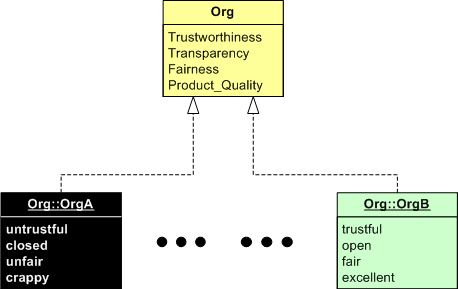
So, what do you think the ratio of OrgAs to OrgBs is in the world, and why? Do you think the ratio is increasing or decreasing as civilization advances? Do you think the four attributes are uncorrelated or are they intimately coupled? Can an untrustful, closed, and unfair org produce excellent products and services? Given an OrgA, can it transform into an OrgB? Given an OrgB, can it transform into an OrgA? Which transformation is more likely?
Environmental Influence
In “Engineering A Safer World“, Nancy Leveson states:
Human behavior is always influenced by the environment in which it takes place. Changing that environment will be much more effective in changing operator error than the usual behaviorist approach of using reward and punishment. Without changing the environment, human error cannot be reduced for long. We design systems in which operator error is inevitable and then blame the operator and not the system design.
So why is that? Could it be because the system designers and environment caretakers are also the same people who have the power to assign blame – and it’s much easier to blame than to change the environment?

The Uncrossable Threshold
Unless you work in a Chinese sweatshop, the likelihood is high that your management has an “open door” policy. After all, it’s been the right thing to do since the 80’s, right? However, the likelihood that anyone but their “direct reports” casually cross the threshold to chat about problems and ideas for improvement at any level in the org is low, no?
So why is that? Could it be an unwritten rule in hierarchies that “little” people aren’t allowed to “whine” to stratospheric luminaries? Could it be a culture of fear of reprisal? Could it be a dearth of trust? Could it be the perception that bosses don’t like to hear bad news? What do you think it could be?

Resource And Asset Ban
Stocks and bonds are assets; water and iron ore are resources. Assets and resources are “its“. People are not resources and they’re not assets and they’re not “its“. Get it? So, stop parroting your moo-herd peers if you want to distinguish yourself from the pack like you say you do.

Hitherto, the unesteemed BD00 proposes a federal law (Phil, if your reading this, the last two words are fer you 🙂 ) that will ban all orgs from using the MBA-inspired, utterly unauthentic, and Taylor-esque words “resource” and “asset” when their PR spinners and glossy annual report writers refer to their “people“.
Referring to people as assets is a vestige of the so-yesterday theory X management mindset that is so ingrained in the psyches of both SCOLs and DICs everywhere that this standard practice remains unexamined even today by most orgs. So, please consider replacing the phrases on the left with those on the right:
- Deploy our assets -> deploy our people
- Utilize our resources -> utilize our people
- Allocate some resources -> allocate some people, time, and money
- People are our greatest asset -> People are our greatest strength
You may think that BD00 is being anal when he brings up such minutia, and that’s OK. BD00 thinks that the little things matter, and this is one of those little things that matter. What little things matter to you?
Ingrained Internal Shared Mindset
All Models are wrong, but some are useful – George Box
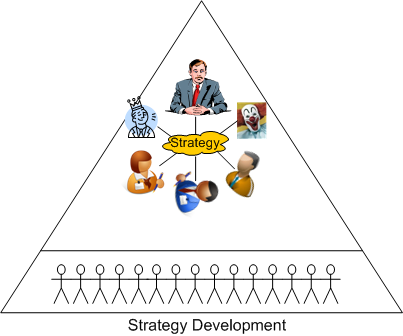
One of the models below puts the owners and managers of an enterprise at the top and the other model places them at the bottom. Which system design do you think is capable of creating more wealth for all stakeholders over the long term?

A Succession Of Funerals
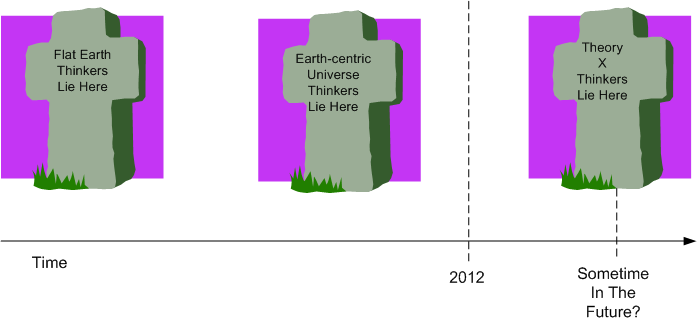
Science advances one funeral at a time. – Max (walk the freakin’) Planck
As implied by the quote above, new and more effective ideas/techniques/practices/methods take hold only when the old guard, which fiercely defends the status quo regardless of the consequences, “dies” off and a new generation takes over.
Frederick Winslow Taylor, who many people credit as the father of “theory X” management science (workers are lazy, greedy, and dumb), died in 1915. Even though it was almost 100 years ago, theory X management mindsets and processes are still deeply entrenched in almost all present day institutions – with no apparent end in sight.
Oh sure, many so-called enlightened companies sincerely profess to shun theory X and embrace theory Y (workers are self-motivated, responsible, and trustworthy), but when you look carefully under the covers, you’ll find that policies and procedures in big institutions are still rooted in absolute control, mistrust, and paternalism. Because, because, because…, that’s the way it has to be since a corollary to theory X thinking is that chaos and inefficiency would reign otherwise.
Alas, you don’t have to look or smell beneath the covers – and maybe you shouldn’t. You can just (bull)doze(r00) on off in blissful ignorance. If you actually do explore and observe theory X in action under a veneer of theory Y lip service, don’t be so hard on yourself or “them“: 1) there’s nothing you can do about it, 2) they’re sincerely trying their best, and 3) “they know not what they do“.
He’s In The MIX
Ricardo Semler, one of my innovation heroes, is now a MIXer: Ricardo Semler | Management Innovation eXchange. Until reading his first contribution to the MIX, I hadn’t seen hair nor hide of him for a couple of years. I had thought he’d retired or something like that.
As usual, in his “Retire-a-Little: Enabling More Fulfilled Working Lives“ management hack, Mr. Semler tells the story of yet another heretical and “outrageous” practice that he implemented at Semco Inc. Even if you don’t “buy into” his “retire a little” program, ya gotta love his 3 hour “Are You Nuts?” meetings, no? Try to picture the reception someone would get in your org for suggesting something like an “Are You Nuts?” initiative. Would anyone even attempt to suggest it?

Transparency, Meritocracy, and Collaboration
When Red Hat Inc. went public with much fanfare 12 years ago, I thought there was no way the company would make money on the Linux open source operating system. As usual, BD00 was outright wrong. This MIX article by Red Hat VP Jackie Yeaney, “Democratizing the Corporate Strategy Process at Red Hat”, may explain one reason why.
In her article, Ms. Yeaney shares all the details of the company’s strategic development process along with some performance metrics that demonstrate its effectiveness. Here are some snippets that I found refreshingly interesting.
“When I first started working with Red Hat at the beginning of 2008, it was readily apparent that the traditional corporate strategy development process would simply not work in an open source company where transparency, meritocracy, and collaboration were prized elements of the culture.”
“While many might view it is as a disadvantage or a time sink to systematically gather feedback from across the company, at Red Hat it’s a core part of our competitive advantage.”
“We built an internal wiki that leaders of each exploration team used to organize their thoughts and ideas out in the open where any employee could make comments or suggestions. Anyone who was particularly interested could read about the progress, and add their ideas or volunteer to help (and many did).”
“This information-gathering dialog lasted about 5 months. We communicated our progress along the way through regular updates at company meetings, through email, and on the Intranet. The strategy team leaders posted status updates to the wiki and replied to comments on their team’s internal blog. Jim hosted a company-wide online chat session where associates could ask him any question they wanted to about the strategy process (or anything else that was on their minds), and team leads communicated key updates through company-wide announcements and discussions.”
The likelihood that you have any clue of how business strategy is created in your org is low. The likelihood that you’re given the chance to actively participate in the process is even lower, dontcha think? Instead of being “engaged with” you’re simply “communicated to“, no?

Why am I here?
WTF?
Meh!
D'oh!

My BTC Address



 Bulldozer00's Blog