Archive
Central Planning
The most visibly confirming event that showcased the fact that “central planning” doesn’t work was the demise of the former Soviet Union. The 5 year plans foisted down on the populace by the politburo big-wigs stifled creativity, innovation, and motivation. In spite of the impeccable planning by those “who knew better“, the country imploded.
Likewise, in corpocracies that are incapable of learning from the past (no matter how compelling the evidence), the same fate awaits. By the time the perfectly infallible strategies and plans from the corpo junta get approved, poured in concrete, and trickled down to the DICforce at rock bottom, they’re mostly useless and obsolete.
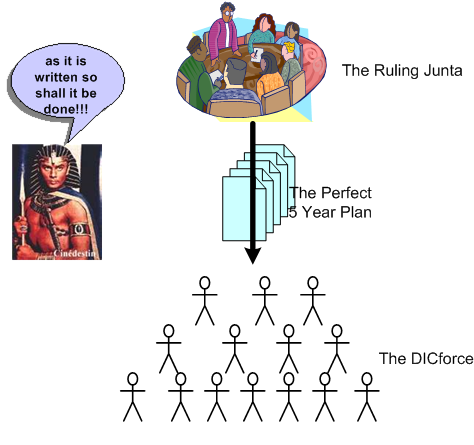
So, what’s a better way? How about generating flexible, multi-year rolling plans that are revisited often? Ricardo Semler uses that method at Semco. How about exposing the plans to the DICforce as they are being developed in real-time so that some insights from a larger pool of brains may be elicited? Got any other ideas?
Waiting
- “I’m waiting for the requirements specification”.
- “I’m waiting for management approval”.
- “I’m waiting for the customer’s answers to my questions”.
- “I’m waiting for QA appproval”.
- “I’m waiting for management to solidify our strategy.”
- “I’m waiting to get a software (or hardware or systems or test) engineer assigned to the project”.
- “I’m waiting for the finance department to open the charge number.”
Yada, yada, yada. On goes the list of pseudo-legitimate excuses for being late and inefficient in bureaucratic corpocracies. When a system is set up so that everything is tightly coupled and each element is highly dependent on everything else, productivity sinks, end-to-end delay increases, and it takes a miracle to get any value added work done. The funny thing is that the dudes in the bozone layer demand continuously increasing productivity while simultaneously allowing their system to deteriorate into an inflexible and intertwined mess of confusion.

Unscalable Orgs
My friend Byron Davies sent me a link to this 3 minute MIT Media Lab video in which associate Media Lab Director Andy Lippman challenges us to recognize four common flaws plaguing all of our institutions. Obtaining a new awareness and understanding of the plague is the first step toward meaningful redesign.
According to Lippman, the top four reasons for organizational decline are:
- They’re out of scale – they’ve grown too big to perform in accordance with their original design
- They’re monocultures – they all act the same
- They’re opaque – nobody from within or without understands how they freakin’ work
- They’ve lost their original mission – A summation of the previous three reasons.
Because of the pervasive institutional obsession for growth, Lippman seems to think that solving the scaling problem through the development of nested communities is the most promising strategy for halting the decline.

Nested Bureaucracies
By definition, ineffective bureaucracies (are there any effective ones?) consume more resources than they produce in equivalent value to their users/consumers. According to Russell Ackoff, the only way an ineffective bureaucracy can remain in place is by external subsidization that is totally disconnected with its performance. In other words, bureaucracies rely on clueless sugar daddies supplying them with operating budgets without regard to whether they are contributing more to “the whole” than they are withdrawing. Unchecked growth of internal bureaucracies siphons off profits and it can, like a cancer, kill the hosting org.
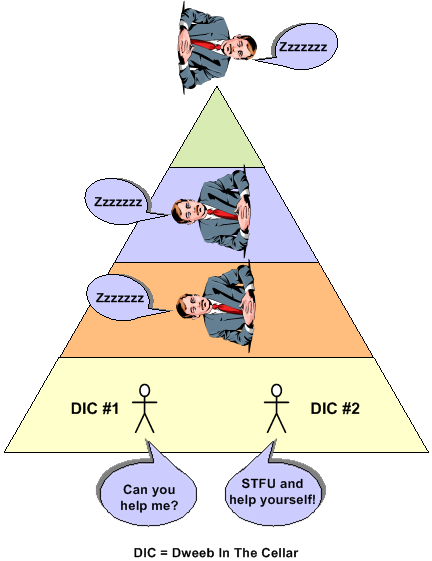
The figure below shows a simplistic bird’s eye view of an American economic system dominated by CCH bureaucracies. The irony in this situation is that even though the Corpo Granite Heads (CGH) in charge of the CCHs are staunch supporters of the distributed free market model which rewards value creation and punishes under-performance, they run their own orgs like the old Soviet Union. Ala GM and most huge government departments, they operate as centralized, nested bureaucracies where the sloth at the top trickles money down to the mini-bureaucracies below – without regard to value produced.
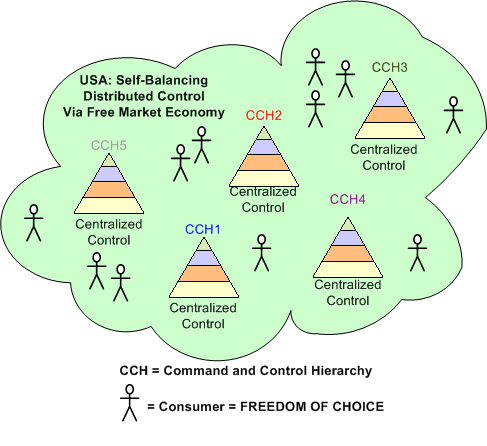
Bureaucracies, being what they are and seeking to survive at all costs, jump through all kinds of hoops to camouflage their worthlessness and keep the money flowing down from the heavens. Since the cabal at the top is too ignorant to recognize that it’s a bureaucracy in its own right, it’s an expert camouflage spinner to the corpocracy’s stakeholders (who gobble up the putrid camouflage with nary a whimper) and it sucks much more out of the corpo coffers than it adds value without being “discovered and held accountable”. In the worst nested bureaucracies, none of the groups in the hierarchy, from the top layer all the way down the tree to the bottom layer, produce enough value to offset their ravenous appetite for resources. They collapse under the weight of their own incompetence and then wonder WTF happened. From excellence to bankruptcy in 24 hours.
The really sad part is that before a bureaucracy auto-snaps into place, it wasn’t a bureaucracy in the first place. Everybody in the “startup” contributed more than they withdrew from the whole, and the excess value translated into external sales and internal profits. Like the boiled frog story, the transformation into a bureaucracy was slooow and undetectable to the CGHs in charge. Bummer.
The answer to this cycle of woe, according to Ackoff, is for the leaders in an org to operate the whole (including themselves) as a system of nested free markets, where each internal consumer of services gets to choose whether it will purchase needed services from internal groups, or external groups. Each internal group, including the formerly untouchable head shed, must operate as a measurable profit and loss center. Mr. Ackoff describes all the details of nested free market operation, including responses to many of the “it can’t work because of……” elite whiners, in his insightful book: Ackoff’s Best. Check it out, if you dare.
A Democratic Workplace? No Freakin’ Way!
“We’ll send our sons anywhere in the world to die for democracy,” says Ricardo Semler (CEO of Semco), “but don’t seem to apply the concept to the workplace. This is a tragic error, because people on their own developing their own solutions will develop something different“.
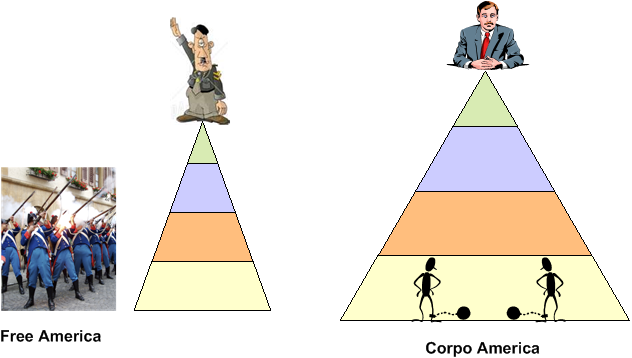
In Semler’s own firm, there are no five-year business plans (which he views as wishful thinking), but rather “a rolling rationale about numbers.” A project takes off only if a critical mass of employees decides to get involved. Staff determine when they need a leader, and then choose their own bosses in a process akin to courtship, says Semler, resulting in a corporate turnover rate of 2% over 25 years.
Interested in hearing more from Mr. Semler? Then check out this video of a lecture he gave to elite MIT business students way back in 2005:
Blasphemy! We know what’s best for all the cake eaters in our kingdom because we’re infallible, of course. That couldn’t possibly work here because our business is too different. It’s “not applicable“.
Cog Diss
If interested, check out Mary Jo Foley‘s hindsight blog post regarding Microsoft CEO Steve Ballmer‘s screw-up on the Vista fiasco: Feedback Failure. Mary laments:
“As a result, I’m left wondering about Vista, as many are/were about the current financial crisis: Why didn’t anyone inform us sooner of the impending meltdown? Weren’t there warning signs? Where was everybody?”
Surely Mary, you’re joking, right? You’re wondering where everybody was and why nobody informed us? In short, at least some Microsoft DICS who weren’t deeply and personally invested in the Vista project either:
- knew about the impending doom but were afraid to speak up,
- did have the courage to speak up but were “ignored” or slapped down,
- “disconnected and distanced” themselves from the project because they didn’t give a chit about it (apathy)
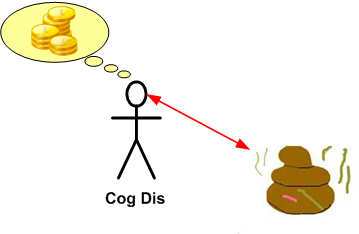
Those who were fully ensconced in the quagmire were blinded by the light. They suffered from the common and pervasive human malady called “cognitive dissonance“. Cog Diss is where you convince yourself that you’re looking at a pile of gold when in reality you’re staring at a pile of poop. However, deep down, you sense the mismatch and experience uneasy feelings as a result.
All the dysfunctional behaviors described above are caused by living life too long within the confines of an unchanging and soul-busting CCH bureaucracy.
Stunning, But Not Surprising
Suppose you had an innately complex product to sell. Now suppose that a potential customer comes up to you and asks for a user’s starter guide to help him/her understand your product for the purpose of making a buy decision. Would you tell that customer “We’re short-handed and have schedules to meet, so write It yourself!“? WTF!
For people who work in CCH bureaucracies but don’t know it (or who do know it, but conveniently ignore it and don’t do squat to dissolve it), this behavior between internal groups is ubiquitous, systemic, and so pervasive that it’s taken for granted. It’s stunning, but not surprising.
Incremental Watts
I don’t know which name I like better, Watts Wacker or Soupy Sales, but this post is about Watts. Watts Wacker is a CEO and futurist who uttered one of my favorite quotes:
You can’t increment your way into the future – Watts Wacker
I think this quote is directed toward leaders of cushy, static, and stanky CCH companies who are so afraid of the future that they move by inches at a time in passive response to external changes. The only way to leapfrog your competitors, since they’re just as afraid as you and are inching along like molassess running up hill, is to make a disruptive leap into the future.
It takes revolutionaries to trigger disruptive leaps into the unknown. Someone (actually, two people) with an innocent but assuredly incremental mindset recently said to me: “Revolutionaries are usually lined up in front of a wall and shot“. My response was “that’s why there are so few of them“. Bummer.

Surprise! GM Is Still Hosed
In a followup to my first post on GM’s initial BS attempt to dismantle their horrendous do-nothing-but-line-management’s-pocket-with-dough Command And Control Hierarchy (CCH), I submit this freshly minted AP article. It describes yet another management shake up at post-bankruptcy, taxpayer-money-sucking GM. The “new” (LOL!) leadership continues to pray that the feeble and well worn tradition of sloganeering and cajoling will stave off annihilation. Geeze, these elite hierarchs are really doing quite a job earning their seven figure paychecks, dontcha think?
In announcing a sudden management overhaul yesterday, GM chairman and acting CEO Ed Whitacre Jr. was speaking Lutz’s words when he told employees that the bureaucracy needs to end and they can take reasonable risks without fear of being fired.
“We want you to step up. We don’t want any bureaucracy,’’ Whitacre said to about 800 GM workers. “We’re not going to make it if you won’t take a risk,’’ he said in the address, which was broadcast to employees worldwide on the Internet.
Uh, yes massa CEO, we’ll do whatever you say, dear leader. We sincerely believe that you’re a man of high integrity and impeccable credentials who speaks the truth and will lead us to the promised land. We’ll gladly storm the machine gun nests that guard the status quo for you. Blech.
Whitacre, 68, who has been frustrated with the pace of change, appointed the 77-year-old Lutz as a top adviser, creating an alliance of hard-charging veteran executives to lead the troubled company.
Yeah, that’ll do it. A 145 year duo of machine age, assembly line thinkers who probably don’t know WTF “WTF” means. Social intra-networking? Corpo-wide sharing of accessible and findable information? Sincere collaboration within and between layers of rank and status? Transparency, Authenticity, and Openness? Sorry to be so negative, but not a chance.
Sadly, I await the next big GM makeover and press release.

Committee Performance Metrics
A favorite and frequent activity undertaken by corpocrats everywhere is the formation of committees and special task forces to “aggressively” tackle and solve pressing org problems that are negatively affecting the performance of the corpocracy’s DICforce. The typical cycle of events is as follows:
- 1) The committee of elites is formed to “help” the DICforce do their jobs better.
- 2) After: a) several months of meetings with half-assed attendance, b) infinite BS sessions where nothin’ of substance is produced or propagated downward, c) there’s no detectable performance improvement from those dwelling in the cellar, and d) gobs of money have been consumed, the committee sponsor (a.k.a. the money supplier) asks for measures of performance to judge whether his/her investment is paying off.
- 3) The committee conjures up some BS “camouflage” metrics that feign problem solving prowess and progress (see the figure below for examples).
- 4) The sponsor buys into the BS set of metrics and the resource drain continues.
- 5) Go to step 2).
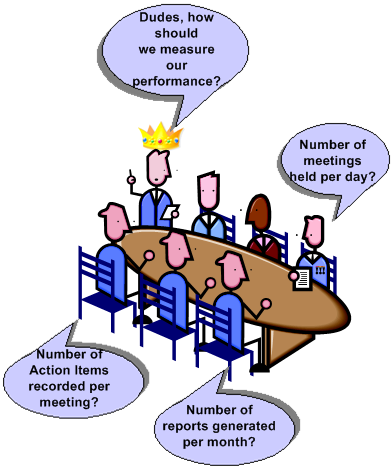
You’d think that a meaningful metric could be obtained by periodically polling the people that the elite committee is supposed to be helping – the DICforce. Do you think many committees, councils, task forces, centers of excellence, yada-yada-yada, do this? If not, why do you think that is the case?

Why am I here?
WTF?
Meh!
D'oh!

My BTC Address



 Bulldozer00's Blog