Archive
Monopolistic Providers
In search of economies of scale, centrally planned and controlled economies in nations and corporations tend to create monopolistic providers of goods and services. For example, in corporations, accounting, personnel, and R&D departments are usually deliberately organized as subsidized monopolies. They are subsidized in the sense that the users of their products or services do not pay for them directly; the supplying units are supported financially by funds that are allocated to them from above. The pool from which these funds are drawn is filled by a “tax” allocated from above to the units served. Monopolistic units that are subsidized are generally insensitive and unresponsive to the users of their services, but they are sensitive and responsive to the desires of the higher-level units that subsidize them. These higher level units are even more removed from the units served than the serving units. As a result, they are often unaware of, or unresponsive to, the needs and desires of the internal users of monopolistically provided goods and services. – Russell Ackoff (Ackoff’s Best: His Classic Writings on Management)
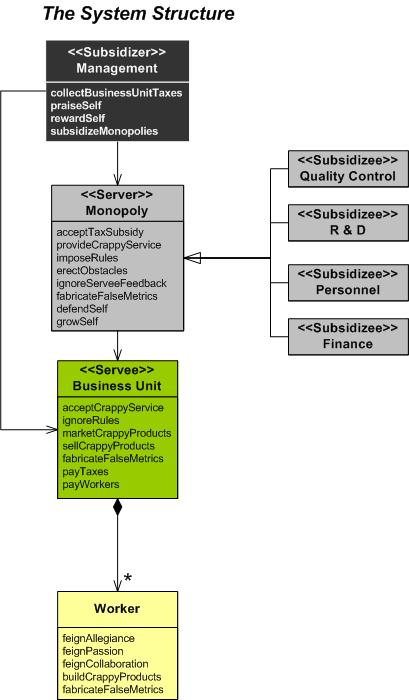
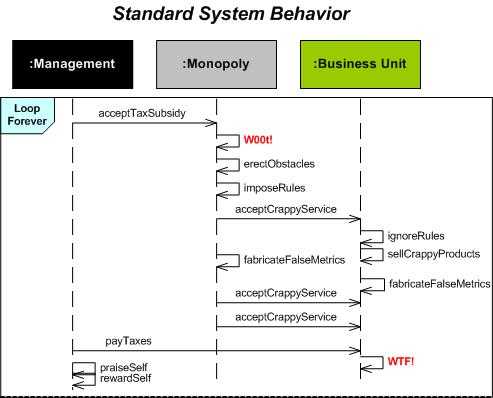
OK, time to practice my “bent” UML modeling skills and test your understanding with the class and sequence diagram pair below. The class diagram provides a structural view of a fictional Ackoffian system. The sequence diagram steps through an amalgam of behaviors in a world where monopolies rule. Any questions, comments, critiques, accolades, WTFs?
Healthy Debates
The article, “Overconfidence May Be a Result of Social Politeness”, opens up with:
Since society has taught us not to hurt other people’s feelings, we rarely hear the truth about ourselves, even when we really deserve it.
Phew, BD00 is glad this is the case. Otherwise BD00 would be inundated with “negative feedback” for being a baddy. Uh, he actually does get what “he deserves” occasionally, but what da hey.
Florida State University researcher Joyce Ehrlinger, upon whose research the article is based, empirically validated the following hypothesis to some degree:
If person A expressed views to a political subject that person B found contradictory to their own, the result would not be a healthy debate, but just silence from B – and an associated touch of overconfidence from A.
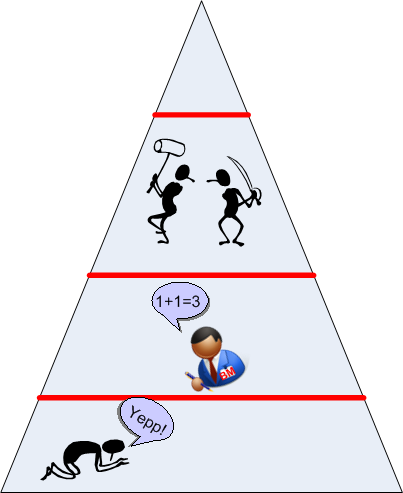
Now, imagine applying this conjecture to a boss-subordinate relationship in a hierarchical command and control bureaucracy. Bureaucratic system design natively discourages healthy debate up and down the chain of command and (almost) everybody complies with this design constraint. As a result, overconfidence increases as one moves up the chain. Healthy debates can, and do, occur among peers at any given level, but up-and-down-the-ladder debates on issues that matter are rare indeed. Hasn’t this been your experience?
Building The Perfect Beast
The figure below illustrates a simplified model of a Starkermann dualism. My behavior can contribute to (amity), or detract from (enmity) your well being and vice versa.

Mr. Starkermann spent decades developing and running simulations of his models to gain an understanding of the behavior of groups. The table below (plucked from Bill Livingston’s D4P4D) shows the results of one of those simulation runs.
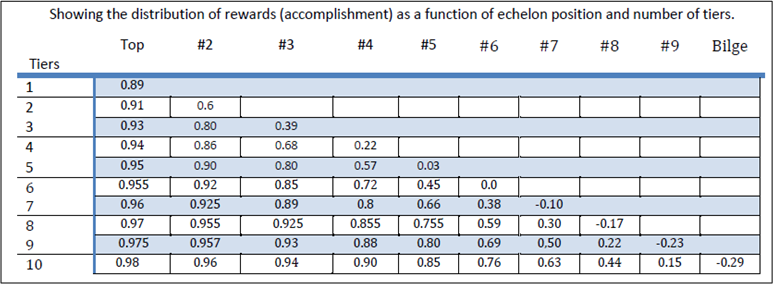
The table shows the deleterious effects of institutional hierarchy building. In a single tier organization, the group at the top, which includes everyone since no one is above or below anybody else, attains high levels of achievement (89%). In a 10 layer monstrosity, those at the top benefit greatly (98% achievement) at the expense of those dwelling at the bottom – who actually gain nothing and suffer the negative consequences of being a member of the borg.
What do you think? Does this model correspond to reality? How many tiers are in your org and where are you located?
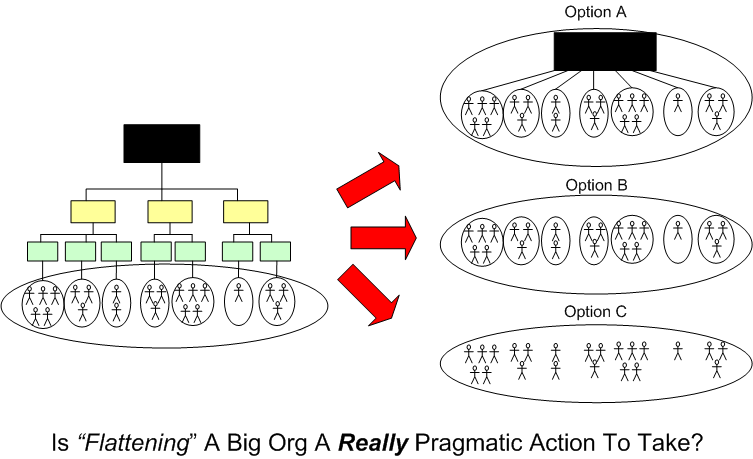
Pragmatic?
Approval Barriers
All business advice is founded on the core principle of “delighting the customer“. However, not all customers are created equal. Most mainstream business advice seems to “assume” that the “customer” is an individual point source payer and user of the product/service.

However, the really big bux business deals occur between social systems of orgs where it’s hard to discern the payer(s) from the actual product end user(s). The seller has to navigate through the customer’s org to influence the right payers and users.

When the end user is some struggling group deeply nested within a behemoth command and control structure (like the US government or a Fortune 500 company), the system is setup for all kinds of mischief to occur. The gauntlet of approval barriers erected by bureaucrats and disinterested little Hitlers in the customer org often makes it impossible to get the right problem solving product into the hands of the problem holders. Tis what it is.
More Bureaucratic Than A Bureau
Tsukasa Makino is one of the Harvard Business Review/McKinsey “Beyond Bureaucracy Challenge” winners. In “From bureaucratic, divided, passive, and exhausted to productive, creative, autonomous, and happy company”, Tsukasa tells the transformational story of Tokio Marine Nichido Systems (TMNS) from a classic, robotic, unhealthy borg into a vibrant community.
In 2005, Hideki Iwai, a system engineer, proposed a corporate culture assessment by an outside consulting firm. Management “approved” of the idea and here was the bottom line:

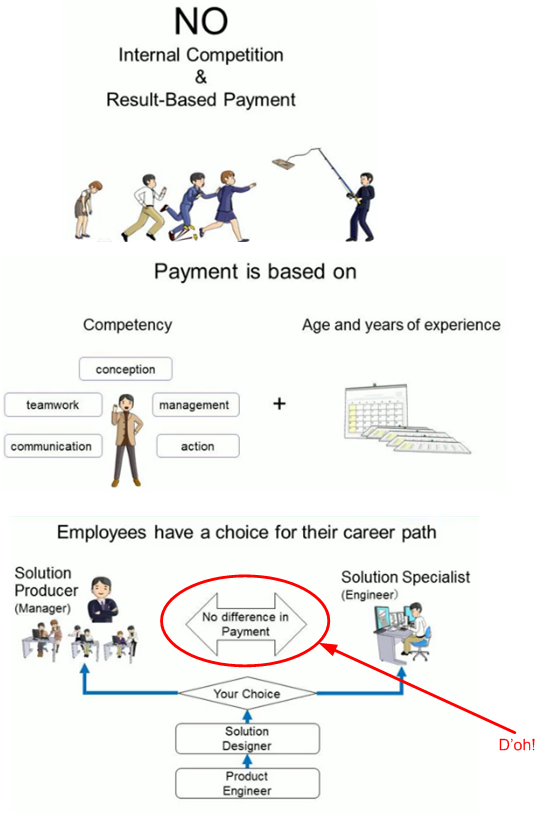
D’oh!
Taking the bull by the horns, Hideki formed the “Work Style Reform committee” to change the culture. Despite being a “committee” the communist-sounding group worked! It spawned, and followed through on, a slew of blockbuster initiatives:

The challenge presented by bullet number 4 seems daunting. How did they vanquish it? They just said “NO!”
I love finding heartwarming stories like this. They’re hard to find, but thanks to web sites like Gary Hamels’ MIX, it’s getting easier.
Us And Them
BD00 speculates that all non-psycho leaders would love to dissolve the “us vs them” attitude that most likely pervades their org. Alas, it’s not easy to do when your org is structured as, and operates like, a standard command and control hierarchy. Here’s a list of reasons why the “us vs them” conundrum endures within the walls of the CCH:
- We unilaterally set the rules, policies and procedures they are required to unquestioningly follow
- We get bonuses and they get COLAs (Cost Of Living Adjustments)
- We plan their work and evaluate them; and there is no “quid pro quo Clarisse“
- We have a loose set of criteria for evaluating for ourselves and a strict set for evaluating them
- We have nicer offices than them
- We promote/demote them, not vice versa
- We conform them to the org and we conform the org to us.
- We physically co-locate our team in a corner and fragment their teams throughout the org
Got any other “us and them” reinforcers to add to the list?

Value And Effectiveness
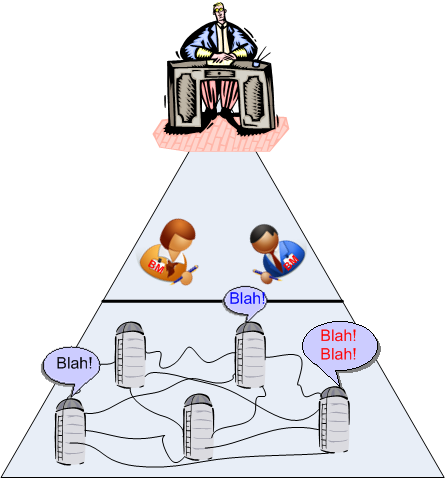
A few weeks ago, my friend Charlie Alfred challenged me to take a break from railing against the dysfunctional behaviors that “emerge” from the vertical command and control nature of hierarchies. He suggested that I go “horizontal“. Well, I haven’t answered his challenge, but Charlie came through with this wonderful guest post on that very subject. I hope you enjoy reading Charlie’s insights on the horizontal communication gaps that appear between specialized silos as a result of corpo growth. Please stop by his blog when you get a chance.
——————————————————————————————————————————–
In “Profound Shift in Focus“, BD00 discusses the evolution of value-focused startups into cost-focused borgs. There’s ample evidence for this, but one wonders what lies at the root?
One clue is Russell Ackoff’s writings on analysis and synthesis. Analysis starts with a system and takes it apart, in the pursuit of understanding how it works. Synthesis, starts with a system, identifies the systems which contain it, and studies the role of the original system within its containing systems in the pursuit of understanding why it must work that way.
Analytical thinking is the engine that powered the Industrial Revolution and many of the most important scientific advances of the 21st century. Understanding how things work is essential to making them work better (also known as efficiency). Today, we have better automobiles, airplanes, computers, phones, and TV’s than our parents. And we owe much of this to analytical thinking.
But one of the side effects of analytical thinking is specialization. As understanding deepens, the volume of subject matter knowledge explodes. This leads to the old joke.
Q: What’s the difference between an engineer and an executive?
A: Every day engineers learn more and more about less and less, until one day they know everything about nothing, while executives learns less and less about more and more, until one day they know nothing about everything.
But all joking aside, this is a serious concern. The vast majority of organizations today are organized functionally: sales, marketing, finance, engineering, manufacturing, HR, IT, etc. And withing these organizations, there are even more specializations. Marketing has specialists in advertising, public relations, research, distribution channels, and product management. Engineering has chemical, mechanical, electrical, firmware, and software engineers. Even in software development, you have specialists in user interfaces, networking, databases. realtime embedded and project management.
One of the critical problems is that most people working in each of these areas become overspecialized. They spend so much time accumulating and applying specialized knowledge, that they can only communicate with people in their own specialty. If you don’t believe me, observe a two hour meeting involving somebody from sales, market research, product management, mechanical engineering, electrical engineering, finance, and purchasing.
In Mythical Man Month, Frederick Brooks retells the Tower of Babel as a project management story. It fits perfectly, because the root cause of the Tower of Babel failure was overspecialization and a failure to communicate. Today, instead of talking Hebrew, Arabic, Persian and Greek, we talk gross margin, differentiation, segmentation, tensile strength, electromagnetic interference, and virtual inheritance.
And our communication has another quality. Solution focus. We routinely argue the flaws and merits of solutions with only the foggiest understanding of what the problem is. And we use the vast levels of specialized knowledge from our respective disciplines to shout down the cretans who disagree with us.
Cost reduction and efficiency live in the same neighborhood as specialization and analytical thinking:
- If we replace these two steps with this one, the process will be faster.
- If we replace this part with this other part, the unit cost will be reduced by 2%.
- If we consolidate these three models into one, we can reduce inventory by 20%.
If efficiency is “doing things the right way”, then effectiveness is “doing the right things the right way.” Value lives next door to effectiveness and both live in the same neighborhood as synthesis. Value, like beauty, is in the eye of the beholder. Products and services can deliver benefits, but only the buyers and users can apply these benefits to realize value. Consider smartphones. Some people only use their phones for mobile calls, others for text messaging, some to read books on the train.
So in the end, there are a couple of reasons that startups are inherently focused on value. First, because they are small, specialization is a liability. Most people in startups do several jobs (well), by necessity. Second, because they are not yet profitable and self-sustaining, their survival is highly dependent on their surroundings (e.g. customers, competitors, economic conditions). This requires more synthesis than analysis.
As they grow, their strategy shifts to cost. Michael Porter writes about this in Competitive Advantage. And guess what, every one of us bargain-hunting, coupon-clipping, “buy one get one free” consumers is the root cause of this. Why mention this? Because synthetic thinkers love systems with feedback loops!
Magical Transformation
In this interview of Scott Berkun by Michael “Rands In Repose” Lopp, “Rands In Repose: Interview: Scott Berkun“, Scott was asked about his former stint at Microsoft as a program manager. Specifically, Rands asked Scott what his definition of “program manager” is. Here is Scott’s answer:
It’s a glorified term for a project leader or team lead, the person on every squad of developers who makes the tough decisions, pushes hard for progress, and does anything they can to help the team move forward. At its peak in the 80s and 90s, this was a respected role of smart, hard driving and dedicated leaders who knew how to make things happen. As the company grew, there became too many of them and they’re often (but not always) seen now as annoying and bureaucratic.
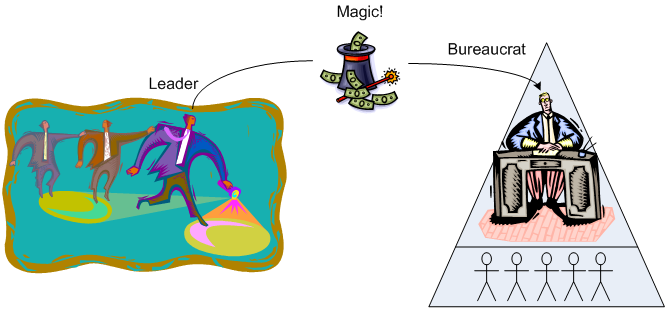
Americans have a love affair with small businesses. But due to the SCOLs, CGHs, BUTTs, and BMs that ran companies like Enron, Tyco, and Lehman Bros, big businesses are untrusted and often reviled by the public. That’s because, when a company grows, its leaders often “magically” morph into self-serving, obstacle-erecting, and progress-inhibiting bureaucrats; often without even knowing that the transformation is taking place. D’oh! I hate when that happens.
Process Delays And Variety Suppression
Even though it’s unrealistically ideal and unworkable, I give you this zero-overhead value and wealth creation system as a point of reference:

For speculative comparison to the idealized design, I give you this system “enhancement“:

For the ultimate delay-inducing, variety-suppressing, and assimilating borg, I give you this “optimal” design:

Over time, as an org unconsciously but almost assuredly morphs into a borg, the existing delay-inducing “value-added overhead processes” grow bigger, and more of them are inserted into the pipeline for sincere but misguided performance-increasing reasons. To add insult to injury, more and thicker variety-suppression control channels are imposed on the pipeline from above. If this rings a bell with you, then it’s pure coincidence, because like all other delusionary BD00 posts, it’s totally made up.

Why am I here?
WTF?
Meh!
D'oh!

My BTC Address



 Bulldozer00's Blog