Archive
A Blast From The Past
In the 1980s, Ed Yourdon was very visible and influential in the software development industry. Arguably, Ed was the equivalent to what Martin Fowler is today – a high profile technical guru. Then at some point, it seemed like Mr. Yourdon disappeared off the face of the earth. He really didn’t vanish, but he’s much less visible now than he was back then. He’s actually making big bux serving as an expert witness in software disaster court cases.
Since I enjoyed Ed’s work on structured systems analysis/design (before the OO juggernaut took off) and I’ve read several of his articles and books over the years, I was delighted to discover this InfoQ interview: “Ed Yourdon on the State of Agile and Trends in IT“.
In the interview, Ed states that he’s asked many CIOs what “agile” means to them. Unsurprisingly, the vast majority of them said that it enabled developers to write software faster. Of course, there was no mention of the higher quality and/or the elevated espirit de corps that’s “supposed” to hitch a free ride on the agile gravy train.

What’s The Diff?
One of the problems I’ve always had with the word “agile” is that it’s so overloaded (like “system“) that anyone can claim “agility“:
Everyone is doing agile these days – even those who aren’t – Scott Ambler
Along this vein, check out this slide from a unnamed agile expert:
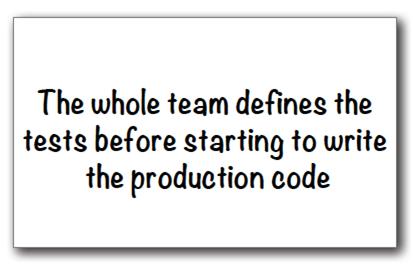
Now tell me, how is this advice different from the unconscionable and anti-agile:
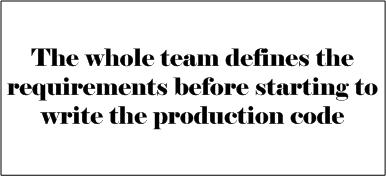
To define tests, you have to have some understanding of the requirements to test against in your cranium, no? It’s just that, in agile-land, you’ll be excommunicated from the cult if you formally write them down before slinging code. WTF?
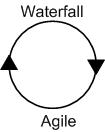
Like “agile” was a backlash against “waterfall” in the past, maybe “waterfall” will be a circular backlash against “agile” in the future?
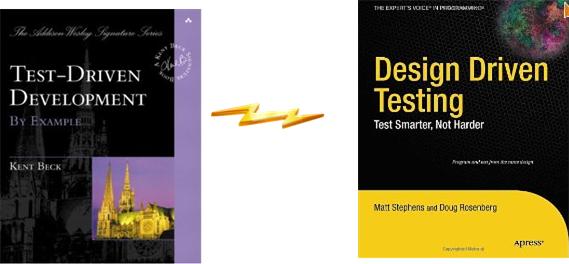
Likewise, instead of creating an emergent Frankensteinian design with revered “TDD“, why not hop off the bandwagon and create emergent tests with “DDT“?
King Of The Hill
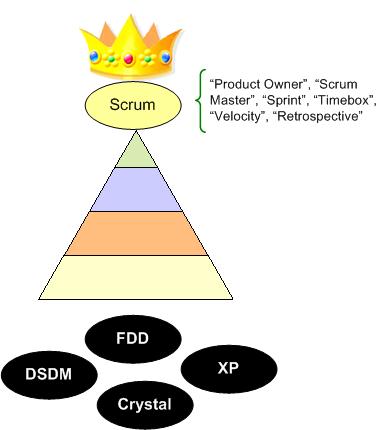
Scrum is an agile approach to software development, but it’s not the only agile approach. However, because of its runaway success of adoption compared to other agile approaches (e.g. XP, DSDM, Crystal, FDD), a lot of the pro and con material I read online seems to assume that Agile IS Scrum.
This nitpicking aside, until recently, I wondered why Scrum catapulted to the top of the agile heap over the other worthy agile candidates. Somewhere online, someone answered the question with something like:
“Scrum is king of the hill right now because it’s closer to being a management process than a geeky, code-centric set of practices. Thus, since enlightened executives can pseudo-understand it, they’re more likely to approve of its use over traditional prescriptive processes that only provide an illusion of control and a false sense of security.”
I think that whoever said that is correct. Why do you think Scrum is currently the king of the hill?
Related articles
- The Scrum Sprint Planning Meeting (bulldozer00.com)
- Scrum And Non-Scrum Interfaces (bulldozer00.com)
Scrum And Non-Scrum Interfaces
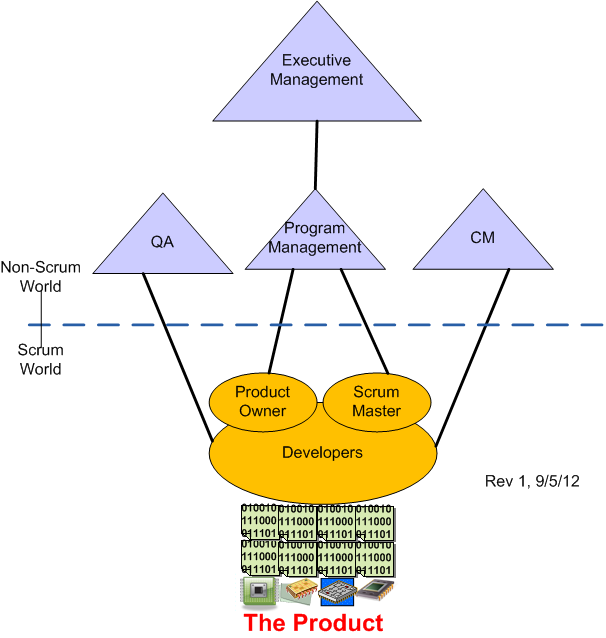
According to the short and sweet Schwaber/Sutherland Scrum Guide, a Scrum team is comprised of three, and only three, simple roles: the Product Owner, the Scrum Master, and the Developers. One way of “interfacing” a flat and collaborative Scrum team to the rest of a traditional hierarchical organization is shown below. The fewer and thinner the connections, the less impedance mismatch and the greater the chances of efficient success.
Regarding an ensemble of Scrum Developers, the guide states:
Scrum recognizes no titles for Development Team members other than Developer, regardless of the work being performed by the person; there are no exceptions to this rule.
I think (but am not sure) that the unambiguous “no exceptions” clause is intended to facilitate consensus-based decision-making and preclude traditional “titled” roles from making all of the important decisions.
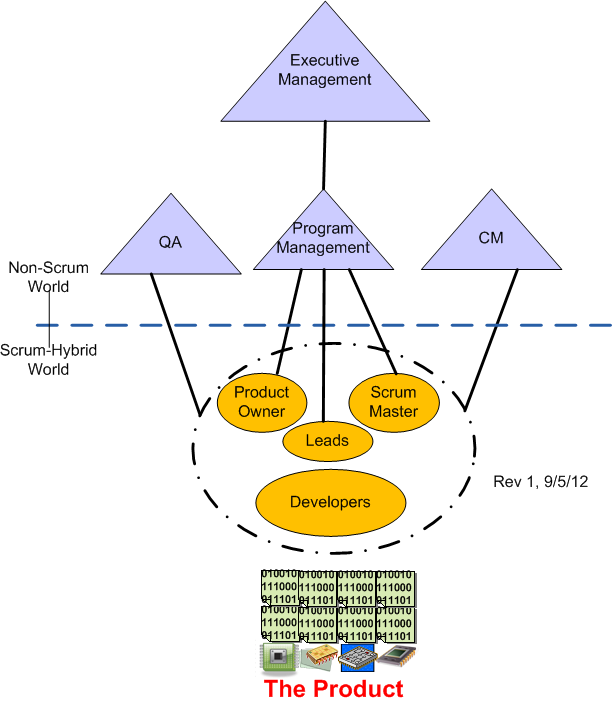
So, what if your conservative org is willing to give Scrum an honest, spirited, try but it requires the traditional role of “lead(s)” on teams? If so, then from a pedantic point of view, the model below violates the “no exceptions” rule, no? But does it really matter? Should Scrum be rigidly followed to the letter of the law? If so, doesn”t that demand go against the grain of the agile philosophy? When does Scrum become “Scrum-but“, and who decides?
Related articles
- The Scrum Sprint Planning Meeting (bulldozer00.com)
- Bring Back The Old (bulldozer00.com)
- Ultimately And Unsurprisingly (bulldozer00.com)
- From Complexity To Simplicity (bulldozer00.com)
- Why I’m done with Scrum (lostechies.com)
Methodology Taxonomy
Here’s a feeble attempt at sharing a taxonomy of well-known (to BD00) software development methodologies:
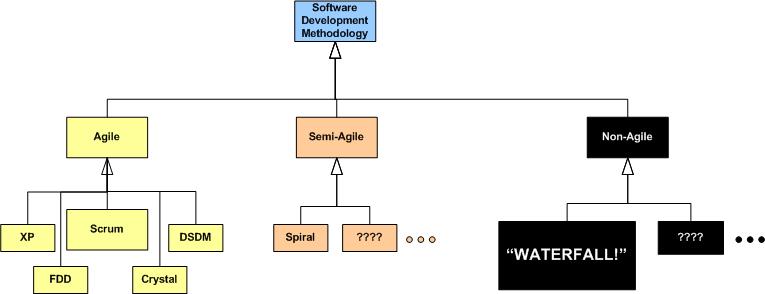
Got any others to add to revision 1? How about variations on the hated “WATERFALL!” class? Where should the sprawling RUP go? What about “Scrum-but“? Does “kanban” fit into this taxonomy, or is it simply a practice to be integrated within a methodology? What about “Lean“?
Don’t Do This!
Because of its oxymoronic title, I started reading Paul McMahon’s “Integrating CMMI and Agile Development: Case Studies and Proven Techniques for Faster Performance Improvement“. For CMMI compliant orgs (Level >= 3) that wish to operate with more agility, Paul warns about the “pile it on” syndrome:
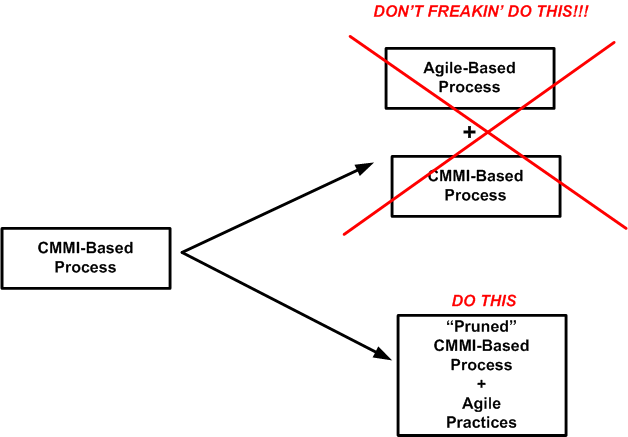
So, you say “No org in their right mind would ever do that“. In response, BD00 sez “Orgs don’t have minds“.
Scrum Cheat Sheet
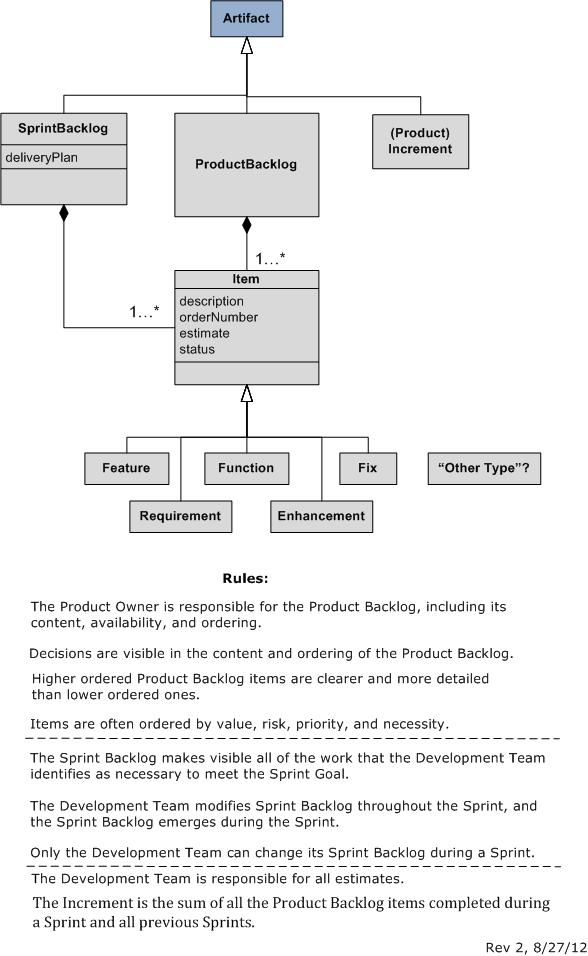
While reading Schwaber and Sutherland’s official Scrum Guide, I decided to concoct a graphical UML-heavy cheat sheet of the monstrously famous agile framework.
Scrum Framework Components
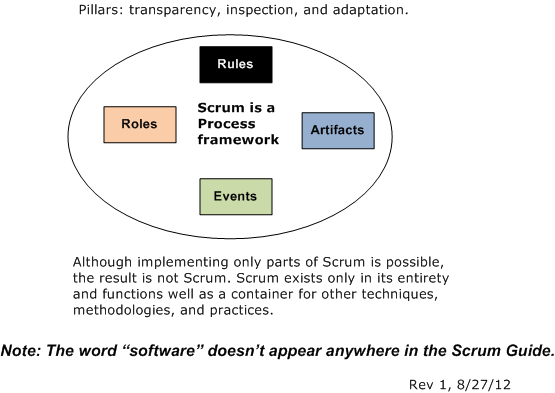
System Class Diagram
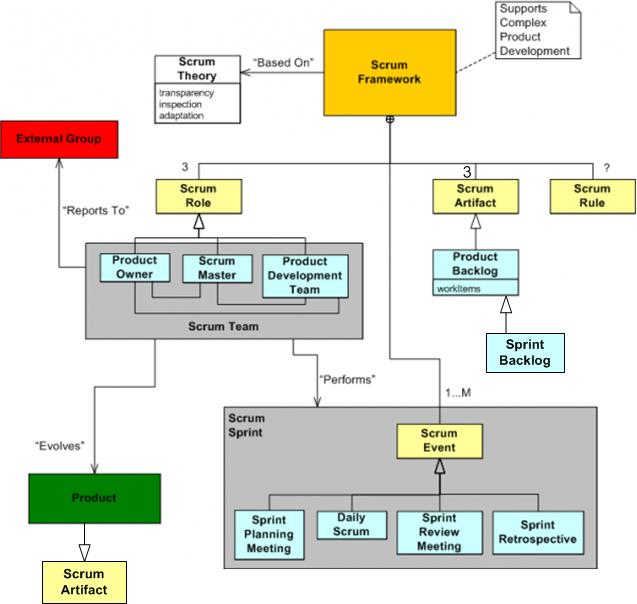
Scrum Roles
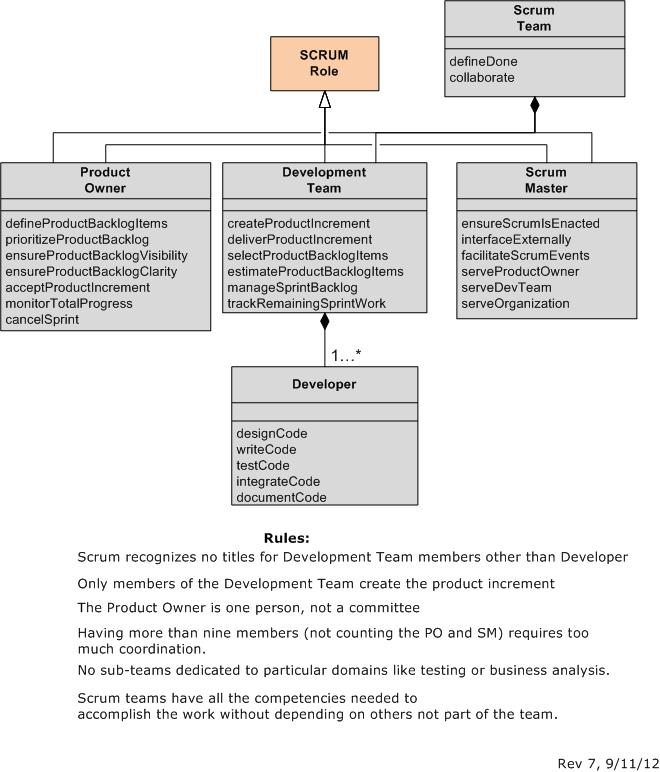
Scrum Events

Scrum Artifacts
Snapback To “Business As Usual”
Over the years, I’ve read quite a few terrific and insightful reports from the General Accountability Office (GAO) on the state of several big, software-intensive, government programs. The GAO is the audit, evaluation, and investigative arm of the US Congress. Its mission is to:
help improve the performance and accountability of the federal government for the American people. The GAO examines the use of public funds; evaluates federal programs and policies; and provides analyses, recommendations, and other assistance to help Congress make informed oversight, policy, and funding decisions.
In a newly released report titled “Software Development: Effective Practices And Federal Challenges In Applying Agile Methods“, the GAO communicated the results of a study it performed on the success of using “agile” software methods in five agencies (a.k.a. bureaucracies): the Department of Commerce, Defense, Veterans Affairs, the Internal Revenue Service, and the National Aeronautics and Space Administration.
The GAO report deems these 10 best practices as effective for taking an agile approach:
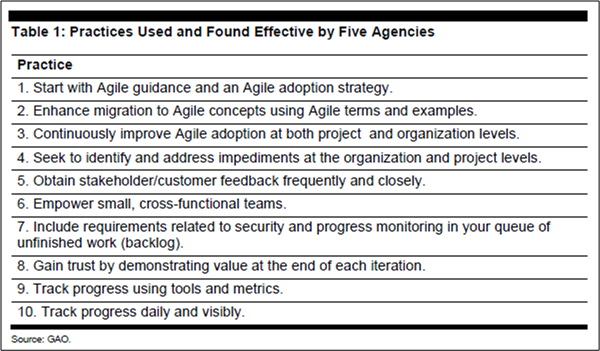
Yawn. Every time I read a high-falutin’ list like this, I’m hauntingly reminded of what Chris Argyris essentially says:
Most advice given by “gurus” today is so abstract as to be un-actionable.
The GAO report also found more than a dozen challenges with the agile approach for federal agencies:
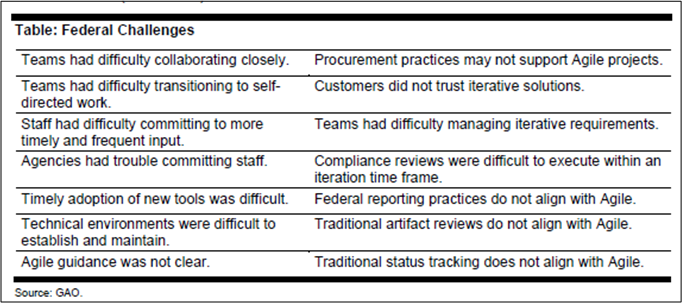
Again, yawn. These are not only federal challenges…. they’re HUGE commercial challenges as well. When the whole borg infrastructure, its policies, its protocols, its (planning, execution, reporting) procedures, and most importantly, its sub-group mindsets are steadfastly waterfall-dominated, here’s what usually happens when “agile” is attempted by a courageous borg sub-group:
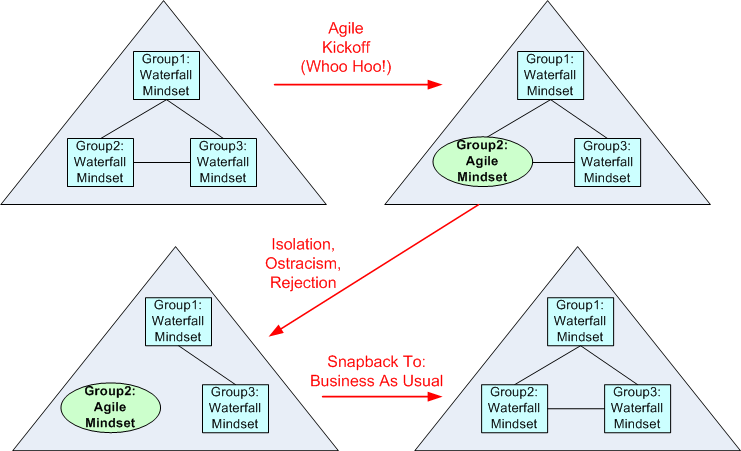
D’oh! I hate when that happens.
Scrumming For Dollars
“Systems Engineering with SysML/UML” author Tim Weilkiens recently tweeted:

Tim’s right. Check it out yourself: Scrum Guide – 2011.
Before Tim’s tweet, I didn’t know that “software” wasn’t mentioned in the guide. Initially, I was surprised, but upon further reflection, the tactic makes sense. Scrum creators Ken Schwaber and Jeff Sutherland intentionally left it out because they want to maximize the market for their consulting and training services. Good for them.
As a byproduct of synthesizing this post, I hacked together a UML class diagram of the Scrum system and I wanted to share it. Whatcha think? A useful model? Errors, omissions? Does it look like Scrum can be applied to the development of non-software products?

Home Grounds
In Barry Boehm and Richard Turner‘s book, “Balancing Agility And Discipline“, they present the concept of the “home ground“. Agile and plan-driven (a.k.a. waterfall) software development methodologies each have their own turf where one is superior to the other for getting the job done within time, budget, and quality constraints.
As the figure below shows, the Boehm/Turner definition of “home ground” is based on 5 dimensions: personnel (experience/expertise), criticality, dynamism, size, culture.
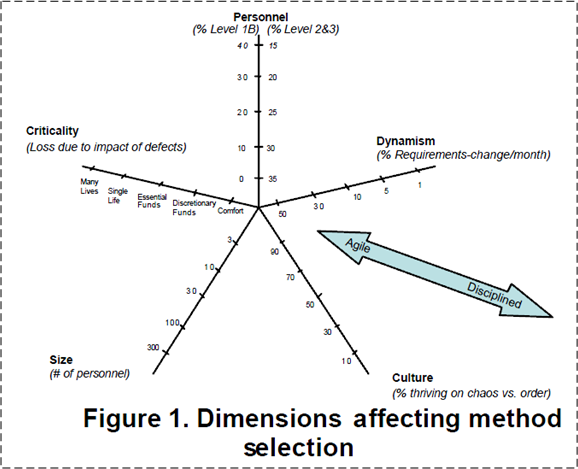
At the origin of the 5 dimensional chart, where dynamism is high, culture is liberally open, project size is small, criticality of application is low, and the majority of the project staff is highly competent, agile approaches are more effective and efficient and efficacious. At the extremes of the 5 axes, plan-driven approaches are more effective and efficient and efficacious.
Do you think Boehm and Turner have got it right? Are there any dimensions missing from their model; like level of management humility, quality of management-knowledge worker relationships, quality of tools, quality of physical work environment?

Why am I here?
WTF?
Meh!
D'oh!

My BTC Address



 Bulldozer00's Blog