Archive
Ego And Apathy
The other day, my teammates and I had a short e-discussion on how much ego we should each personally invest in our code base. On the one hand, “no ego” can lead to apathy and a crappy, untended, code base. On the other hand, too much ego can trigger too many confrontational ego-battles and lead to a crappy, colliding styles, code base. We decided that there’s some sweet spot in the middle, but we don’t know what the freak it is. D’oh!
Historically, my personal style has been investing “too much ego“; which manifests as both offensive and defensive behavior. Being a devilishly clever (but certainly not smart) bloke, I’ve spent way more time offending than defending – cuz offense is much more fun to the ego. On the bright side, I think I have been slooowly getting betting over time, but it doesn’t really matter what I think.
How about you? Are you too apathetic? Too ego-dominated? Do you care?

A Steady Drumbeat
In the context of getting a message to sink in, a wise and dear friend once told me: “it’s not a cymbal crash, it’s a steady drumbeat“. The reason this quote came to mind is because my blog dashboard says that I’ve published 607 posts to date and I was wondering how many of them were redundant – repeating the same message over and over again.

I have no freakin’ idea how many published posts seem redundant to you, but if they do, I’ll use that musical quote as the excuse for my narrow minded focus and lack of breadth. Plus, repetition is a powerful tool for brainwashing others into doing what you want them to do. Moooo Hah Hah!

Buzz Me, Please
Check out this graphic that I borrowed from “LinkedIn Reveals the 10 Most Overused Job-Hunter Buzzwords“.
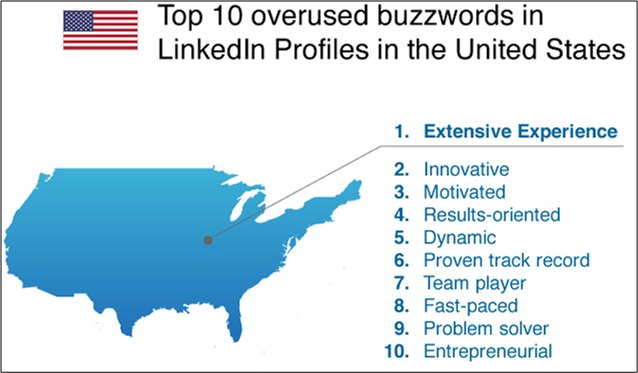
Oh crap! Do I use any of these hoytee-toytee terms in my own dishonest LI profile? Wait…. checking….. checking…. Nope! Phew, I thought I might have opened a gaping hole in my armor that would have exposed me as the true hypocrite that I am.
Here’s some advice for recruiters and hiring managers to consider. If you use any of these words-du-jour in your own profile, replace them with something authentic. Then, discard any candidates you stumble upon that use them in their profiles and resumes.
Note1: Being the lazy and useless sod that I am, I didn’t actually check my profile for bozo buzzword usage. So, if you find any of these laughers in there, call me out.
Note2: On my final proofread of this post prior to publication, I actually did search my profile for bozo buzzword usage and….. D’oh! I had actually started my summary off with “I have extensive experience..”. Bummer. Of course, I covered my tracks by changing the opening to “Over the years, I’ve acquired lots of experience…”.
A Delighted Customer
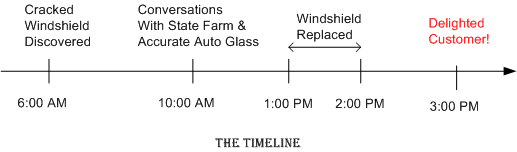
Being a crusty ole’ curmudgeon, it’s not often that I’ve been delighted as a customer of a product or service, but it’s a wonderful feeling when it does happen. Last week, when I parked my car at the gym at 6:00 AM, I noticed a crack in my windshield just below the steering wheel. Upon further inspection, I discovered that the crack stretched across the entire length of the windshield. D’oh!
After exercising, I called my State Farm agent at 10:00 AM. During the call, after I told the agent my story of woe, she connected me with an Accurate Auto Glass (AAG) employee. Right then and there, the AAG employee set up an appointment to have a technician drive out to my workplace and replace the windshield in the parking lot sometime between 1 and 2 PM.
After expecting a call when the technician was supposed to arrive and still not hearing from him/her by 3 PM, I gave AAG a “WTF?” call. The AAG worker pulled the ticket and said the job was completed. Sure enough, as I walked out to the parking lot with the AAG person still on the phone, I did indeed find that the job was completed. Whoo Hoo – delight city! After telling him that AAG rocks, I hung up the phone – as a delighted customer of both State Farm and AAG.
Do you get delighted often by vendors you buy stuff from? Do you delight your own customers? Do you know who your customers are?
American Idle
Are you as talented as I am for probing your environment, filtering out stuff that doesn’t fit within your entrenched UCB of the world, and whole-heartedly embracing ideas and thoughts that match it? The blabber that follows is, as Pink Floyd would sing, “just another brick in my wall“.
In 1932, the brilliant Bertrand Russell wrote his essay “In Praise of Idleness“. Here’s the brick mortar, in the form of quotes carefully plucked from Mr. Russell’s essay:
I think that there is far too much work done in the world, that immense harm is caused by the belief that work is virtuous, and that what needs to be preached in modern industrial countries is quite different from what always has been preached.
In these days, however, no one will deny that most enterprises fail. That means that a large amount of human labor, which might have been devoted to producing something that could be enjoyed, was expended on producing machines which, when produced, lay idle and did no good to anyone.
I want to say, in all seriousness, that a great deal of harm is being done in the modern world by belief in the virtuousness of work, and that the road to happiness and prosperity lies in an organized diminution of work.
Work is of two kinds: first, altering the position of matter at or near the earth’s surface relatively to other such matter; second, telling other people to do so. The first kind is unpleasant and ill paid; the second is pleasant and highly paid.
These landowners are idle, and I might therefore be expected to praise them. Unfortunately, their idleness is only rendered possible by the industry of others; indeed their desire for comfortable idleness is historically the source of the whole gospel of work. The last thing they have ever wished is that others should follow their example.
The conception of duty, speaking historically, has been a means used by the holders of power to induce others to live for the interests of their masters rather than for their own. Of course the holders of power conceal this fact from themselves by managing to believe that their interests are identical with the larger interests of humanity.

Thirty-Six Lucky Ones
With all this ranting that I do against hierarchical orgs, you’d think I would have been burned badly in the past by a succession of tyrant bosses. You’d be wrong. I’m fifty-two years old (D’oh!) and I’ve been working in hierarchies since I was 16. Throughout those 36 years, I can honestly say that I’ve never had a horrendous boss. I’ve worked for a handful of terrific ones that I deeply admire and respect. I’ve also worked for several good ones, and many average ones. In absolute terms, I’ve never felt underpaid, but in relative terms, I have (Waaah and Boo-Hoo!).

The “bad” experiences I’ve had within the hallowed halls of hierarchy were with 1 dimensional program managers, project managers, and product managers (damn-the-people-schedule-is-all-that-matters). Interestingly, the most friction I’ve been a co-creator of has been with manager wannabes. You know, those so-called technical peers who:
- talk a good, jargon-filled game to cover up their incompetence,
- continuously obstruct progress to fill their time and simultaneously cover up their own lack of contribution,
- don’t create any value directly – not even spreadsheets or Gannt charts in preparation for their upward advancement into the guild of management.
When those dudes do get promoted, and IMHO it has happened unconscionably often throughout my “career“, I steer clear of them. It’s BM city and my car ain’t gonna drive through it.
Even though I’ve been incredibly lucky with hierarchical bosses, I’ve known quite a few fellow DICsters over the years who’ve felt that they weren’t treated fairly by hierarchs – even by some of the exact same bosses that I’ve had.
How about you, what’s your boss story? Why won’t you tell me about it?
VHP Package
Several months ago, when I bought and read Zappos.com CEO Tony Hsieh‘s “Delivering Happiness: A Path To Profits, Passion, and Purpose” book, I signed up for the VHP (Very Happy Person) program. I also followed the “Happiness Bus” around as it cheerfully toured the USA, spreading a little bit of happiness at every stop.
Recently, I received in the mail, unsolicited and free of charge, a cool little thank you package filled with these five goodies:

Since the care package contains a copy of the DH book signed by Mr. Happiness himself, Tony Hsieh, I’d like to try and return the favor by spreading a little happiness of my own. Therefore, I’ll send my unsigned copy gratis to the first person who indicates, via the comments section in this post, that they’d like to own it. Hell, I’ll even spring for the postage cost 🙂
Reporting Delay
The figure below shows a generic Bulldozer00 model (which means it’s outright wrong) of what happens ‘tween the time one experiences an “important” event to the time at which one communicates to others about the event. What’s an important event? It’s something that has meaning – which implies that it is person-specific. One person’s important event is another’s trivial yawner.
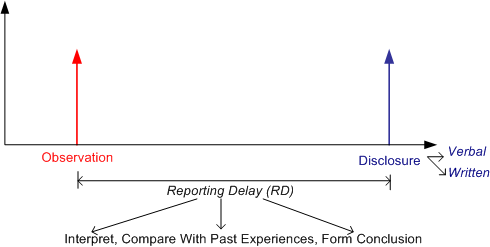
The length of the reporting delay (RD) is critical. If it’s too short, then one can suffer from foot-in-mouth syndrome like Bulldozer00. If it’s too long, with infinity being the limit, then the lack of disclosure can eat away at one’s psyche and cause stress and ill-health.
In dysfunctional corpricracies, the unspoken tool of “fear imposition” keeps the RD of many DICsters at infinity, or in layman’s words – STFU. What’s the nature of your RD?

Berkun Myths
Steven Johnson‘s book, “Where Good Ideas Come From“, seems to have garnered more accolades and publicity, but Scott Berkun‘s “The Myths Of Innovation” is also an insightful, well crafted, and surprising read on much-the-same topic. I haven’t read Steven’s book yet (it’s on my list), but I’ve read and enjoyed both editions of Scott’s book.
Here is Scott’s list of the 10 myths of innovation:

My faves are numbers 4, 6, and 7. Regarding number 4, one of my favorite quotes fits the bill:
Don’t worry about people stealing your ideas. If your ideas are any good, you’ll have to ram them down people’s throats. – Howard Aiken
What are your faves? Are there any myths missing from the list? What do you think are the “truths” of innovation? Are they just the inverses of the list?
Super Secret Recipe
Wanna know what the super secret recipe is for building an impenetrable UCB pyramid? OK, you said no – but that t’aint gonna stop me from loosening my lips and sinking ships. Here we go…..
- Directly or (better yet) vicariously experience a real-life situation involving people in which the outcome is a “surprise” to you.
- Judge the outcome as absolutely good or bad (no gradations allowed!)
- Strip and discard all messy contextual meaning from the situation.
- If you judged the outcome as “good”, then ignore it and kick out of this recipe – you’re done! Otherwise…..
- Concoct a reason why the outcome turned out “bad”.
- By removing all the uncomfortable details that don’t align with your existing UCB, vertically abstract your interpretation of the reason for the outcome.
- Horizontally generalize your cause-effect conclusion to subsume any and all situations with any remote resemblance to the experienced situation.
- Pour mental concrete around your newly discovered nugget of knowledge and jam it somewhere into your growing UCB pyramid.
- Pat yourself on the back for “knowing” how the world worx. Whoo Hoo!

Every man, wherever he goes, is encompassed by a cloud of comforting convictions, which move with him like flies on a summer day. – Bertrand Russell

Why am I here?
WTF?
Meh!
D'oh!

My BTC Address



 Bulldozer00's Blog