Archive
Long Live The King!
Even though it has a title and cover design that only a Harvard MBA could love, I picked up Robert Austin’s “Measuring and Managing Performance in Organizations” on a twitter tip from Torbjörn Gyllebring. As soon as I cracked the cover, I knew it was gonna be a classic. The foreword was written by one of my all time favorite software authors, Tom DeMarco.
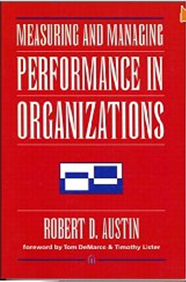
Mr. Austin discovered perhaps the first recorded instance of the well worn “schedule is king!” management law:
Such scenarios, in which program managers or contractors attend to measurements of timeliness of delivery to the exclusion of all else, are reported as early as 1882. In that year, the newly built U.S.S. Omaha was discovered to have onboard-coal-room for only four days’ steaming; in the rush to stay on schedule, no one had been willing to force notice of this defect at a high enough level to ensure its correction.
 Since there seems to be no worthy candidate on the horizon capable of dethroning the king, expect this monarch to live long indeed.
Every once in a blue moon, I finish a book so engrossing that I immediately reread it before cracking open a different one. Mr. Austin’s MAMPIO is one of those gems and I’m well into my second romp through it. Since it’s loaded with a gazillion ideas for blog posts, expect more over-the-top BD00 distortions to come. W00t!
POTM Has Landed
You are in the future. You were sent by a magical wormhole as you entered the elevator, What do you see? The remains of your company, destroyed… The only clue to what happened? An organizational chart where all boxes read: “Manager”. They’ve finally done it, they’ve destroyed the company by turning everybody into a manager – Random Manager
It took forever, but I finally received my POTM T-shirt from my Germany-based e-friend, Vasco Duarte (@duarte_vasco). W00t!
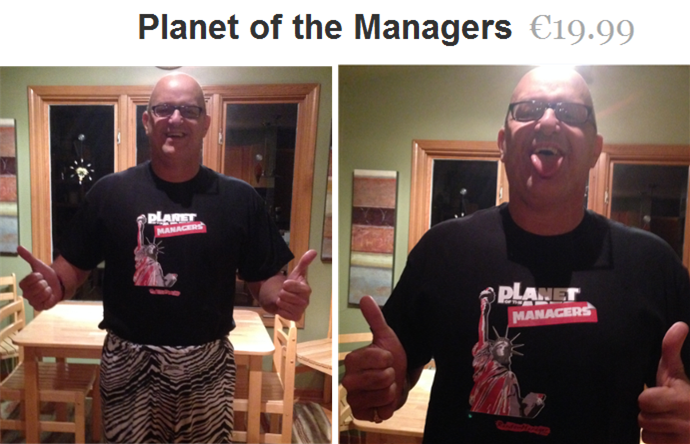
You can get your very own copy of the POTM masterpiece here: POTM T-Shirt.
Management Idiots And Programming Idioms
In TC++PL, Bjarne Stroustrup introduces the concept of a class hierarchy with this simple business world example:
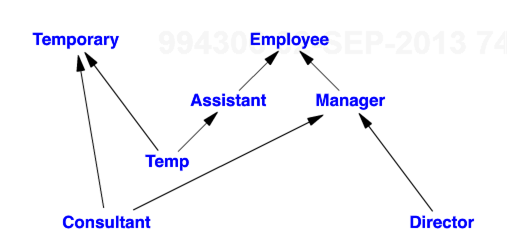
Temporary and Employee base class “objects” get paid by the company to do work that directly creates value. Manager objects inherit an Employee’s responsibilities and encapsulate new, manager-specific, behaviors; like monitoring/commanding/reprimanding non-manager Employees, Temps, and Assistants. Proceeding down the inheritance tree on the right, a Director object inherits the behaviors of both the Manager and Employee classes while adding new “directorial” behaviors.
When BD00 saw Bjarne’s inheritance tree example, he said to himself “Dude, you got it wrong. If you wanted to model the real world, here’s what you shoulda presented“:
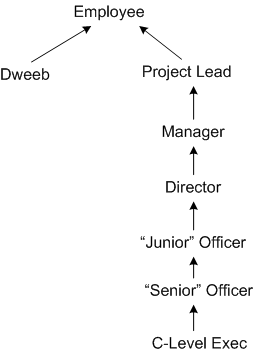
It woulda added a touch of edgy humor to the book, dontcha think?
When I write my first programming book, I’m gonna have diagrams like that and code fragments like this in it:
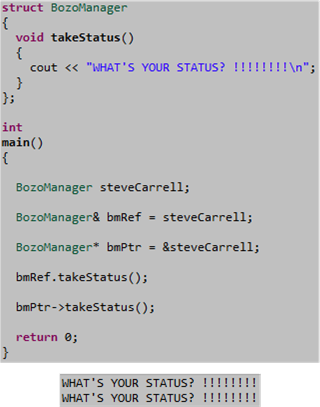
I’m thinking of hatching a kickstarter.com project and titling the hybrid book something like “Management Idiots And Programming Idioms“. What would you name it, and would you buy it?

Mistrust Over Teamwork
Because I’ve stumbled upon several rave reviews of the book, I started reading “Team Geek“.
Right off the bat, the authors present this brilliant endlessorigami.com graphic:
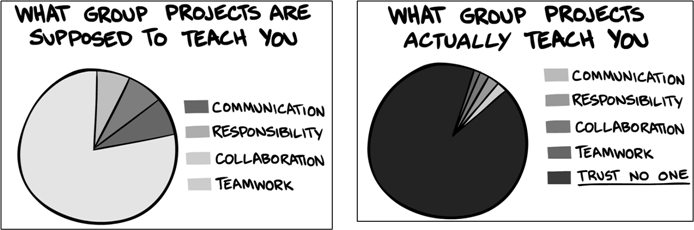
D’oh! Maybe that’s why it’s so hard to become a good “team player“.
But why do group projects tend to teach mistrust instead of teamwork? Could it be because the ancient hierarchical structures and individual-centric reward policies baked into the vast majority of institutions demand an “it’s all about me” attitude?
Of course not. When someone is castigated by HR for not being a “rah-rah” team player, it’s because of personal failure – not because of dysfunctional organizational structures and policies, right?
Another One Bites The Dust
Another one bites the dust. Another one bites the dust. And another one gone, and another one gone… – Queen
Companies that have a superficial dual career ladder love to delude themselves into thinking they have a real one. The alternative, which is “unacceptable!” because it would trigger an unsettling feeling of cognitive dissonance and undermine a self-image of infallibility, is to simply own up to the inconsistency and stop lying to themselves and their constituents.

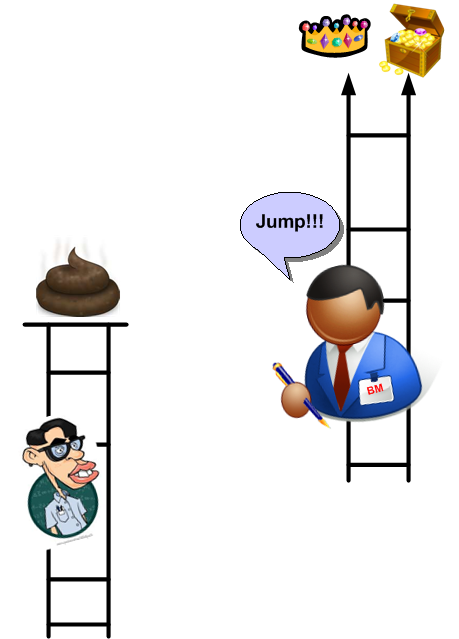
It’s always a sad affair to watch brilliant engineers jump from the dead-end technical ladder to the golden management ladder because it’s the only way they can do more for themselves and their families.
Sometimes the “promotion” works out fine for both the org and the newly minted manager. But sometimes it achieves a double loss. The engineer morphs into a crappy manager with poor people skills, a propensity to obsess over schedules, and a bent toward micro-managing technical details. Plus (or should I say minus?), the org’s product development group loses precious technical expertise. D’oh! I hate when that double whammy happens.
So Much More
If you haven’t seen the following hilarious and entertaining “I Quit” youtube video, then you’ve been living in a cave for too long. It’s gone viral with over 14 million hits as of this writing.
The fact that so many people tuned in says a lot about how organizations operate in the 21st century. Sure, there’s been some progress in injecting more humanity into the workplace since the dawn of the 2oth century, but there’s so much more that can be done.
Sadly, the dudes who have the power to get it done don’t want it to get done. It’s all about ego, loss of control, loss of stature, yada, yada, yada. Take your pick.
It is difficult to get a man to understand something, when his salary depends upon his not understanding it. – Upton Sinclair
PLAN MORE!
Check out this 20th century retro banner that BD00 stumbled upon whilst being given a tour of a friend’s new workplace:

OMG! The smug agilista community would be outraged at such a bold, blasphemous stunt! But you know what? BD00’s friend’s org is alive and well. It’s making money, the future looks bright for the business, and the people who work there seem to be content. Put that in your pipe and stoke it up.
They’ve Finally Done It, They Are In Control!
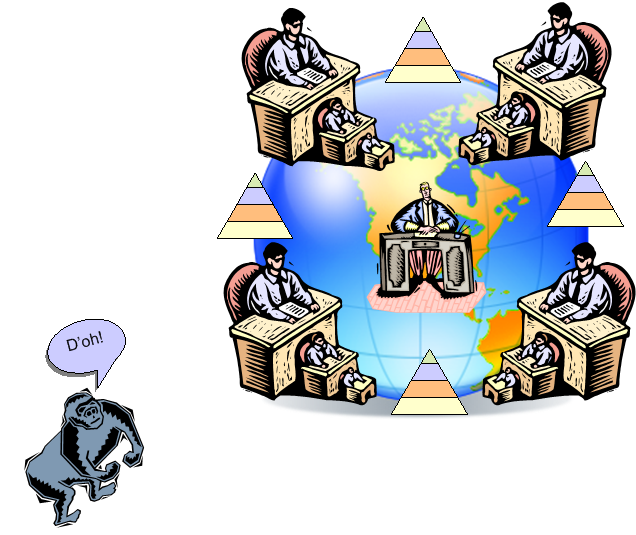
Oh ratz! BD00 wishes he concocted this brilliant “Planet Of The Apes” parody T-shirt:

But alas, BD00 didn’t create the masterpiece. The Random Manager team did. Damn it! Here’s the BD00 rip off version:
The Confusion Of Roles
Scott Berkun’s books have always been lucrative gold mines for bloggers wanting to explore novel ideas and insights. His latest release, “The Year Without Pants“, is no different.
In TYWP, Scott discloses a major cultural malady that plagues corpo America: “The Confusion Of Roles“.
One major mistake Schneider (Automattic Inc’s CEO) had seen was how companies confused supporting roles, like legal, human resources, and information technology, with product creation roles like design and development. Product creators are the true talent of any corporation, especially one claiming to bet on innovation. The other roles don’t create products and should be there to serve those who do. A classic betrayal of this idea is when the IT department dictates to creatives what equipment they can use. If one group has to be inefficient, it should be the support group, not the creatives. If the supporting roles, including management, dominate, the quality of products can only suffer. – Scott Berkun
The “Confusion Of Roles” is simply not a problem at Automattic Inc. That’s because there are no legal, human resources, finance, quality assurance, or information technology silos within the flat-as-a-pancake company.
Well, that’s all fine and dandy for a cozy, small company like Automattic. But there is no cure for the “role confusion” disease in big borgs like yours, right? Bzzzzt!
HCLT CEO Vineet Nayar wrote about the exact same productivity and morale killer in his shockingly titled “Employees First, Customers Second” book. Taking the bull by the horns, Vineet corrected the “confusion of roles” epidemic at his 30,000 person Leviathon by inverting the pyramid and instituting a transparent system of reverse accountability called the Smart Service Desk (SSD) .
The SSD is where front line employees can submit problem tickets against the (so-called) support functions. Each ticket has a deadline date and the submitter is the ultimate judge of results – not some self-important manager. Shortly after its introduction, the SSD was receiving tickets at a rate of 30,000 per month – one per employee. D’oh!
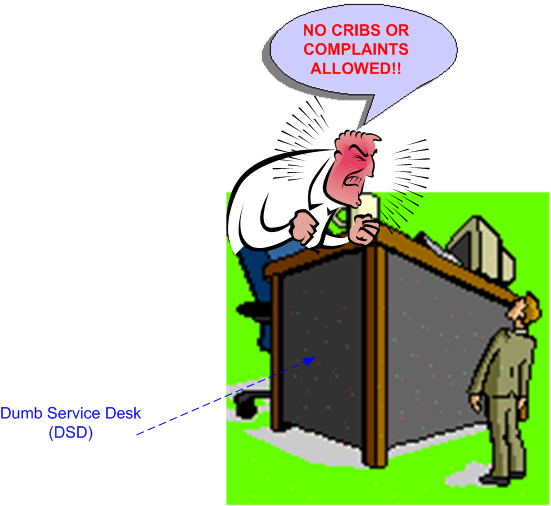
Why, you may be asking, aren’t there more “unconfusion-of-roles” change efforts taking place in the land of a million pointy hierarchies? It’s because the pinnacle dwellers who rule the roost don’t see it as a problem at all. It’s the way it is because it’s always been that way and, more importantly, it’s the way it’s supposed to be.

Goal Setting
Given the generic control system model below, how can we improve the performance of an underachieving production system?
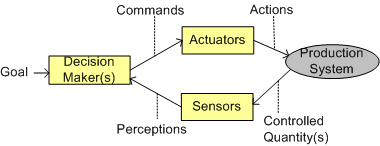
One performance improvement idea is to make the goal directly visible to the production system; as opposed to indirectly via the policy/process actions of the actuators.
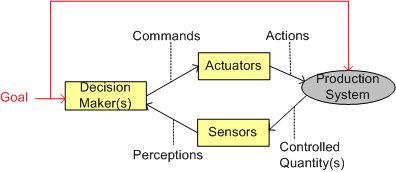
A meta-improvement on this idea is to allow the production system constituents direct involvement in the goal setting process.
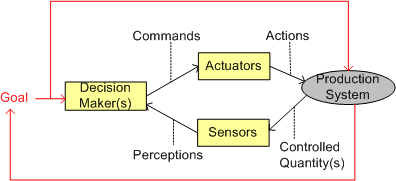
It seems to make naive sense, doesn’t it? Well, it does unless the goal is some arbitrarily set financial target (“increase market share by 10%“, “decrease costs by 5%“, “increase profits by 25%“) pulled out of a hat to temporarily anesthesize Wall Street big-wigs.
Related articles
- Who’s Controlling The Controller? (bulldozer00.com)
- Unobservable, Uncontrollable (bulldozer00.com)

Why am I here?
WTF?
Meh!
D'oh!

My BTC Address



 Bulldozer00's Blog