Archive
Where You Stand
In “Making It Big In Software“, author Sam Lightstone quotes former GE CEO Jack Welch:
You want to make sure everyone knows where they stand in the organization. It’s a leader’s obligation. In most companies, the leaders stand back, and people don’t know where they stand. – Jack Welch
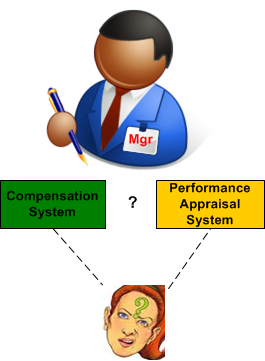
Do your performance appraisal and compensation systems allow you to clearly determine where you stand? If not, do you know what’s missing (hint: a clear and unconfusing connection between the two)? If you do know what’s missing, have you raised your concern to management? If you haven’t raised your concern to management, why not (hint: fear)?
Bureaucracy Formation
Since I’m not a big fan of bureaucracies, let’s have some fun and see how these resource sucking and dehumanizing orgs are naturally formed right under the noses of the high paid corpo dudes who are ironically “responsible” for keeping costs down. As you’ll see, it may even be worse than you think. The infallible, know-it-all, multi-titled CGHs in charge not only allow their bureaucracy to flourish, they feed and water it as a result of the unconscious and self-centered need for ego expansion.
Check the figure below out for a hypothetical example of the formation of a bureaucracy over time. As usual, I’ve made the example up (cuz I’m a L’artiste) and I’ve simplistically decomposed a complex org into two group archetypes; product and support. In my obviously wrong dream-world, the otherwise highly esteemed management class is a support group sub-type, of course.
At t=Start, when a vibrant and competent startup org is initialized, there are no “support” groups: nada, zilch. There’s only a product development (or service provider) group that does everything needed to sustain and grow a business around the wealth-creating product (or service).

As time tics by and the fledgling enterprise grows, one support group after another is added as another ring of fat around the product development group core. At the beginning, the support groups are few, and they’re subordinate both in stature and compensation to the wealth creation group because everyone knows that the product and/or service brings home the bacon.
As the org matures, an incredulous flip in the stature structure snaps into place (t=T3 in the example above) because, well, because that’s the way it is. The first of many subsequent support groups to rise in stature is the executive level management cadre. As even more corpo maturation accrues, all emotional enthusiasm and passion is expelled from the org because the same-old, same-old, mechanistic, B-school and Wall Street psychology usurps the childlike and immature “let’s change the world” mindset which birthed the org in the first place. The so-called management leadership cabal catalyzes and accelerates the move to bureaucracy by; treating wealth creators as easily replaceable DICs, punishing any publicly expressed passion and enthusiasm, cloning themselves in newly added middle management layers, and growing their personal empires in order to inflate their pocketbooks and sense of importance at the expense of the org as a whole. Bummer.
“Are you here to build a career or to build an organization?” – Peter Block
Herman Miller’s Design for Growth
Herman Miller Inc, of Aeron chair fame, is a rare breed. They consistently morph with the times and remain profitable in turbulent waters. This article, Herman Miller’s Design for Growth, tells the compelling story of the genesis of a new suite of products named Convia that spawned a brand new subsidiary business.
The terrific strategy + business article not only recounts the technical story behind the convia product line, it tells the story of the innovative management practices employed by the company’s leadership over the lifetime of the company:
The creation of Convia might sound like a tale of pure product innovation, or even of technology adoption, but it is actually a story about management — and only the most recent of several similar stories at Herman Miller. Over many decades, the company has made itself a laboratory for testing new management ideas and turning them into effective practice.
First, the hard evidence that the company is highly successful despite its repeated forays into the unknown:
Herman Miller competes in an industry slammed by arguably the worst commercial real-estate crisis in a generation. Still, despite a 19 percent plunge in sales for fiscal 2009 (ending in May), the US$1.6 billion company reported a $68 million profit, albeit down from $152 million in fiscal 2008. Over the last 10 years, its stock has consistently outperformed the Standard & Poor’s 500 index.
Next, the snippets that yield insights into the off-the-beaten-path management mindset of the company’s leaders:
…two key principles that continue to inform the company’s management approach. One was a commitment to participative management; the other, a problem-solving approach to design.
Max De Pree, CEO from 1980 to 1987, drew broad attention to the culture at Herman Miller by writing the bestselling Leadership Is an Art (Dell, 1990). Of participative management, he wrote: “Each of us, no matter what our rank in the hierarchy may be, has the same rights: to be needed, to be involved, to have a covenantal relationship, to understand the corporation, to affect our destiny, to be accountable, to appeal, to make a commitment.”
He (Brian Walker, the company’s former chief financial officer, who took over as CEO in 2004) wanted everyone at the company to calculate the financial effect of decisions big and small. It didn’t matter if they were involved in buying, selling, building, designing, billing, paying, or financing. Or whether they were charged with controlling quality, reliability, inventory, waste, energy use, scrap, or the kinds of staples people used.
As Long (now director of the corporate HMPS team) toured the file cabinet plant recently, a visitor paused by a welding robot and asked, “Why don’t you use more robots?” “Robots,” Long said, “can’t make themselves better.”
The objective was to have top decision makers invest themselves in the work — to be companions on the journey, not simply judges of it. “The idea,” Miller says, “was to change the dynamic from traditional review-and-approve to advocacy.”
But Walker argued that in the feeble economy, the main goal was to keep the business sustainable, not to increase profitability at the expense of employees.
Walker says he has no regrets about paying people for time not worked, as the program generated a lot of goodwill and credibility for top management.
So, what do you think? Is the image of Herman Miller Inc. different from the stale corpo model entrenched in your brain?

Exaggerated And Distorted
The figure below provides a UML class diagram (“class” is such an appropriate word for this blarticle) model of the Manager-Developer relationship in most software development orgs around the globe. The model is so ubiquitous that you can replace the “Developer” class with a more generic “Knowledge Worker” class. Only the Code(), Test(), and Integrate() behaviors in the “Developer” class need to be modified for increased global applicability.
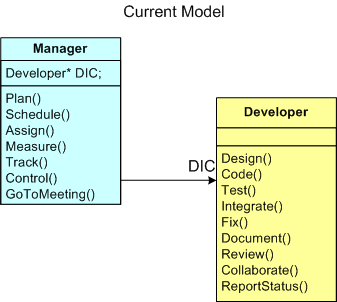
Everyone knows that this current model of developing software leads to schedule and cost overruns. The bigger the project, the bigger the overruns. D’oh!
In this article and this interview, Watts Humphrey trumps up his Team Software Process (TSP) as the cure for the disease. The figure below depicts an exaggerated and distorted model of the manger-developer relationship in Watts’s TSP. Of course, it’s an exaggerated and distorted view because it sprang forth from my twisted and tortured mind. Watts says, and I wholeheartedly agree (I really do!), that the only way to fix the dysfunction bred by the current way of doing things is to push the management activities out of the Manager class and down into the Developer class (can you say “empowerment”, sic?). But wait. What’s wrong with this picture? Is it so distorted and exaggerated that there’s not one grain of truth in it? Decide for yourself.

Even if my model is “corrected” by Watts himself so that the Manager class actually adds value to the revolutionary TSP-based system, do you think it’s pragmatically workable in any org structured as a CCH? Besides reallocating the control tasks from Manager to Developer, is there anything that needs to socially change for the new system to have a chance of decreasing schedule and cost overruns (hint: reallocation of stature and respect)? What about the reward and compensation system? Does that need to change (hint: increased workload/responsibility on one side and decreased workload/responsibility on the other)? How many orgs do you know of that aren’t structured as a crystalized CCH?
Strangely (or not?), Watts doesn’t seem to address these social system implications of his TSP. Maybe he does, but I just haven’t seen his explanations.
Ignore The Messenger
The more civilized, modern day equivalent of “shoot the messenger” is “ignore the messenger“. In (so-called) enlightened organizations, couriers of bad news aren’t physically eviscerated like in the old days, they’re simply ignored – at first.
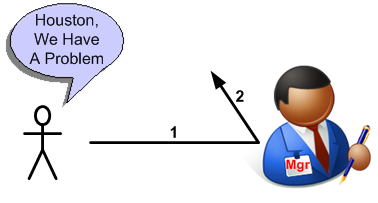
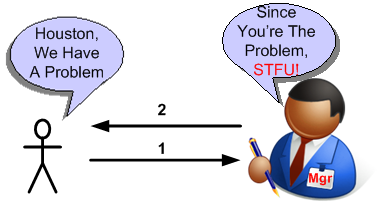
If the bearers of blasphemy don’t get the hint and continue to badger the dudes in the upper layers of the corpo cake, a stronger feedback signal is emitted in the form of cleverly disguised words. Well, they’re cleverly disguised most of the time?
Double Whammy
Five Principles
Watts Humphrey is perhaps the most decorated and credentialed member of the software engineering community. Even though his project management philosophy is a tad too rigidly disciplined for me, the dude is 83 years young and he has obtained eons of experience developing all kinds of big, scary, software-intensive systems. Thus, he’s got a lot of wisdom to share and he’s definitely worth listening to.
In “Why Can’t We Manage Large Projects?“, Watts lists the following principles as absolutely necessary for the prevention of major cost and time overruns on knowledge-intensive projects – big and small.
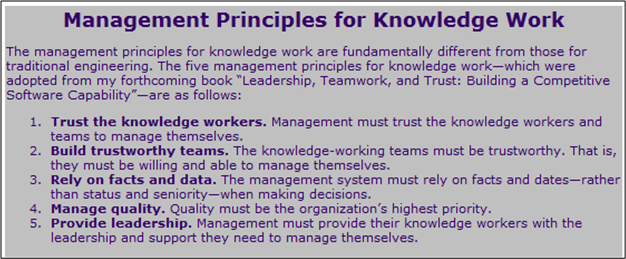
Since nobody’s perfect (except for me — and you?), all tidy packages of advice contain both fluff and substance. The 5 point list above is no different. Numbers 1, 4 and 5, for example, are real motherhood and apple pie yawners – no? However, numbers 2 and 3 contain some substance.
Trustworthy Teams
Number 2 is intriguing to me because it moves the screwup spotlight away from the usual suspects (BMs of course), and onto the DICforce. Watt’s (rightly) says that DIC-teams must be willing to manage themselves. Later in his article, Watts states:
To truly manage themselves, the knowledge workers… must be held responsible for producing their own plans, negotiating their own commitments, and meeting these commitments with quality products.
Now, here’s the killer double whammy:
Knowledge worker DIC-types don’t want to do management work (planning, measuring, watching, controlling, evaluating), and BMs don’t want to give it up to them. – Bulldozer00
Besides disliking the nature of the work, the members of the DICforce know they won’t be rewarded or given higher status in the hierarchy for taking on the extra workload of planning, measuring, and status taking. Adding salt to the wound, BMs won’t give up their PWCE “job” responsibilities because then it would (rightfully) look like they’re worthless to their bosses in the new scheme of things. Bummer, no?

Facts And Data
As long as orgs remain structured as stratified hierarchies (which for all practical purposes will be forever unless an act of god occurs), Watts’s noble number 3 may never take hold. Ignoring facts/data and relying on seniority/status to make decisions is baked into the design of CCHs, and it always will be.
It’s the structure, stupid! – Bulldozer00
DIC In A Box
I’ll wager $0 cents that 99% of corpo America institutes some kind of (yawn) standard DIC-in-a-box compensation system as shown in the figure below. Why? Because that’s what the Sloan, Wharton, and other “elite” B-schools say is the “optimum” motivational system, of course. Plus, it’s the safest and easiest way to reward the DICforce. What box are you in, fellow DICster? If you’re a BM, you’re unboxed at the mysterious and unrecorded level N+1, where there is no $Max, right?

Check out the two radical, but non-theoretical, compensation systems in place at these two real and deviant orgs:
According to “normal” business criteria, which are profit and revenue growth, Fog Creek Software and Semco must be considered successful companies, no?
 What kind of innovative compensation system does your company use?
The Art Of Rationalization
A major defense mechanism that all human beings develop over time is the art of rationalization. A perpetrator (like me and you?) of “bad” behavior who doesn’t want to be held accountable for his/her behavior always uses the skill of rationalization to disconnect and distance him/herself from personal feelings of guilt and to convince others that the manifest behavior was “noble and just”. Street smart politicians, corpo managers, so-called leaders, and over-educated experts are extremely clever and highly skilled rationalizers. They’re at the top of Everest.
“Half of the harm that is done in this world is due to people who want to feel important. They do not mean to do harm… They are absorbed in the endless struggle to think well of themselves.” – T. S. Eliot
Hitler is perhaps the ultimate example of a supremely skilled rationalizer. He not only convinced himself that the atrocities he committed against mankind were noble and just, this dude convinced an entire nation so effectively that “his” people deified him. Ominously, in many orgs around the globe, millions of little Hitlers operate unfettered. They perpetrate their “bad” behavior on their fellow human beings while (astonishingly) being rewarded for it. Blech!

Three Types
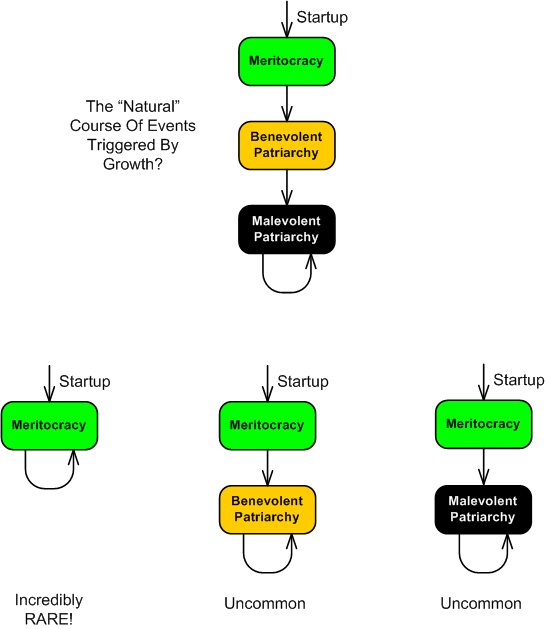
One simple (simplistic?) way of looking at how orgs of people operate is by classifying them into three abstract types:
- The Malevolent Patriarchy
- The Benevolent Patriarchy
- The Meritocracy
Since it’s so uncommon and rare to find a non-patriarchically run org (which is so pervasive that the genre includes small, husband-wife-children, families like yours and mine), I struggled with concocting the name of the third type. Got a better name?
The figure below shows a highly unscientific family of maturation trajectories that an org can take after “startup”. The ubiquitous, well worn path that is tread as an org grows in size is the Meritocracy->Benevolent Patriarchy->Malevolent Patriarchy sojourn. Note that there are no reverse transitions in any of the trajectories. That’s because reverse state changes, like a Benevolent Patriarchy-to-Meritocracy transformation, are as rare as a company remaining in the Meritocracy state throughout its lifetime.
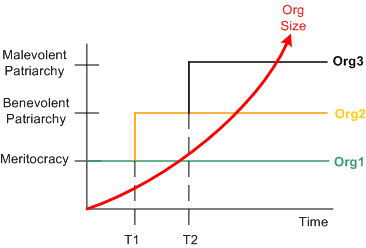
The state versus time graph below communicates the same information as the state machine family above, but from a time-centric viewpoint. Since “all models are wrong, but some are useful” (George Box), the instantaneous transition points, T1 and T2, are wrong. These insidious transitions occur so gradually and so slooowly that no one, not even the So-Called Org Leadership (SCOL), notices a state change. Bummer, no?
Push Back
Besides being volatile, unpredictable, and passionate, I “push back” against ridiculous schedules. While most fellow DICs passively accept hand-me-down schedules like good little children and then miss them by a mile, I rage against them and miss them by a mile. Duh, stupid me.
How about you? What do you do, and why?


Why am I here?
WTF?
Meh!
D'oh!

My BTC Address



 Bulldozer00's Blog