Archive
Deterministic, Animated, Social
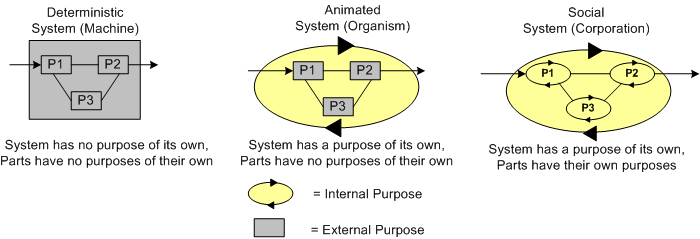
Unless you object, of course, a system can be defined as an aggregation of interacting parts built by a designer for a purpose. Uber systems thinker Russell Ackoff classified systems into three archetypes: deterministic, animated, and social. The main criterion Ackoff uses for mapping a system into its type is purpose; the purpose of the containing whole and the purpose(s) of the whole’s parts.
The figure below attempts to put the Ackoff “system of system types” 🙂 into graphic form.
Deterministic Systems
In a deterministic system like an automobile, neither the whole nor its parts have self-purposes because there is no “self”. Both the whole and its parts are inanimate objects with fixed machine behavior designed and assembled by a purposeful external entity, like an engineering team. Deterministic systems are designed by men to serve specific, targeted purposes of men. The variety of behavior exhibited by deterministic systems, while possibly being complex in an absolute sense, is dwarfed by the variety of behaviors capable of being manifest by animated or social systems.
Animated Systems
In an animated system, the individual parts don’t have isolated purposes of their own, but the containing whole does. The parts and the whole are inseparably entangled in that the parts require services from the whole and the whole requires services from the parts in order to survive. The non-linear product (not sum) of the interactions of the parts manifest as the external observable behavior of the whole. Any specific behavior of the whole cannot be traced to the behavior of a single specific part. The human being is the ultimate example of an animated system. The heart, lungs, liver, an arm, or a leg have no purposes of their own outside of the human body. The whole body, with the aid of the product of the interactions of its parts produces a virtually infinite range of behaviors. Without some parts, the whole cannot survive (loss of a functioning heart). Without other parts, the behavior of the whole becomes constrained (loss of a functioning leg).
Social Systems
In a social system, the whole and each part has a purpose. The larger the system, the greater the number and variety of the purposes. If they aren’t aligned to some degree, the product of the purposes can cause a huge range of externally observed behaviors to be manifest. When the self-purposes of the parts are in total alignment with whole, the system’s behavior exhibits less variety and greater efficiency at trying to fulfill the whole’s purpose(s). Both internal and external forces continually impose pressure upon the whole and its parts to misalign. Only those designers who can keep the parts’ purpose aligned with the whole’s purpose have any chance of getting the whole to fulfill its purpose.
System And Model Mismatch
Ackoff states that modeling a system of one type with the wrong type for the purpose of improving or replacing it is the cause of epic failures. For example, attempting to model a social system as a deterministic system with an underlying mathematical model causes erroneous actions and decisions to be made by ignoring the purposes of the parts. Human purposes cannot be modeled with equations. Likewise, modeling a social system as an animated system also ignores the purposes of the many parts. These mismatches assume the purposes of the parts align with each other and the purpose of the whole. Bad assumption, no?
What’s Your ITAR?
A recent personal discovery that revealed itself to me is that “inquiring more and asserting less” is more effective than vice versa. Nonetheless, even after discovering this insight, I’m having a hard time increasing my Inquiry To Assertion Ratio (ITAR).
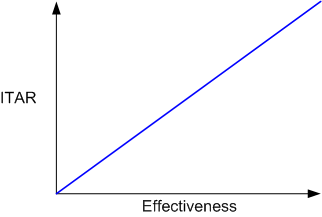
As you probably know, it’s difficult to change ingrained, long term behavior. When a social situation pops up in which the choice to inquire or assert appears, there often is no choice for me. In order to appear “in the know“, I automatically pull the trigger and make an assertion without asking any questions beforehand. However, I think I’ve made some progress. I can now often detect what I did after the fact. To improve even further, I’m hoping to reach the point where I can detect my transgression instantaneously, in the moment, so that I actually can choose to inquire or assert before I act. Ahhh, that would be nirvana, no?
In patriarchical CCH orgs, the ingrained mindset is such that the higher one moves up in the hierarchy, the lower the ITAR. That’s because BOOGLs and SCOLs unconsciously feel the need to appear infallible in front of the DICforce. Adding fuel to the fire, the DICsters fuel this behavior by expecting patriarchs to be infallible and have all the answers. It’s a self-reinforcing loop of ineffective behavior.
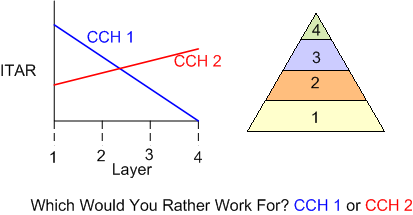 What’s your ITAR? As you age, do you find it rising – or sinking?
Add Managers And Hope
The figure below shows the result of two attempts to increase the productivity of a hypothetical DICteam. In this totally concocted and fictional example, the nervous dudes in the penthouse (not shown in the figure) keep adding specialized managers to the team to fill voids that they perceive are keeping performance from improving. However, since the SCOLs never baseline the TEAM_VALUE_ADDED metric before each brilliant move, or track its increase or decrease with time, they have no idea whether they have achieved their goal. Because SCOLsters think they’re infallible, they just auto-assume that their brilliant moves work out as expected.

Of course, it often turns out that SCOLster decisions and actions do more harm than good. As the graph in the figure for this bogus example shows, not only did the team operating cost increase by the addition of two new manager salaries to the total, the team productivity decreased because of the additional communication and coordination delays inserted into the system. Add an additional “hidden” operating cost due to the high likelihood of jockeying and infighting between the three BMs (to gain favor from the penthouse dudes), and the system performance deteriorates further. Bummer.
So how can SCOLs increase team performance without throwing more useless overhead BM bodies at the problem? For starters, they can clearly communicate the gaps they “see” to the single team coordinator and help him/her rise to the challenge by providing mentorship and advice. They also can replace the BM with a competent, non-BM (fat chance). They can also (heaven forbid) invest in better tools, infrastructure, and training for the one coordinator and team of DICmates – instead of investing that money in more BM specialists. Got any more performance increasing alternatives to the standard “add managers and hope” tactic?
Pyramid Conversion
In this Inc. blog post, Joie de Vivre hotel chain founder Chip Conley says:
The most contagious emotion in most companies is fear. Most companies do such a poor job communicating that most employees get stuck in a place of survival and don’t have a lot of room for creativity, innovation, or ingenuity.
Every survey that’s been done in the U.S. tends to show money is not the primary, secondary, or third; It’s fourth place on why people leave their jobs.
We took the Maslow pyramid and turned it into an employee pyramid with three basic themes: survival the base, succeed at the middle, and transformation at the top. Applying that to employees, it’s money, recognition, and meaning.

Once people are satisfied with how much money they are making, the next human desire they need fulfilled at work is recognition. According to Conley: “What really is meaningful to people is genuine appreciation shown in real time“. The key words are “genuine” and “real time“. I interpret this to mean; not months after a significant accomplishment has been achieved or once a year at an all hands meeting where a boring and generic “atta boy” is delivered from on-high down to the DICforce.
If you just sit in the control tower and solely monitor the numbers that result from the effort without recognizing the effort itself in the moment, then you’re behaving just like the herd and you deserve what you get – mediocrity. Mooooooooooo.

Esther Tweets
I’m passionate about all aspects of software development, including, uh, project management (I really am). Since Esther Derby is an insightful and pragmatic thinker filled with valuable tips, techniques, and methods for successfully executing hairball software projects, I follow her on Twitter. Check out this trio of sequential tweets.
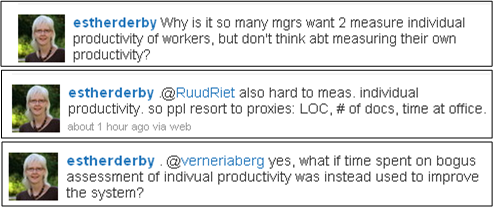
My answer to Esther’s last question is: “It would be great!“. Alas, most managers don’t, or aren’t allowed to, think in terms of systems. Systems thinking isn’t valued in siloed, CCH corpricracies, so managers have no incentive to learn or apply it’s principles and techniques for continuous improvement. In really badly run orgs, it’s too dangerous for one’s career to think or act horizontally in silo-city. It’s too bad, because orgs of people are richly interactive dynamic systems of systems that require constant shepherding to keep every person and every group and every unit aligned and connected.
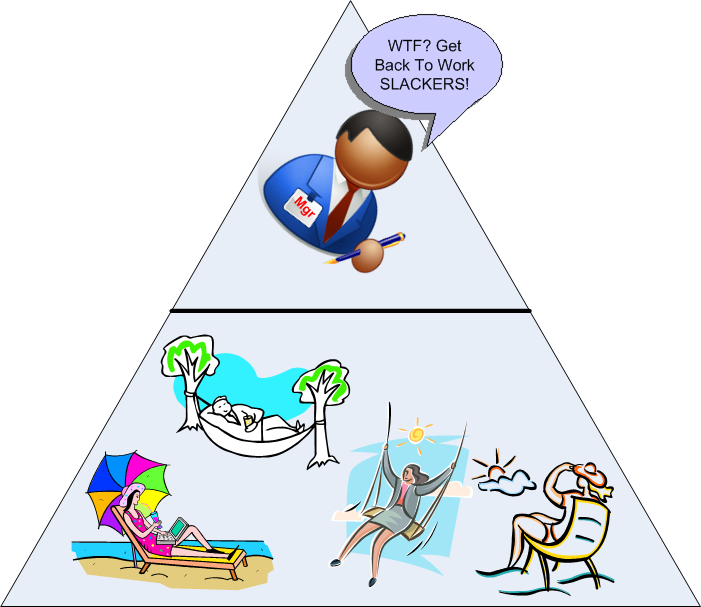
Get Back To Work, Slackers
Penny Herscher, CEO of FirstRain, states in her blog:
We’ve made a terrific change this year to our vacation policy – which is basically not to have one…. We have a very intense culture today. People work hard, they work long hours inside and outside “normal business hours”, from home, from airplanes, and we don’t clock or watch the hours they work. So if we don’t clock the hours they are here, why should we clock the hours they are not? Why should we be tracking paperwork and forms when an employee takes the day off but we don’t do the same for when they work over a weekend.
She’s joking right? Trusting your employees and giving them total responsibility for managing their time? No way bro. That’s just not how it’s done! Poor FirstRain. Productivity is going to plummet and a trip to bankruptcy court is forthcoming, no?
Zappos Rocks Again
As a huge, huge, huge, (did I say youuuuuuuge-uh?), fan of Tony Hsieh and Zappos.com, I blabber about them often. Zappos latest action to make the whole world, yes, the whole world, a better place is to offer up a free, yes free, download of the audio version of the best seller, yes best seller, book “Tribal Leadership“. The link is here, yes here.

Even though I’ve stalked Zappos.com for years, until recently I’ve never bought anything from them because I’m not a shoe or clothes dude. Hell, I’m an old and unredeemable person of questionable integrity and questionable character and questionable morality and questionable <<add your own trait here if you know me>>, so I renew these things about every 10 years or when they fall apart; whichever comes first. However, even with zero revenue from me, they upgraded me to VIP status. This means that with every order I place, they’ll guarantee free overnight shipping. WTF, you say? Uh, the only answer that I can give to you is: They’re fuckin’ Zappos.com dude, that”s why! Oops, I hope the F-bomb didn’t make you mad and send you to the altar to pray for me. If it did, then maybe you shouldn’t be wasting your time reading this blasphemous blog 🙂
Lopp-Sided
Michael Lopp is an engineer’s kind of manager. Besides having a great last name (can you say Lopp-sided?) and an even better pen name (“Rands In Repose“), the guy still understands and relates to down-in-the-trenches engineering work. He even drops an occasional F-bomb in his writing for dramatic effect. The dude is a rare bird and I pay attention to what he says.
Although I think the name of his latest book, “Being Geek“, is meh, there’s a lot of great stuff in there for both managers and DICs. Here’s a sampling of “culled” passages:
The story we tell ourselves when someone we like chooses to leave the group or the company is, “Everyone is replaceable.” This is true, but this is a rationalization designed to lessen the blow that, crap, someone we really like is leaving. We are losing part of the team. Professional damage is done when a team member leaves, and while they are eventually replaceable, productivity and morale take a hit.
A manager’s job is to forget. That’s what they do. They get promoted and begin the long processes of forgetting everything that got them promoted in the first place. I’m not joking. Manager amnesia will be the source of much professional consternation throughout your career.
My management strategy is to assume those closest to the problem can make the best decisions. That’s how I scale.
In defense of my brethren managers, we don’t forget everything, and during all that forgetting, we’re learning other useful things like organization politics, meeting etiquette, and the art of talking for 10 minutes without saying a thing.
The list of words that define management are revealing: direct, in charge, handle, control, and force. Looking at this list, it’s not a surprise that the term “management” has a distasteful Orwellian air.
If it’s been six months, you’ve been actively looking, and no one has told you a great story about how engineering shaped the fortunes of your company, there’s a chance that engineering doesn’t have a seat at the culture table in your company.
There’s the been-here-forever network, the I-survived-the-layoff people, and the untouchable did-something-great-once crew.
It pains me to write this, but my first question about your boss is this: is he taking the time to talk with you in a private setting? A 1:1 is a frequent, regularly scheduled meeting between you and your boss, and if it’s not happening, I, uh, don’t really know where to start. The absence of a 1:1 is the absence of mentorship, and that means your need to gather your experience in the trenches. And while there is nothing to replace “real-world experience,” I’m wondering what the value add of your boss is.
My impression is that the presence of status reports is an indication that your boss doesn’t trust the flow of information in your organization.
We’re knowledge workers, which is an awkwardly lame way of stating that we don’t actually build physical things with our hands.
Asking for the impossible is an advanced management technique, and it’s one that is particularly abhorrent to engineers. Frequent impossible requests result in an erosion of respect and a decaying of credibility.
You’re not going to engage if you don’t respect the person who is asking you to do something.
Management by crisis is exhilarating, but it values velocity over completeness; it sacrifices creativity for the illusion of progress.
Everyone is an adjustment. When you’re interacting with anyone, you leave the core you and become slightly them.

Busy Doing Nothing
The British created a civil service job in 1803 calling for a man to stand on the Cliffs of Dover. The man was supposed to ring a bell if he saw Napolean coming….. The job was abolished in 1945. – Robert Townsend.
The battle of Waterloo, in which Napolean’s army was routed, was fought in 1815. Thus, the series of dudes who stood guard for 130 years after the fall of the egotistical French emperor were busy doing nothing but pissing and pooping off the cliffs every few hours – and gettin’ paid for it.

In “Ackoff’s Best: His Classic Writings On Management“, uber systems thinker Russell Ackoff rails against bureaucracies:
A bureaucracy is an organization whose principle objective is to keep people busy doing nothing. They are preoccupied with what we call make-work…. The problem created by people who are busy doing nothing is that they frequently obstruct others who have real work to do. They impose unproductive requirements on others…. Bureaucracies obstruct development. They retard improvement of quality of life…. Bureaucrats want all parts of an organization to conform to one set of rules and regulations…. Conformity is treated as good in itself, an ultimate good. – Russell Ackoff
Mr. Ackoff not only rages against the machine, he advises on how to beat the system with a bevy of hilarious real-life examples in which individuals successfully “fought city hall” and won. He follows each ditty with a moral. Buy the book and read it for the delicious details of every battle.
From Wanted To Unwanted
You can have a product without a business, but you can’t have a business without a product. If you build a product that people want, a business will be born either from your loins or from some copycat’s. There’s no chicken and egg dilemma here. It’s simply, product-first and business-second. Ka-ching!
But wait, that’s not all! Let’s say you do get lucky and start a biniss around a “wanted” product that you built. To sustain your business, you gotta sustain your product. That means continuously maintaining it via the addition of new value-added features and the correction of customer-annoying defects.
Upon observing the deterioration of his original ArsDigita product under the so-called leadership of “new management”, Philip Greenspun said:
Once you have a product that nobody wants, it doesn’t matter how good your management team is. – Phil Greenspun (Founders At Work, Jessica Livingston)
So, how does a “wanted” product morph into an “unwanted” product? Via neglect and indifference. That’s what happened to Phil’s baby when the vulture capitalists he hooked up with installed an incompetent “professional management team” to run ArsDigita (into the ground). By focusing on the superficial instead of the substance, the promotion instead of the maintenance, the company’s product, and then the company itself, went down hill fast:
ArsDigita grew out of the software that Greenspun wrote for managing photo.net, a popular photography site. He released the software under an open source license and was soon deluged by requests from big companies for custom features. He and some friends founded ArsDigita in 1997 to take on such consulting projects. In 2000, ArsDigita took $38 million from venture capitalists. Within weeks of the deal closing, conflict arose between the new investors and the founders. They marginalized and then fired most of the founders, who responded by retaking control of the company using a loophole the VCs had overlooked. The legal battle culminated in Greenspun’s being bought out, and a few months later the company crashed. ArsDigita was dissolved in 2002. – (Founders At Work, Jessica Livingston)


Why am I here?
WTF?
Meh!
D'oh!

My BTC Address



 Bulldozer00's Blog