Archive
No Spin From Greenspun
Jessica Livingston interviews a boatload of founders (32 to be exact) of startup companies in her book “Founders At Work“. The most fascinating interview that I’ve read to date is with Phil Greenspun. It’s especially fascinating because it strongly reinforces “my belief system” that most corpo SCOLs are incompetent and most venture capitalists are obsessed with greed. You know how it is, relentlessly seeking out and amassing stories and evidence that irrefutably “prove” that you’re right while ignoring any and all disconfirming evidence to the contrary.
After reading the Livingston-Greenspun dialog, I was so giddy with ego-inflating joy that I wanted to copy and paste the entire interview into this post. However, I thought that would be too extravagant and probably a copyright law violation to boot. Here are some jucilicious fragments that prove beyond a shadow of a doubt that I’m absolutely right and anyone who disagrees with me is absolutely wrong. Hah Hah! Nyuk, nyuk, nyuk!
We talked to a headhunting firm, and the guy was candid with me and said, “Look, we can’t recruit a COO for you because anybody who is capable of doing that job for a company at your level would demand to be the CEO.” And I thought, “That’s kind of crazy. How could they be the CEO? They don’t know the business or the customers. How could we just plunk them down?” In retrospect, that was pretty good thinking; look at Microsoft: it took them 20 years to hand off from Bill Gates to Steve Ballmer. He needed 20 years of training to take that job. Jack Welch was at GE for 20 years before he became CEO. Sometimes it does work, but I think for these fragile little companies, just putting a generic manager at the top is oftentimes disastrous.
The guys on my Board had been employees all of their lives. You can’t turn an employee into a businessman. The employee only cares about making his boss happy. The customer might be unhappy and the shareholders are taking a beating, but if the boss is happy, the employee gets a raise.
Some of my cofounders and more experienced folks were also stretched pretty thin because of the growth. I thought, “We just need the insta-manager solution.” Which, in retrospect, is ridiculous. How could someone who didn’t know anything about the company, the customers, and the software be the CEO?
A lot of the traditional skills of a manager were kind of irrelevant when you only have two or three-person teams building something. So it was almost more like you were better off hiring a process control person or factory quality expert instead of a big executive type.
The CEO was a guy who had never been a CEO of any organization before, and he brought in his friend to be CFO. His buddy didn’t have an accounting degree and he was really bad with numbers. He couldn’t think with numbers, he couldn’t do a spreadsheet model accurately. That generated a lot of acrimony at the board meetings. I would say, “Things are going badly.” And he’d say, “Look at this beautiful spreadsheet. Look at these numbers; it’s going great.” In 5 minutes I had found ten fundamental errors in the assumptions of this spreadsheet, so I didn’t think it would be wise to use it to make business decisions. But they couldn’t see it. None of the other people on the board were engineers, so they thought, “Well, he’s the CFO, so let’s rely on his numbers.” Having inaccurate numbers kept people from making good decisions. They just thought I was a nasty and unpleasant person, criticizing this guy’s numbers, because they couldn’t see the errors. From an MIT School of Engineering standpoint, they were all innumerate.
Meanwhile, because these people didn’t know anything about the business, they were continuing to lose a lot of money. They hired a vice president of marketing who would come in at 10 a.m., leave at 3 p.m. to play basketball, and had no ideas. He wanted to change the company’s name. This was a product that was in use in 10,000 sites worldwide—so at least 10,000 programmers knew it as the ArsDigita Community System. There were thousands and thousands of people who had come to our face-to-face seminars. There were probably 100,000 people worldwide who knew of us, because it was all free. And he said, “We should change the company name because, when we hire these sales-people and they’re cold-calling customers, it will be hard for the customer to write down the name; they’ll have to spell it out.” And they did hire these professional salespeople to go around and harass potential customers, but they never really sold anything.

Inability To Assimilate
In this Federal Computer Week magazine blog post, the author laments about the inability to hire talented people into the government borg:
- “The supervisors here are sycophants who are only interested in their careers.”
- “My experience is (more or less) a third of folks (management and labor) are amazing and functional well beyond pay and expectations. Another third are limited, work-reward clock-punchers. The last third are untrainable and unfireable.”
- “I’ve seen one too many occasions of “hiring teams” not hiring the best qualified but hiring friends that don’t meet the job requirements. “
- “The federal human resources processes do not necessarily match skills and education with job positions. “
- “We have more layers of management and more keep getting added without adding any workers.”
- “There are contracting personnel put in jobs who have not a clue about true contracting processes. These individual are put in position because of favoritism.”
- “Most middle-level managers want to demonstrate they are in control.”
Of course, the statements above only apply to government bloat-ocracies, no?

Ty Detmer
Remember Philadelphia Eagles quarterback Ty Detmer? The DETMER metric, which was introduced in yesterday’s post and stands for Decision-To-Meeting-Ratio, is named after Ty. Hah, hah – just joking. There’s no connection between Detmer and DETMER. DETMER is a bogus metric acronym that I concocted and, for some weird reason, Ty’s name repeatedly comes to my defective mind every time I think of it. Time for a straight jacket and meds?
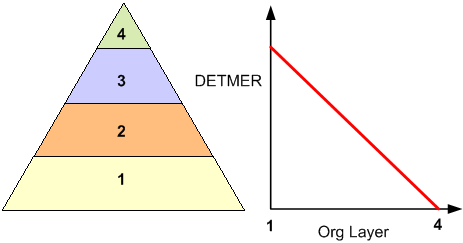
The figure below shows a madeup DETMER vs layer-of-importance curve for a typical corpricracy. The higher one moves up in the caste system, the more useless no-decision meetings one gets to attend. At these egofests, peer SCOLs psychologically duel with each other “under the covers” to prove “I’m great and you’re not“. It’s like a gaggle of peacocks struttin’ around in front of each other showing off how much prettier their plumes are. Of course, few if any important decisions are arrived at during these aristocratic social events. At the highest levels in the CCF, every hour of every day is booked with these “Dancing With The Czars” assemblies.
Meetings and Decisions
Orgs of people exist for a purpose. In order to continuously fulfill the org’s purpose in a changing external environment, its members need to make decisions regarding what to do and when to do it in order to counter unfavorable changes that are at odds with the org’s purpose. Since people need to know who will do what, when they’ll do it, and how they’ll coordinate with others to collectively counter external threats, decision-making meetings are held at all levels to decide such issues of importance.
The figure below introduces the Decision-To-Meeting-Ratio (DETMER) metric. It also shows the divergence of this metric for two competing orgs who initially had the same DETMER value at an arbitrary time, T=0. Assuming (and it’s a bad assumption) that all decisions made at each meeting are effective, as the DETMER goes to zero nothing changes for the good within the org walls. People do the same thing everyday, even as the environmental conditions outside the walls relentlessly change. Voila, a bureaucracy led by a cadre of Bozeltines emerges. Bummer.

Zero Time, Zero Cost
In “The Politics Of Projects“, Robert Block states that orgs “don’t want projects, they want products“. Thus, the left side of the graph below shows the ideal project profile; zero cost and zero time. A twitch of Samantha Stevens’s nose and, voila, a marketable product appears out of thin air and the revenue stream starts flowin’ into the corpo coffers.
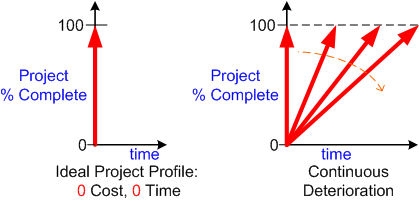
Based on a first order linear approximation, all earthly product development orgs get one of the performance lines on the right side of the figure. There are so many variables involved in the messy and chaotic process from viable idea to product that it’s often a crap shoot at predicting the slope and time-to-100-percent-complete end point of the performance line:
- Experience of the project team
- Cohesiveness of the project team
- Enthusiasm of the project team
- Clarity of roles and responsibilities of each team member
- Expertise in the product application domain
- Efficacy of the development tool set
- Quality of information available to, and exchanged between, project members
- Amount and frequency of meddling from external, non-project groups and individuals
- <Add your own performance influencing variable here>
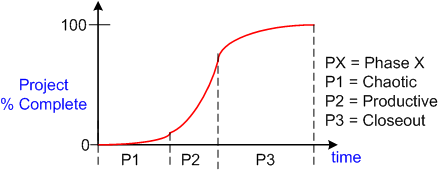
To a second order approximation, the S-curve below shows real world project performance as a function of time. The slope of the performance trajectory (% progress per unit time) is not constant as the previous first order linear model implies. It starts out small during the chaotic phase, increases during the productive stage, then decreases during the closeout phase. The objective is to minimize the time spent in phases P1, P2, and P3 without sacrificing quality or burning out the project team via overwork.
 Assume (and it’s a bad assumption) that there’s an objective and accurate way of measuring “% complete” at any given time for a project. Now, assume that you’ve diligently tracked and accumulated a set of performance curves for a variety of large and small projects and a variety of teams over the years. Armed with this data and given a new project with a specific assigned team, do you think you could accurately estimate the time-to-completion of the new project? Why or why not?
Loop Of Disrespect
In most companies, “respect” is either an explicit or implicit core value. Is it respectful to repeatedly watch, and covertly condone, project teams working 50-60 hour, unpaid overtime weeks for years at a time to meet some schedule that they most likely had no hand in making? Since the overtime is not paid, it isn’t tracked and future schedule estimates derived from past performances don’t accurately reflect the effort needed to get the job done. Thus, the practice is a self-reinforcing loop of disrespect. But hey, since virtually all corpricracies operate that way, the practice must not be disrespectful, right?
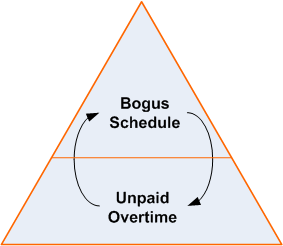
Demanding respect while not giving it, or pretending to give it, creates mediocracies. And since respect and loyalty are intimately coupled, demanding loyalty without giving respect doesn’t work too well either.
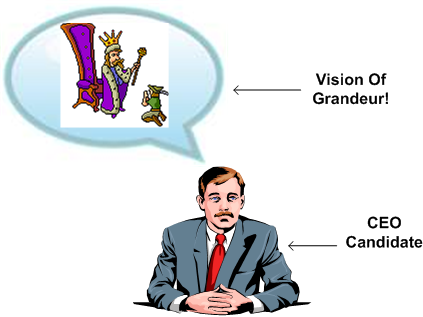
Delusions of Grandeur
In “Founders At Work“, Jessica Livingston interviews a boatload of company founders about their personal experiences with regard to starting their companies from the ground up. Paul Graham, who co-founded “ViaWeb” and sold it to Yahoo 3 years later for a cool $45M, was asked about his search for a CEO in the early days. Here’s what he said:
The problem with all of them was that they had delusions of grandeur. This was the beginning of the Internet Bubble, remember, and I think all of these guys saw themselves as some kind of grand CEO, while we programmers labored in the kitchen cooking the food and washing the dishes. If the deal were simply that the business guy would be the public face of the company, but we would be allowed to do what we wanted and make sure everything worked right, that would have been OK. But we were worried about what might happen if one of these guys wanted to actually be the chief executive officer and tell us what our strategy should be. We’d be hosed, because they didn’t know anything about computer stuff. – Paul Graham
The Uselessness Of MBAs
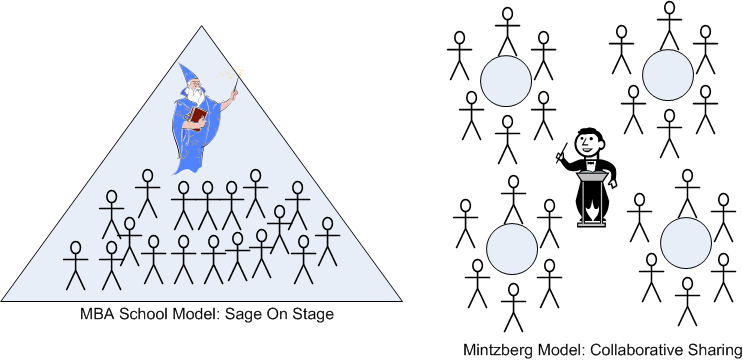
Two of my favorite management (or anti-management, if you prefer) thinkers and doers, Henry Mintzberg and Ricardo Semler, talk about the uselessness of MBA degrees for managing people in this MIT World video. In the video, Mr. Semler interviews Mr. Mintzberg shortly after the release of Mintzberg’s book, “Managers Not MBAs“, in 2005. The interview is conducted in front of a class full of MIT MBA students.
In case you’re interested, here are some of my notes:
This will work in practice, but will it work in theory 🙂
You can’t create a manager in a classroom. When you do that, all you do is create hubris.
MBA students are taught how to apply business skills in an assumed command-and-control hierarchy, not how to be a manager. B-schools don’t distinguish between the two.
Management is craft (rooted in experience), art (rooted in creativity) and analysis (rooted in science). It’s not just analysis – which is what B-schools exclusively teach.
Earn a management position first, then go to business school while you are a practicing newbie manager.
There are no naturally born surgeons, but there are many natural managers who never went to MBA school.
The problem with being in a rat race is that if you win, you’re still a rat 🙂
In a study of Harvard MBA gradutates, 10 of 19 were outright failures, 4 had questionable records, and 5 did fine.
The notion that a generic manager can parachute in and manage anything is crazy. There are exceptions like IBM’s cookie man, Lou Gerstner, but failure is the norm.
Many managers practice “Kiss up, kick down”. The dudes who receive the kisses don’t care or want to know about the “kick down” behavior.
Without action, nothing gets done. Without reflection, action is mindless. Thus, mindful action is required for success.
Watching Closely
Please tell me what type of manager broadcasts statements like this one:
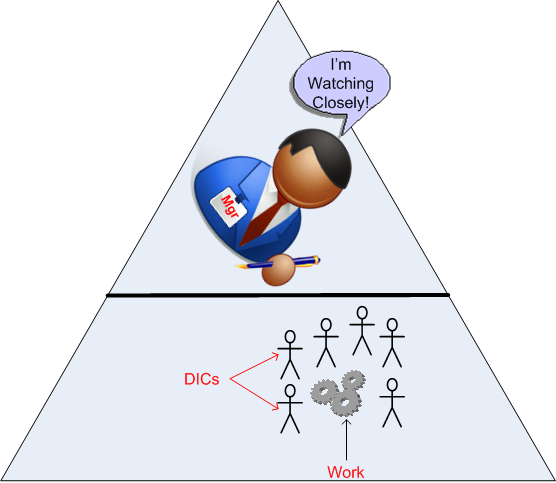
“Since there were no major accomplishments reported on this task last week, I’ll be watching this task closely.”
When I see or hear comic statements like this, I privately think to myself (but never publicly speak, of course):
- What are you gonna do to help if reported status is not up to your lofty but unarticulated expectations next week?
- Are you gonna issue more pointed and specific threats to the DICs assigned to the task?
- Are you gonna ratchet up the pressure even more so?
- Are you gonna roll up your sleeves, dive in and find out what is halting progress so you can directly or indirectly help?
What would you ask yourself?
DIC Revolt
From High-Frequency Programmers Revolt Over Pay – Forbes.com:
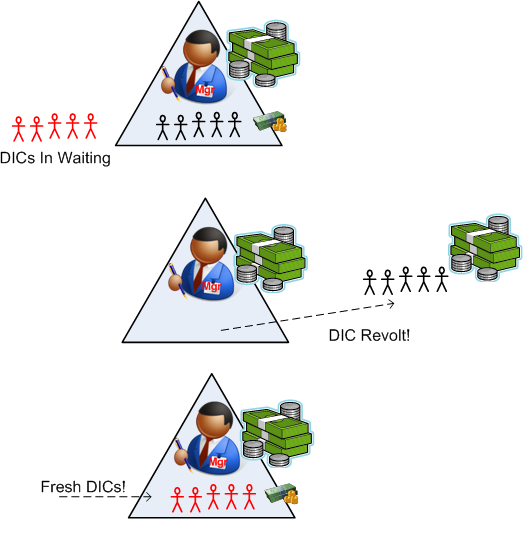
“Pity the programmers toiling away at Wall Street’s secretive high-frequency trading shops–places like Goldman Sachs, Citadel and Getco. They wrote algorithms that take advantage of fleeting trading opportunities and bring in up to $100,000 a day. In return, they received a fraction of the pay doled out to their bosses.”
Now some programmers feel used and are instigating a revolt. They are doing so by striking out on their own or forming profit-sharing arrangements.
Wow! A sampling of DICs has risen above the talking, whining, complaining, poor-me stage. They’ve actually taken action toward their perception of justice. Of course, the holes they’ve created at their former Wall Street greed-masters will be filled by other willing slave-DICs who will revive the whining, complaining, poor-me tradition left behind.

Why am I here?
WTF?
Meh!
D'oh!

My BTC Address



 Bulldozer00's Blog