Archive
Thirty-Six Lucky Ones
With all this ranting that I do against hierarchical orgs, you’d think I would have been burned badly in the past by a succession of tyrant bosses. You’d be wrong. I’m fifty-two years old (D’oh!) and I’ve been working in hierarchies since I was 16. Throughout those 36 years, I can honestly say that I’ve never had a horrendous boss. I’ve worked for a handful of terrific ones that I deeply admire and respect. I’ve also worked for several good ones, and many average ones. In absolute terms, I’ve never felt underpaid, but in relative terms, I have (Waaah and Boo-Hoo!).

The “bad” experiences I’ve had within the hallowed halls of hierarchy were with 1 dimensional program managers, project managers, and product managers (damn-the-people-schedule-is-all-that-matters). Interestingly, the most friction I’ve been a co-creator of has been with manager wannabes. You know, those so-called technical peers who:
- talk a good, jargon-filled game to cover up their incompetence,
- continuously obstruct progress to fill their time and simultaneously cover up their own lack of contribution,
- don’t create any value directly – not even spreadsheets or Gannt charts in preparation for their upward advancement into the guild of management.
When those dudes do get promoted, and IMHO it has happened unconscionably often throughout my “career“, I steer clear of them. It’s BM city and my car ain’t gonna drive through it.
Even though I’ve been incredibly lucky with hierarchical bosses, I’ve known quite a few fellow DICsters over the years who’ve felt that they weren’t treated fairly by hierarchs – even by some of the exact same bosses that I’ve had.
How about you, what’s your boss story? Why won’t you tell me about it?
Don’t Listen…. Imitate
To most (but not all) corpo execs and fatty middle managers everywhere, take heed:
“Children are never good at listening to their elders, but they never fail to imitate them.” – James Baldwin

OMG, I’m so embarrassed! In yesterday’s post, I hinted that I sort-of wanted to do away with my Father Guido Sarducci “find-the-poop-in-the-picture” pattern of immaturity. Nevertheless, if this quote from the “Wilde” man doesn’t hold a grain of truth to it, then I’m hopelessly hosed:
Life is too short to be taken seriously – Oscar Wilde
Without Any Sting
Thanks to @stefanstern, I discovered the MIX. In this blarticle, Moving Past Austerity—Let’s Make 2011 the Year of Honesty, Humanity and Generosity, Polly LaBarre eloquently states what I wish I could, and without any offensive sting:
“zero-sum thinking, profit-obsession, power, conformance, control, hierarchy, and obedience don’t stand a chance against community, interdependence, freedom, flexibility, transparency, meritocracy, and self-determination.”
When you feel isolated and alone with your “abnormal” thoughts about a particular topic, it’s always comforting to discover others with similar opinions. Polly, in specific, and the MIX, in general, fit the bill for me. Now, if I could only learn how to keep immature, offensive language and childish poopie pictures out of my posts, I might soothe the occasional pangs of guilt that course through my being.
The line between constructive passion and destructive obsession is a tenuous one. Do you tread the line, or do you keep yourself warm and cozy and numb, hiding in the womb and not wanting to “get involved“?

Peer Relationships
As you move up into the Bozone layers in a DYSCO, in addition to honing your Kiss-Up-Kick-Down skills, your horizontal relationships with your peers mysteriously start to change…..

Of course, the diagram is totally wrong and it lacks credible scientific evidence to back it up, no? Hey, what do you expect from a L’artiste?
Trustworthiness Metrics
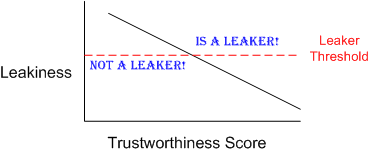
Check out this hilarious blarticle from “Federal Computer Week“: Measuring federal employees’ moods to determine trustworthiness. If you don’t want to go there, I’ll cherry pick the parts that reinforce my UCB:
In the memo, national security officials ask agencies what metrics they use to measure trustworthiness without alienating employees. They also ask agencies if they use psychiatrists or sociologists to measure relative happiness or “despondence and grumpiness” as means to gauge an employee’s trustworthiness.
My question is: Do these rule-making, memo-writing “national security officials” eat their own dog food; practice what they preach? Do they “objectively” measure their own trustworthiness and “leakability“? I’d love to see an enumerated list of these officially sanctioned metrics.
Moving on, let’s see what the article says about the latest fading management buzzword, “engaged“:
…because now there’s more understanding about the importance of an engaged workforce.
WTF? Just now, and not waaay before now?
I’m sure that our government is going down the right path with the strategies they’re proposing for stopping future Wikileaks type fiascos. Our government SCOLs need to declare “a war on leaks” and appoint a “Leak Czar“. Wars and czars are sure-fire solutions that have worked before on terrorism, drugs, crime, and obesity, right? Maybe businesses should employ the “war” and “czar” metaphors too. Oops, they already do, but without publicly espousing it.
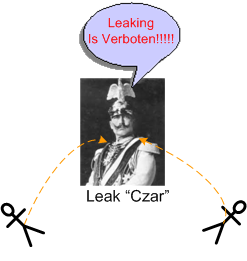
Does writing this post decrease my trustworthiness score? By how much? What’s your trustworthiness score?
Caught Chetan Again!
It’s sad, so sad. It’s a sad, sad situation. And it’s gettin’ more absurd. – Elton John
Sometimes, actually, a lot of times, I like to commiserate with like-minded people (isn’t that what community is all uh-boot?). Thus, when I recently hooked up with new e-friend and author of “Why Your Boss Is Programmed To Be A DICtator“, Chetan Dhruve, we commiserated about the current stagnant state of leadership in the business world. In one of our exchanges, Mr. Dhruve asked:
May I request a favor. Could you please post your review of my book on Amazon.com? This is because many readers email me their comments directly after reading the book – with the result that the number of reviews is low (only 3 reviews currently). In many cases, readers are afraid to put up reviews for fear of being being found out and victimized at their workplaces, and hence don’t want to take any chances. In fact, many people have told me that they are afraid to even place the book on their workplace desks in full view, simply because of the book’s title. – Chetan Dhruve
Of course, that statement sent a shiver down my spine, but I did what he asked because – a man’s gotta do what he’s gotta do (for me, replace the word “man” with “child“). Upon further dialog, Chetan continued on with a couple of other scary vignettes:
A friend of mine (in the US) who loved the book bought 10 copies to give to clients. He then had the thought: “What if my clients feel that I’m implying they are bad bosses? Maybe I will lose their contracts.” So instead of giving the books to clients, he gave the books to relatives. He told me all this saying, “The book’s title will scare people, and it’s going to be a problem for you.” Indeed, he has proven to be correct.
A similar thing happened with another friend of mine. She gave a copy of my book as a gift to a friend of hers, whereupon the friend was instantly offended and got defensive saying, “I promise I will try hard to be a good boss.” This was even before reading the back cover of the book!
The irony is that the book doesn’t blame individuals but the system. And these gut-reaction behaviors only prove the point that we have dictatorship systems at our workplaces. It’s terrible, absolutely terrible, to know that people are frightened to simply have such a book on their table! I didn’t anticipate that the fear levels would be so high, that too in a free country.
I hate to sound like a know-it-all (well, maybe not), but I coulda told Chetan of the reality of his last sentence before he shockingly discovered it for himself. No matter how much one abstracts an anti-hierarchy message and directs it away from specific people, people above level 0 in a hierarchy are going to get offended at the slightest hint that you resonate with Chetan’s blasphemous message. After all, hierarchy has a sacred origin and religion has always been at the top of the heap when it comes to instilling fear into people, no?.

The statements that make people mad are the ones they worry might be believed. I suspect the statements that make people maddest are those they worry might be true. – Paul Graham
Related Articles
Nice And Competent
It’s prolly just me, but I can’t seem to fully accept that most people equate niceness with competence – especially in the guild of layered management. Oh sure, there are lots of cases where people are both nice and competent, but there may be more cases where people are both nice and incompetent. What does your experience indicate?
One reason why there may be a lot of people who are both nice and incompetent is because niceness can camouflage incompetence – at least temporarily, and at most, till retirement. If you’re nice, your boss won’t scrutinize your work output (if he can understand it and isn’t incompetent himself) as closely than if you’re not nice. Thus, it’s better to be nice and incompetent than to be mean and incompetent – duh. Hell, niceness counts so much at top tier DYSCOs that it’s better to be nice and incompetent than not-nice and competent. Niceness trumps competence at these back asswards citadels.
If you’re a DICster, where it’s easier to “measure” competence by the material results you either do or don’t create, the cover up of incompetence by niceness doesn’t work nearly as well than if you’re a BM, SCOL, CGH, or BOOGL in a CCH org. Why? Because it’s much harder to measure middle management output. Most managers don’t create much of anything (except for angst and turmoil), so how can their performance be meaningfully measured? Plus, the senior managers who are supposed to do the “objective” measuring of their appointees don’t want to look bad by admitting that they knighted incompetent subordinate managers and incompetent, elite staff members.
So, what about me? I’m not nice and I’m incompetent, so this blarticle doesn’t apply to me. What about you?

Note: One way for a senior manager to measure a “junior manager’s performance is to ask junior’s people how he/she is helping them to grow and do a better job. Do you think this is done often in the corpo world? Even when this skip-level technique is miraculously performed, do you think honest feedback is obtained? Why or why not?
Meritocracy Hippocracy
Thanks to software guru Ron Jeffries, I just discovered this article from “Sociation Today“: The Meritocracy Myth. In their piece, authors McNamee and Miller restate the oft espoused American dream as:
Getting ahead is ostensibly based on individual merit, which is generally viewed as a combination of factors including innate abilities, working hard, having the right attitude, and having high moral character and integrity.
They then attempt to prove that it’s a myth:
“..the really big money in America comes not from working at all but from owning, which requires no expenditure of effort, either physical or mental. In short, working hard is not in and of itself directly related to the amount of income and wealth that individuals have.”
Of course, being academics, McNamee and Miller are required to present income and wealth distribution statistics to bolster their case:
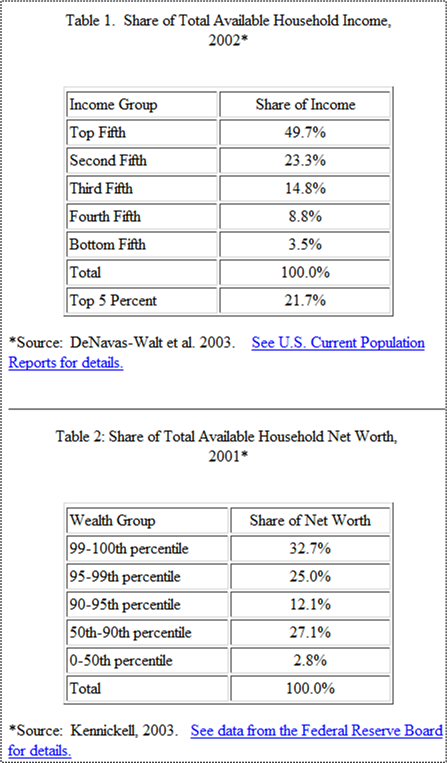
OK, so assume that they convinced “us” that the American dream has morphed into a ruse. What actions do McNamee and Miller propose to transform the myth into reality? They present these well-worn yawners:
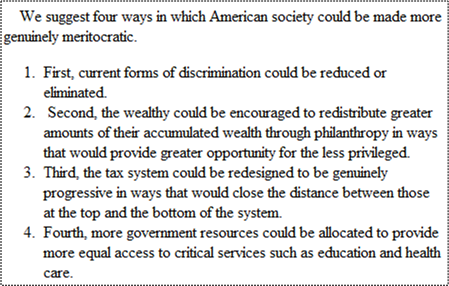
But wait. Maybe we don’t want an ideally meritocratic society. As McNamee and Miller imply: Isn’t there a chance that the meritorious who’ve risen to the top of the income and wealth charts would develop a sense of righteous entitlement? Wouldn’t they “look down” upon those who haven’t advanced in life based on merit?
Well, yeah – ego dominated humans will be humans. But wouldn’t a system based on merit be fairer than one that keeps privileged and meritless aristocrats entrenched in power and “looking down“? Don’t you think meritorious leaders would have a greater sense of humility and compassion than aristocratic, silver-spoon-fed leaders? At least the American dream would be alive and kicking. The hope of personally creating a better life would become a reality, and not remain just a mythical pipe dream.
All ideologies end up killing people. – Jean Goss
Healthy And Stress Free
Via the Netflix “Watch Instantly” service, I recently viewed this wonderful and scary National Geographic documentary: “Stress: Portrait Of A Killer“. The program focused on the results of these two studies:
- A thirty year study on African baboon troupes by a dedicated Stanford University professor.
- A forty year study, called the “Whitehall Study“, on 18,000 British civil service employees (hint: hierarchy)
Ready to be surprised? In both studies, the results showed that the higher up in the hierarchy you ascend, the healthier and less stressed you become. Yepp, that’s right. Fuggedabout the crap that’s been drilled into your brain about the increased stress that comes with the so-called increase in “responsibility” as one ascends the corpo ladder. The reality is that the higher up you go:
- the more titles you accumulate (for your impressive LinkedIn profile),
- the more money you make for taking on more responsibility that you’re not held accountable for,
- the less “dirty and visible work” you have to do, uh, except for aimless and agenda-less meetings where you toot your own horn over others,
- the more control over “others” you have – to deflect blame when you screw up – which you never do.
How can that be stressful and detrimental to your health? By all means fellow DICsters, keep scratchin’ and clawin’ your way toward the top. It’s healthy fer ya.
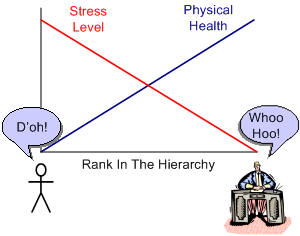
I actually wasn’t surprised by the show. Well over 20 years ago, friend and mentor William L. Livingston opened my eyes to the Whitehall study results in his epically disturbing “Have Fun At Work” book. It stunned me back then, but makes me laugh now.
To be fair, I have no doubt that there are many non-BMs in hierachical DYSCOs who do feel the increased stress their job should bring on. These are the people who thoughtfully and endlessly struggle with the conflicting demands of the wide ranging set of stakeholders who have an interest in the org’s economic and social performance. Thankfully, I have known, and do know, some of these people. How about you?
Note: If you want more detail on the documentary, check out my notes plus audio livescribe pencast on the program here.
Your Chetan Heart
OK, OK. The title of this post has nothing to do with its content. It just “felt” right.
The “Chetan” in the post title is a placeholder for “Chetan Dhruve”, the author of the splendidly candid and hard-hitting “Why Your Boss Is Programmed To Be A Dictator“. Recently, Chetan (I don’t know how to pronounce his name but I’ll bet it doesn’t sound like “cheetin'”) contacted me via LinkedIn. He graciously asked if he could use the content of my “Leader Or Dictator” post on his web site. Of course, being the needy, fame-seeking, egomaniac that I am, I used my “power of authority” to “approve” of his request – after he filled out all of the proper forms and paid the licensing fee, of course. Check out Mr. Dhruve’s site here – and then buy the freakin’ book.
 Note: The “man” on book cover is actually a collage of six of the most notorious dictators of all time. Can you guess who they are? If not, you can find out on Mr. Dhruve’s site.

Why am I here?
WTF?
Meh!
D'oh!

My BTC Address



 Bulldozer00's Blog