Archive
Four Attributes
Assume that every commercial enterprise can be “objectively” (LOL!) characterized by the following four discrete attributes:
- Trustworthiness [untrustful | trustful]
- Transparency [closed | open]
- Fairness [unfair | fair]
- Product_Quality [crappy | meh | excellent]
If I did the math right, there are 2*2*2*3 = 24 attribute combos. At one end of the spectrum, we have orgs that are untrustful, closed, unfair producers of crappy products and services. At the other end of the spectrum we have enterprises that are trustful, open, fair producers of excellent products and services.
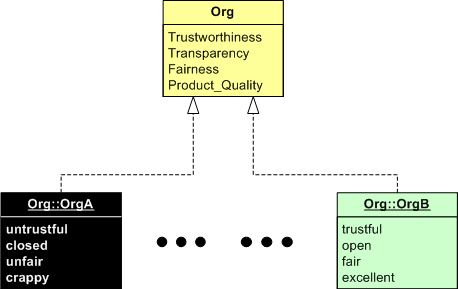
So, what do you think the ratio of OrgAs to OrgBs is in the world, and why? Do you think the ratio is increasing or decreasing as civilization advances? Do you think the four attributes are uncorrelated or are they intimately coupled? Can an untrustful, closed, and unfair org produce excellent products and services? Given an OrgA, can it transform into an OrgB? Given an OrgB, can it transform into an OrgA? Which transformation is more likely?
Thoers
In case you were wondering how to pronounce the title of this post, it’s “thoo-errs“. It rhymes with “Dewar’s“.
During the rise of the “institution” in the 1900s, Taylorism produced the segregated thinkers/doers model of operation (as shown on the left in the figure below) in order to get things done. Most doers were uneducated and assumed to be lazy/unmotivated barbarians.The “superior” thinkers created the framework of how/what/when work was done; hired some doers; tightly monitored and controlled the process of production.

Relative to the institution-less past, the segregated Thinkers/Doers modus of operandi was an improvement. Via an exchange of pay for work done, institutions provided the means for doers to satisfy Maslow‘s level one/two physiological needs for themselves and their families.
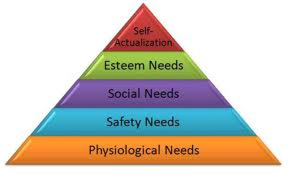
The vast majority of institutions today still operate in accordance with (a milder and veiled form of) Taylor’s segregated thinker-doer model. However, there are some gems (Zappos, Morningstar, Semco, Gore, HCL) out there that operate according the “thoer” model – where everyone is both a thinker and a doer. Although they’re hard to ferret out, these gems proactively provide a work environment in which all 5 levels of Maslow’s hierarchy are attainable to all stakeholders within the organization – not just those in the upper echelons.
Instantaneous Feedback
Alfie Kohn wrote a whole book on the subject. So, what subject…. you ask? Why, it’s the subject of the “venerable” yearly performance review created in the bygone era of the early 1900s. Specifically, Alfie’s book conscientiously provides details on how to get rid of what Dan Pink describes as the “highly stylized ritual in which people recite predictable lines in a formulaic way and hope the experience ends very quickly“.
In case you don’t want to, or are afraid to read Alfie’s heretical tome for fear of tossing a grenade at your existing mental model, Mr. Pink gives the subject some treatment as point number 12 in his FLIP Manifesto: “Scrap performance reviews”.
Dan gives not only 1, but 3 ideas for drop kicking the yearly performance review out of the borg and into its rightful place in obscurity. My fave is number 2:
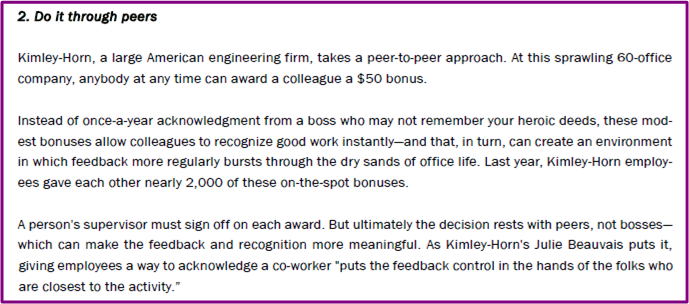
I know, I know. Abolishing the yearly performance review can’t possibly work in your borg. Your business and industry are “different“. It is the way it is because it is the way it has always been and it is the way it has to be. Case closed.
Magical Transformation
In this interview of Scott Berkun by Michael “Rands In Repose” Lopp, “Rands In Repose: Interview: Scott Berkun“, Scott was asked about his former stint at Microsoft as a program manager. Specifically, Rands asked Scott what his definition of “program manager” is. Here is Scott’s answer:
It’s a glorified term for a project leader or team lead, the person on every squad of developers who makes the tough decisions, pushes hard for progress, and does anything they can to help the team move forward. At its peak in the 80s and 90s, this was a respected role of smart, hard driving and dedicated leaders who knew how to make things happen. As the company grew, there became too many of them and they’re often (but not always) seen now as annoying and bureaucratic.
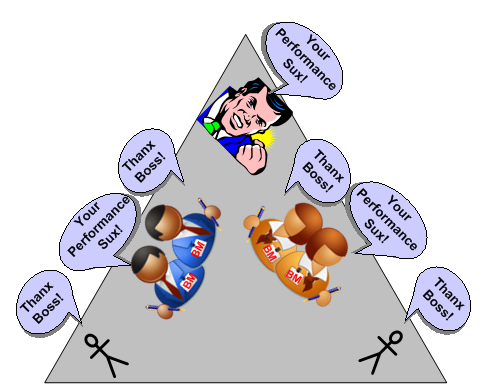
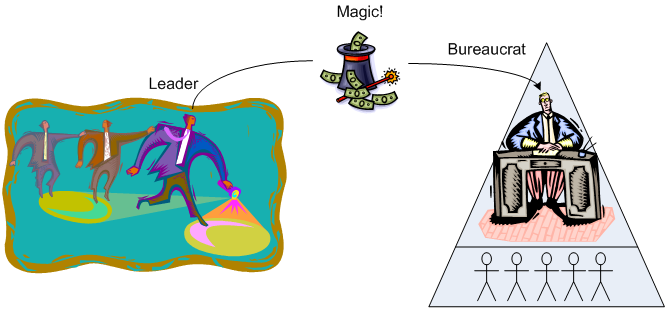
Americans have a love affair with small businesses. But due to the SCOLs, CGHs, BUTTs, and BMs that ran companies like Enron, Tyco, and Lehman Bros, big businesses are untrusted and often reviled by the public. That’s because, when a company grows, its leaders often “magically” morph into self-serving, obstacle-erecting, and progress-inhibiting bureaucrats; often without even knowing that the transformation is taking place. D’oh! I hate when that happens.
Environmental Influence
In “Engineering A Safer World“, Nancy Leveson states:
Human behavior is always influenced by the environment in which it takes place. Changing that environment will be much more effective in changing operator error than the usual behaviorist approach of using reward and punishment. Without changing the environment, human error cannot be reduced for long. We design systems in which operator error is inevitable and then blame the operator and not the system design.
So why is that? Could it be because the system designers and environment caretakers are also the same people who have the power to assign blame – and it’s much easier to blame than to change the environment?

Cracked Up
One of the reasons why I love Russell Ackoff is that he cracks me up even while he writes about depressingly serious matters. Here’s just one example from his bottomless well of wisdom:
Business schools do not teach students how to manage. What they do teach are (1) vocabularies that enable students to speak with authority about subjects they do not understand, and (2) to use principles of management that have demonstrated their ability to withstand any amount of disconfirming evidence. – Russell Ackoff

Want another example? OK, OK, here it is:
“Walk the talk” is futile advice to executives because for them walking and talking are incompatible activities. They can do only one at a time. Therefore, they choose to talk. It takes less effort and thought. – – Russell Ackoff
Interdisciplinary Team Effort
Where are the clowns? Send in the clowns. – Shirley Bassey
The Gap Of Woe
In “Why Software Fails”, the most common factors that contribute to software project failure are enumerated as:
- Unrealistic or unarticulated project goals
- Inaccurate estimates of needed resources
- Badly defined system requirements
- Poor reporting of the project’s status
- Unmanaged risks
- Poor communication among customers, developers, and users
- Use of immature technology
- Inability to handle the project’s complexity
- Sloppy development practices
- Poor project management
- Stakeholder politics
- Commercial pressures
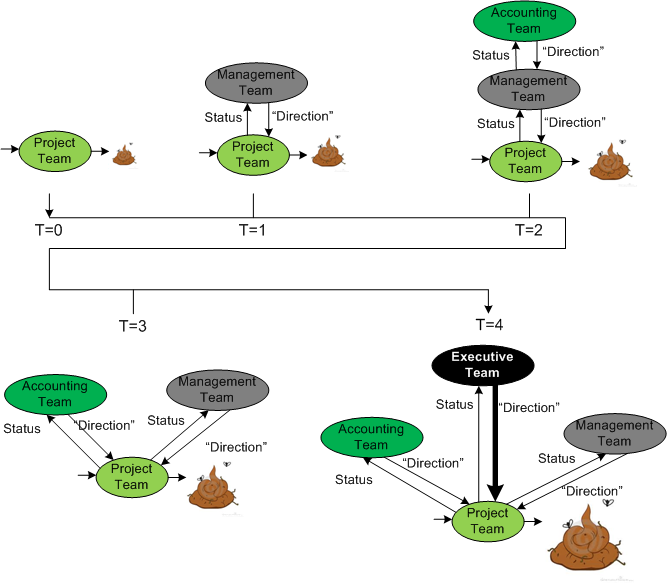
Yawn. These failure factors have remained the same for forty years and there are no silver bullet(s) in sight. Oh sure, tools and practices and methodologies have “slightly” improved project performance over the decades, but the increase in size/complexity of the software systems we develop is outpacing performance improvement efforts by a large margin.

The Uncrossable Threshold
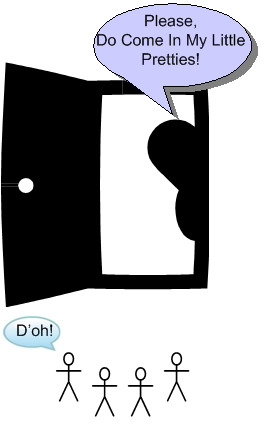
Unless you work in a Chinese sweatshop, the likelihood is high that your management has an “open door” policy. After all, it’s been the right thing to do since the 80’s, right? However, the likelihood that anyone but their “direct reports” casually cross the threshold to chat about problems and ideas for improvement at any level in the org is low, no?
So why is that? Could it be an unwritten rule in hierarchies that “little” people aren’t allowed to “whine” to stratospheric luminaries? Could it be a culture of fear of reprisal? Could it be a dearth of trust? Could it be the perception that bosses don’t like to hear bad news? What do you think it could be?
Resource And Asset Ban
Stocks and bonds are assets; water and iron ore are resources. Assets and resources are “its“. People are not resources and they’re not assets and they’re not “its“. Get it? So, stop parroting your moo-herd peers if you want to distinguish yourself from the pack like you say you do.

Hitherto, the unesteemed BD00 proposes a federal law (Phil, if your reading this, the last two words are fer you 🙂 ) that will ban all orgs from using the MBA-inspired, utterly unauthentic, and Taylor-esque words “resource” and “asset” when their PR spinners and glossy annual report writers refer to their “people“.
Referring to people as assets is a vestige of the so-yesterday theory X management mindset that is so ingrained in the psyches of both SCOLs and DICs everywhere that this standard practice remains unexamined even today by most orgs. So, please consider replacing the phrases on the left with those on the right:
- Deploy our assets -> deploy our people
- Utilize our resources -> utilize our people
- Allocate some resources -> allocate some people, time, and money
- People are our greatest asset -> People are our greatest strength
You may think that BD00 is being anal when he brings up such minutia, and that’s OK. BD00 thinks that the little things matter, and this is one of those little things that matter. What little things matter to you?

Why am I here?
WTF?
Meh!
D'oh!

My BTC Address



 Bulldozer00's Blog