Archive
Amazappos.com

This morning, I stumbled upon a New York Times article announcing that purchase of Zappos.com by the behemoth that is Amazon.com (I’ve owned shares in Amazon.com for over 10 years). From the article:
- “Amazon initially sought to pay cash, but Zappos asked for an all-stock deal, this person said.The extra cash and restricted stock for employees is meant to keep them on board and preserve the company’s culture, the person said. The deal is expected to close in the fall.”
- “Zappos appears to engender friendly feelings even among some of its smaller competitors. Korey Buzzell, who runs the independent site Shoe-Store.net, said Zappos had been an amicable competitor in the past, sending customers to his site when it could not fulfill their orders.”
Since (because of its totally unique and far out culture) Zappos is currently my favorite company to externally watch and follow, I was initially bummed. However after reading Zappos CEO Tony Hsieh’s down-to-earth, understandable, and jargon-less letter to employees, I’m actually excited about the future potential of Amazappos.com.
Here are some snippets from Hsieh’s letter that rang my bell and changed my feelings toward the deal. Notice how many times the word “culture” is used.
- “For Zappos, our vision remains the same: delivering happiness to customers, employees, and vendors. We just want to get there faster.”
- “Amazon supports us in continuing to grow our vision as an independent entity, under the Zappos brand and with our unique culture.“
- “Our culture at Zappos is unique and always evolving and changing, because one of our core values is to Embrace and Drive Change. What happens to our culture is up to us, which has always been true. Just like before, we are in control of our destiny and how our culture evolves.“
- “They are not looking to have their folks come in and run Zappos unless we ask them to. That being said, they have a lot of experience and expertise in a lot of areas, so we’re very excited about the opportunities to tap into their knowledge, expertise, and resources, especially on the technology side.“
- “We learned that they truly wanted us to continue to build the Zappos brand and continue to build the Zappos culture in our own unique way. I think “unique” was their way of saying “fun and a little weird.” 🙂 “
- “Amazon focuses on low prices, vast selection and convenience to make their customers happy, while Zappos does it through developing relationships, creating personal emotional connections, and delivering high touch (“WOW”) customer service.“
- “Jeff Bezos (CEO of Amazon) made it clear that he had a great deal of respect for our culture and that Amazon would look to protect it.“
- “Our mission remains the same: delivering happiness to all of our stakeholders, including our employees, our customers, and our vendors.“
- “We do not have any plans to move any departments, nor does Amazon want us to because they recognize that our culture is what makes the Zappos brand special.”
- “This is not a cash transaction. This is a stock exchange. Our shareholders and option holders will be issued approximately 10 million Amazon shares on a fully converted basis.“
I was also stunned by the disclosure that Zappos.com, which grew into a $1B company over 10 years selling a commodity product – shoes, only has (had?) 100 shareholders. I wish I was one, but now I am!
BTW, Hsieh’s e-letter has a really great video of Amazon CEO Jeff Bezos’ intro to Zappos employees embedded within it. He describes his values, and more interestingly, how Amazon got started. He also unembarassingly and openly shares some of the stupid mistakes that he made in piloting Amazon to where it is today.
Productivity Lag II
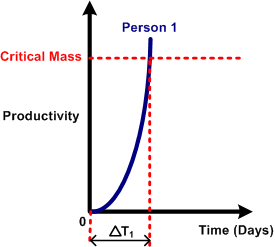
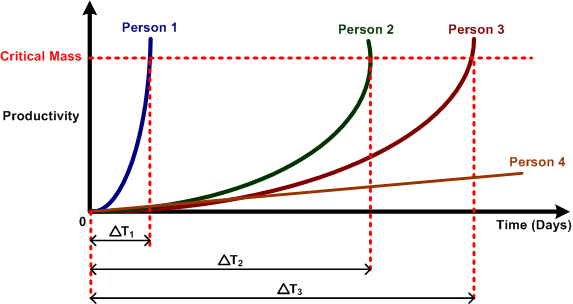
In part I, we saw that the learning curve for each person is different (duhhh). I also defined the Critical Mass Time (CMT) to be the time lag between starting a new project and actually being able to “start contributing something useful”. The figure below recaps this idea.
Other factors, besides experience and expertise, that determine the CMT value are: the amount of, the quality of, and accessibilty of pre-existing information about the problem to be solved. If the information is sparse, fragmented, and/or inefficiently stored in other people’s fallible memories (tribal knowledge) because of the failure of management to lead, then the CMT will be larger than if the critical-to-success information is coherent, integrated, and recorded somewhere that is easily navigable and accessible.
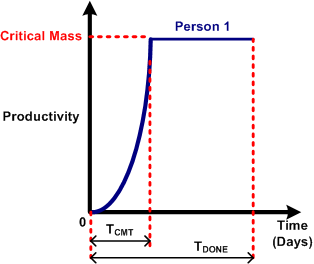
At the CMT point, productivity starts manifesting in the physical world as visible intermediate work outputs. Product specifications, designs, test definitions, equipment assembly, prototyping, model definitions, etc., begin to emerge and push the project forward. Like any activity that is predicated on fallible human thought, the creation process is iterative and chaotic. It is not smooth and organized as the final output may imply to an after-the-fact external observer (like most managers). It takes iterative, mistake-prone work and structure to temporarily harness the ever present increase in entropy.
The figure below shows the full time lag between project start and project completion. Again, the time lag ‘tween CMT and project “done” is highly person-specific.
The figure below shows the end-to-end project start time to project done time for three different people that were given the same project task to perform. The difference between the total “schedule” performance of person 3 and person 2 is the case we want to zoom in on. How could it be that person 2 ramped up faster than person 3 but finished the project later? WTF?
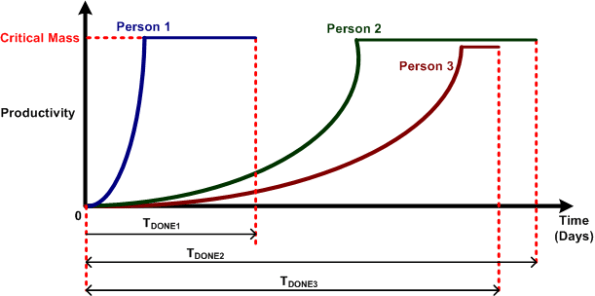
Some reasons that may explain this anomaly are:
- Person 3 had a hard time finding and absorbing high quality, pre-existing information about the project and task at hand.
- Person 3 is slower at learning, but more talented at applying.
- Person 2 lost some motivation for one or more reasons and slacked off somewhat
- Person 3 rushed through the task and produced crappy output that may not be discovered until the project is further downstream; where the cause might not be connectable to the person’s output.
I’m sure that there are a gazillion other factors that may explain the anomaly. You can form your own list.
The main point of this article was to discuss what everyone knows, but often forgets: Numbers don’t always tell the truth. Superficially looking at hard and cold “schedule performance” numbers without digging in to examine their validity can be unfair to those who are quantitatively measured for personal performance evaluation by hierarchs. Lazy bozo managers who do this deserve what they get: the exodus of some of their best performers, an unmotivated workforce, a low quality product portfolio, and an unfair reward system. In essence, it’s one of the hallmark characteristics of the herd of mediocracies that cover the landscape of the business community.
Productivity Lag I
Each person naturally has a different learning curve. When an engineer is assigned a new task to perform on a new technical project, there will be a lag in productivity because, well, it’s new to him/her. The person needs time to learn and understand the context surrounding the project and the details of the problem to be solved. Since each person is different, each person will have a different time-to-productivity, or Critical Mass Time (CMT). The graphic below shows a typical learning curve for a specific person. The slope increases with time because as new learning occurs, it feeds on itself and the acquisition of knowledge gets easier.
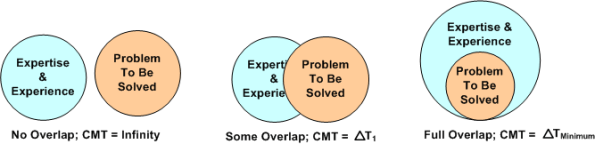
The CMT is a physically underive-able function of the experience and expertise (two independent qualities) of a person. It is also a function of the area of overlap between those two attributes and the novelty/depth of the problem to be solved. As the figure below shows, the person-specific CMT is at its minimum when there is 100% overlap. Note that if there is no overlap, the CMT is essentially infinity. This sad state can happen, for example, if a Radio Frequency circuit designer is assigned the task of designing and writing product software, or a plumber is assigned to perform brain surgery, or an enterprise IT software engineer is assigned the task of writing embedded signal processing software. It’s easy to find other examples of total mismatch.
Assuming that the experience and expertise of each person in a group of people overlaps somewhat with the project task that needs to be performed (no cases where CMT = infinity), the graphic below shows how CMT differences within the group can vary radically. Obviously, if you were a manager, you’d like to have Person 1 working the problem.
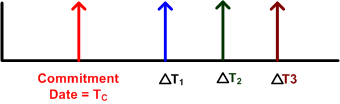
So what happens when an executive manager or marketer commits the company to a scheduled project completion date without knowing the learning curves of his/her people, or the difficulty of the problem to be solved? As the figure below shows, blown schedules occur. Before (and after) the schedule is missed, increasing pressure-to-complete is continuously exerted by management, mistrust grows, and the employee-management relationship suffers. Of course, since management is (at least) one level removed from the action and they don’t have to perform the task themselves, they are blameless. Because of the FAE, the employee, of course, is fully at fault and a “performance improvement” plan may be in order. If an employee ruffles feathers and dares to publicly point out the mismatch, accusations of “not being a team player“, “malcontent“, and/or “bad attitude” are the thanks he/she gets. If the employee persists, the ostracism may be followed by a stronger message to STFU – a required trip to “people-skills school“.
This pattern of dysfunctional behavior occurs so often in hierarchical corpos across the land that it is taken for granted and it is “undiscussable“. It is also one of the reasons why people do everything they can to get out of the pig sty and climb the corpo ladder to succes. The further away from the action you move, the higher the chance that you’ll be sanctioned by the big boys(gals) to convert from a pressure-receiver into a pressure-exerter. As an added bonus, you’ll make more money because of your “increased responsibilities” (sic).
Clanthink, Groupthink, Spreadthink
Everyone has heard of the term “groupthink“. However, have you ever heard of the terms “clanthink” or “spreadthink” applied to a group of people? John Warfield, a prolific systems thinker who’s been ignored for decades by the mainstream, defines these three types of psychological phenomena as follows:
Clanthink = Everyone in the group believes in the idea/concept, but it’s outright wrong. Those outside of the group that don’t believe the idea/concept are ostracized, tortured, killed……. or all of the above.
Groupthink = Everyone believes in the idea/concept, but tantalizingly, it could be either wrong or right. If the group is wrong and all of the the individuals outside of the groupthink circle of membership remain steadfastly silent out of fear of persecution, then the group, and those that that they lead, all suffer.
Spreadthink = Everyone in the group places a different level of importance and meaning on the idea/concept.
Classic clanthink examples are: 1) the massive group of flat-earthers back in Columbus’ time; 2) the church-brainwashed, sun-revolves-around-the-earth-because-humans-are-the-center-of-the-universe gang back in the Galileo era. Can you think of others, besides whack jobs like: Hitler’s inner circle, Enron executives, George W. Bush WMD disciples, the Moonies, scientologists?
Groupthink is a weaker, but much more common form of clanthink. The cult size is much smaller, but there are many more groupthink groups than clanthink groups, especially in the business domain. Just about every organization in the world is infected with groupthink to some extent because they are hierarchically structured. Hierarchically structured pyramids of rank, privilege, and I’m-smarter-than-you step-ladder-idiots are especially rife with the stank of groupthink. The higher up you go, the more groupthinkage there is. Why? Because (almost) everyone wants to get to the head shed in order to acquire the material riches and titles that hierarchs sprinkle upon themselves. Thus, the exclusive club members: 1) unconsciously accept whatever idea/concept/method the next hierarch above them espouses, 2) kiss ass, and 3) say “yes massa” in order to facilitate their next step up the gold plated ladder of privilege.
In my mind, spreadthink is the most interesting concept in Warfield’s trio. Each person is, duhhhh, an individual. Thus, each person will naturally have an internally created, different opinion on any given issue. In environments that facilitate/enable/catalyze the public externalization of each individual person’s true thoughts and opinions, spreadthink will naturally emerge. In such a situation, assuming that the group has an a-priori agreement on how to make and execute a decision, the “best” course of action may be achieved. Hierarchies, by the physical and meta-physical shackles that the pyramidal structural pattern imposes on their members, are anathema to the diversity of spreadthink. Bummer, cuz the corpo pyramid, an unnatural structure of human creation, hubris, and self-aggrandizement, isn’t gonna go away soon.
Hierarchy will never go away. Never. – Tom Peters
Reconfiguration
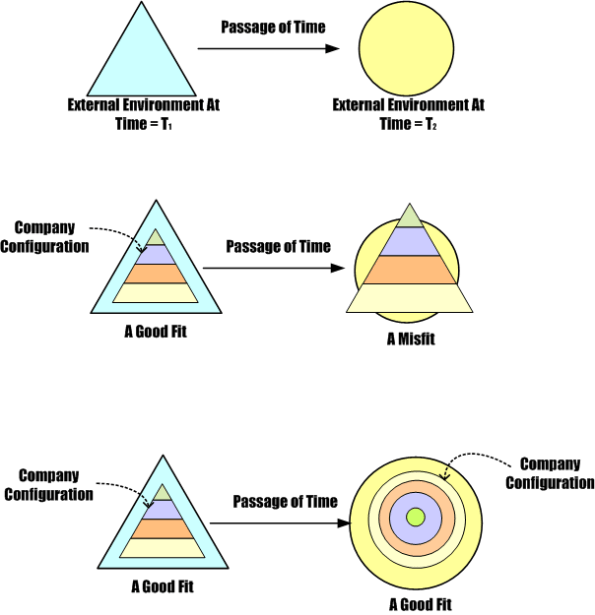
Understandably, companies that achieve success in a business area strive to maintain the behaviors that got them there. However, as they work to continuously stabilize themselves, the external world keeps changing around them. Sometimes the change is gradual, and other times it’s instantaneous and explosive. Regardless of the rate and magnitude of change, if the company does not adapt to the new external situation, they’re hosed.
“When you’re through changing, you’re through.” – Bruce Barton
“Without deviation from the norm, progress is not possible.” – Frank Zappa
One Level Removed
Assume that you’re on the third level or higher in a hierarchical corporate (dis)organization. If you want to know what’s really going on so that you can take action to keep improving the org’s performance, ask the people below you, one level removed. Do it frequently, and do it periodically. If you have lots of people that indirectly report to you two levels down, you could listen to their inputs in small groups or, even better, randomly pick a different person every week to listen to.
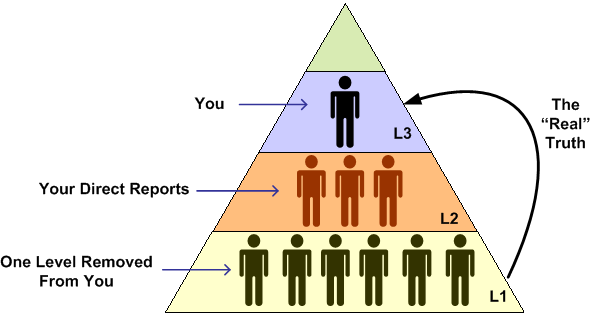
Why should you do this? Since you hand-picked your direct reports and you directly control their salaries, they’ll naturally tend to distort the truth if it makes them or you look bad. You’ll tend to unquestioningly believe them just so you can continue to feel warm and fuzzy inside. If you don’t have a machismo culture of fear that hierarchical structures auto-instill into the lower segments of the org, then at least some of the courageous people two levels down will tell you the truth as they see it. Otherwise, they won’t tell you anything of substance, so don’t waste your time trying to find out the true state of things.
Why don’t most managers frequently survey those people one level removed? Because as one rises up the corpo ladder: they usually get lazier, they get disconnected from the real work that creates and sustains value, and their head expands. Bummer.
“The day soldiers stop bringing you their problems is the day you have stopped leading them. They have either lost confidence that you can help or concluded that you don’t care. Either case is a failure of leadership.” – Karl Popper
Boomerang Effect
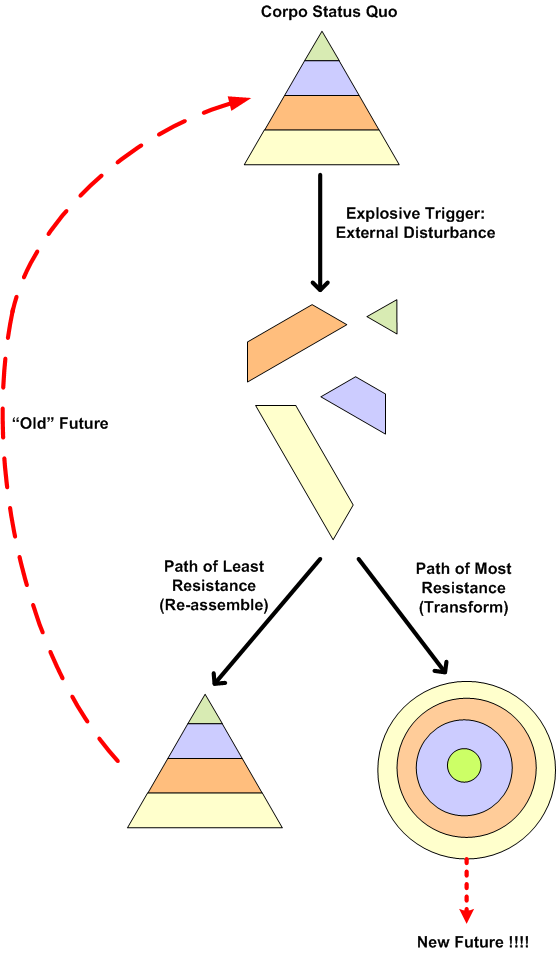
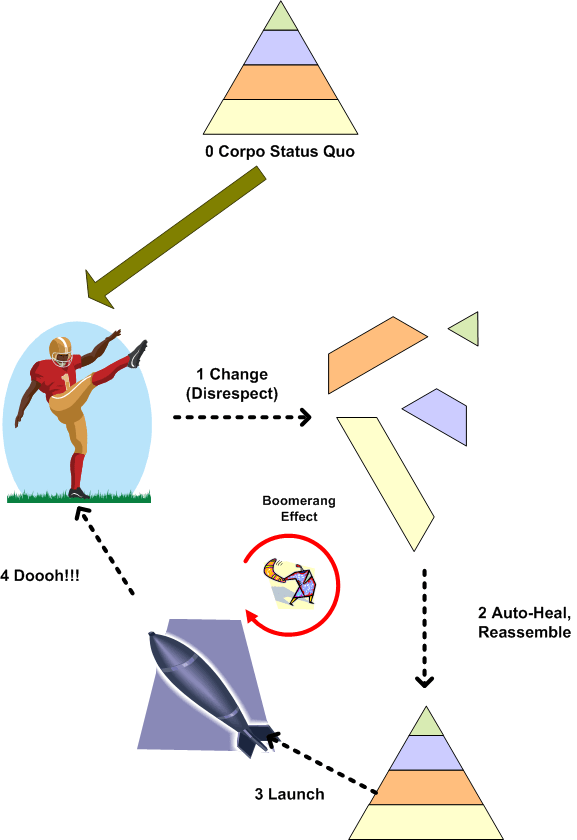
Be careful. Be very careful. If you’re at the bottom of the corpo pyramid, don’t even try to break the status quo. Maintaining the status quo in a staid corpo hierarchy is the number one priority of the people at the top of the pyramid. Why? Because they’re at the top, and they’ll do anything to stay there. It doesn’t matter if their actions, or lack thereof, keep the company’s existing products and supporting infrastructure in the dark ages or erode profits, they’ll ensure that they stay on top. Period.
The only thing that a stratified hierarchy is fast at, is fending off attempts to, and squashing ideas designed to, help the company improve. Even if a major idea does somehow miraculously get initiated from the middle or the bottom, as soon as the hierarchs realize that it may result in sweeping change, the crumbling pyramid will do an auto-realignment. Just like that flexible molten metal robot from Terminator III.
To top it off with an exquisite cherry, the top managers will set an example of the poor soul(s) who started the move toward change. The graphic below shows what usually happens. You don’t want to be the guy or gal who tried to kick the field goal 🙂 .
Wannabe
Everybody wants to be a manager or director. Hell, why not? Extracting yourself from the pig sty of hard and sweaty work that directly creates value is the smart thing to do in an obsolete org that is structured as a stratified pyramid. And, how many orgs do you know that aren’t structured as outdated command and control hierarchys? Subjectively of course, I assert that managing and directing others ( fancy words for command and control) is easy relative to doing hard work and constantly getting beat over the head with the schedule stick. Plus, it’s pays more, and you get to have some fancy title of superficial importance appended to your name. Oh sure, you have to put up with whiny direct reports (like me 🙂 ) but does that really warrant more pay and value by fancier and higher paid people positioned even higher up in the pyramid of woe?
I respect people, not titles. If you, as an anointed and highly compensated manager or director:
- listen to your people and treat them as equals,
- actively and visibly help your people get their jobs done better and better each day ,
- pay for ongoing training that’s critical to the company’s future success,
- constantly and diligently take action to repair decaying infrastructure as a result of increasing entropy (2nd law of thermodynamics)
- don’t act two-faced (e.g. pounding your people with schedule while espousing “quality is king”),
- behave congruently and with integrity,
then I’ll respect you and the title that you rode in with. Otherwise, fuggetabout you, your fat head, and your fancy title. Other people, out of the natural fear that all pyramid org structures auto-instill into the minions at the bottom, may feign respect, but I won’t. However, being human, and (hopefully) not too stupid, I do publicly kneel and pay homage to the awesome power to instill fear that is naturally built into the hierarchy – most of the time. Since “most” is not the same as “all”, you can use your imagination to envision my day-to-day experience in a hierarchically structured workplace.
Being a software designer, I’ve learned that different structure types enable or disable different types of behavior. The pointy haired hierarchy, with it’s long history of top down command and control misery, is a disabler of highly creative, adaptive, and efficient human behavior. Since humans (especially those in western countries) are mostly about “me and my story”, and those at the top always accumulate riches at the expense of those at the bottom and on the outside, the pyramid of woe won’t be going away soon.
Regardless of the amount of damage inflicted upon those at the bottom and to external stakeholders, the people at the top will continue to wield their power to keep themselves entrenched. Why continue this irrational behavior? In order to continue living the high life of luxury and consumption, of course. However, the relatively flat network structure fueled by the rise of the internet, will eventually displace the collapsing corpo C & C hierarchy in the future. Those that wait too long will die. Too bad this global maelstrom of change won’t happen in my lifetime.
Ineffective Immediately
“Ninety percent of what we call ‘management’ consists of making it difficult for people to get get things done” – Peter Drucker
If you believe this classic Drucker quote to be true, then whenever you receive an executive e-mail that contains the standard MBA textbook words “effective immediately”, mentally replace them with “ineffective immediately”. That way, you won’t be disappointed or surprised when your local work environment doesn’t change at all, or it changes for the worse.
To be fair, managers, like you and me, are just trying their best to make things better for all stakeholders. It’s just that they, for the most part (90% to be exact) have no clue on how to go about doing that.
Schedule Policy

Just about every corpo mediocracy in the world has a proverbial “Quality Policy” that it proudly displays all over the place. The inspirational words of wisdom, that hierarchs profess staunch adherence to, are inscribed on framed posters, and/or cute little magnetic sheets. These false idols are distributed far and wide within the cathedral walls for everyone to worship.
However, everyone down in the boiler room knows that the true corpo allegiance is to schedule. How do the serfs know this? It’s easy, and it doesn’t require an Einsteinian intellect to figure it out. Just walk around the cubicle farm and count the number of times you hear managers mention the word “quality”. Then count the number of times that you hear “schedule”. Voila, you then have your answer, and it doesn’t involve rocket science math. Companies that have higher schedule to quality ratios are much more likely to fill the ranks of the average and boring herd.
Schedule worship, at whatever the human and organizational cost, is one of those issues that Chris Argyris calls “undiscussable”. Anyone who points out the fact that the quality policy is actually a lame attempt to camouflage the true and unconditional allegiance to schedule, gets beheaded in true shoot-the-messenger form. Nobody in their right mind “discusses” the quality versus schedule irony because, well, it’s “undiscussable”. 🙂
I propose that all companies develop, distribute, and display their very own authentic schedule policy. One could go something like this:
“The Duefiss corporation is proudly dedicated to meeting schedule. Our allegiance is unconditional. At Duefiss Inc., we will aggressively cut every corner and apply any amount of pressure to our human resources to meet any schedule. It doesn’t matter how laughable or unrealistic any given schedule is. We will commit our minions to it, no matter what the consequences to them, their families, our product quality, or our long term credibility and profitability. When we fall behind the hallowed schedule, we guarantee to turn up the heat on those responsible for the slip, and increase the frequency of status meetings to reinforce our commitment.”
What would your schedule policy be?

Why am I here?
WTF?
Meh!
D'oh!

My BTC Address



 Bulldozer00's Blog