Archive
Open Kimono
I continue to be enamored and awed by the way the leadership at zappos.com operates the company. I’m convinced that they’re the real deal. They’ve obtained a level of business nirvana that balances altruism with profitability which is perhaps unmatched by any other company on earth – except for maybe Semco.
Sadly, even though Zappos continuously and willingly opens its kimono to all those who care to learn about how they nurture and sustain their success, the Zappos operational model probably won’t go very far. The endless sea of power-obsessed dinosaurs that rule the corpo roost are too clever (cleverness is how they got into the protected nest in the first place).
The most common refrain for rejecting any attempt to emulate Zappos “best practices” will be: “none of that stuff will work here because our business is totally different“. These will be the words of wisdom uttered from the same moo-herd potty mouths that repetitively proclaim “customers are number one and our employees are our most valuable asset“. Blah, blah, blah. Yawn, yawn, yawn. BS, BS, BS.
Incremental Watts
I don’t know which name I like better, Watts Wacker or Soupy Sales, but this post is about Watts. Watts Wacker is a CEO and futurist who uttered one of my favorite quotes:
You can’t increment your way into the future – Watts Wacker
I think this quote is directed toward leaders of cushy, static, and stanky CCH companies who are so afraid of the future that they move by inches at a time in passive response to external changes. The only way to leapfrog your competitors, since they’re just as afraid as you and are inching along like molassess running up hill, is to make a disruptive leap into the future.
It takes revolutionaries to trigger disruptive leaps into the unknown. Someone (actually, two people) with an innocent but assuredly incremental mindset recently said to me: “Revolutionaries are usually lined up in front of a wall and shot“. My response was “that’s why there are so few of them“. Bummer.

Surprise! GM Is Still Hosed
In a followup to my first post on GM’s initial BS attempt to dismantle their horrendous do-nothing-but-line-management’s-pocket-with-dough Command And Control Hierarchy (CCH), I submit this freshly minted AP article. It describes yet another management shake up at post-bankruptcy, taxpayer-money-sucking GM. The “new” (LOL!) leadership continues to pray that the feeble and well worn tradition of sloganeering and cajoling will stave off annihilation. Geeze, these elite hierarchs are really doing quite a job earning their seven figure paychecks, dontcha think?
In announcing a sudden management overhaul yesterday, GM chairman and acting CEO Ed Whitacre Jr. was speaking Lutz’s words when he told employees that the bureaucracy needs to end and they can take reasonable risks without fear of being fired.
“We want you to step up. We don’t want any bureaucracy,’’ Whitacre said to about 800 GM workers. “We’re not going to make it if you won’t take a risk,’’ he said in the address, which was broadcast to employees worldwide on the Internet.
Uh, yes massa CEO, we’ll do whatever you say, dear leader. We sincerely believe that you’re a man of high integrity and impeccable credentials who speaks the truth and will lead us to the promised land. We’ll gladly storm the machine gun nests that guard the status quo for you. Blech.
Whitacre, 68, who has been frustrated with the pace of change, appointed the 77-year-old Lutz as a top adviser, creating an alliance of hard-charging veteran executives to lead the troubled company.
Yeah, that’ll do it. A 145 year duo of machine age, assembly line thinkers who probably don’t know WTF “WTF” means. Social intra-networking? Corpo-wide sharing of accessible and findable information? Sincere collaboration within and between layers of rank and status? Transparency, Authenticity, and Openness? Sorry to be so negative, but not a chance.
Sadly, I await the next big GM makeover and press release.

Under Pressure
Uh oh. One of my favorite companies, the SAS Institute, is under increasing pressure from big, deep pocketed rivals. This NY Times article, Rivals Take Aim at the Software Company SAS – NYTimes.com, elaborates on the details. Since I’m confident that they’ll overcome the competitive threat, that’s not what this post is about. It’s about what the SAS leadership, led by founder, CEO, and PHOR, Jim Goodnight, does to continuously grow and develop both the company and its people. Here are some snippets from the article and this linked-to 60 minutes article that reinforce my faith in the company’s ability to overcome all odds:
There is the subsidized day care and preschool. There are the four company doctors and the dozen nurses who provide free primary care. The recreational amenities include basketball and racquetball courts, a swimming pool, exercise rooms and 40 miles of running and biking trails. There is a meditation garden, as well as on-site haircuts, manicures, and jewelry repair. Employees are encouraged to work 35-hour weeks.
The office atmosphere is sedate. There are no dogs roaming the halls, no Nerf-ball fights, no one jumping on trampolines — no whiff of Silicon Valley. The SAS culture is engineered for its own logic: to reduce distractions and stress, and thus foster creativity.
Employee turnover at SAS averages 4 percent a year, versus about 20 percent for the overall software industry.
SAS has never had a losing year and never laid off a single employee.
“No, we’re not altruistic by any stretch of the imagination. This is a for-profit business and we do all these things because it makes good business sense,” says Jeff Chambers, director of human resources at SAS.
“You know, I guess 95 percent of my assets drive out the front gate every evening,” says Goodnight. “It’s my job to bring them back.”
Academics have studied the company’s benefit-enhanced corporate culture as a model for nurturing creativity and loyalty among engineers and other workers.
SAS invested heavily in research and development, and even today allocates 22 percent of the company’s revenue to research. The formula has paid off in steady growth, year after year. Revenue reached $2.26 billion in 2008, up from $1.34 billion five years earlier.
Unlike many other tech companies, SAS has had no recession-related layoffs this year. “I’ve got a two-year pipeline of projects in R & D,” Mr. Goodnight says. “Why would I lay anyone off?”
Mr. Goodnight recalls those days as a brief period of New Economy surrealism, and going public as a path wisely avoided. SAS, he says, is a culture averse to the short-term pressures of Wall Street, which he characterizes as “a bunch of 28-year-olds, hunched over spreadsheets, trying to tell you how to run your business.”
Goodnight says it’s pressure from Wall Street to please shareholders by delivering rising quarterly earnings that has poisoned the corporate well.
Mr. Goodnight, though 66, has no plans to retire himself. His fingerprints, colleagues say, remain all over the business, especially in meeting with customers and in overseeing research.

We Promise To Change, And We Really Mean It This Time
GM is a classic example of a toxic Command and Control Hierarchical (CCH) corpocracy. In this NY Times article, the newly anointed hierarchs and their spin doctors promise that “things will be different” in the future. Uh, OK. If you say so.
According to corpo insiders, here’s the way things were.
…employees were evaluated according to a “performance measurement process” that could fill a three-ring binder.
“We measured ourselves ten ways from Sunday,” he said. “But as soon as everything is important, nothing is important.”
Decisions were made, if at all, at a glacial pace, bogged down by endless committees, reports and reviews that astonished members of President Obama’s auto task force.
“Have we made some missteps? Yes,” said Susan Docherty, who last month was promoted to head of United States sales. “Are we going to slip back to our old ways? No.”
G.M.’s top executives prized consensus over debate, and rarely questioned its elaborate planning processes. A former G.M. executive and consultant, Rob Kleinbaum, said the culture emphasized past glories and current market share, rather than focusing on the future.
“Those values were driven from the top on down,” said Mr. Kleinbaum. “And anybody inside who protested that attitude was buried.”
In the old G.M., any changes to a product program would be reviewed by as many as 70 executives, often taking two months for a decision to wind its way through regional forums, then to a global committee, and finally to the all-powerful automotive products board.
“In the past, we might not have had the guts to bring it up,” said Mr. Reuss. “No one wanted to do anything wrong, or admit we needed to do a better job.”
In the past, G.M. rarely held back a product to add the extra touches that would improve its chances in a fiercely competitive market.
“If everybody is afraid to do anything, do we have a chance of winning?” Mr. Stephens said in one session last month.
The vice president would say, ‘I got here because I’m a better engineer than you, and now I’m going to tell you how bad a job you did.’ ”
The Aztek was half-car, half-van, and universally branded as one of the ugliest vehicles to ever hit the market. … but his job required him to defend it as if it were a thing of beauty.
Here’s what they’re doing to change their culture of fear, malaise, apathy, and mediocrity:
G.M.’s new chairman, Edward Whitacre Jr., and directors have prodded G.M. to cut layers of bureaucracy, slash its executive ranks by a third, and give broad, new responsibilities to a cadre of younger managers.
Replacing a binder full of job expectations with a one-page set of goals is just one sign of the fresh start, said Mr. Woychowski.
Mr. Lauckner came up with a new schedule that funneled all product decisions to weekly meetings of an executive committee run by Mr. Henderson and Thomas Stephens, the company’s vice chairman for product development.
Mr. Stephens has been leading meetings with staff members called “pride builders.” The goal, he said, was to increase the “emotional commitment” to building better cars and encourage people to speak their minds.
“But now we need to be open and transparent and trust each other, and be honest about our strengths and weaknesses.”
So, what do you think? Do you think that these “creative” CCH dissolving solutions and others like them will do the trick? Do you think they’ll pull it off? Is it time to invest in the “new” GM’s stock?
My Company
After reviewing most of the “made up” BS entries that I’ve hoisted on this blog, I’ve noticed (like you, no doubt) that just about every other post either starts out as, or progresses towards, a rant against standard Command and Control Hierarchical (CCH) corpocracies and horrendous managers who delude themselves into thinking they are “leaders”. It’s funny how all freakin’ roads lead to Rome, no?
To set the record straight, I honestly don’t think that all hierarchically structured organizations are soulless and spirit crushing CCHs. One of those companies happens to be the company that I work for; the Sensis Corporation.

I’ve been at Sensis for a long time, and despite what you may have concluded from reading this blog (all 2 of you), I really do like working there. For the most part, I’m given more freedom than most to do what I do best and the list of pluses far outnumbers the list of minuses. Besides matching the standard benefits package that most other companies give their workforce, here are some of the uncommon plusses:
- A CEO that genuinely cares about the people who work for him
- Subsidized in-house cafeteria
- Subsidized in-house gym facility
- No special executive parking spaces
- Special, named parking places for individual handicapped people
- Company-wide profit sharing when yearly sales & profit numbers are met
- Occasional company-wide barbeques
- Quarterly disclosure of the numbers to the troops
- In-house happy hours for significant achievements
- Free lunches at all-hands meetings
- Vacation rollover
- Free coffee
- Summer Hours (Friday afternoons off)
The two biggest pluses for me are:
- No layoffs in the entire 24 year history of the company’s existence and a policy that explicitly states that “no layoffs” is a top goal.
- I haven’t been fired (whoo hoo!) despite multiple exhibitions over the years of truly disrespectful behavior toward a handful of targeted “others”.
The minuses of working at Sensis are typical of any company in our industry (military and aerospace); they’re just not practiced as badly as our bigger and more stodgy peers.
Initiative Initiation
Assume that the graph below describes the rise and fall of a hypothetical CCH (Command and Control Hierarchical) business. During the party time phase of increasing profits (whoo hoo!), the CCH corpocrats in charge pat themselves on the back, stuff their pockets, and slowly inflate their heads with bravado and delusions of infallibility.
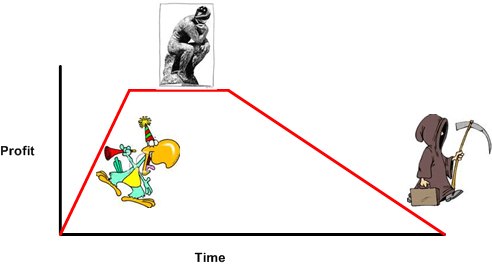
In order to extend the increasing profit trajectory, an undetectable status quo preserving mindset slowly but surely kicks in. Hell, if it ain’t broke, don’t touch the damn thang. Since what the CCH (so-called) leadership is doing is working, any individual or group from within or without the cathedral walls who tries to deviate significantly from the norm is swiftly “dealt with” by the corpocrats in charge. Everthing needs to get approved by a gauntlet of “important” people. However, while the shackles are being tightened and the ability to scale for success is being snuffed, the external environment keeps changing relentlessly in accordance with the second law of thermodynamics. Profit starts eroding and tension starts ratcheting upwards. Out of fear of annihilation, the cuffs are tightened further and the death dive has begun. Bummer.
During the free fall to obscurity, the now brain-dead and immobile corpocrats in charge start “taking aggressive action” to stem the flow of red ink. Platitudes and Matt Foley-like motivational speeches are foisted upon the DICs (Dweebs In the Cellar) in frantic attempts to self-medicate away the pain of stasis and failure. Initiatives with cute and inspiring names are started but never finished (because it takes real hands-on leadership, sweat, and work to follow through). As corposclerosis accelerates, silver-bullet-bearing consultants are brought in and the frequency of initiative initiation increases. Calls for accountability of “them” pervade the corpocracy from the top down and vice versa.

After being hammered by pleas to “improve performance” and being pounded by the endless tsunamis of hollow initiatives, the DICs disconnect and distance themselves from the lunacy being doled out by the omnipotent dudes in the politboro. Since the DICs expect the corpocrats to effect the “turnaround” and the corpocrats expect the DICs to strap on their Nikes and “just do it”, no one takes ownership and nothing of substance changes. As you might surmise, it’s a Shakespearian tragedy with no happy ending. Bummer squared.
Leaderless CCHs deserve what they get; a fearful, disconnected workforce and a roller coaster ride to oblivion.

Galileo And Kepler
To reinforce my anti-corpocracy UCB (Unshakeable Cognitive Burden), I just finished reading “The Age Of Heretics: A History Of The Radical Thinkers Who Reinvented Corporate Management“. It’s the second time in the last few months that I stumbled across the Galileo-Pope Urban story. The first time was in W. L. Livingston’s forthcoming “Design For Prevention”. Here’s a snippet from “Heretics”:
Why does Galileo Galilei have the reputation of a heretic, while his seventeenth-century fellow scientist Johannes Kepler does not? Because Kepler evaded the Church. Galileo sought to change it. The professor from Pisa spent the last third of his life arguing, with increasing fervor, that the Christian doctrines and even Bibles should be rewritten to conform to the realities he had seen through his telescope. Many of the cardinals and Church officials who censured and imprisoned him recognized the validity of the new cosmology and physics that Galileo championed, but they didn’t want to shake up their system too quickly. Too many monks and village priests clung to Ptolemy and Aristotle. The “people” would rebel at any sudden revision of the “truth.” Galileo didn’t care. Like many other heretics, past and present, he thought at first that the truth would set the institution free. He only had to show people what he had seen, and they would naturally adapt. When people doubted observations that to him were obvious, he lost his tact. He made enemies (some said needlessly) of the Jesuits, who fought bitterly to see him condemned, and he closed one of his notorious tracts, the Dialogue on the Great World Systems, with a snide lampoon of the views of Pope Urban VIII. Until then Urban had been his patron and champion. Ten months after publication in 1633, Galileo was on trial in Rome.

Here’s a snippet that is written further along in the book:
Even the Roman Catholic church eventually admitted that Galileo’s cosmology was correct—after 359 years.

Bummer. Behind the illusory cloak of modern civility, irrational and insane institutional behavior hasn’t changed much over the years. Heretics are still reviled by the bozos in power who will do whatever it takes to retain that power, and more importantly, the personal riches that automatically go along with it. Today’s well meaning but unconscious corpocrats are simply much more clever at veiling the methods that they use to annihilate heretics, even when individual heretics arise from their own ranks. Kepler rules!
Sole Source
When a customer awards a vendor a contract without considering bids from other competitors, it is deemed a sole source victory. There are two ways to look at “sole source” contracts:
- The customer loves you
- The customer hates you
If you’ve done a great job providing a product that unobtrusively solves a customer’s problem, then that customer will love your company. Hence, if the “rules” allow it, that customer will shower you with follow on sole source contracts for more copies and variants of the product.
If your product sux but it is inextricably and pervasively intertwined within the customer’s day-to-day operations, then your customer may hate you. However, since it would cost a ton of money and time to rip out and replace your junk with someone else’s junk, the customer may still shower you with follow on sole source contracts.
Regardless of which reality is true, corpo hierarchs will always attribute sole source contract awards to love.

Fifty-Fifty
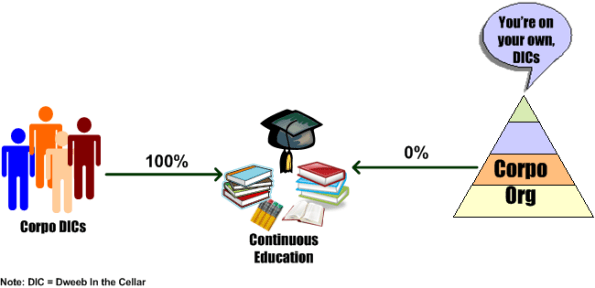
Because of the current economic environment, lots of recycled articles (take charge) regarding continuous education have appeared. Almost every one of them dispenses the same advice: “only you are responsible for continuously educating yourself and keeping your skills up to date”. Of course this is obviously true, but what about an employer’s duty to its stakeholders for ensuring that its workforce has the necessary training and skills to keep the company viably competitive in a rapidly changing landscape? Because of this duty, shouldn’t the responsibility be shared? What about fifty-fifty?
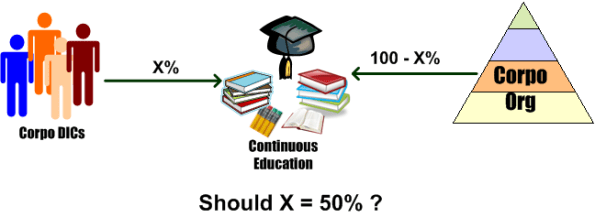
There are at least two ways that corpo managements (if they aren’t so self-absorbed that they’re actually are smart enough to detect the need) react to the need for continuing education of the people that produce its products and provide its services.
- Hire externally to acquire the new skills that it needs
- Invest internally to keep its workforce in synch with the times
Clueless orgs do neither, average orgs do number 1, above average orgs do 2, and great orgs do 1 and 2. Hiring externally can get the right skills in the right place faster and cheaper in the short run, but it can be much riskier than investing internally. Is your hiring process good enough to consistently weed out bozos, especially those that will be placed in positions that require leading people? If it’s a new skill that you require, how can your interviewers (most of whom, by definition, won’t have this new skill) confidently and assuredly determine if candidates are qualified? As everyone knows, face-to-face interviews, references and resumes can be BS smokescreens.
If external competitive pressures require a company to acquire deep, vertical and highly specialized skills, then hiring or renting from the outside may be the right way to go. It may be impractical and untimely to try and train its workforce to acquire knowledge and skills that require long term study. If you have a bunch of plumbers and you need an electrician to increase revenue or execute more efficiently, then it may be more cost effective and timely to hire a trained electrician than to train your plumbers to also become electricians (or it may not).
Which strategy does your corpocracy predominantly use to stay relevant? Number 1, number 2, both, or neither? If neither, why do you think that is the case? No cash, no will, neither?

Why am I here?
WTF?
Meh!
D'oh!

My BTC Address



 Bulldozer00's Blog