Archive
A Change In Funding Source
The figure below shows a dorkily simplistic UML sequence diagram example of the provision of service from a support group (e.g. purchasing, quality assurance, configuration management) to a product development group within a CCH patriarchy. During product development, the team aperiodically requires and requests help from one or more corpo groups who’s raison d’etre is to provide timely support to those who need it. 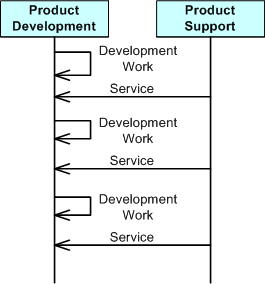 Depending on who’s leading the support group, the service it provides can be highly responsive and of high quality. However, since the standard “system” setup in all CCH corpocracies is as shown in the sequence diagram below, the likelihood of that being true is low. That’s because in centralized patriarchies, all budgets, salaries, and token rewards are doled out by the sugar daddys perched at the top of the pyramid. On the way down, the middlemen in the path take a cut out of the booty for, uh, the added-value “leadership” they provide to those on the next lower rung in the ladder.

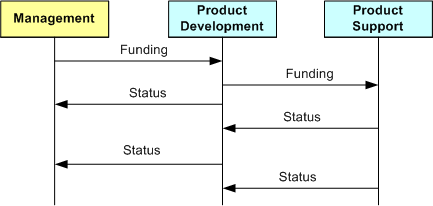
In exchange for their yearly/quarterly investments in the lower layers of the caste system, the dudes in the penthouse require periodic status reports (which they can’t understand and which are usually cleverly disguised camouflage) that show progress toward wealth creation from the DICs below.
Since their bread is buttered from the top and not their direct customers, the natural tendency of support groups is to blow off their customers’ needs and concentrate on maximizing their compensation from the top. They do this, either consciously or unconsciously, by adding complexity to the system in the form of Byzantinian procedural labyrinths for customers to follow to show how indispensable they are to the b’ness. As a result, their responsiveness decreases and their customers experience an increase in frustration from shoddily late service.
So how does one fix the standard, dysfunctional, centralized, CCH setup? Check out and ponder the sequence diagram below for a possible attempt at undoing the dysfunctional mess. Can it work? Why, or why not?
By definition, if everyone is doing industry best practice, it’s not best practice. It’s average practice.
Bureaucracy Formation
Since I’m not a big fan of bureaucracies, let’s have some fun and see how these resource sucking and dehumanizing orgs are naturally formed right under the noses of the high paid corpo dudes who are ironically “responsible” for keeping costs down. As you’ll see, it may even be worse than you think. The infallible, know-it-all, multi-titled CGHs in charge not only allow their bureaucracy to flourish, they feed and water it as a result of the unconscious and self-centered need for ego expansion.
Check the figure below out for a hypothetical example of the formation of a bureaucracy over time. As usual, I’ve made the example up (cuz I’m a L’artiste) and I’ve simplistically decomposed a complex org into two group archetypes; product and support. In my obviously wrong dream-world, the otherwise highly esteemed management class is a support group sub-type, of course.
At t=Start, when a vibrant and competent startup org is initialized, there are no “support” groups: nada, zilch. There’s only a product development (or service provider) group that does everything needed to sustain and grow a business around the wealth-creating product (or service).

As time tics by and the fledgling enterprise grows, one support group after another is added as another ring of fat around the product development group core. At the beginning, the support groups are few, and they’re subordinate both in stature and compensation to the wealth creation group because everyone knows that the product and/or service brings home the bacon.
As the org matures, an incredulous flip in the stature structure snaps into place (t=T3 in the example above) because, well, because that’s the way it is. The first of many subsequent support groups to rise in stature is the executive level management cadre. As even more corpo maturation accrues, all emotional enthusiasm and passion is expelled from the org because the same-old, same-old, mechanistic, B-school and Wall Street psychology usurps the childlike and immature “let’s change the world” mindset which birthed the org in the first place. The so-called management leadership cabal catalyzes and accelerates the move to bureaucracy by; treating wealth creators as easily replaceable DICs, punishing any publicly expressed passion and enthusiasm, cloning themselves in newly added middle management layers, and growing their personal empires in order to inflate their pocketbooks and sense of importance at the expense of the org as a whole. Bummer.
“Are you here to build a career or to build an organization?” – Peter Block
Herman Miller’s Design for Growth
Herman Miller Inc, of Aeron chair fame, is a rare breed. They consistently morph with the times and remain profitable in turbulent waters. This article, Herman Miller’s Design for Growth, tells the compelling story of the genesis of a new suite of products named Convia that spawned a brand new subsidiary business.
The terrific strategy + business article not only recounts the technical story behind the convia product line, it tells the story of the innovative management practices employed by the company’s leadership over the lifetime of the company:
The creation of Convia might sound like a tale of pure product innovation, or even of technology adoption, but it is actually a story about management — and only the most recent of several similar stories at Herman Miller. Over many decades, the company has made itself a laboratory for testing new management ideas and turning them into effective practice.
First, the hard evidence that the company is highly successful despite its repeated forays into the unknown:
Herman Miller competes in an industry slammed by arguably the worst commercial real-estate crisis in a generation. Still, despite a 19 percent plunge in sales for fiscal 2009 (ending in May), the US$1.6 billion company reported a $68 million profit, albeit down from $152 million in fiscal 2008. Over the last 10 years, its stock has consistently outperformed the Standard & Poor’s 500 index.
Next, the snippets that yield insights into the off-the-beaten-path management mindset of the company’s leaders:
…two key principles that continue to inform the company’s management approach. One was a commitment to participative management; the other, a problem-solving approach to design.
Max De Pree, CEO from 1980 to 1987, drew broad attention to the culture at Herman Miller by writing the bestselling Leadership Is an Art (Dell, 1990). Of participative management, he wrote: “Each of us, no matter what our rank in the hierarchy may be, has the same rights: to be needed, to be involved, to have a covenantal relationship, to understand the corporation, to affect our destiny, to be accountable, to appeal, to make a commitment.”
He (Brian Walker, the company’s former chief financial officer, who took over as CEO in 2004) wanted everyone at the company to calculate the financial effect of decisions big and small. It didn’t matter if they were involved in buying, selling, building, designing, billing, paying, or financing. Or whether they were charged with controlling quality, reliability, inventory, waste, energy use, scrap, or the kinds of staples people used.
As Long (now director of the corporate HMPS team) toured the file cabinet plant recently, a visitor paused by a welding robot and asked, “Why don’t you use more robots?” “Robots,” Long said, “can’t make themselves better.”
The objective was to have top decision makers invest themselves in the work — to be companions on the journey, not simply judges of it. “The idea,” Miller says, “was to change the dynamic from traditional review-and-approve to advocacy.”
But Walker argued that in the feeble economy, the main goal was to keep the business sustainable, not to increase profitability at the expense of employees.
Walker says he has no regrets about paying people for time not worked, as the program generated a lot of goodwill and credibility for top management.
So, what do you think? Is the image of Herman Miller Inc. different from the stale corpo model entrenched in your brain?

DIC In A Box
I’ll wager $0 cents that 99% of corpo America institutes some kind of (yawn) standard DIC-in-a-box compensation system as shown in the figure below. Why? Because that’s what the Sloan, Wharton, and other “elite” B-schools say is the “optimum” motivational system, of course. Plus, it’s the safest and easiest way to reward the DICforce. What box are you in, fellow DICster? If you’re a BM, you’re unboxed at the mysterious and unrecorded level N+1, where there is no $Max, right?

Check out the two radical, but non-theoretical, compensation systems in place at these two real and deviant orgs:
According to “normal” business criteria, which are profit and revenue growth, Fog Creek Software and Semco must be considered successful companies, no?
 What kind of innovative compensation system does your company use?
High Level Doers
Jim Goodnight, (CEO of the SAS Institute, Inc), writes code on the side: “His first love is programming, which he likens to solving puzzles“. Marissa Meyer (Vice President, Search Products & User Experience, Google, Inc.) writes code on the side:
I still like to write some programs every year. I do some programming on the weekends. Lately it’s been more web-centric, using PHP and MySQL. The next thing I’ll try to tackle is the Google App Engine. I’m looking to do a little more programming with Python and Ruby on Rails. But I think it’s just an element of keeping my skills fresh by exploring some of these new trends and keeping my hand in coding, even if it’s on the side of core Google work. – From the book “Making It Big In Software“
Gee, do you think this low level behavior by high level employees has anything to do with why these two companies are considered insanely great by boatloads of experts and laymen? How about your company? Forget about those in the stratosphere like Jim and Marissa, do any of your front line managers do any grunge work “on the side” to keep themselves grounded in reality? Probably not, because when they made the leap into the guild of management they became too self-important for such mundane activity. Plus, because they’re expected to be infallible, they can’t be “seen” making any mistakes by the DICforce.

Survive And Prosper
The purpose of a living system is to survive and prosper. There are different levels of systems. For example, there’s the organization, the organizational unit, the organizational group, and the organizational worker. Each of these human-composed entities can be considered a System Of Interest (SOI) unto itself and, as the figure below shows, SOIs are nested and connected.

If you believe my BS assertion that the purpose of a SOI is to survive and prosper, then each SOI may (and almost always does) choose to do whatever it can to survive, regardless of the cost to other internally nested and externally coupled systems. Of course, since everything is connected, the actions chosen by one “subsystem” to optimize its survival can (and almost always does) degrade the survival chances of those subsystems nested within it and those systems in which it is nested. For example, if a Bureaucratic Overhead Org Group (BOOG) like “purchasing” puts a boatload of Draconian procedures and forms and approval barriers in place to show how “important” they are, they degrade corpo performance by hindering timely acquisition of external equipment and services needed to get the job done. Schedules slip, which means customers aren’t delighted, and the people in other SOIs think twice about ordering tools that could make them more efficient and happy.
The dysfunction is even worse than you think. When a member of another SOI tries to point out the inefficiency of a BOOG to the so-called BOOG Leader (BOOGL), the auto-defense instinct kicks into high gear. Clever BOOGLs (and they must be clever because they got themselves appointed as a BOOGL in the first place) twist the situation out of whack. The instigator and his/her native SOI are made out to be the cause of inefficiency in the BOOG. This is done, of course, so that the BOOGL and his/her BOOG can survive and prosper. It’s so sad that ya gotta laugh…… LOL!
In Defense Of Incompetence.
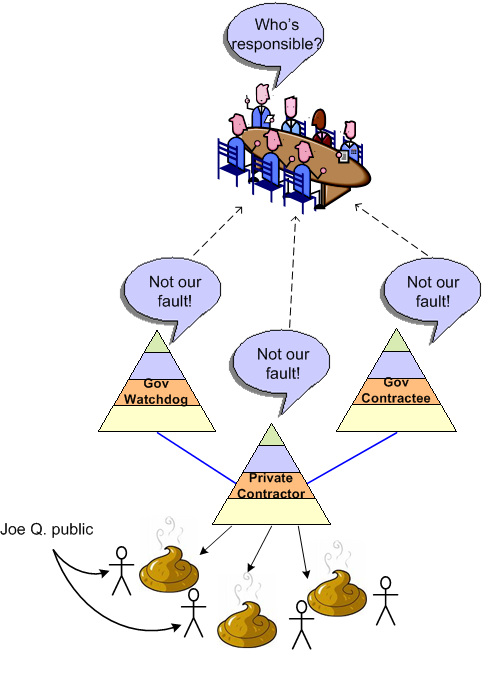
When a government contractor is exposed as incompetent by an external observer (e.g. the press or a civilian group), the government agency that hired them almost always comes to its defense. That shouldn’t be surprising to you because those bureaucratic, and thus, mindless agencies:
- Will do anything to avoid looking incompetent in front of congress for hiring the nin-cum-poops
- Spend other people’s money (yours and mine) instead of their own – and we’re not talkin pocket change here
In addition, the “esteemed” government watchdog agencies (e.g. SEC and FDA and EPA) responsible for ensuring that contractors don’t perpetuate gargantuan disasters make up all kinds of excuses for not detecting the incompetence before massive stakeholder damage has been manifest (lost money, lost lives, lost livelihoods). They do this, of course, because these dudes don’t want to look incompetently asleep at the wheel either.
The system sux and the exhibited behavior is encrusted in its hierarchical, silo+caste system structure that crushes individual conscience. Expect this behavior to go on and on since complexity and the intertwining of interests and agendas will no doubt keep increasing as the world’s population increases. After all, if we can’t fix it, it ain’t broke.
A $1.6M Mistake – And No One Was Fired
The other day, I discovered that a human mistake made on Zappos.com’s sister web site, 6pm.com, emptied the company’s coffers of $1.6 million dollars. Being the class act that he is, here’s what CEO Tony Hsieh had to say regarding the FUBAR:
To those of you asking if anybody was fired, the answer is no, nobody was fired – this was a learning experience for all of us. Even though our terms and conditions state that we do not need to fulfill orders that are placed due to pricing mistakes, and even though this mistake cost us over $1.6 million, we felt that the right thing to do for our customers was to eat the loss and fulfill all the orders that had been placed before we discovered the problem. – Tony Hsieh, CEO, Zappos.com
If this happened at your company, what would your management do? Do ya think they’d look at it as a learning experience?
Besides Zappos.com, here are the other companies that I love. What are yours, and is the company you work for one of them?

What A Deal!
Do you know those dorky self-promotional license plate holders that car dealers attach to your sparkling new vehicle before you drive it off the lot? Well, the Gold’s gym that I religiously go to has had a stack of them publicly available for sale over the past couple of months. When I first saw them next to the other items for sale, I said to myself:
“WTF? Do the clueless BMs in charge of this place really expect to sell any of those stupid, self-serving contraptions? Hell, even if they offered to pay gym members to take them, they’d still gather dust and waste shelf space until someone in the corpo chain of elites finally took responsibility and owned up to the grumpy they pinched in public.”
About a week ago, management placed the stack of crap right on the check-in counter with a sign that proudly displayed a massive reduction in price from $5 to 1$. What a deal, no?
I finally couldn’t take it anymore and I asked my fellow DIC manning the counter if her management really thought they’d be able to sell those abominations. She said she didn’t know and that she personally hadn’t sold a single one over the time they’d been placed on the market. Surprise!
I left the gym that day suggesting that she tell her bosses that a customer said that they should concentrate more on continuously satisfying their customers instead of thinking of them as moronic walking wallets. As an example of customer satisfaction, I told her to ask “them” if they could refill the woefully deflated balance balls every once in awhile. I even suggested (and it wasn’t the first time) that if they put a pump near the ball rack, I’d fill them occasionally and maybe other users would too. Knowing the typical BM mindset, they probably auto-rejected the idea because they’d be afraid that their “customers” would steal the pump.
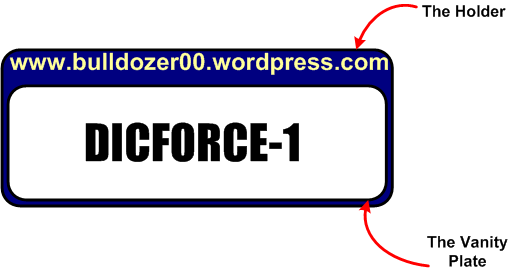
How much would you pay for my license plate holder?
Viable, Vulnerable, Doomed II
As the title indicates, this blow-sst is an extension of yesterday’s inane blabberfest. While yesterday’s lesson (<— lol!) dealt with the static structure of Viable, Vulnerable, and Doomed (VVD) orgs, today’s BS-fest talks about the dynamic behavior of VVD social groups. Behold that if you’re conscious and you concentrate on observing the world around you, the structure plus behavior of an org will clearly and unambiguously reveal over time what it does. Forget what its so-called leaders say it does, observe for yourself how the stratified monolith is structured, how it behaves, and what it actually produces. If you’re diligent and astute, you’ll discover the principle of POSIWID: the Purpose Of a System Is What It Does (not what it’s leadership says it does).
The UML diagram below shows a state machine model of: the mutually exclusive states of a VVV system, the transitions between the states, and the events that trigger the transitions. But wait…… VVV? What happened to VVD? Well, in a dumbass attempt to inject levity and fruitlessly retain your interest, I changed the name of the “Doomed” state to “”Vucked” so that all states start with the letter “V”. Stupid, no?
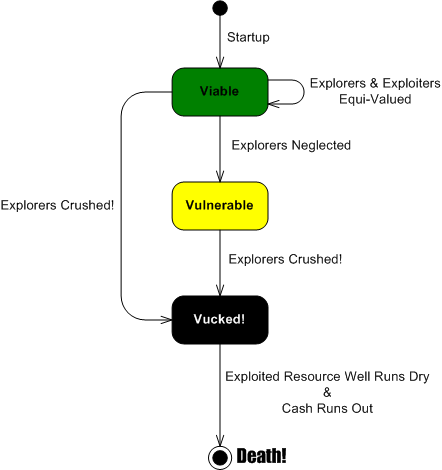
Virtually all startup companies initialize into the viable state. After all, if they didn’t have a product or service that a market didn’t want to consume, they wouldn’t be born as a viable entity, right? Over time, if they neglect their explorers and single mindedly, greedily, milk their product/service to death, eventually they’d become vulnerable to competitors. If the leadership becomes drunk with success and their heads expand too far, they start resenting and rejecting their explorers – they become vucked!
Unless, as the figure below shows, an epiphany in the head shed occurs (and the chances of that occurring in fat headed executives rolling in dough are incredibly slim) it’s death to the org and all its membership – including the innocents who had no hand in the implosion. This ain’t a hollywood story so there’s no happy ending.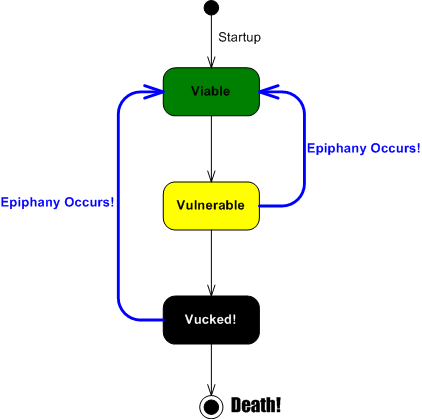

Why am I here?
WTF?
Meh!
D'oh!

My BTC Address



 Bulldozer00's Blog