Archive
Thoers
In case you were wondering how to pronounce the title of this post, it’s “thoo-errs“. It rhymes with “Dewar’s“.
During the rise of the “institution” in the 1900s, Taylorism produced the segregated thinkers/doers model of operation (as shown on the left in the figure below) in order to get things done. Most doers were uneducated and assumed to be lazy/unmotivated barbarians.The “superior” thinkers created the framework of how/what/when work was done; hired some doers; tightly monitored and controlled the process of production.

Relative to the institution-less past, the segregated Thinkers/Doers modus of operandi was an improvement. Via an exchange of pay for work done, institutions provided the means for doers to satisfy Maslow‘s level one/two physiological needs for themselves and their families.
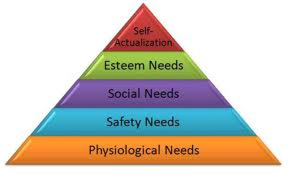
The vast majority of institutions today still operate in accordance with (a milder and veiled form of) Taylor’s segregated thinker-doer model. However, there are some gems (Zappos, Morningstar, Semco, Gore, HCL) out there that operate according the “thoer” model – where everyone is both a thinker and a doer. Although they’re hard to ferret out, these gems proactively provide a work environment in which all 5 levels of Maslow’s hierarchy are attainable to all stakeholders within the organization – not just those in the upper echelons.
Mind Speed
One of my nieces recently sampled my blog and told me: “sometimes the words seem to flow faster than I can read them“. Another person once told me: “you talk faster than I can think“. Alas, such is the downside of having a racy mind.

If you believe the curve above, then the question of how to slow down a speedy mind may have occurred to you. Well, there are tried and true temporary solutions to the dilemma: music, drugs, exercise, alcohol, and meditation.
If you suffer from a racy mind, what works for you? Do you know of any permanent solutions?
Range Checked Vector Access
By now, C programmers who’ve made the scary but necessary leap up to C++ should’ve gotten over their unfounded performance angst of using std::vector over raw arrays. If not, then “they” (I hate people like myself who use the term “they“) should consider one more reason for choosing std::vector over an “error prone” array when the need for a container of compact objects arises.
The reason is “range checked access during runtime“; and I don’t mean using std::vector::at() all over your code. Stick with the more natural std::vector::operator[]() member function at each point of use, but use -D_GLIBCXX in the compiler command line of your “Debug” build configuration. (Of course, I’m talking about the GCC g++ compiler here, but I assume other compilers have a similar #define symbol that achieves the same effect.)
The figure below shows:
- A piece of code writing into the 11th element of a std::vector that is only 5 elements long (D’oh!).
- A portion of the compiler command line used to build the Release (left) and Debug (right) configurations.
- The console output after running the code.

In contrast, here’s what you get with a bad ole array:

The unsettling aspect about the three “D’oh” result cases (unlike the sole “no D’oh” case) is that the program didn’t crash spectacularly at the point of error. It kept humming along silently; camouflaging the location of the bug and insidiously propagating the error effect further downstream in the thread of execution. Bummer, I hate when that happens.
Instantaneous Feedback
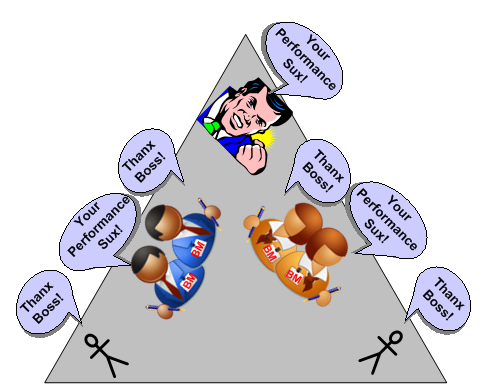
Alfie Kohn wrote a whole book on the subject. So, what subject…. you ask? Why, it’s the subject of the “venerable” yearly performance review created in the bygone era of the early 1900s. Specifically, Alfie’s book conscientiously provides details on how to get rid of what Dan Pink describes as the “highly stylized ritual in which people recite predictable lines in a formulaic way and hope the experience ends very quickly“.
In case you don’t want to, or are afraid to read Alfie’s heretical tome for fear of tossing a grenade at your existing mental model, Mr. Pink gives the subject some treatment as point number 12 in his FLIP Manifesto: “Scrap performance reviews”.
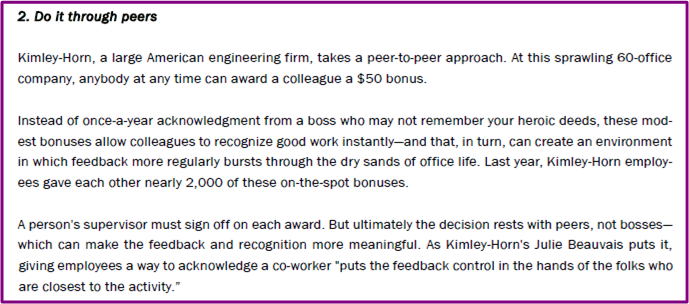
Dan gives not only 1, but 3 ideas for drop kicking the yearly performance review out of the borg and into its rightful place in obscurity. My fave is number 2:
I know, I know. Abolishing the yearly performance review can’t possibly work in your borg. Your business and industry are “different“. It is the way it is because it is the way it has always been and it is the way it has to be. Case closed.
Magical Transformation
In this interview of Scott Berkun by Michael “Rands In Repose” Lopp, “Rands In Repose: Interview: Scott Berkun“, Scott was asked about his former stint at Microsoft as a program manager. Specifically, Rands asked Scott what his definition of “program manager” is. Here is Scott’s answer:
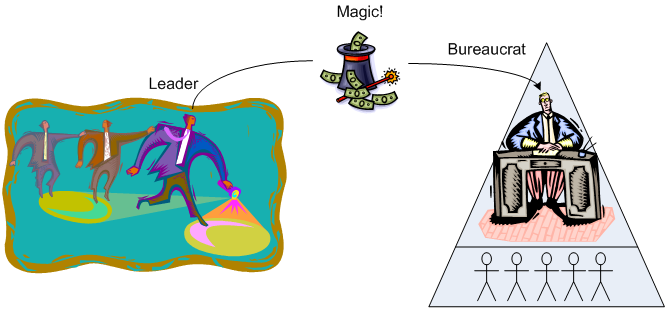
It’s a glorified term for a project leader or team lead, the person on every squad of developers who makes the tough decisions, pushes hard for progress, and does anything they can to help the team move forward. At its peak in the 80s and 90s, this was a respected role of smart, hard driving and dedicated leaders who knew how to make things happen. As the company grew, there became too many of them and they’re often (but not always) seen now as annoying and bureaucratic.
Americans have a love affair with small businesses. But due to the SCOLs, CGHs, BUTTs, and BMs that ran companies like Enron, Tyco, and Lehman Bros, big businesses are untrusted and often reviled by the public. That’s because, when a company grows, its leaders often “magically” morph into self-serving, obstacle-erecting, and progress-inhibiting bureaucrats; often without even knowing that the transformation is taking place. D’oh! I hate when that happens.
Environmental Influence
In “Engineering A Safer World“, Nancy Leveson states:
Human behavior is always influenced by the environment in which it takes place. Changing that environment will be much more effective in changing operator error than the usual behaviorist approach of using reward and punishment. Without changing the environment, human error cannot be reduced for long. We design systems in which operator error is inevitable and then blame the operator and not the system design.
So why is that? Could it be because the system designers and environment caretakers are also the same people who have the power to assign blame – and it’s much easier to blame than to change the environment?

Fish On Fridays II
By popular demand, he’s back! Who, you ask? Why, it’s guest blogger “my name is a different kind of fish every time I post a comment on BD00’s blawg“. Here’s the second installment of “Fish (Sometimes) On Friday“. Enjoy!
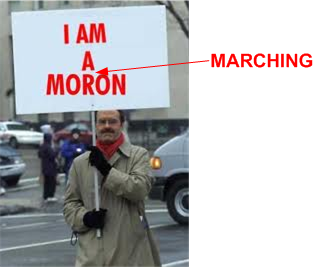
Surrounded by Marching Morons
The trouble with the world is that the stupid are cocksure and the intelligent are full of doubt.”~Bertrand Russell
I saw that quote on the back door of a tractor trailer while driving down the highway. It wasn’t scribbled by hand in the dirty road buildup – it was actually printed on the truck itself as part of the company’s on-road marketing. Don’t ask me what the company was. I don’t remember, other than it was some printing/copying company delivery truck. Not sure how that quote was relevant to their business, but it sure is relevant to mine (and maybe yours?)
Does it ever feel like you’re the only one in your org who knows what’s going on, what needs to be done, and ends up taking care of it because the clowns around you are clueless?
Ayn Rand‘s character John Galt in Atlas Shrugged has this to say:
The man at the top of the intellectual pyramid contributes the most to all those below him, but gets nothing except his material payment, receiving no intellectual bonus from others to add to the value of his time. The man at the bottom who, left to himself, would starve in his hopeless ineptitude, contributes nothing to those above him, but receives the bonus of all of their brains.
I scraped the above from Mike LaBossiere‘s blog Talking Philosophy where he also says:
…innovations and inventions are developed by relatively few people and then used by the many who generally have little understanding of the technology, science, or theories involved.
All this started tickling the back of my head because I remember reading a short story from a Science Fiction collection back in the days of my youth and for the life of me, couldn’t remember what it was called or who wrote it.
After hours of fruitless explorations of my overloaded bookshelves (I did find an old quarter!), I sat down to an internet search where lo and behold, I uncovered the source of my memory.
Cyril M. Kornbluth published a short story in 1951 (no I don’t have the original, just a late 70’s paperback with a bunch of older recycled stories by Asimov, Heinlein, Clarke, etc.) entitled The Marching Morons. I actually found the full text here, but to summarize, The story is set hundreds of years in the future: the date is 7-B-936. A man from the past, John Barlow, is reanimated in this future, where he discovers a fantastic world where people drive around in fancy souped up convertibles at hundreds of miles-per-hour with the wind blowing in their face, but very little makes sense, until he learns that due to a massive population explosion, there are only a small group of intelligent people in the world who struggle to support this ever growing population where the average IQ is around 45. (If you’re interested, you can cheat and read the ‘cliff notes’ synopsis here.) My favorite part is when he realizes why the wind is blowing in his face, even though it doesn’t feel like he’s traveling very fast.
In my work, as I’ve said before, I’m a designer (with a lower case ‘d’, for style). I went through lots of schooling to learn my trade – I even have a masters degree. As a result, I’ve received a great deal of highly specialized training in how to think, look at the world, and solve problems. Innovate. All my peers are cut of the same cloth with years of experience, training, and successful problem-solving under our collective belts. Programmers are the same–you don’t learn code from the back of a crackerjack box. (or maybe you did, which could be the root of the problem).
Most of the other supporting cast in our company, on the other hand, lack this specialized focus – many have simply fallen into their current management and executive positions by luck, in-the-right-place opportunity, or because they fit the suit. These are the people who set the parameters of a project, provide the starting information, eventually critique the solution, and the approach to that solution even though they themselves lack the knowledge to effectively ‘drive the bus‘. And as Adam Bellows says, “… the more incompetent someone is in a particular area, the less qualified that person is to assess anyone’s skill in that space, including their own.” As BD00’s post on interdisciplinary team effort complexity shows, as a business grows, the seemingly disconnected groups that influence the project direction also lack many of the skills to even complete it, so their own inputs add little relative value to the result other than increasing the size of the output pile – and it’s relative stench.
Complementary Views
One classic definition of a system is “a set of interacting parts that exhibits emergent behavior not attributable solely to one part“. An alternative, complementary definition of a system served up by Russell Ackoff is “a whole that is defined by its function in a larger system of which it is a part“.
The figure below models the first definition on the left and the second definition on the right. Neither is “righter” than the other. They, and I love saying this because it’s frustratingly neutral, “just are“.
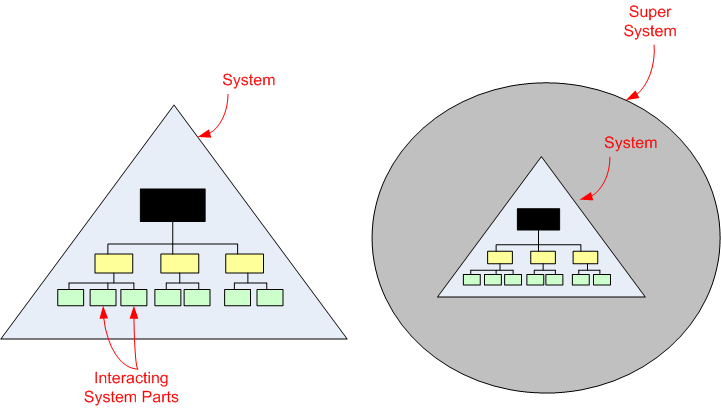
Viewing a system of interest from multiple viewpoints provides the viewer with a more holistic understanding of the system’s what, how, and why. Problem diagnosis and improvement ideas are vastly increased when time is taken to diligently look at a system from multiple viewpoints. Sadly, due to how we are educated, the inculcated tendency of most people is to look at a system from a single, parochial viewpoint: “what’s in it for me?“.
Dramatic Difference
I’ve been an investor in Whole Foods Markets for about 10 years because I like CEO John Mackey‘s “Conscious Business” approach to capitalism. In this Fast Company post, “How Whole Foods Became The Luxury Brand Of Millennials”, Michael Pavone dramatically illustrates the difference between today’s winners and yesterday’s winners with this chart:

Maybe Eckhart Tolle is right when he says that a transformation to a “New Earth” is slowly but surely taking place. But then again, since Mackey-like approaches and businesses like Whole Foods Markets are still extreme outliers, maybe he’s wrong.
What do you think? Putting your company’s BS press clippings and self proclamations of greatness aside for a brief moment, how is your business really different from your moo-herd peers?

Cracked Up
One of the reasons why I love Russell Ackoff is that he cracks me up even while he writes about depressingly serious matters. Here’s just one example from his bottomless well of wisdom:
Business schools do not teach students how to manage. What they do teach are (1) vocabularies that enable students to speak with authority about subjects they do not understand, and (2) to use principles of management that have demonstrated their ability to withstand any amount of disconfirming evidence. – Russell Ackoff

Want another example? OK, OK, here it is:
“Walk the talk” is futile advice to executives because for them walking and talking are incompatible activities. They can do only one at a time. Therefore, they choose to talk. It takes less effort and thought. – – Russell Ackoff

Why am I here?
WTF?
Meh!
D'oh!

My BTC Address



 Bulldozer00's Blog