Archive
Dynamic Loop Of Demise
Uh Oh! Is Google going down the turd hole? First, in “Why I Left Google“, newly minted Microsoft employee James Whittaker says:
..my last three months working for Google was a whirlwind of desperation, trying in vain to get my passion back. The Google I was passionate about was a technology company that empowered its employees to innovate. In such an environment you don’t have to be part of some executive’s inner circle to succeed. The Google I left was an advertising company with a single corporate-mandated focus.
Then, in “Google’s Mounting Trash Pile“, Paul Whyte writes:
Google’s engineering culture has been an incredible asset. But the record shows that without some discipline, that asset can subtly but inevitably work against Google in its mission as a titan of Internet search and software.
On the one hand, Mr. Whittaker bailed because he felt the dense fog of bureaucracy and a narrowing focus descending upon the company. On the other hand, the (not unreasonable) pressure to jettison bogus research projects with no revenue stream in sight seems to be draining the passion and engagement out of the workforce. Can a vicious, self-reinforcing loop be in the making? Increase In Pressure For Profits -> Decrease In Reseach Funding -> Decrease In Employee Passion -> Decrease In Number And Quality Of Products -> Increase In Pressure For Profits.

I don’t think this dynamic loop of demise is one of Peter Senge‘s “Fifth Discipline” archetypes, but maybe it should be.
Loving All That Is
Because it’s very different from any other “religious” book that I’ve ever read, I really like “The Most Rapid and Direct Means to Eternal Bliss” (free pdf download here). In the book, mysterious Michael Langford lays down step by step instructions for five spiritual practices:
- THE AWARENESS WATCHING AWARENESS METHOD
- THE ABANDON RELEASE METHOD
- THE ETERNAL METHOD
- THE INFINITE SPACE METHOD
- THE LOVING-ALL METHOD
To give you a taste of the book’s style and content, here is the procedure for THE LOVING-ALL METHOD:

Love your thoughts, your feelings, your body, your actions, the objects you see, the people you see, every input from each of your senses, every word you utter, every word spoken to you. Piece of cake, no?
The other night, I went to bed with a strong resolve to start practicing THE LOVING-ALL METHOD “tomorrow“. When I woke up the next morning, within seconds I deviated from the plan. My shoulder ached from a touch of arthritis and I automatically thought and said “Ow – damn shoulder!“. Upon discovering my transgression a few milliseconds later, I thought “D’oh!” and gave up. Maybe I’ll give it another spirited try in the future.
It’s weird. When I read a spiritual book that “clicks” (and not many of them do), I experience a sense of peace and serenity during the read. But as soon as I close the cover, the feeling dissolves and IT takes over once again – and it’s hard to love IT; very hard.

Fish On Fridays IV
Earlier this week, sometimes-guest-blogger fishypoo submitted some content for today’s entry to BD00 for “approval“.

Here it is, fishypoo’s b’fore and afta “process improvement” flowchart submittal:
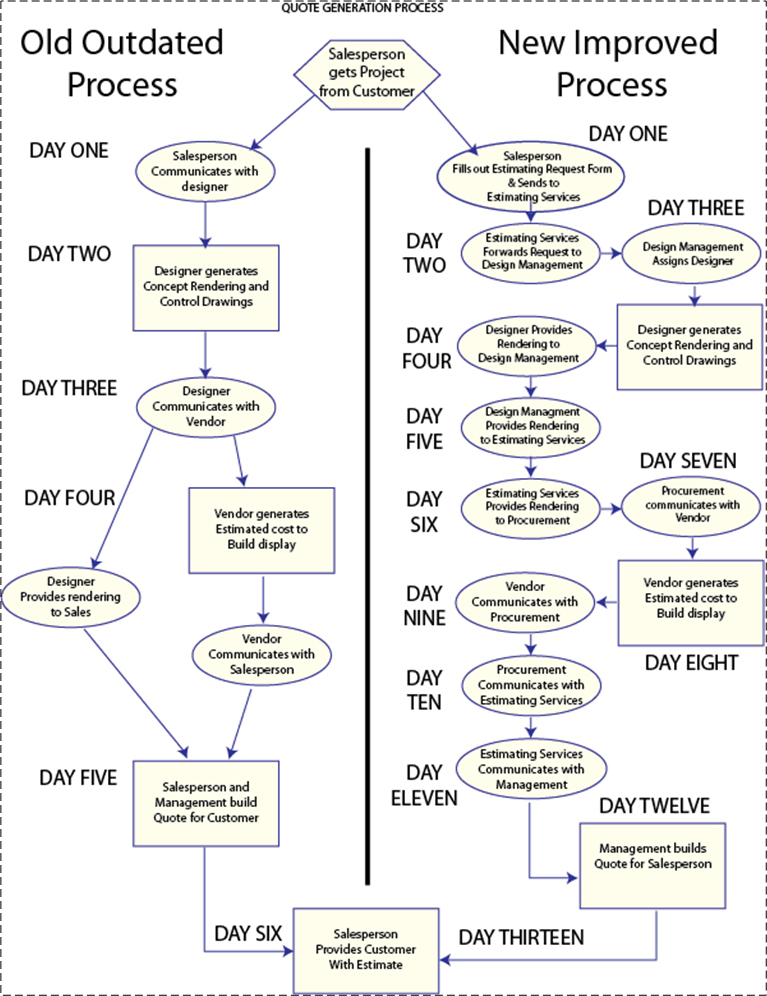
With a 2X increase in delay from input to output and the addition of three new “enabling” actors,
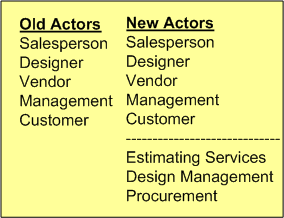
the new process is a slam dunk and a shining example of the value-added that can be achieved from doggedly performing continuous improvement.
Four Attributes
Assume that every commercial enterprise can be “objectively” (LOL!) characterized by the following four discrete attributes:
- Trustworthiness [untrustful | trustful]
- Transparency [closed | open]
- Fairness [unfair | fair]
- Product_Quality [crappy | meh | excellent]
If I did the math right, there are 2*2*2*3 = 24 attribute combos. At one end of the spectrum, we have orgs that are untrustful, closed, unfair producers of crappy products and services. At the other end of the spectrum we have enterprises that are trustful, open, fair producers of excellent products and services.
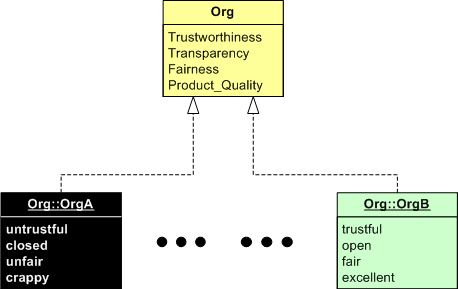
So, what do you think the ratio of OrgAs to OrgBs is in the world, and why? Do you think the ratio is increasing or decreasing as civilization advances? Do you think the four attributes are uncorrelated or are they intimately coupled? Can an untrustful, closed, and unfair org produce excellent products and services? Given an OrgA, can it transform into an OrgB? Given an OrgB, can it transform into an OrgA? Which transformation is more likely?
World Reknowned
WordPress.com is such a sweet blogging platform. The team keeps innovating and adding useful, customer-friendly features to the site. Here’s a recent addition to the stats page that enumerates page hits by country:
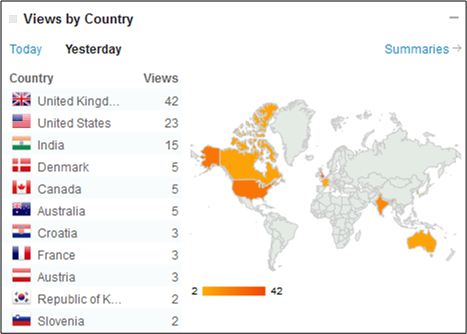
It’s thrilling to see people outside of the USA stopping by and taking a peek at bulldozer00.com. I anxiously await the arrival of viewers from North Korea, Cuba, Iran, the glorious nation of Kazakhstan, and the mud lands of Elbonia.
World Class Help
I’m currently transitioning from one software project to another. After two years of working on a product from the ground up, I will be adding enhancements to a legacy system for an existing customer.
The table below shows the software technologies embedded within each of the products. Note that the only common attribute in the table is C++, which, thank god, I’m very proficient at. Since ACE, CORBA, and MFC have big, complicated, “funky” APIs with steep learning curves, it’s a good thing that “training” time is covered in the schedule as required by our people-centric process. 🙂
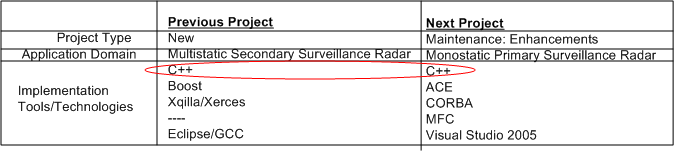
I’m not too thrilled or motivated at having to spin up and learn ACE and CORBA, which (IMHO) have had their 15 minutes of fame and have faded into history, but hey, all businesses require maintenance of old technologies until product replacement or retirement.
I am, however, delighted to have limited e-access to LinkedIn connection Steve Vinoski. Steve is a world class expert in CORBA know-how who’s co-authored (with Michi Henning) the most popular C++ CORBA programming book on the planet:
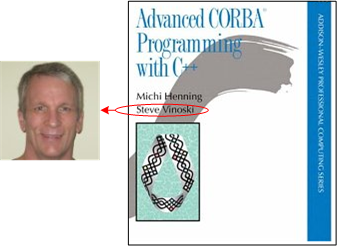
Even though Steve has moved on (C++ -> Erlang, CORBA -> REST), he’s been gracious enough to answer some basic beginner CORBA questions from me without requiring a consulting contract 🙂 Thanks for your generosity Steve!
Whole, Part, Purposeful, Unpurposeful
Perhaps ironically, the various branches of “systems thinking” do not have a consensus definition of “system” archetypes. In “Ackoff’s Best”, Russell Ackoff lays down his definition as follows:
There are three basic types of systems and models of them, and a meta-system: one that contains all three types as parts of it. 1. Deterministic: Systems and models in which neither the parts nor the whole are purposeful (e.g. a computer) 2. Animated: Systems and models in which the whole is purposeful but the parts are not (e.g. you or me). 3. Social: Systems and models in which both the parts and the whole are purposeful (e.g. an institution). All three types of systems are contained in ecological systems, some of whose parts are purposeful but not the whole. For example, Earth is an ecological system that has no purpose of its own but contains social and animate systems that do, and deterministic systems that don’t.


But wait! Why are there no Ackoffian systems whose parts are purposeful but whose whole is un-purposeful? Russ doesn’t say why, but BD00 (of course) can speculate.
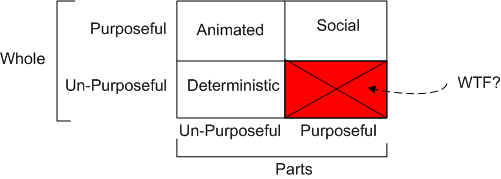 As soon as one inserts a purposeful part into a deterministic system, the system auto-becomes purposeful?
Robot00.com
The other day, I received a package from Amazon and I was popping the packing bubbles to reduce the volume for throwing them away. While robotically popping away, I had a sudden realization that I was thinking about what my next blog post was going to be about. I wasn’t paying attention at freakin’ all to what I was doing.
I reflected further, and then became amazed at how much of my so-called conscious time is spent on autopilot – not thinking in the least about what I’m doing at the moment. I realized that the only time I really think “in the moment” and pay attention to what I’m doing is when I’m designing/writing code, golfing, and writing blog posts. Sadly, that is not the majority of my time. Not even close.

How abut you? Do you find yourself in robopilot mode often?
Picture this
Picture your thoughts as leaves floating down a river. A thought appears in your head, you think it, and then you let it go. Aaaah, what bliss. But wait! One of those leaves just got stuck on a tree root extending out into the water. There it stays, spinning around at a maddening frequency. D’oh! I hate when that happens.
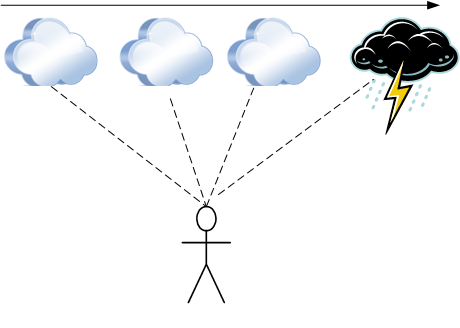
Picture your thoughts as puffy white clouds drifting across the sky. A thought appears in your head, you think it, and then you let it go. Aaaah, what bliss. But wait! One of those clouds just turned dark and started spewing thunder, lightning, and rain. D’oh! I hate when that happens.
Fish On Fridays III
It’s Friday, so it’s time to eat some more fish. Guest blogger “fishmeister” has fried up another tasty treat for you and me to savor.
Firefighter or Fire-proofer: The Tyranny of Today
Software coder. Designer. Thinker.
In those jobs, your primary purpose is to take a blank page and fill it with something that solves an identified problem or need. Often, this requires a great deal of cognitive thinking–noodling out an idea ahead of any actual work. And this takes time.
Unlike a laborer, who’s efforts are immediately apparent as their manual activities produce something tangible, cognitive thinking does not take place on a schedule. You can’t just sit down and say “at 10:30 on Tuesday, I’m going to have a brilliant thought“. It takes time. Sometimes lots of time. And sometimes it happens at odd times when you least expect it.
That ‘eureka moment’ can happen in the car, in the shower, at your desk, in line for coffee–anywhere, anytime. Which brings me to the real reason for this post.
If your work time is spent on putting out fires and solving immediate issues at the expense of thinking strategically about long-term solutions–innovation–you end up getting stuck in the Tyranny of Today–being a fireman instead of a fire-proofer.
Jeffrey Phillips writes a blog that I follow regularly. (BD00’s humble writings and Jeffrey’s are #1 and #2 on my daily morning reading list). ((I won’t say in which order, though)). 🙂
The other day he wrote about The Tyranny of Today. It resonated with me on so many levels that I had to share it with my boss. He outlines everything that we are currently struggling with in our business every day.
We have a large cadre of Designers in our organization, yet we are always being challenged because we don’t think ‘creatively‘. Our deadlines are short–sometimes less than a day between being given a project and expecting a solution to be generated. This creates a dilemma that up until now, I didn’t quite understand. Mr. Phillips puts it most succinctly…
…[The tyranny of today is] An “all hands on deck” mentality, which means that all available resources are focused on today’s issues, today’s needs, today’s problems. Ever more efficient operating models have pared organizations to the bone, meaning that anyone not working on today’s issues seem superfluous. Until the new products and services cupboard is bare because no one was working on new products and services.
We’ve created very powerful “business as usual” engines, and increasingly, these engines no longer serve us, we serve them. The BAU models dictate how we think, how we deploy resources and how we reward people. The tyranny of today is based on our business as usual operating models and the perverted ways in which they drive our strategies, our thinking and the way we apply resources.
We live in an immediate-gratification society these days. Technologies surrounding us have been developed to speed up the processes required to get things done. Back when “I was a kid” designer, developing a concept meant several days of pencil sketches, thumbnails, doodling, and eventually working out a refined concept, that required an artistic skill to draw, paint, and color in a visual representation of an idea up to a sufficient level that someone else (with the purse-strings) would be willing to shell out cash for your idea. All this effort meant that you were “off-line” for any other projects that came along, and as a result, the # of Designers and Freelancers in our studio would increase or decrease based on the workload at the time.
These days, I can bang out a 3-dimensional computer model–complete with textures, surfaces, lighting, and visuals–that looks so convincing that you’d think I’d just taken a picture of a real object in the real world. And I can do this in less than an hour. The tech around me has allowed the mechanical process of simulation to occur at the click of a mouse. But my brain still works the same old way.
At the same time, the down economy has meant that we’ve been cutting back on personnel, letting Designers go and not refilling those positions immediately. Those remaining have to just pick up the load. (“Leveraging resources” is the euphemism we hear every day.) Which means that we rely on our tech to an even greater degree just to get today’s workload completed.
As a result, we have bursts where there is more work that is due right now, than we have bodies in place to handle. Which means that in order to get it all done, I have to take off my propeller-equipped beanie hat and put on my fireman’s helmet. And with all the immediate issues of short-term needs–the fires that take place every day-I put out those fires and sacrifice the time needed to think creatively on another project. I become a victim of the Tyranny of Today.

How about you–do you spend your day sitting under an apple tree waiting for the fruit to smack you on your noggin, or do you piss on fires all day? What can you do in your business to escape the pattern and grow?

Why am I here?
WTF?
Meh!
D'oh!

My BTC Address



 Bulldozer00's Blog