Archive
Value And Effectiveness
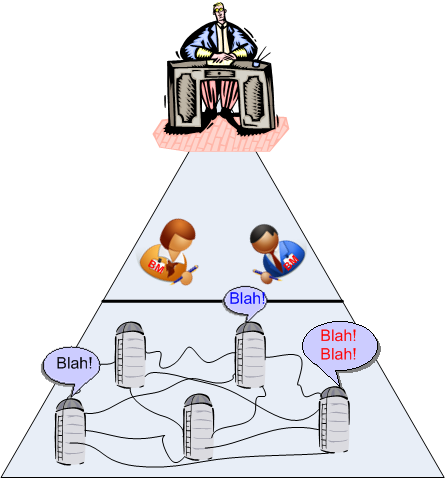
A few weeks ago, my friend Charlie Alfred challenged me to take a break from railing against the dysfunctional behaviors that “emerge” from the vertical command and control nature of hierarchies. He suggested that I go “horizontal“. Well, I haven’t answered his challenge, but Charlie came through with this wonderful guest post on that very subject. I hope you enjoy reading Charlie’s insights on the horizontal communication gaps that appear between specialized silos as a result of corpo growth. Please stop by his blog when you get a chance.
——————————————————————————————————————————–
In “Profound Shift in Focus“, BD00 discusses the evolution of value-focused startups into cost-focused borgs. There’s ample evidence for this, but one wonders what lies at the root?
One clue is Russell Ackoff’s writings on analysis and synthesis. Analysis starts with a system and takes it apart, in the pursuit of understanding how it works. Synthesis, starts with a system, identifies the systems which contain it, and studies the role of the original system within its containing systems in the pursuit of understanding why it must work that way.
Analytical thinking is the engine that powered the Industrial Revolution and many of the most important scientific advances of the 21st century. Understanding how things work is essential to making them work better (also known as efficiency). Today, we have better automobiles, airplanes, computers, phones, and TV’s than our parents. And we owe much of this to analytical thinking.
But one of the side effects of analytical thinking is specialization. As understanding deepens, the volume of subject matter knowledge explodes. This leads to the old joke.
Q: What’s the difference between an engineer and an executive?
A: Every day engineers learn more and more about less and less, until one day they know everything about nothing, while executives learns less and less about more and more, until one day they know nothing about everything.
But all joking aside, this is a serious concern. The vast majority of organizations today are organized functionally: sales, marketing, finance, engineering, manufacturing, HR, IT, etc. And withing these organizations, there are even more specializations. Marketing has specialists in advertising, public relations, research, distribution channels, and product management. Engineering has chemical, mechanical, electrical, firmware, and software engineers. Even in software development, you have specialists in user interfaces, networking, databases. realtime embedded and project management.
One of the critical problems is that most people working in each of these areas become overspecialized. They spend so much time accumulating and applying specialized knowledge, that they can only communicate with people in their own specialty. If you don’t believe me, observe a two hour meeting involving somebody from sales, market research, product management, mechanical engineering, electrical engineering, finance, and purchasing.
In Mythical Man Month, Frederick Brooks retells the Tower of Babel as a project management story. It fits perfectly, because the root cause of the Tower of Babel failure was overspecialization and a failure to communicate. Today, instead of talking Hebrew, Arabic, Persian and Greek, we talk gross margin, differentiation, segmentation, tensile strength, electromagnetic interference, and virtual inheritance.
And our communication has another quality. Solution focus. We routinely argue the flaws and merits of solutions with only the foggiest understanding of what the problem is. And we use the vast levels of specialized knowledge from our respective disciplines to shout down the cretans who disagree with us.
Cost reduction and efficiency live in the same neighborhood as specialization and analytical thinking:
- If we replace these two steps with this one, the process will be faster.
- If we replace this part with this other part, the unit cost will be reduced by 2%.
- If we consolidate these three models into one, we can reduce inventory by 20%.
If efficiency is “doing things the right way”, then effectiveness is “doing the right things the right way.” Value lives next door to effectiveness and both live in the same neighborhood as synthesis. Value, like beauty, is in the eye of the beholder. Products and services can deliver benefits, but only the buyers and users can apply these benefits to realize value. Consider smartphones. Some people only use their phones for mobile calls, others for text messaging, some to read books on the train.
So in the end, there are a couple of reasons that startups are inherently focused on value. First, because they are small, specialization is a liability. Most people in startups do several jobs (well), by necessity. Second, because they are not yet profitable and self-sustaining, their survival is highly dependent on their surroundings (e.g. customers, competitors, economic conditions). This requires more synthesis than analysis.
As they grow, their strategy shifts to cost. Michael Porter writes about this in Competitive Advantage. And guess what, every one of us bargain-hunting, coupon-clipping, “buy one get one free” consumers is the root cause of this. Why mention this? Because synthetic thinkers love systems with feedback loops!
Profound Shift In Focus
The following quote comes from John Hagel via this Peter Vander Auwera blog post: “Corporate Rebels United” – the start of a corporate spring?”:
The key answer that defines the post-digital enterprise is to shift attention from the cost side to the value side. Rather than treating employees as cost items that need to be managed wherever possible, why not view them as assets capable of delivering ever-increasing value to the marketplace? This is a profound shift in focus. For one thing, it moves us from a game of diminishing returns to an opportunity for increasing returns. There is little, if any, limit to the additional value that people can deliver if given the appropriate tools and skill development. – John Hagel
For big, established companies who can’t even remember what it was like to focus on value, “profoundly shifting” from a cost mindset back to a value mindset is a tall order indeed.
As the state machine based figure below illustrates, successful startups are totally “value focused” in the sun-up phase of their life. But over time, as they obsessively grow and misguidedly try to become more efficient by adding layers upon layers of cost watchers, the vast majority of them (with few Apple-like exceptions) morph into “cost focused” borgs.

Once a formerly vibrant org has moved into the sundown phase of its life, the borgdom hardens. It’s cost-focus till death, with no memory of any prior, value-focused behavior.

Incomplete AND Inconsistent
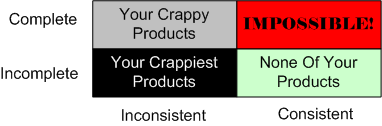
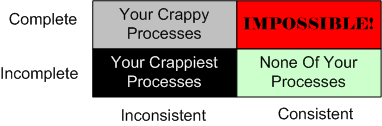
In the early 1900s, Bertrand Russell and Alfred Whitehead published their seminal work, “Principia Mathematica“. Its purpose was to “derive all of mathematics from purely logical axioms” and many smart minds thought they pulled off this Herculean task. However, Kurt Godel came along and busted up the party by throwing a turd in the punch bowl with his blockbuster incompleteness theorem. The incompleteness theorem essentially states that no system of logic can be both consistent and complete. One or the other, but not both.
So, let’s apply Godel’s findings to “logical“, software-intensive systems:
Next, let’s apply the incompleteness theorem to “logical” management systems:
Me thinks that Mr. Spock, one of my all time heroes because of his calm, cool, and collected demeanor and logical genius, was wrong – at least some of the time. Damn that Kurt Godel!
Efficient Abstraction
In “The Design And Evolution Of C++“, Bjarne Stroustrup presents a tree-like picture on the history of programming languages and how they’ve influenced each other. For your studying pleasure, BD00 surgically extracted and augmented a slightly more C++ focused sub-tree. In other words, BD00 committed yet another act of plagiarism. I hope you like the result.
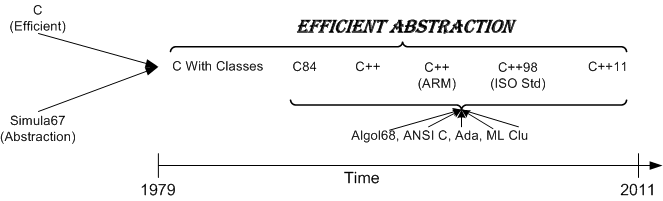
All through the 30+ years of C++’s evolution, Bjarne and the ISO C++ standards committee have maintained a fierce and agonizing determination to march to the tune of “efficient abstraction” over theoretical purity. Adding increasing support for abstraction without sacrificing much in efficiency is more of an art than science.
D&E is not just a history book. As the figure below shows, it won one of the “Software Development Productivity Awards” from Software Development magazine waaay back when. That’s because knowing “why” and “how” the (or any) language became the way it is gives a qualitative edge to those programmers over those who just know “what” the language is.

Cover of The Design and Evolution of C++
The Lost Decade?
I think you’ll be hard pressed to find many knowledgeable C++ programmers who won’t admit that managed languages provide higher per-programmer productivity than native languages (because they’re easier to learn, have bigger libraries, and are not as “picky“). Likewise, I think you won’t find many “reasonable” managed language advocates who won’t admit that native language programs are more efficient (smaller and faster for a given solution) than their managed language counterparts. Having said that, take a look at this chart:

According to Herb Sutter, efficiency has(will) usurped(usurp) productivity as the dominating cost factor for software-intensive products in this decade (battery life in mobile devices, power consumption in the data center). Agree?
If you’re interested in watching the video and/or downloading Herb’s slides, here’s the link: “C++ and Beyond 2011: Herb Sutter – Why C++?“.
Unstated, But Deeply Rooted
Maturity is a state that most companies eventually reach. To break out of – or avoid – maturity, innovation is required: new products or services, new marketing or markets, more of what is different, not more of the same. – Russell Ackoff
Not only is “maturity” reached by most orgs, it is actively pursued in order to fulfill an unstated, but deeply rooted amygdalayian desire to transition from org to borg. The hilarity of the situation is that while a “maturing” org’s behaviors and processes unceasingly and silently nudge it toward rigid borgdom, the esteemed leadership continuously cries out for innovation. Do as I say, not as I do. D’oh!

Hameltonian Gems
Hameltonian == Hamiltonian, get it? I know, I know – that’s the worst free-association joke you’ve ever heard.
When it comes to eloquently cracking good jokes while talking about serious matters, Gary Hamel is right up there with fellow heretical management genius Russell Ackoff. Check out these gems from Mr. Hamel’s latest book, “What Matters Now“:
- Unfortunately, the groundwater of business is now heavily contaminated with the runoff from morally blinkered egomania.
- It was a perfect storm of human delinquency. Deceit, hubris, myopia, greed, and denial were all luridly displayed.
- “ninja” loans (no income, no job, no assets).
- Among the powerful, blame deflection is a core competence.
- As ethical truants, big business seems to rank alongside Charlie Sheen and Lindsay Lohan.
- If life had adhered to Six Sigma rules, we’d still be slime.
- …they seem to have come from another solar system—one where CFOs are servants rather than gods.
- …you’d have an easier time getting a date with a supermodel or George Clooney than turning your company into an innovation hottie.
- Unlike Apple, most companies are long on accountants and short on artists. They are run by executives who know everything about cost and next to nothing about value.
Dumb And Dumber And Dumbest

In case this is your first look at this awful blawg, that’s Bulldozer00 with the colorful Katy Perry-like locks on the right.
Please do not forward, reblog, share, or link to this post. After all, I’ve got a respectable reputation to uphold and an impeccable image to protect. It’ll be our leetle shared secret; an exercise in spiritual E-bonding.
If I do catch you, yes you, dear reader, violating my edict, then I’ll hunt you down and brand your forehead with the BD00 seal of unapproval:

The Nightly News Template

Call For Artists!
Are you a fledgling e-artist who wants to show off his/her work and earn a few bux? If so, then BD00 wants to partner with you in a book project. Like Elton John and Bernie Taupin did with music and lyrics, we can do with graphics and words.
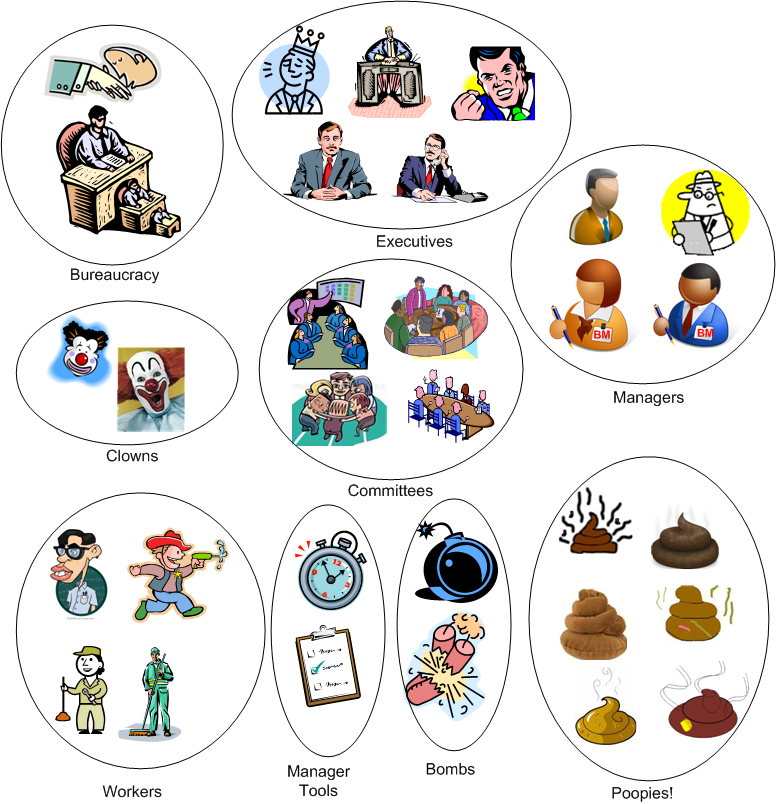
The majority of posts on this site fall into the “management” category. Thus, I’m gonna try to write a self-published e-book that showcases my utter lack of understanding and unparalleled ignorance of the subject. The biggest hurdle I have to overcome is the fear of being sued by Microsoft, and perhaps others, from the commercial use of their graphics. Thus, I need someone to draw up legit replacements for the icons I plan to use in my so-called work; and to be on standby for others that I might need during the effort.
Here’s a categorized collage of images that I need to be redrawn:
If you’re interested, please give me a shout out in the comments section so that we can get the business negotiation process started.

Why am I here?
WTF?
Meh!
D'oh!

My BTC Address



 Bulldozer00's Blog