Archive
Tight, Theory-Based, Loose, Empirical
Processes designed to execute the business of an enterprise should be tight and theory-based. Processes designed to develop the products of an enterprise should be loose and empirical.

In the best performing companies, this ridiculously simplistic BD00 generalization is true? In the worst companies, the opposite is true?

Multiturding
The best graphic I’ve ever seen on the inefficiency of multitasking comes via one of my long-time mentors from afar, Mr. Gerry Weinberg.
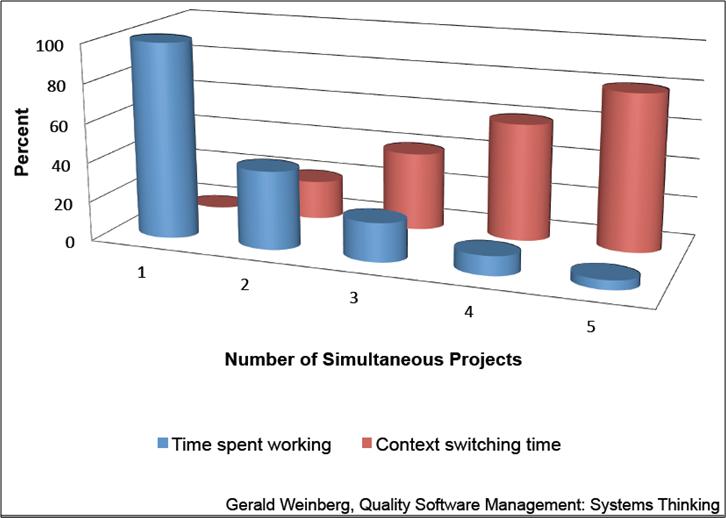
Even though some level of multitasking is pragmatically required once in awhile for getting things done, some orgs explicitly put multiturding up on a pedestal as a desired skill to be developed and honed. In these types of orgs, if you have multiple titles, roles, projects, etc, going on at the same time, you’re probably in the good graces of your bosses and a prime candidate for promotion. Plus, you get to pump up your annual appraisal form with a boatload of (half-assed) “accomplishments“.
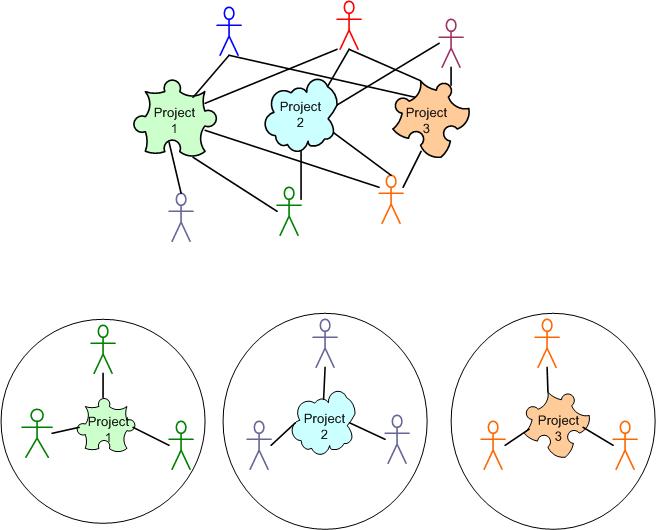
As a test to see if you’re a member of an org that’s hooked on multiturding, try telling your boss that you’d like to work on one project at a time – and then observe the response. Also, observe the feelings that arise within you before you make the request – if you do indeed make the request.


Related articles
- Beware Employees Who Boast About Multitasking (business.time.com)
- The myth of multitasking (smartplanet.com)
- If You Think You’re Good at Multitasking – You Probably Aren’t (richandco.wordpress.com)
- Frequent Multitaskers Aren’t Good At Multitasking, Study Shows (huffingtonpost.com)
- So, you think you can multitask? – Social Grad (thesocialgrad.wordpress.com)
Stingy And Uncooperative
As a temporary reprieve from writing preposterously heretical posts on dysfunctional management and biased opinion pieces on software development, I axed myself: “What different topic can I squirt out into the ether today?” Then, out of nowhere, the eery and scary theme song from the oooold Twilight Zone TV series started playing in my head – doo doo doo doo, doo doo doo doo, doo doo doo doo….. WAAAGH! As a result, I thought: “What is my favorite TV series theme song?“.
After waiting for a slew of other songs to spontaneously start coursing through my diseased neural circuitry in rapid succession, only one other tune started up: the theme from the old “Hawaii Five-O” show – which I don’t even like. Then, a progression of visual snapshots from old TV series like “Lost In Space“, “The Mod Squad“, “All In The Family“, “Sanford & Son“, and “The Jeffersons” appeared. However, except for the latter’s unforgettable but meh “Movin’ On Up” song, the tunes didn’t come along for the ride with the pictures. D’oh!
So, for now, until I can think of a better one (which may be freakin’ never), my fave TV theme song is the theme from……

What is your fave TV theme song? When you came up with it, did your memory freely expose a boatload of candidates, or was it stingy and uncooperative during the search, like mine?
The Skeptical Empiricist
Thanks to my friend at ThinkPurpose.com, I discovered a bona-fide “skeptical empiricist“:
As a skeptical empiricist I prefer the experiments of empirical psychology to the theories-based MRI scans of neurobiologists, even if the former appear less “scientific” to the public. – Nassim Taleb
In his refreshingly original and caustic book, “The Black Swan“, this former Wall St. quant convincingly trashes the ubiquitous Gaussian probability distribution because of its lack of scalability and utter failure to account for “Black Swans“. Mr. Taleb also disses those statisticians, Nobel prize-winning economists, and planners that make predictions based on the reductionist properties of the taken-for-granted Gaussian probability distribution.
According to Mr. Taleb, a Black Swan is an event with these three attributes: unpredictability, consequences, and retrospective explainability. A prime example of a Black Swan is the 9/11 terrorist attack. Note that the housing bubble was not a Black Swan – since many people predicted it was coming.
Throughout his tome, Nassim exhibits some profound insight and wisdom across a wide range of topics. Here are just some of the many snippets that resonated with me.
Humans will believe anything you say provided you do not exhibit the smallest shadow of diffidence; like animals, they can detect the smallest crack in your confidence before you express it. The trick is to be as smooth as possible in personal manners.
The problem with business people… is that if you act like a loser they will treat you as a loser—you set the yardstick yourself. There is no absolute measure of good or bad. It is not what you are telling people, it is how you are saying it.
Now contemplate epistemic humility. Think of someone heavily introspective, tortured by the awareness of his own ignorance. He lacks the courage of the idiot, yet has the rare guts to say “I don’t know.” He does not mind looking like a fool or, worse, an ignoramus. He hesitates, he will not commit, and he agonizes over the consequences of being wrong. He introspects, introspects, and introspects until he reaches physical and nervous exhaustion.
Forecasting by bureaucrats tends to be used for anxiety relief rather than for adequate policy making.
By removing the ten biggest one-day moves from the U.S. stock market over the past fifty years, we see a huge difference in returns—and yet conventional finance sees these one-day jumps as mere anomalies.
…it is contagion that determines the fate of a theory in social science, not its validity.
…there was a strange cohabitation of technical skills and absence of understanding that you find in idiot savants.
Missing a train is only painful if you run after it! Likewise, not matching the idea of success others expect from you is only painful if that’s what you are seeking.
The Achilles’ heel of capitalism is that if you make corporations compete, it is sometimes the one that is most exposed to the negative Black Swan that will appear to be the most fit for survival.
Asynchronous Flows And Synchronous Transactions
The figure below shows a pair of BD00 concocted models for two classes of systems; peer-to-peer and client-server:

The primary mission of an AFCS is to progressively transform a high rate stream of incoming raw samples into a higher level, abstract representation of some phenomena that’s important to its users. In an STCS, the system’s primary mission is to transform low rate user requests into information that’s important to its users.
In business support applications, STC systems dominate the scene. In aerospace and defense applications, AFC systems are king. Of course, the situation is never as simplistic as BD00 sez. Hybrid systems like the sensor-based command and control model below can be found everywhere.
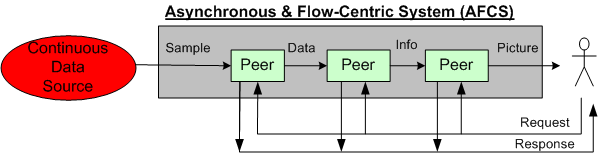
For some reason (maybe market size and/or community culture and/or media exposure?), most software technology advancements (languages, patterns, methodologies, frameworks, etc) seem to emerge out of the STCS space. Those innovations that are “applicable” get adopted in the AFCS space. Hell, even those that are inapplicable (because they weren’t designed with performance as the top priority) get adopted.
Nobel, Or Un-Noble ?
From Nassim Taleb’s “The Black Swan“:
And now a brief history of the “Nobel” Prize in economics, which was established by the Bank of Sweden in honor of Alfred Nobel, who may be, according to his family who wants the prize abolished, now rolling in his grave with disgust. An activist family member calls the prize a public relations coup by economists aiming to put their field on a higher footing than it deserves. True, the prize has gone to some valuable thinkers, such as the empirical psychologist Daniel Kahneman and the thinking economist Friedrich Hayek. But the committee has gotten into the habit of handing out Nobel Prizes to those who “bring rigor” to the process with pseudoscience and phony mathematics. – Taleb, Nassim Nicholas. The Black Swan: Second Edition.
One example (out of several) that Mr. Taleb uses to back his disrespectful opinion of the vaunted Nobel prize in economics is the tale of prize winners Robert Merton, Jr., and Myron Scholes. Robert and Myron worked for Long Term Capital Management LP in the late 90’s. Of course, since they had a rigorously tight and academically peer reviewed modeling strategy, they were touted as geniuses and lots of people threw money at them in the hopes of making a killing in the financial markets. However, a combination of events lying outside of their impeccably rigorous, Gaussian-based, award-winning, often-copied, financial models caused the company to go ka-boom! Because of the massive 4.6 billion dollar loss (suffered in only 4 months) authored by these perceived Gods, the US Federal Reserve sensed that an LTCM bankruptcy could topple the entire financial system. Thus, the Fed orchestrated a huge bailout by a consortium of Wall St. and international banks.
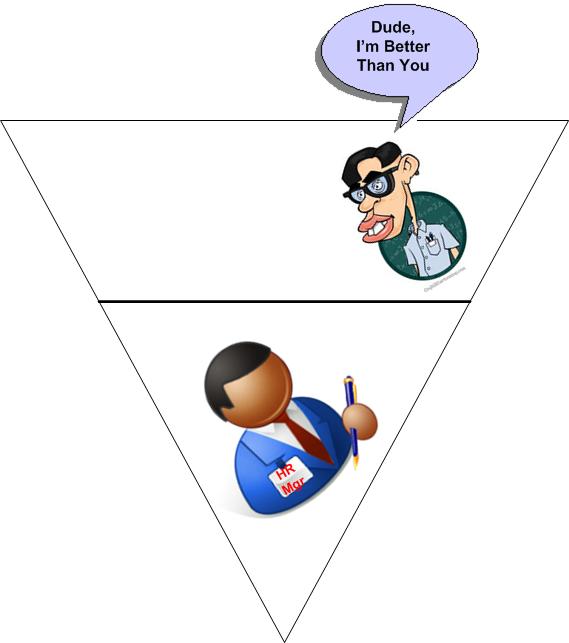
The attempt by the guild of economics to elevate themselves to a level of respect higher than they deserve reminds me of this quote by Sam Culbert about the Gestapo, uh, I mean (in)Human(e) Resource departments in “Get Rid Of The Performance Appraisal” :
So in return for being the cheerleaders for management, the (HR) department that permits management abuse and cleans up after its mistakes, it gets a seat at the big boys’ table.
But so…. freakin’…. what! Every individual, group, and institution has an innate need to survive and thrive before the grim reaper comes a callin’ fer us down the road. It’s simply that the tactics and methods that we use to achieve our needs differ. Obviously, BD00 (and most likely you too) are “above” all the unfairness and inequity in the world. We’re fair and just and we deserve better. We’re not like the guild of economists or the Gestapo HR departments in corpocracies. Damn it, we’re better than “them“! The behaviors we exercise in order to survive and thrive are always noble; never un-noble (cough, cough).
A Hoarrific Failure
Work started (on the 503 Mark II software system) with a team of fifteen programmers and the deadline for delivery was set some eighteen months ahead in March 1965.
Although I was still managerially responsible for the 503 Mark II software, I gave it less attention than the company’s new products and almost failed to notice when the deadline for its delivery passed without event.
The programmers revised their implementation schedules and a new delivery date was set some three months ahead in June 1965. Needless to say, that day also passed without event.
I asked the senior programmers once again to draw up revised schedules, which again showed that the software could be delivered within another three months. I desperately wanted to believe it but I just could not. I disregarded the schedules and began to dig more deeply into the project.
The entire Elliott 503 Mark II software project had to be abandoned, and with it, over thirty man-years of programming effort, equivalent to nearly one man’s active working life, and I was responsible, both as designer and as manager, for wasting it.
The above story synopsis was extracted from Tony “Quicksort” Hoare‘s 1980-ACM Turing award lecture.
Mr. Hoare’s classic speech is the source of a few great quotes that have transcended time:
I conclude that there are two ways of constructing a software design: One way is to make it so simple that there are obviously no deficiencies and the other way is to make it so complicated that there are no obvious deficiencies. The first method is far more difficult…. No committee will ever do this until it is too late.
A feature which is included before it is fully understood can never be removed later.
At first I hoped that such a technically unsound project would collapse but I soon realized it was doomed to success.
The price of reliability is the pursuit of the utmost simplicity. It is a price which the
very rich find most hard to pay.The mistakes which have been made in the last twenty years are being repeated today on an even grander scale. (1980)
Dontcha think that last quote can be restated today as:
The mistakes which have been made in the last fifty years are being repeated today on an even grander scale.
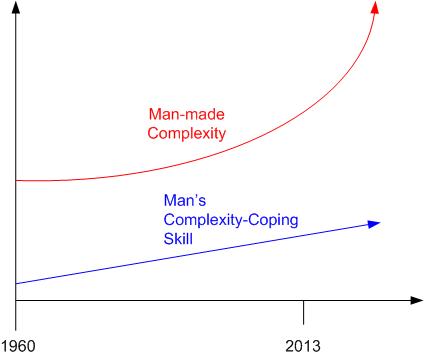
Since man’s ability to cope with complexity is relentlessly being dwarfed by his propensity to create ever greater complexity, the same statement might probably be true 50 years hence, no?
Mulligan!
In golf, when you shank a shot off the tee, sometimes you’re allowed a “Mulligan“. A Mulligan is a “do over” where everyone cheatingly agrees that your first shot never took place and you get to tee off again with no stroke penalty. As you might surmise, I love freakin’ Mulligans; especially when the agreement allows TWO Mulligans per 18 hole round. Whoo Hoo!
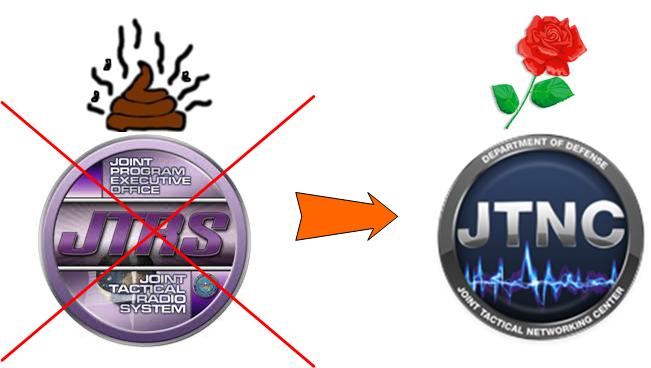
Like the bailed-out principals that ignited the world’s financial meltdown, it looks like the army and its contractor cohorts are getting a Mulligan with the cancelled, 15-year, multi-billion dollar JTRS (Joint Tactical Radio System) program. Everyone involved in the original shank shot gets to wipe the slate clean; the program gets a shiny new name (JTN = Joint Tactical Networks program) to shake off the prior stank; and the players can start gorging on taxpayer money again.
But of course, this next go around will be different – the approach will be “entrepreneurial” despite the fact that all the participants are huge command & control hiermalarkies.
Related articles
- No Lessons Learned (bulldozer00.com)
- No Lessons Learned II (bulldozer00.com)
The Only Process?
While reading Richard Dawkins’s classic book, “The God Delusion“, I found myself pausing after reading this snippet:
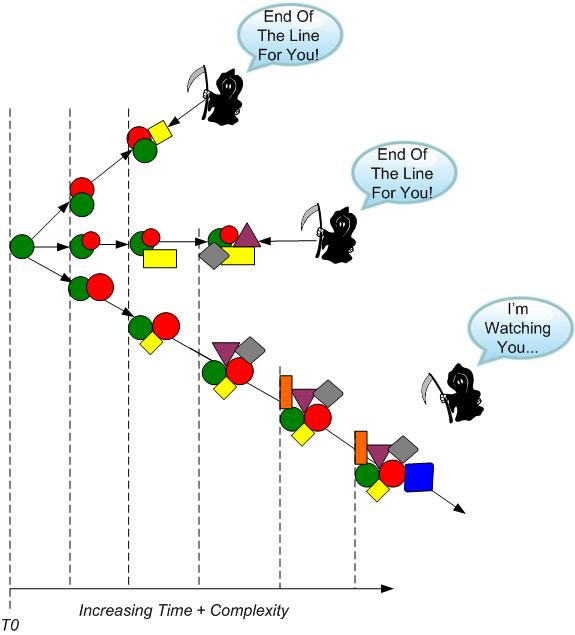
“…natural selection: the process which, as far as we know, is the only process ultimately capable of generating complexity out of simplicity. The theory of natural selection is genuinely simple. So is the origin from which it starts. That which it explains, on the other hand, is complex almost beyond telling: more complex than anything we can imagine…” – Richard Dawkins
Of course, Mr. Dawkins is talking about the evolution of natural, biological systems over time. But isn’t this also true for man-made, socio-technical systems?
Hyped And Valueless
In “Major Software Development Trends for 2013”, the editors of InfoQ asked its readers to rank several software development trends in terms of their “adoption readiness” and the “value proposition” they offer. As you can see below, the 623 voters (so far) think that “the resurgence of C++” is the least valuable and least adoptable among the 16 listed trends.
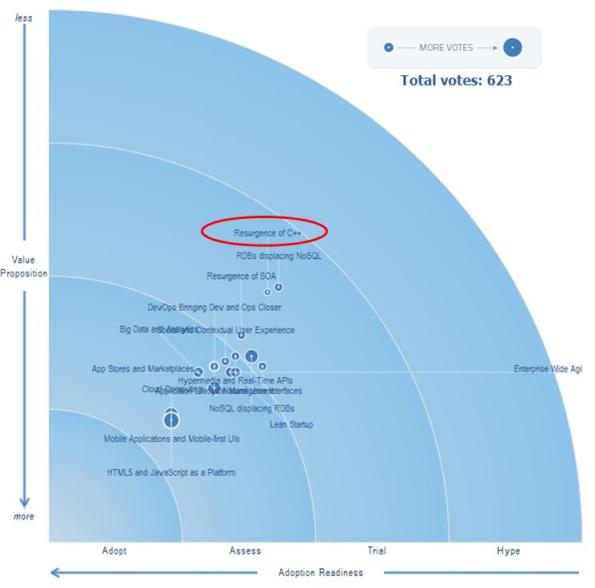
My take, and I fully admit to being totally biased for C++11, is that the vast majority of voters are web, mobile, or IT business application developers. They don’t develop real-time and/or safety-critical systems where C and C++ excel. Hell, just looking at the list of trends, you can tell that they are all geared toward web/mobile/IT applications. But that makes sense because the market for those types of apps dwarfs all others and that’s what’s driving the relentless innovation that keeps the software industry fresh, new, and brutally exciting.

Why am I here?
WTF?
Meh!
D'oh!

My BTC Address



 Bulldozer00's Blog