Archive
Man, These Guys Are Good
In general, I think that management consultants are way overpaid and full of themselves. These bozos with fat heads come waltzing in to a company in trouble and:
- analyze the “situation” from afar without getting their hands dirty,
- dispense all kinds of “proprietary” voodoo advice,
- collect their fee,
- and then bolt – leaving the ineffective corpocrats (who caused the mess in the first place) to clean up their own dung.
Notwithstanding the vitriolic diatribe in the previous paragraph, I think the following consulting dudes are the real deal: Vital Smarts. They’re people-oriented instead of mechanistically process-oriented. Collectively, they’ve talked with tens of thousands of workers; from the dweebs in the cellar to the exalted royalty in the corner of the building. They’ve also analyzed a ton of academic research to derive some down to earth, pragmatic, and potentially actionable direction for everyone – not just the patriarchs who direct the horror show. I’ve read all of their terrific bestselling books:
I’ve actually tried to employ their teachings in an attempt to be more effective in the workplace, but Ive failed miserably. Of course, it’s not their fault. It’s me and my “Unshakeable Cognitive Burden” of negativity toward all man-made command and control hierarchies.
A Professional Failure
I’m a professional failure. Why? Because I’m pretty sure that I’ve never satisfied any unreasonable schedule that I was ever “given” to meet. Since almost all schedules are unreasonable, then, by definition, I’m a professional failure. Hell, it didn’t even matter if I was the one who created the unreasonable schedule in the first place, I’ve failed. Bummer.

Looking back, I think that I’ve figured out why I underperformed (<– that’s management-speak for “failed”). It’s simply that the problem solving projects that I’ve worked on have been grossly underestimated. Why is that? Because they all required learning something new and acquiring new knowledge in the problem area of pecuniary interest.
So, how can you know if a given schedule is unreasonable, and does it matter if you conclude that meeting the schedule is a lost cause? You most likely can’t, and no, it doesn’t matter. Assume that, based on personal experience and a deep “knowing” of what’s involved in a project, you actually can determine that the schedule is a laughable, but innocent, lie. There’s nothing you can do about it. If you speak up, at best, you’ll be ignored. At worst, you’ll receive multiple peek-a-boo visits from one or more STSJs (Status Taker and Schedule Jockey) who don’t have to do any of the project work themselves.
How about you, have you been a perpetual failure like me? Of course not. Your resume says here that you have been 100% successful on every project you’ve worked on; and that implies that you’ve met every schedule. But wait, every other resume in my stack says the same thing. Damn! How am I gonna decide among all of these perfect people who gets the job?
Particular Individuals Don’t Matter
It doesn’t matter who the particular individuals in a corpocracy are. No matter how smart and well meaning they are, the awesome power of the pyramidal structure of woe to suppress their individuality and transform them into zombie clones tasked to guard the status-quo will prevail. How many of you have seen and experienced the ascension of smart, and formerly-effective, people into the ranks of the elite, only to be instantaneously transformed into ineffective druids?

Must Be An Outsider
One must be an outsider to escape being scalded for pointing out problems within a corpocracy. Unlike insiders (except for the obligatory, once a year, watered down employee survey), outsider opinions are actually solicited by the infallible hierarchs (who confidently and assuredly think they run the show). In addition, outsider pundits with “impeccable credentials” actually get paid for their analysis and recommendations! That’s why Weinberg’s “Secrets of Consulting” is in my reading queue.

Sadly, even if the situation on the left in the above diagram never happens in your org, DICs won’t stand up and expose turds that threaten the well being of the corpocracy because the image is dogmatically burned into their mind. There’s a reason why the story of the “emperor’s new clothes” is so funny and well known. The boy who pointed out his “highny”-ness’ s wardrobe malfunction was outside of the emperor’s kiss-ass court. Had he been an insider, it would have been “off with his head”.
Galileo And Kepler
To reinforce my anti-corpocracy UCB (Unshakeable Cognitive Burden), I just finished reading “The Age Of Heretics: A History Of The Radical Thinkers Who Reinvented Corporate Management“. It’s the second time in the last few months that I stumbled across the Galileo-Pope Urban story. The first time was in W. L. Livingston’s forthcoming “Design For Prevention”. Here’s a snippet from “Heretics”:
Why does Galileo Galilei have the reputation of a heretic, while his seventeenth-century fellow scientist Johannes Kepler does not? Because Kepler evaded the Church. Galileo sought to change it. The professor from Pisa spent the last third of his life arguing, with increasing fervor, that the Christian doctrines and even Bibles should be rewritten to conform to the realities he had seen through his telescope. Many of the cardinals and Church officials who censured and imprisoned him recognized the validity of the new cosmology and physics that Galileo championed, but they didn’t want to shake up their system too quickly. Too many monks and village priests clung to Ptolemy and Aristotle. The “people” would rebel at any sudden revision of the “truth.” Galileo didn’t care. Like many other heretics, past and present, he thought at first that the truth would set the institution free. He only had to show people what he had seen, and they would naturally adapt. When people doubted observations that to him were obvious, he lost his tact. He made enemies (some said needlessly) of the Jesuits, who fought bitterly to see him condemned, and he closed one of his notorious tracts, the Dialogue on the Great World Systems, with a snide lampoon of the views of Pope Urban VIII. Until then Urban had been his patron and champion. Ten months after publication in 1633, Galileo was on trial in Rome.

Here’s a snippet that is written further along in the book:
Even the Roman Catholic church eventually admitted that Galileo’s cosmology was correct—after 359 years.

Bummer. Behind the illusory cloak of modern civility, irrational and insane institutional behavior hasn’t changed much over the years. Heretics are still reviled by the bozos in power who will do whatever it takes to retain that power, and more importantly, the personal riches that automatically go along with it. Today’s well meaning but unconscious corpocrats are simply much more clever at veiling the methods that they use to annihilate heretics, even when individual heretics arise from their own ranks. Kepler rules!
Sum Ting Wong
- SYS = Systems
- SW = Software
- HW = Hardware
When the majority of SYS engineers in an org are constantly asking the HW and SW engineers how the product works, my Chinese friend would say “sum ting (is) wong”. Since they’re the “domain experts”, the SYS engineers supposedly designed and recorded the product blueprints before the box was built. They also supposedly verified that what was built is what was specified. To be fair, if no useful blueprints exist, then 2nd generation SYS engineers who are assigned by org corpocrats to maintain the product can’t be blamed for not understanding how the product works. These poor dudes have to deal with the inherited mess left behind by the sloppy and undisciplined first generation of geniuses who’ve moved on to cushy “staff” and “management” positions.
Leadership is exploring new ground while leaving trail markers for those who follow. Failing to demand that first generation product engineers leave breadcrumbs on the trail is a massive failure of leadership.

If the SYS engineers don’t know how the product works at the “white box” level of detail, then they won’t be able to efficiently solve system performance problems, or conceive of and propose continuous improvements. The net effect is that the mysterious “black box” product owns them instead of vice versa. Like an unloved child, a neglected product is perpetually unruly. It becomes a serial misbehaver and a constant source of problems for its parents; leaving them confounded and confused when problems manifest in the field.

A corpocracry with leaders that are so disconnected from the day-to-day work in the bowels of the boiler room that they don’t demand system engineering ownership of products, get what they deserve; crappy products and deteriorating financial performance.
Let’s Be Careful Out There!
Based on a recommendation from fellow whack-job W. L. Livingston, I’m currently trying to read “The Theory Of The Leisure Class” by Thorstein Veblen (cool name, eh?). Man, this guy’s a tough read. The vocabulary that Thor(?) uses and his huge paragraphs often cause my CPU to overheat and spew blue smoke, but the self-imposed intellectual torture is worth the pain.
I love exploring the ideas and thoughts of guys like Veblen because they are so far off the beaten path and mind stretching that they cause new, but previously unused synaptic sub-networks to be instantaneously created in my brain. For me, spiritual and intellectual growth is painful but inspiring. The acts of continuously trying to widen my horizons, destroying old and obsolete mental models, and exposing myself to the ideas of others makes me feel vibrantly alive.
When you consciously choose to explore and probe weird and non-standard ideas that go against the norm, you’ve got to watch out for yourself. Internalizing and then subsequently espousing your new learnings in public can be detrimental to your health. If people are really set in their ways and you don’t take their feelings into account, you could trigger the fight or flight response in them. In one-on-one exchanges, the blowback that you experience may not be so bad. However, publicizing your new thoughts in a meeting with a group of clanthinkers can cause you considerable external and internal damage.
“Let’s Be Careful Out There” – Sergeant Esterhaus

Some Of My Heroes
“We’re just two wild and crazy guys” – Yortuk and Georg Festrunk

Unlike the quote above, Joe Walsh’s “I’m just an ordinary average guy” fits me to a tee. In spite of this, I’d like to think that I’m open to new ideas and thinking. At the moment, here are some of my favorite, inspirational, weird, and forward looking (but pragmatic) thinkers:
- Seth Godin
- Hugh MacLeod
- Clay Shirky
- Chris Guillebeau
- Leo BaBauta
- Paul Graham
- Scott Berkun
- Tony Hseih
- Ricardo Semler
- Joel Spolsky
Check out what one or more of these whack jobs have to say if you’re yearning to explore and discover new opportunities that may crack the concrete in your brain and challenge your same-old, same-old mental models of the world. If you think there is an “edge” to my blarticle posting style, then you should give all the credit to those dudes.
Who are your favorite thinkers, visionaries, and potential status-quo busters? What, you don’t have any? Why not?
Dorkis? Or is it Dorkus?
The other day at the gym, I met a really nice, elderly lady and we started talking about the art of exercise. After a few minutes of chit chat, I introduced myself to her: “My name is Tony“. Then she dropped the bombshell: “I’m Dorkis“. Assuming that she said “Dorothy“, I asked again, and she repeated “Dorkis”. D’oh! WTF? I almost crapped a deuce, but I somehow miraculously kept my composure (which I’m not at all any good at) and didn’t start laughing my ass off.

After she said the D-word, I barely managed to verbalize the response: “Nice to meet you“. Then I automatically went into never-never land and all kinds of stupid jokes and questions spontaneously appeared in my petty little mind:
- “How do you spell that?”,
- “I’m sure that I’ve been called that behind my back”,
- “I’ve called some people that, behind their backs”,
- “Did you ask your parents why they gave you that name?”,
- “What was it like for you when you were growing up?”,
- “Did anyone ever bust a gut laughing just after you introduced yourself to them?”
- “Did you name one of your children Bumpkis?”,
- “Is you last name Asskiss?”.
I honestly didn’t hear a word that she said for the next few seconds until a group of other ladies walked by us and said “Hi Dorkis“.
What’s the funniest name of a person that you’ve met?
My “Status” As Of 09-27-09
I recently finished a 2 month effort discovering, developing, and recording a state machine algorithm that produces a stream of integrated output “target” reports from a continuous stream of discrete, raw input message fragments. It’s not rocket science, but because of the complexity of the algorithm (the devil’s always in the details), a decision was made to emulate this proprietary algorithm in multiple, simulated external environmental scenarios. The purpose of the emulation-plus-simulation project is to work out the (inevitable) kinks in the algorithm design prior to integrating the logic into an existing product and foisting it on unsuspecting customers :^) .
The “bent” SysML diagram below shows the major “blocks” in the simulator design. Since there are no custom hardware components in the system, except for the scenario configuration file, every SysML block represents a software “class”.
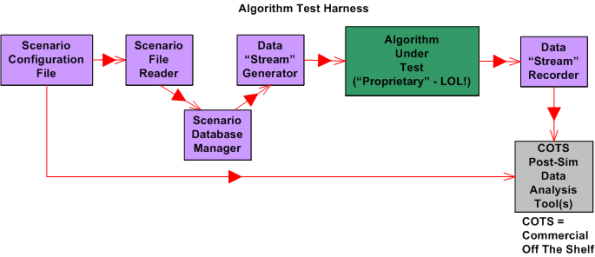
Upon launch, the simulator:
- Reads in a simple, flat, ASCII scenario configuration file that specifies the attributes of targets operating in the simulated external environment. Each attribute is defined in terms of a <name=value> token pair.
- Generates a simulated stream of multiplexed input messages emitted by the target constellation.
- Demultiplexes and processes the input stream in accordance with the state machine algorithm specification to formulate output target reports.
- Records the algorithm output target report stream for post-simulation analysis via Commercial Off The Shelf (COTS) tools like Excel and MATLAB.
I’m currently in the process of writing the C++ code for all of the components except the COTS tools, of course. On Friday, I finished writing, unit testing, and integration testing the “Simulation Initialization” functionality (use case?) of the simulator.Yahoo!
The diagram below zooms in on the front end of the simulator that I’ve finished (100% of course) developing; the “Scenario File Reader” class, and the portion of the in-memory “Scenario Database Manager” class that stores the scenario configuration data in the two sub-databases.

The next step in my evil plan (moo ha ha!) is to code up, test, and integrate the much-more-interesting “Data Stream Generator” class into the simulator without breaking any of the crappy code that has already been written. 🙂
If someone (anyone?) actually reads this boring blog and is interested in following my progress until the project gets finished or canceled, then give me a shoutout. I might post another status update when I get the “Data Stream Generator” class coded, tested, and integrated.
What’s your current status?

Why am I here?
WTF?
Meh!
D'oh!

My BTC Address



 Bulldozer00's Blog