Archive
In Defense Of Incompetence.
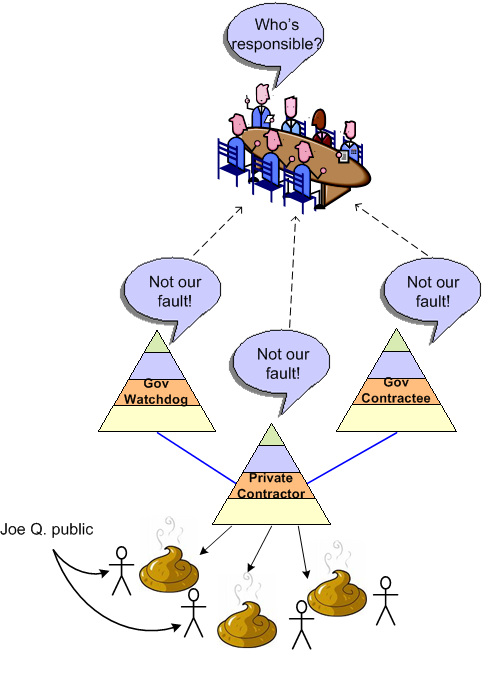
When a government contractor is exposed as incompetent by an external observer (e.g. the press or a civilian group), the government agency that hired them almost always comes to its defense. That shouldn’t be surprising to you because those bureaucratic, and thus, mindless agencies:
- Will do anything to avoid looking incompetent in front of congress for hiring the nin-cum-poops
- Spend other people’s money (yours and mine) instead of their own – and we’re not talkin pocket change here
In addition, the “esteemed” government watchdog agencies (e.g. SEC and FDA and EPA) responsible for ensuring that contractors don’t perpetuate gargantuan disasters make up all kinds of excuses for not detecting the incompetence before massive stakeholder damage has been manifest (lost money, lost lives, lost livelihoods). They do this, of course, because these dudes don’t want to look incompetently asleep at the wheel either.
The system sux and the exhibited behavior is encrusted in its hierarchical, silo+caste system structure that crushes individual conscience. Expect this behavior to go on and on since complexity and the intertwining of interests and agendas will no doubt keep increasing as the world’s population increases. After all, if we can’t fix it, it ain’t broke.
Play ISTY For Me
In my experience, the more raw technical knowledge an engineer acquires, the more the tendency for him/her to drift unconsciously into ego-centricity and arrogance. The more specialized the knowledge, the more the arrogance. Having personally overcome this malady to at least some extent, I’m facing a conundrum with a brilliant younger colleague. The conundrum is how to teach the youngster to internalize a sense of humility while trying to remain somewhat humble myself.
Like many academically smart kids with a few years of programming experience under his belt, this kid knows a lot of details about a few topics in software engineering (if it can be called engineering) along with a few details about a bunch of others – especially more abstract subjects like large scale design and architecture. On the topics he has little knowledge of (but just enough to be dangerous), he makes sweeping generalizations that I know aren’t correct based on my long but undistinguished career. However, when I try to gently poke holes in his sweeping generalizations and assertions, he digs in. I then lose my patience and tend to get sucked into the awful, I’m-Smarter-Than-You (ISTY) game. The irony of the situation is that my young friend doesn’t lose patience and he stays “cooler” than I do while playing ISTY. D’oh! Because of this ability to remain cool, ignorant, and overconfident, he no doubt has the makings of a future bozo-type manager. Alas, I hope he doesn’t choose that path because he is truly a remarkable technical contributor who creates value.
Oh well, life would be boring without challenges (<- that’s bozo-management-speak for “problems”) to overcome.

Call Tree
Check out the call thicket, oops, I mean call tree, below. From the root main() node, you can deduce that the 26 function program is written in C. Actually, there are several more than 26 functions because a few of the functions in the model call other lower level functions not shown in the figure.
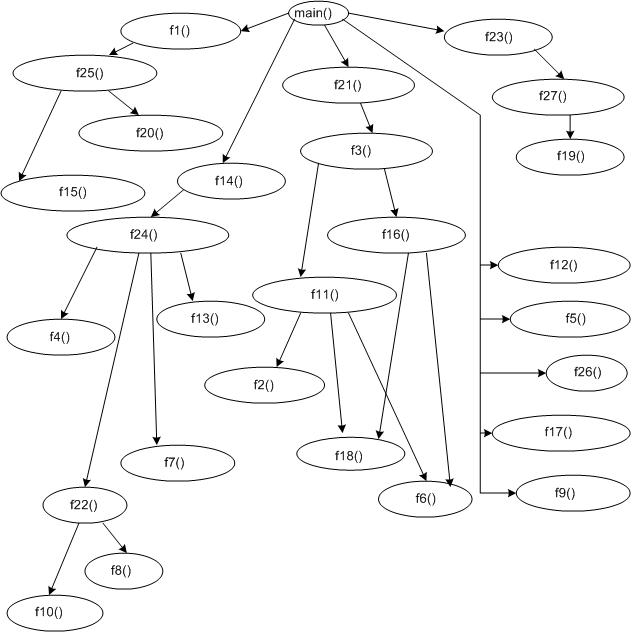
Even though the functions are cloaked in a sequential numbering scheme, they’re not neatly called one right after another. Intertwined between, around, and across the function calls are a bunch of nested if-then and switch-case statements that make the mess more intimidating. Execution path sequencing is controlled by > 20 statically loaded configuration parameters and several dynamically computed control parameters.
I’ve got to transform this beast into an object oriented C++ design and verify that the new design works. Of course, there are no existing unit, integration, or system tests to reuse. Wish me luck!
How Do You Like It?
Stunningly, I was once (and only once) asked by a manager how I liked my raise. It was stunning because I speculate that cosmic events like this rarely happen. Has it ever happened to you?
I told the manager that I was happy to get a raise at all. I also told him that since it was the same amount as the average company given raise, I perceived that he thought of me as an average employee. He, and no other manager has ever asked me for “raise feedback” again.
Of course, fairness and unfairness are in the eye of the beholder, or, in physicist-speak, the “observer”.

The Meeting Surrogate
How’s this for a new product idea, “The Meeting Surrogate“. It’s a gadget that hooks up to your phone and participates in call-in conference meetings for you – freeing you up to do whatever you’d like. When you power it on and press its “Start BS” button, it intelligently monitors the conversations and strategically voices out words and phrases like “uh huh”, “yes – yes”, “I get it”, “very insightful”, “nice”, “understood”, “got it”, at appropriate times during the yawnfest.
“The Meeting Surrogate” is extendable. You could program in catchy new phrases as you think of them when you’re offline. You pre-configure “The Meeting Surrogate” by speaking into it so that it can process and store a replica of the pitch, tone, and inflections of your voice.

Do ya think it would sell to the Dilbert crowd? How much should it cost?
Meetings are a refuge from the dreariness of labor and the loneliness of thinking – Bernard Barush
Past, Present, Future
I can’t remember who said it, but;
Feedback is information given in the present about behavior in the past that can be used to modify behavior in the future.

Just because feedback can be used to modulate future behavior doesn’t mean it actually will be used. Depending on the quality of the relationship between the feedback provider and the feedback receiver, the feedback may be taken to heart or it may be ignored. If the feedback receiver has little respect for the feedback provider, regardless of whether the provider is the receiver’s so-called “superior”, the feedback will be ignored. Oh sure, the receiver’s behavior may appear to superficially change out of fear, but counterproductive behind-the-scenes behavior will be guaranteed if the feedback is delivered as an “or else” ultimatum. On the other hand, if there is a two way connection of respect and trust between provider and receiver, the receiver’s behavior may change – if the receiver agrees with the provider’s assessment and it strikes an emotional chord within the receiver’s being.
Emotional energy, not logical deduction, is the driver of behavior. So stop being puzzled when people don’t behave “logically”.
All My Children
When rearranging the chairs within their stratified and siloed command and control hierarchies fails (and it almost always fails) to improve performance, mechanistically thinking patriarchs often resort to the ubiquitous centralize/decentralize cycle. However, the c/d cycle is also a stone cold loser for improving performance because all it does is spawn mini command and control patriarchies – just like daddy’s. The mindsets of daddy and his sons don’t change, so neither does performance – duh! But hey, at least there’s a lot of action taking place and it looks impressive to outsiders – til the duplication of work and resources is realized and the move back to centralization takes place.

What’s REALLY Required
An understanding and application of “Systems Thinking” are pre-requisites to effective leadership in any large socio-technical group endeavor. Since business schools and pundits teach so-called business skills in disconnected, specialized, fragmented chunks and the primary component of systems thinking is the opposite of this classically entrenched Descartesian way of thinking, effective large scale leadership is nowhere to be found except in rare, small pockets of brilliance.
Systems thinking employs analytical thinking as a subordinate to its opposite – synthetic thinking. Since most (the vast majority of?) elite execs intentionally fragment their time to match their thinking style and they don’t know how to synthesize anything but an inflated and infallible image of themselves, they’re eternally stuck in the quagmire of one dimensional analytical thinking without a clue. But hey, ya gotta give them credit for knowing how to stuff their pockets with greenbacks.

A $1.6M Mistake – And No One Was Fired
The other day, I discovered that a human mistake made on Zappos.com’s sister web site, 6pm.com, emptied the company’s coffers of $1.6 million dollars. Being the class act that he is, here’s what CEO Tony Hsieh had to say regarding the FUBAR:
To those of you asking if anybody was fired, the answer is no, nobody was fired – this was a learning experience for all of us. Even though our terms and conditions state that we do not need to fulfill orders that are placed due to pricing mistakes, and even though this mistake cost us over $1.6 million, we felt that the right thing to do for our customers was to eat the loss and fulfill all the orders that had been placed before we discovered the problem. – Tony Hsieh, CEO, Zappos.com
If this happened at your company, what would your management do? Do ya think they’d look at it as a learning experience?
Besides Zappos.com, here are the other companies that I love. What are yours, and is the company you work for one of them?

DICbox Be Gone!
Check out the “DIC in the box” below. The DICbox is drawn around the DICster because that’s the way BMs dehumanize the person behind the DIC label. They do this, of course, in order to make their so-called job easier and to preclude getting their hands dirty with unimportant people. In a BM’s mechanistic mind, all DICs are the same and they’re interchangeable.
In a corpricracy, DICs are given work to do and, if they’re competent and self-motivated, they create high quality work products that increase the wealth of the corpricracy – in spite of the management chicanery that takes place.
 The figure below shows an expanded DICbox model with a BM integrated into the system. Since the dude is part Bozo, he doesn’t:
- have a clue (or care) what the work is,
- know (or care) what it takes to do the work,
- know (or care) what the work products are, or how to evaluate them.
That’s why there are no connections in the picture traversing from the work products or work definition flows to the BM. Of course, the BM feigns it as best he can and knows some generic technical buzzwords like “requirements”, “analysis”, “design”, etc. To a BM, all technical projects, from web site development to space shuttle development, are the same – a linear, sequential, unchangeable schedule of requirements, design, coding, testing, and delivery.
 Since the BM is in over his head, he must justify his highly compensated existence. He does this via the only option available: behavior watching. Thus, all he essentially does is intently watch for non-conformance of DIC behavior to a set of unwritten and arbitrarily made up corpo rules. He really shines when he detects a transgression and issues the boiler plate “get with the program” speech (a.k.a peek a boo visit) to coerce the DIC back into the box. If that fails, he calls in the big guns – his fellow overhead management dudes in the HR silo. But that’s another story.
OK, OK. So you want to arse me on my own turf and say: “It’s easy to whine and complain about bad management. I’m as good as you are at it.” You follow that up with “How should it be, smarty pants?“. Well here’s one model:
 I don’t think the above model needs to be accompanied with much explanation. However, I do think these caveats should be pointed out:
- The DICbox is gone.
- The “BM” label has been replaced by “Leader”.
- The work is co-defined by the leader and the doer.
- The leader knows what the work products should be (work products = “expected outcomes” in management lingo).
- The leader still watches behavior, not as an end in itself, but as a means to help the doer grow, develop, and succeed.
- The leader does what some people (like me) may consider – real work.

Why am I here?
WTF?
Meh!
D'oh!

My BTC Address



 Bulldozer00's Blog