Archive
D4P Has Been Hatched
Friend and long time mentor Bill Livingston has finished his latest book, “Design For Prevention” (D4P). I mildly helped Bill in his endeavor by providing feedback over the last year or so in the form of idiotic commentary, and mostly, typo exposure.
Bill, being a staunch promoter of SCRBF feedback and its natural power of convergence to excellence, continuously asked for feedback and contributory ideas throughout the book writing process. Being a blabbermouth and having great respect for the man because of the profound influence he’s had on my worldview for 20+ years, I truly wanted to contribute some ideas of substance. However, I struggled mightily to try and conjure up some worthy input because even though I understood the essence of this original work and it resonated deeply with me, I couldn’t quite form (and still can’t) a decent and coherent picture of the whole work in my mind.
D4P is a socio-technical process for designing a solution to a big hairy problem (in the face of powerful institutional resistance) that dissolves the problem without causing massive downstream stakeholder damage. Paradoxically, the book is a loosely connected, but also dense, artistic tapestry of seemingly unrelated topics and concepts such as:
- Alan Turing’s thesis of infallibility vs. intelligence
- Leveraging nature’s physical laws, with a special emphasis on suspending the 2nd law of thermodynamics and entropy growth
- W. Ross Ashby‘s cybernetic law of requisite variety
- Thorstein Veblen’s theory of the leisure class
- Nash Equilibriums in game playing
- Rudolf Starkermann‘s mathematical analysis of social group system behavior
Bill does a masterful and unprecedented job at connecting the dots. The book will set you back, uh, $250 beaners on Amazon.com, but wait….. there’s a reason for that astronomical price. He doesn’t really care if he sells it. He wants to give it away to people who are seriously interested in “Designing For Prevention”. Posers need not apply. If you’re intrigued and interested in trying to coerce Bill into sending you a copy, you can introduce yourself and make your case at vitalith “at” att “dot” net.

Update 12/29/12:
The D4P book is available for free download at designforprevention.com. The second edition is on its way shortly.
Services And Outcomes
In an e-mail from friend and mentor Bill Livingston, he said:
If duty is focused on method and practices, there can be no responsibility either for meeting the objective or for any consequences of services. If goal attainment is chosen paramount, there can be no limitations on methodology. Duty for professional services is given by authority. Responsibility for outcomes must be willingly taken by the designer. – William L. Livingston
Think about how obsessed most companies (especially large ones run by fat heads) are with regard to following standard corpo policies, rules, methods, and practices. In other words, red freakin’ tape. In these abominations that have lost their way, if one is a good soldier and loyally follows the unchangeable rules inscribed in stone by the dudes in the head shed, there can be no repercussions for failure to achieve goals. After all, since the corpocrats created the operational rule set and they’re (of course) infallible, that means the rule set is perfect. Hence, if you follow the rules to the letter but cause a disaster, you’re absolved.

Short Cycle, Long Cycle
Since my memory isn’t that great, I think (but am not sure) that I wrote about short and long cycle run-break-fix before. Nevertheless, I’m gonna do it again because repetition can drive a message home.
In a nutshell, short cycle run-break-fix (SCRBF) and LCRBF are ways of enhancing product quality. High frequency SCRBF iteration jacks up quality by removing errors and fixing design disasters before a product gets shipped to customers. LCRBF is (hopefully) a low frequency technique of error removal after a product has made it into the customer’s hands. In that sense, SCRBF is good and LCRBF is bad. In a perfect world, LCRBF is never needed because the customer gets exactly what he/she wants right out of the shoot.
The figure below depicts side-by-side models of two different company’s day to day operating systems. Which one do you think is more successful? Why do you think the company on the right doesn’t do any SCRBF? Could it be that internal mistakes aren’t tolerated and hence covered up? Do you think it’s innocent ignorance? Do you think it’s because management puts schedule first and quality second – while publicly espousing the opposite? Which model best represents your company’s ingrained way of doing things?
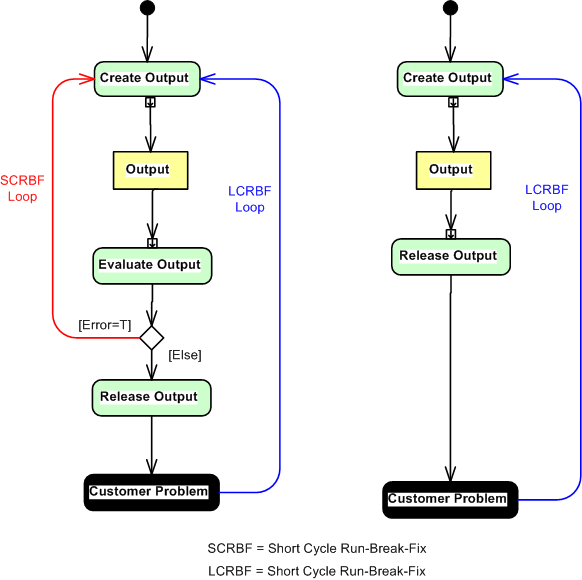
Note: The terms SCRBF and LCRBF were coined by William L. Livingston in his masterful second book, “Have fun at work“.
Trust
In “Design For Prevention” (there’s no link here because the book hasn’t been released yet), friend and mentor Bill Livingston elegantly states:
Trust substitutes for search, negotiation, monitoring, and enforcement; it substitutes for hierarchical control internally and for the legalisms of contracts externally. The core elements of trust include: reciprocity, reputation, and a common semantic.
Reciprocity and reputation align motives, and a common semantic aligns perceptions. People have an innate, passionate desire to contribute, called the instinct of workmanship. Opposing this urge to contribute is fear of rejection, failure, loss, retribution, or embarrassment. Earned trust tips the balance between the urge to contribute and fear. Working in an environment of trust reinforces, validates, and supports trust. – William L. Livingston
The truth in Bill’s words ring loud and clear to me. Trust flattens the hierarchy and nurtures the emergence of a collaborative, wealth creating community. Without trust, a herd-following and hardened mediocracy is guaranteed.
Sadly, because those in the top tiers of CCHs want nothing more than to stay in the penthouse, trust is not allowed within corpocracies. Fine grained, micro-detailed work schedules (that are hopelessly out of date as soon as the ink dries) coupled with useless daily status meetings continuously destroy trust and clearly show “who’s in charge” and who’s supposed to be more important.


Why am I here?
WTF?
Meh!
D'oh!

My BTC Address



 Bulldozer00's Blog