Archive
Layoffs
If you”re familiar with the Zappos.com business success story, you might think that it’s the perfect company. Unlimited growth, unlimited profits, enthusiastic employees, all good and no bad. But did you know that the company had to lay off some of their workforce not once, but twice? The first layoff, which came in the early startup years when they were struggling to survive month to month, was much more understandable than the second layoff, which occurred in 2008 while they were profitable.
When 2008 started, Zappos.com exceeded sales and profit expectations for 2007, so CEO Tony Hsieh and his leadership team decided to dole out a surprise, 10% bonus, to all Zapponians. Incredibly, eight months later he was hatching an e-mail stating that Zappos would be laying off 8% of the workforce. WTF, you ask?
2008 was a whirlwind year. The stock market crashed, the housing market crashed, hundreds of thousands of people were thrown out of work, and businesses everywhere, including Zappos, started reeling from lower sales. Since Zappos was growing like mad up to that point, they discovered that they were overhiring. Even though they weren’t losing money, the Zappos leadership team decided that they had to cut their workforce to better align their costs with decreasing revenues. In Tony’s words from his book “Delivering Happiness“;
Rather than trying to spin the story as a “strategic restructuring” as many other corporations were doing, we stuck by our core values and remained open and honest, not only with our employees, but with the press as well. – Tony Hsieh, CEO, Zappos.com
In November of 2008, Tony sent an e-mail announcing the cuts to all employees and the publicly visible Zappos.com blogs. After the bloodletting was over, he sent a followup e-mail. The full text of both e-mails is in the book, so buy it if you’re curious about what he said to the world.

Extended Business Model
In Zappos.com CEO Tony Hsieh’s new book: “Delivering Happiness“, Tony describes the original Zappos.com business model as “drop-ship”. As the UML sequence diagram below shows, a customer would place an order at the Zappos.com website, Zappos would relay the order directly to the shoe manufacturer’s warehouse, and the order would be fulfilled and shipped directly from ground zero. It was a low cost model for Zappos, but it limited sales growth since many shoe manufacturers didn’t have the information systems in place to execute their end of the model. In addition, sales were limited to the inventory that warehouses held in storage, not necessarily what Zappos’ customers wanted.
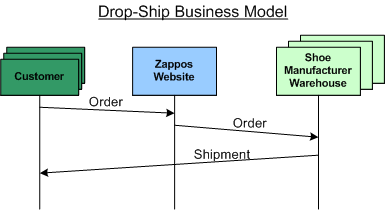
During the initial stage of growth, Zappos.com was often short on cash (surprise!) and often just a month or two away from goin’ kaput (surprise, again!). The Zapponians needed to increase sales in order to increase cash flow. During a brainstorming session in a local bar (not in a committee of BMs, CCRATS, BOOGLs, consultants, and other self-important dudes) they came up with the idea of extending their existing business model.
Man creates by projection, nature creates by extension – Unknown
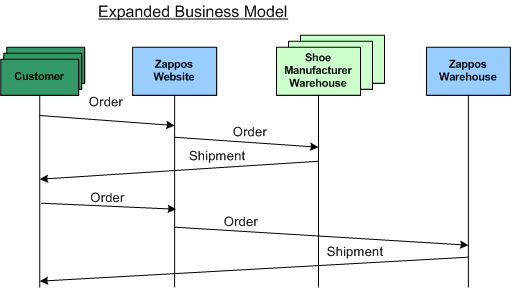
The sequence diagram below shows the extended business model that Tony “chez” et al decided to move toward. In a nutshell, Zappos would purchase or lease a warehouse and stock its own inventory based on trend information extracted from its website. As simple as it looks, the devil is in the details. Buy and read the book to learn how they pulled it off – despite being cash poor and close to going tits-up.
If changing our business model is what’s going to save us, then we need to embrace and drive change. – Tony Hsieh
How many times have you heard or spoken the “embrace change” words above but never experienced or executed any follow through?
Death By A Thousand Cuts
Zappos.com CEO Tony Hsieh has a new book out titled “Delivering Happiness“. Early in this heartwarming and wonderful little tome, he tells the story of the first real company he co-founded – LinkExchange. As LinkExchange grew and became more successful, he turned down offers of $1M (from BigFoot) and then $20M (from Yahoo!) to sell the company. He ended up selling out later for $265M to Microsoft. Tony’s personal take from the sale was a whopping $40M, of which $8M would be forfeited if he didn’t stay on for 1 year after the sale.
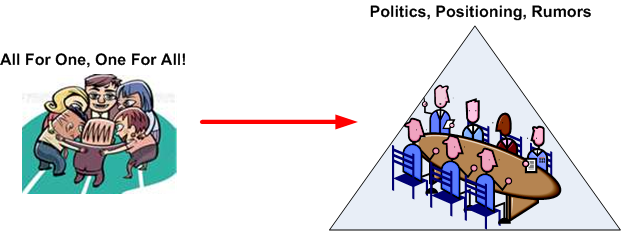
Before the sale of LinkExchange, he woke up one day wondering what happened to the company culture. Tony pondered how the day-to-day culture transformed from a joyous “one for all, and all for one” working environment into one that was dominated by “politics, positioning, and rumors“. He couldn’t put a finger on any one specific event or person(s) as the cause of the deterioration in culture, it was more like “death by a thousand cuts“; an insidious and undetectable rise in malady sustained by some unknown force.
After the sale of LinkExchange, Tony walked away from the company before his contracted year was up, leaving $8M on the table. His reasoning was that he already had plenty of money and his happiness was worth more than the extra $8M. The end of LinkExchange was the start of Zappos.com…..
I had decided to stop chasing the money, and start chasing the passion – Tony Hsieh
A $1.6M Mistake – And No One Was Fired
The other day, I discovered that a human mistake made on Zappos.com’s sister web site, 6pm.com, emptied the company’s coffers of $1.6 million dollars. Being the class act that he is, here’s what CEO Tony Hsieh had to say regarding the FUBAR:
To those of you asking if anybody was fired, the answer is no, nobody was fired – this was a learning experience for all of us. Even though our terms and conditions state that we do not need to fulfill orders that are placed due to pricing mistakes, and even though this mistake cost us over $1.6 million, we felt that the right thing to do for our customers was to eat the loss and fulfill all the orders that had been placed before we discovered the problem. – Tony Hsieh, CEO, Zappos.com
If this happened at your company, what would your management do? Do ya think they’d look at it as a learning experience?
Besides Zappos.com, here are the other companies that I love. What are yours, and is the company you work for one of them?

Spreading Happiness
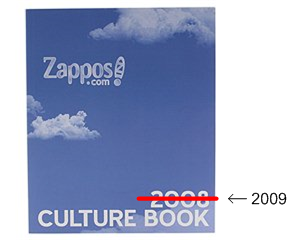
Just like last year, as soon as I heard that Zappos.com’s 2009 culture book was available, I e-mailed the company to get one. Just like last year, I received my free, postage paid copy in the mail three days later. What a great way to spread happiness, no?
Right on page number 1, Zappos CEO Tony Hsieh states:
People may not remember exactly what you did or what you said, but they will always remember how you made them feel.
Who says there is no room in business for emotions? Ninety-nine percent of business schools and business executives do, that’s who: “It’s not personal, it’s business.” Over the years I’ve learned to question the assumptions that institutional bozeltines, oops, leaders operate under. Sadly, I’ve discovered that most of those taken-for-granted, 100 year old assumptions like “the separation of feeling from work” don’t hold true anymore. How about you?
Ya Can’t Put The Cat Back In The Bag
Check out this snippet from “Can Larger Companies Still be Passionate and Quirky?“:
Writing for The New York Times, Adam Bryant conducted an interview with Tony Hsieh, the chief executive of Zappos.com. Part of the interview that intrigued me was Hsieh’s explanation of why he and his roommate sold their company LinkExchange to Microsoft in 1998.
Part of it was the money, he admits. But, mostly, it was because the passion and excitement that permeated the company in the beginning was gone, and he’d grown to dislike its culture:
“When it was starting out, when it was just 5 or 10 of us, it was like your typical dot-com. We were all really excited, working around the clock, sleeping under our desks, had no idea what day of the week it was. But we didn’t know any better and didn’t pay attention to company culture. By the time we got to 100 people, even though we hired people with the right skill sets and experiences, I just dreaded getting out of bed in the morning and was hitting that snooze button over and over again.”
To avoid this happening with Zappos, Hsieh says he formalized the definition of the Zappos culture into 10 core values; core values that they would be willing to hire and fire people based on. Read the interview with Hsieh for details on how they went about this.
With LinkExchange, Tony was wise enough to know that it was fruitless to try and restore the company’s original esprit de corps culture. Once the cat gets out of the bag, it’s pretty much a done deal that you won’t get it back in.
What’s mind boggling to me is that leaders of startups that grow and “mature” over time don’t even have a clue that the vibrant culture of community/comraderie that they originally created has petered out. They get disconnected and buffered from the day to day culture by adding layer upon layer of pyramidal stratification and they delude themselves into thinking the culture has been maintained “for free” over the duration. Those dudes deserve what they get; a transformation from a communal meritocracy into a corpo mediocracy just like the rest of the moo-herd.

Best Of The Best
The breadth of variety of companies, markets, customers, industries, products, and services in the world is so wide and diverse that it can be daunting to develop objectively measurable criteria for “best in class” that cuts across all of the variability.
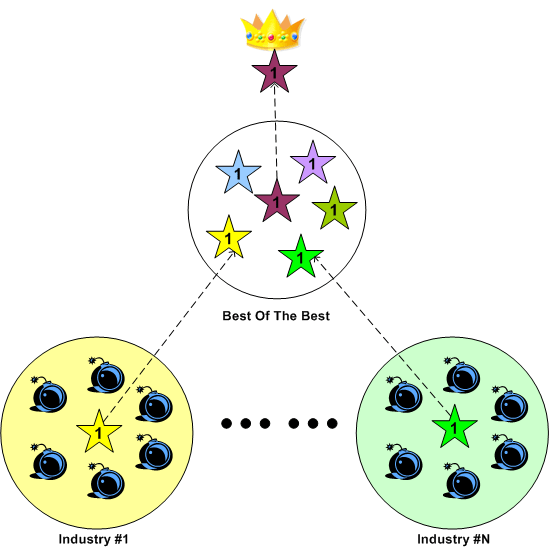
Being a simpleton, my pseudo-measurable criteria for a “best in class” company is:
- Everybody (except for the inevitable handful of malcontents (like me?) found in all organizations) who works in the company sincerely feels good about themselves, their co-workers, the products they build, their customers, and the company leadership.
That’s it. That’s my sole criterion (I told you I was a simpleton). Of course, the classical financial measures like year-over-year revenue growth, profitability, yada, yada, yada, matter too, but in my uncredentialed and unscholarly mind, those metrics are secondary. They’re secondary because good numbers are unsustainable unless the touchy-feely criterion is continuously satisfied.
The dilemma with any kind of “feel good” criteria is that there aren’t many good ways of measuring them. Nevertheless, one of my favorite companies, zappos.com, has conjured up a great way of doing it. Every year, CEO Tony Hsieh sends an e-mail out to all of his employees and solicits their thoughts on the Zappos culture. All the responses are then integrated and published, unedited, in a hard copy “Zappos Culture Book”.
The Zappos culture book is available free of charge to anyone who emails Tony (tony@zappos.com). Earlier this year, I e-mailed Tony and asked for a copy of the book. Lo and behold, I received the 400+ page tome, free-of-charge, four days later. I poured through the 100’s of employee, executive, and partner testimonials regarding Zappos’s actual performance against their espoused cultural values. I found no negative entries in the entire book. There were two, just two, lukewarm assessments of the company’s cultural performance. Of course, skeptics will say that the book entries were censored, and maybe they were, but I doubt it.
How would your company fare if it compiled a yearly culture book similar to Zappos’s? Would your company even entertain the idea? Would anyone feel comfortable proposing the idea? Is the concept of a culture book only applicable to consumer products companies like Zappos.com, or could its value be industry-independent?
Note: Zappos.com was recently bought out by Amazon.com. It should be interesting to see if the yearly Zappos culture book gets squashed by Jeff Bezos et al.
Some Of My Heroes
“We’re just two wild and crazy guys” – Yortuk and Georg Festrunk

Unlike the quote above, Joe Walsh’s “I’m just an ordinary average guy” fits me to a tee. In spite of this, I’d like to think that I’m open to new ideas and thinking. At the moment, here are some of my favorite, inspirational, weird, and forward looking (but pragmatic) thinkers:
- Seth Godin
- Hugh MacLeod
- Clay Shirky
- Chris Guillebeau
- Leo BaBauta
- Paul Graham
- Scott Berkun
- Tony Hseih
- Ricardo Semler
- Joel Spolsky
Check out what one or more of these whack jobs have to say if you’re yearning to explore and discover new opportunities that may crack the concrete in your brain and challenge your same-old, same-old mental models of the world. If you think there is an “edge” to my blarticle posting style, then you should give all the credit to those dudes.
Who are your favorite thinkers, visionaries, and potential status-quo busters? What, you don’t have any? Why not?

Why am I here?
WTF?
Meh!
D'oh!

My BTC Address



 Bulldozer00's Blog