Archive
Self Inquiry
I used to follow a bunch of spiritual and motivational teachers on Twitter, but I’ve “unfollowed” most of them since I didn’t connect much with their tweets – meh. It reached the point where I equated their mostly-boring tweet floods with spam. However, “brite2briter“ hits the sweet spot because her tweets invite her tweetees to practice “self inquiry” like the more well known Byron Katie (Is it absolutely true?) and Ramana Maharshi (Who am I?).
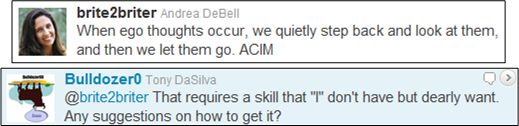
Recently, brite2briter fired off a couple of tweets that hit home. Here they are, along with my replies:

Do these examples do anything fer ya? Too far out and new agey? Meh?
Colored Thinking
In his short and pithy “Six Thinking Hats” book, Edward De Bono describes his structured, but diverse, problem solving method for groups of people who are wrestling with an issue. The picture below summarizes Edward’s six thinking hat colors and the modes of thinking that they represent.

Armed with an understanding of the six thinking hats method, the idea is that a group led by a blue hat facilitator could collectively switch colors and express aligned thinking to explore all aspects of an issue/problem/decision under discussion. The good thing about Mr. De Bono’s method is that it is down-to-earth; it’s easily and quickly learned. It’s not anchored in the latest management jargon du jour and you don’t have to attend a 40 hour elitist university MBA course to absorb the subject matter.
The figure below models a typical six thinking hats use case. The group gathering is framed by “blue hat” thinking book ends. At the start of the discussion, the blue hat wearer (usually the meeting instigator) frames and bounds the gathering with answers to the “why we are here” and “what we’re trying to do” questions. Next, under the fluid direction of the blue hat wearing dude, the group iterates on the issue by collectively switching modes of thinking when deemed necessary. Finally, the blue hat director ends the gathering with the answer to the “what we accomplished here” question – which may or may not be nothing. Simple and doable, no?

By applying the six hats thinking method, the hope is that the mold will be broken on the same-old, same-old, rudderless, alpha-dominated, black-hat-only, egofestive modus of operandi that takes place everywhere in command and control hierarchies across the land:

So, what do you think? Substance or snake oil? If substance, would you try to promote the six thinking hats method in your org? If you think the method has potential but you won’t step up to champion it………. why not?
Cradle To Grave Indoctrination
“Few people are capable of expressing with equanimity opinions which differ from the prejudices of their social environment. Most people are even incapable of forming such opinions.” – Albert Einstein
To me, the second sentence is the most insightful part of this quote. My subjective interpretation is that Einstein discovered that the cradle-to-grave indoctrination of most individuals teaches them to become subservient to the herd mindset prevailing during their time on earth. This indoctrination is so effective and so complete that they don’t have a clue that their capacity to think afresh has been vastly constrained by their social environment. What do you think Einstein meant when he said the words? Your interpretation is as invalid as mine.
I don’t think there’s any conspiracy theory here, it’s just the natural course of development in any society that has been “trained” to revere human-concocted hierarchical structures of governance. I say “human-concocted” because there are no hierarchies in nature. We automatically and impulsively impose hierarchies on everything we observe because that’s the only way we know how to make sense of, understand, and (attempt to) control the world. Building command and control hierarchies and requiring unquestioning subservience to those arbitrarily placed “above” you in the caste system is the way of the human race – today. Do you think this situation will remain that way for your lifetime? How about, forever?

Don’t Sign That Check!
When someone presses your buttons and tries to insult you or your strongly held beliefs, you don’t have to automatically fall into a defensive position and start your own retaliatory offensive onslaught. It’s like the perp has written out a check from your checkbook, but your signature is required for him/her to cash it in.
The trick is to realize the meteoric rise in emotional temperature before your ego, or what Eckhart Tolle calls the pain body, takes over the steering wheel. Alas, even knowing this, I have the hardest time keeping the cap on the pen.

What A Deal!
Do you know those dorky self-promotional license plate holders that car dealers attach to your sparkling new vehicle before you drive it off the lot? Well, the Gold’s gym that I religiously go to has had a stack of them publicly available for sale over the past couple of months. When I first saw them next to the other items for sale, I said to myself:
“WTF? Do the clueless BMs in charge of this place really expect to sell any of those stupid, self-serving contraptions? Hell, even if they offered to pay gym members to take them, they’d still gather dust and waste shelf space until someone in the corpo chain of elites finally took responsibility and owned up to the grumpy they pinched in public.”
About a week ago, management placed the stack of crap right on the check-in counter with a sign that proudly displayed a massive reduction in price from $5 to 1$. What a deal, no?
I finally couldn’t take it anymore and I asked my fellow DIC manning the counter if her management really thought they’d be able to sell those abominations. She said she didn’t know and that she personally hadn’t sold a single one over the time they’d been placed on the market. Surprise!
I left the gym that day suggesting that she tell her bosses that a customer said that they should concentrate more on continuously satisfying their customers instead of thinking of them as moronic walking wallets. As an example of customer satisfaction, I told her to ask “them” if they could refill the woefully deflated balance balls every once in awhile. I even suggested (and it wasn’t the first time) that if they put a pump near the ball rack, I’d fill them occasionally and maybe other users would too. Knowing the typical BM mindset, they probably auto-rejected the idea because they’d be afraid that their “customers” would steal the pump.

How much would you pay for my license plate holder?
Why So Much Overlap?
If, as some spiritualists say, we all create our own unique personal reality, then why is there so much overlapping commonality in what we see, smell, taste, hear and physically feel? Oh sure, there are different levels of pain, different shades of red, etc, but when 1 million people have their thumbs chopped off with a machete, I’ll assert that every single one of them will feel some level of pain and not ecstasy.
If there was no overlap in perception, we’d have nothing in common, right? We’d all be isolated and life wouldn’t be worth living, or would it? Am I taking this topic too literally? If you know the answer to my conundrum, please help me out here. Thanks.

Viable, Vulnerable, Doomed
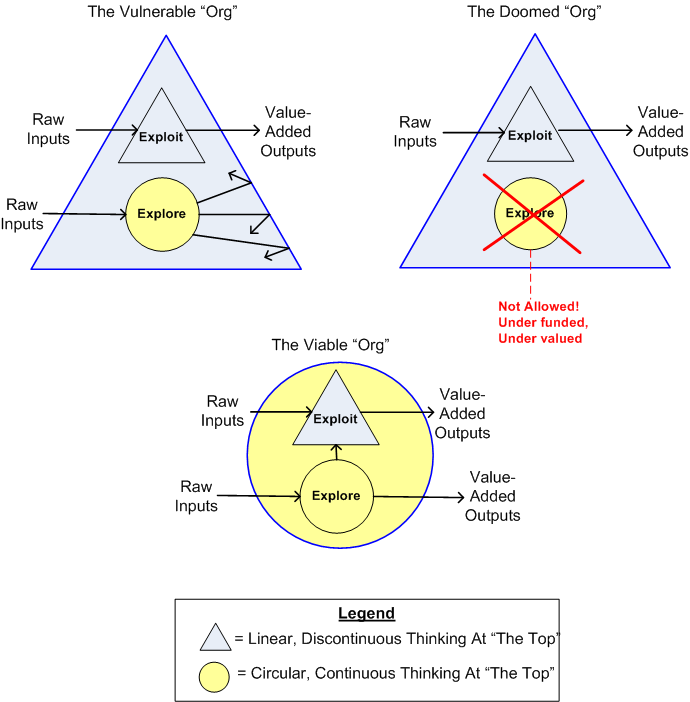
Unless an org is subsidized without regard to its performance (e.g. a government agency, a pure corpocracy overhead unit like HR), it must both explore and exploit to retain its existence. Leaders explore the unknown and managers exploit the known, so competence in both these areas is required for sustained viability.
Exploitation is characterized by linear thinking (projecting future trajectory solely based on past trajectory) and exploration is characterized by loop thinking. Since these two types of thinking are radically different and prestigious schools teach linear thinking exclusively, all unenlightened orgs have a dearth of loop thinkers. Sadly, the number of linear thinkers (knowers) increases and the number of loop thinkers (unknowers) decreases as the management chain is traversed upward. This is the case because linear thinkers and loop thinkers aren’t fond of one another and the linear thinkers usually run the show.
The figure below hypothesizes three types of org systems: vulnerable, doomed, and viable. The vulnerable org has a loop thinking exploration group but most new product/service ideas are “rejected” by the linear thinkers in charge because of the lack of ironclad business cases. Those new product/service ideas that do run the gauntlet and are successful in the marketplace inch the org forward and keep it from imploding. The doomed org has an exploration group, but it’s just for show. These orgs parade around their credentialed rocket scientists for the world to see and hear but nothing of exploitable substance ever comes out of the money sucking rathole. The viable org not only has a productive explorer group, but the top leadership group is comprised of loop thinkers too – D’oh! These extraordinary orgs (e.g. Apple, Netflix, Zappos, SAS) are perpetually ahead of their linear thinking peers and they continually (and unsurprisingly) kick ass in the marketplace.
What type of org are you a member of?
From Searcher To Explorer
Most spiritual teachers advise students to “stop the search!”. Like many other frustrated spiritual aspirants, I don’t know of any other strategy for attaining enlightenment, an awakening, inner peace, relief from suffering, separation from ego, or whatever you want to call it.
To me, “searching” means looking for something specific, like lost keys or oil. Since I don’t have a freakin’ clue as to what “enlightenment” is and I do want to follow the advice of those who purportedly have dissolved the ego (or at least have rid themselves of ego-dominance), I’ve stopped being a searcher. As of today, I’m now (drum roll please) an explorer! Since exploring means probing and sensing for the new and unknown, that’s what I will do from now on.

OK, OK, back to reality. This post is just another self-delusional attempt to fill a new bottle with the same old wine, err, vinegar. Ergo, on with the search!
Thich Nhat Hanh
Thich Nhat Hanh (don’t fret cuz I don’t know how to feakin’ pronounce his name either) is a man with a remarkable story. This gentle Buddhist monk:
- was banished from his homeland, Vietnam, for opposing the war,
- was educated at Princeton and taught at Columbia and Cornell (thus, he’s got “authorized” credentials),
- was the main influencer of Martin Luther King’s stance against the Vietnam war,
- was nominated by Martin Luther King for the Nobel peace prize,
- has written over 100 books (I’ve read “No Death, No Fear“).

In this interview with Oprah, (yes, I’m a girlie-mahn) Oprah Talks to Thich Nhat Hanh, Thich said some Eckhart Tolle-ishly inspiring words:
If you breathe in and are aware that you are alive—that you can touch the miracle of being alive—then that is a kind of enlightenment. Many people are alive but don’t touch the miracle of being alive.
With mindfulness, you can establish yourself in the present in order to touch the wonders of life that are available in that moment. It is possible to live happily in the here and the now. So many conditions of happiness are available—more than enough for you to be happy right now. You don’t have to run into the future in order to get more.
If you are fully present, you need only make a step or take a breath in order to enter the kingdom of God. And once you have the kingdom, you don’t need to run after objects of your craving, like power, fame, sensual pleasure, and so on.
People sacrifice the present for the future. But life is available only in the present.
Deep listening is the kind of listening that can help relieve the suffering of another person. You can call it compassionate listening. You listen with only one purpose: to help him or her to empty his heart.
In the present moment, you are producing thought, speech, and action. And they continue in the world. Every thought you produce, anything you say, any action you do, it bears your signature.
Wonderful stuff, no? When I read words like those, I temporarily experience a bit of internal calm and realize that all “objects” are divine creations of the universe expressing its love for itself. Before “getting it“, I used to blow off spirituality as new age poo-poo and a collosal waste of time. I’m so grateful for my shift in understanding because before I started my quest for spiritual advancement I rarely experienced personal moments of peace.
Some words that Thich spoke in the Oprah interview hit a bit closer to home:
…we have to be ready to release our knowledge in order to come to a higher understanding of reality.
People suffer because they are caught in their views. As soon as we release those views, we are free and we don’t suffer anymore.
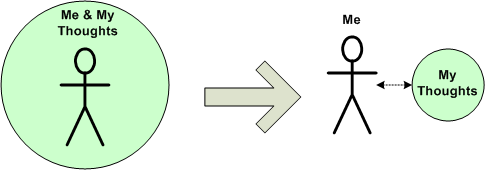
I can confidently say that over the years I’ve gotten better and better at releasing old knowledge, views, and opinions to make room for new and refreshing ones. For the most part, I’m less “binary” and I’m not married to my thoughts. Thus, I don’t suffer as much in terms of anger, anxiety, and fear.
How about you? As you age, are you suffering less and less or more and more? Why?
Data-Meaning-Information
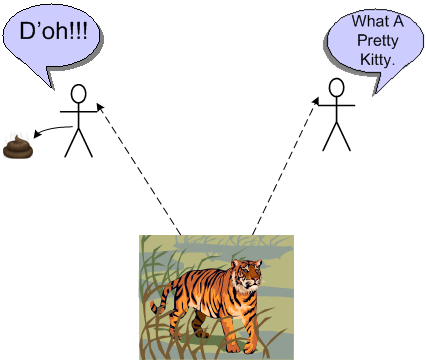
When raw data acquires meaning to someone or some group, it becomes actionable information. Otherwise, it’s just noise.
While reading Melanie Mitchell’s “Complexity: A Guided Tour”, one of the tantalizing questions raised by the author is: “how does raw data acquire meaning?“. I think that’s a cool question and I think the author’s answer is cool too: “data acquires meaning when, after processing, it is perceived by the observer to be connected with the observer’s survival or well being“. Ergo, because all perception is subjective, one man’s meaningless data is another man’s meaningful information. More interestingly, one man’s meaningful information is another man’s different meaningful information.

Why am I here?
WTF?
Meh!
D'oh!

My BTC Address



 Bulldozer00's Blog