Archive
Disengaging
In “We Learn Nothing“, uber-essayist Tim Kreider said something like “it’s sad to see people disengage from life as they get older.” OMG! When I read that, I felt like Timbo had just articulated one of my greatest fears.
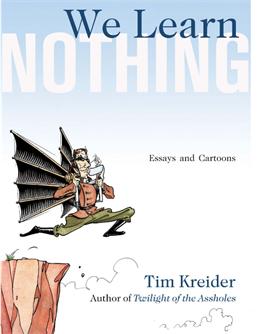
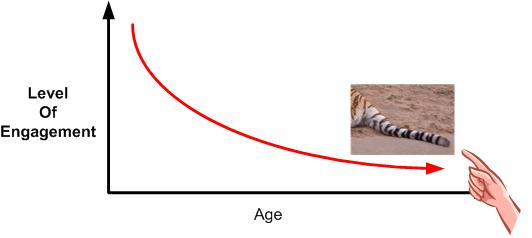
Except for a handful of painful but relatively short times when I’ve totally disengaged from participating in life, I’ve been committed to desperately holding on to the tiger’s tail and racing through the jungle of life with (almost) reckless abandon.
How about you? Do you feel yourself sloooowly disengaging from life as the years tick by? If not, then good for you. If so, then do you think you should wake up and start searching for that tiger tail?
Motorcycle And Software Maintenance
Robert Pirsig’s “Zen And The Art Of Motorcycle Maintenance” is one of my fave books of all time. I have a soft cover copy that I bought in the nineties. Because of its infinite depth and immersive pull, I’ve read it at least three times over the years. Thus, when Amazon.com sent me a recommendation for the kindle version of it for $2.99, I jumped at the chance to e-read it and capture some personally meaningful notes from it.
(Published in 1974) the book sold 5 million copies worldwide. It was originally rejected by 121 publishers, more than any other bestselling book, according to the Guinness Book of Records. – Wikipedia
In a nutshell, ZATAOMM is about a college professor (Pirsig himself) who ends up going insane over his obsession with trying to objectively define what the metaphysical concept of “quality” means.
Quality…you know what it is, yet you don’t know what it is. But that’s self-contradictory. But some things are better than others, that is, they have more quality. But when you try to say what the quality is, apart from the things that have it, it all goes poof! There’s nothing to talk about. But if you can’t say what Quality is, how do you know what it is, or how do you know that it even exists? If no one knows what it is, then for all practical purposes it doesn’t exist at all.
During my fourth read of ZATAOMM, I started noticing how much of the wisdom Mr. Pirsig proffers up applies to the “art” of software development/maintenance:
When you want to hurry something, that means you no longer care about it and want to get on to other things.
This comes up all the time in
mechanicalsoftware work. A hang-up. You just sit and stare and think, and search randomly for new information, and go away and come back again, and after a while the unseen factors start to emerge.Sometimes just the act of writing down the problems straightens out your head as to what they really are.
The craftsman isn’t ever following a single line of instruction. He’s making decisions as he goes along. For that reason he’ll be absorbed and attentive to what he’s doing even though he doesn’t deliberately contrive this. He isn’t following any set of written instructions because the nature of the material at hand determines his thoughts and motions, which simultaneously change the nature of the material at hand.
Any effort that has self-glorification as its final endpoint is bound to end in disaster.
Stuck. No answer. Honked. Kaput. It’s a miserable experience emotionally. You’re losing time. You’re incompetent. You don’t know what you’re doing. You should be ashamed of yourself.
This gumption trap of anxiety, which results from overmotivation, can lead to all kinds of errors of excessive fussiness. You fix things that don’t need fixing, and chase after imaginary ailments. You jump to wild conclusions and build all kinds of errors into the machine because of your own nervousness.
Impatience is close to boredom but always results from one cause: an underestimation of the amount of time the job will take. You never really know what will come up and very few jobs get done as quickly as planned. Impatience is the first reaction against a setback and can soon turn to anger if you’re not careful.
Impatience, stuckness, underestimation, anxiety, and carelessness. These are just a subset of the feelings and behaviors that pervade dysfunctionally soulless organizations whose sole focus is on “following prescribed process and meeting schedule“.

Stingy And Uncooperative
As a temporary reprieve from writing preposterously heretical posts on dysfunctional management and biased opinion pieces on software development, I axed myself: “What different topic can I squirt out into the ether today?” Then, out of nowhere, the eery and scary theme song from the oooold Twilight Zone TV series started playing in my head – doo doo doo doo, doo doo doo doo, doo doo doo doo….. WAAAGH! As a result, I thought: “What is my favorite TV series theme song?“.
After waiting for a slew of other songs to spontaneously start coursing through my diseased neural circuitry in rapid succession, only one other tune started up: the theme from the old “Hawaii Five-O” show – which I don’t even like. Then, a progression of visual snapshots from old TV series like “Lost In Space“, “The Mod Squad“, “All In The Family“, “Sanford & Son“, and “The Jeffersons” appeared. However, except for the latter’s unforgettable but meh “Movin’ On Up” song, the tunes didn’t come along for the ride with the pictures. D’oh!
So, for now, until I can think of a better one (which may be freakin’ never), my fave TV theme song is the theme from……

What is your fave TV theme song? When you came up with it, did your memory freely expose a boatload of candidates, or was it stingy and uncooperative during the search, like mine?
Befuddled

BD00 is be-freakin-fuddled. Out of over 1200+ posts in 3+ years of finger painting “The World According To BD00” on this blawg canvas, the “Accountability” post has gotten the most hits.

The first hypothesis that comes to mind is that everyone is afraid to be held “ACCOUNTABLE!” for their perceived “bad” behaviors, deeds, actions, words. I know I am. Are you? Why do you suppose that post has been pinged more than any other?
Underlying Assumptions
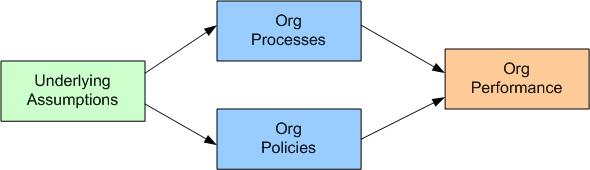
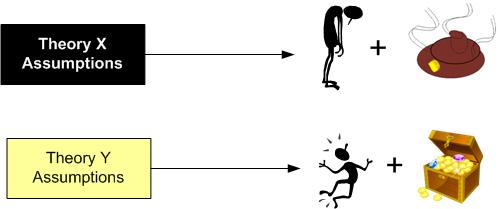
The underlying assumptions harbored by executive decision-makers drive an org’s processes/policies. And those processes/policies influence an org’s social and financial performance. As a rule, assumptions based on Theory X thinking lead to mediocre performance and those based on Theory Y lead to stellar performance. Most org processes/policies (e.g. the annual “objective” performance appraisal ritual) are Theory X based constrictions cloaked in Theory Y rhetoric – regardless of what is espoused.
One Hit, One Miss
In “So Far from Home: Lost and Found in Our Brave New World“, Margaret J. Wheatley hits the mark with BD00:
The interactive nature of the Net distinguishes it from all earlier technologies; from the start, it was based on public interactions, not on private use such as with books or recordings. It fed on two powerful human needs— to be visible and to connect— at a time when we were already feeling lonely and invisible. Our insatiable appetites for self-creation and self-expression have transformed us into twenty-first-century hunter-gatherers. We’ve become addicted to what else we might find, where the next click might lead us, so we incessantly keep hunting.
Meg also misses the mark with:
…we’ve abandoned the thinking skills we humans developed over many centuries of evolution: abstract thinking, nuanced language, envisioning, moral reasoning, the scientific method.
Note that the hit and miss only apply to BD00; according to BD00. How do they apply to you; according to you?

Ignored, Denied, Or Pushed Aside
Fresh from Margaret Wheatley‘s “So Far from Home: Lost and Found in Our Brave New World“, I present you with these four vexing questions:
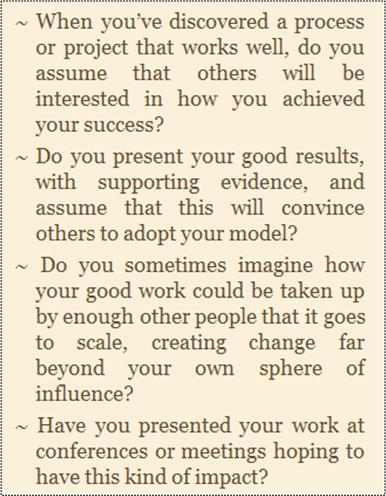
If you answered “yes” to any of these questions and your expectations were met, then you’re incredibly lucky because:
They’re based on an assumption of rational human behavior— that leaders are interested in what works— and that has not proven true. Time and again, innovators and their highly successful projects are ignored, denied or pushed aside, even in the best of times. In this dark era, this is even more true. – Margaret Wheatley
Not that I’m an innovator, but these questions hit me hard because it took decades of disappointment and bewilderment for me to realize that Ms. Wheatley is right. But you know what? Once I became truly aware that “it is the way it is“, I felt liberated. Now I do the work for the work itself. An intimate, joyful communication between the creator and the created.
Holding On For Too Long
I’ve always admired Linus Torvalds. Thus, I found this slashdot.org article, “Linus Torvalds Answers Your Questions“, fascinating. Particularly, this Q & A struck a chord in me:
Q: You must of been burned out on Linux kernel development multiple-times over by now… how do you deal with it?
Linus: Oh, I really enjoy what I do. And I actually enjoy arguing too, and while I may swear a lot and appear like a grumpy angry old man at times, I am also pretty good at just letting things go. So I can be very passionate about some things, but at the same time I don’t tend to really hold on to some particular issue for too long, and I think that helps avoid burn-out.
Obsessing about things is important, and things really do matter, but if you can’t let go of them, you’ll end up crazy.
I’ve found that when I can’t let go of something that “shouldn’t be like it is“, the world suddenly stops. I get stuck; immobilized by a stagnating cesspool of circular thoughts and wondering if I’ll ever get unstuck.

The key for me to getting unstuck and moving forward again is to realize that I can’t control or fix everything to “my” liking. As hard as it is to accept, the world doesn’t exist to accommodate “ME“. Thus, when I can remember it (which is a challenge in itself), my favorite prayer is:
BD00, please grant the “other” BD00 the serenity to accept the things he cannot change,
The courage to change the things he can,
And the wisdom to know the difference.
How about you? Do you ever get stuck? What gets you unstuck?
The Experiences Of Others
When you think “differently” about the world than the majority, there’s a tendency to start feeling isolated and alone. Such is the power of authority and peer pressure to impose thought conformance to the prevailing world view.

When you encounter others, either in person or more likely in prose, whose “different” thoughts overlap with yours, a sense of kinship and belonging, which all human beings crave, blossoms.

Whenever you find that you are on the side of the majority, it is time to reform. – Mark Twain
One of the main reasons I read a lot of non-fictions books and articles is because I love to discover and learn through the direct experiences of others. Because of the constraints imposed by the limits of physical space and time, I cannot do and directly experience everything in all the areas that interest and impact me. Thus, I rely on the written expressions of others to feed my thirst for knowledge, understanding, and wisdom. To do otherwise would be to live life in a closed bubble, devoid of richness and variety.
Bounded Solution Spaces
As a result of an interesting e-conversation with my friend Charlie Alfred, I concocted this bogus graphic:
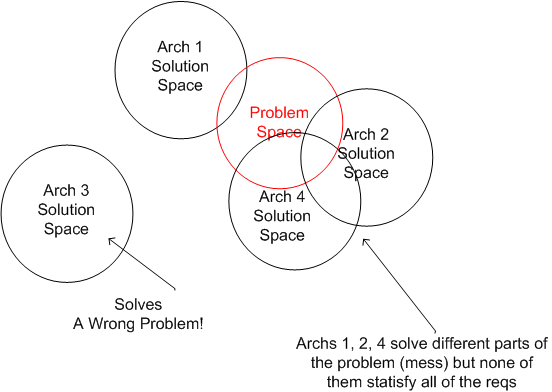
Given a set of requirements, the problem space is a bounded (perhaps wrongly, incompletely, or ambiguously) starting point for a solution search. I think an architect’s job is to conjure up one or more solutions that ideally engulf the entire problem space. However, the world being as messy as it is, different candidates will solve different parts of the problem – each with its own benefits and detriments. Either way, each solution candidate bounds a solution space, no?

Why am I here?
WTF?
Meh!
D'oh!

My BTC Address



 Bulldozer00's Blog