Archive
Roster Of System Thinkers
Someone on Twitter, I can’t remember who, tipped me off to a terrific “Complexity Thinking” Slideshare deck. I felt the need to snip out this slide of system thinkers and complexity researchers to share with you:
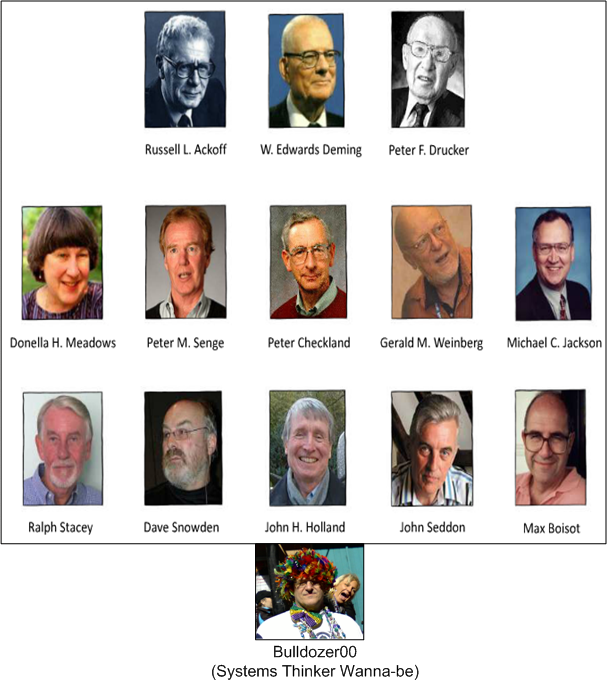
So far, I’ve read some of the work of Ackoff (my fave), Deming, Drucker, Meadows, Senge, Weinberg, and Jackson. In addition, I’ve studied the work of “fringe” system thinkers Rudy Starkermann, John Warfield, Bill Livingston, Ludwig von Bertalanffy, Thorstein Veblen, Ross Ashby, Stafford Beer, and Norby Wiener.
I look forward to discovering what the others on the roster have to say.
Protocol Deterioration
Russ Ackoff once said something like: “A system is not the sum of its parts. It’s the product of its part-interactions“. With that Ackoffism in mind, lo and behold the slooow and relentless process of inter-part protocol deterioration.
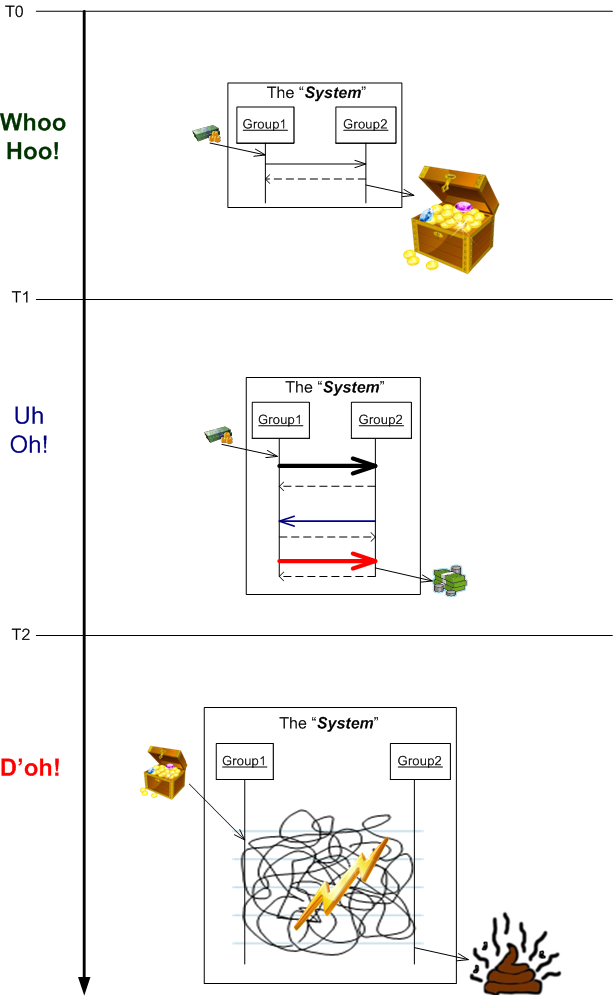
What state are your org protocols in? “Whoo Hoo!“, “Uh Oh!“, “D’oh!“, or “I Dunno!“?
Whole, Part, Purposeful, Unpurposeful
Perhaps ironically, the various branches of “systems thinking” do not have a consensus definition of “system” archetypes. In “Ackoff’s Best”, Russell Ackoff lays down his definition as follows:
There are three basic types of systems and models of them, and a meta-system: one that contains all three types as parts of it. 1. Deterministic: Systems and models in which neither the parts nor the whole are purposeful (e.g. a computer) 2. Animated: Systems and models in which the whole is purposeful but the parts are not (e.g. you or me). 3. Social: Systems and models in which both the parts and the whole are purposeful (e.g. an institution). All three types of systems are contained in ecological systems, some of whose parts are purposeful but not the whole. For example, Earth is an ecological system that has no purpose of its own but contains social and animate systems that do, and deterministic systems that don’t.


But wait! Why are there no Ackoffian systems whose parts are purposeful but whose whole is un-purposeful? Russ doesn’t say why, but BD00 (of course) can speculate.
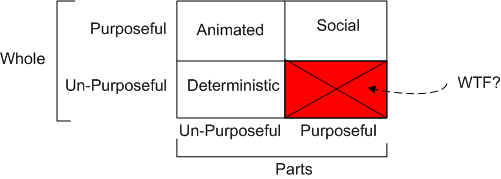 As soon as one inserts a purposeful part into a deterministic system, the system auto-becomes purposeful?
Complementary Views
One classic definition of a system is “a set of interacting parts that exhibits emergent behavior not attributable solely to one part“. An alternative, complementary definition of a system served up by Russell Ackoff is “a whole that is defined by its function in a larger system of which it is a part“.
The figure below models the first definition on the left and the second definition on the right. Neither is “righter” than the other. They, and I love saying this because it’s frustratingly neutral, “just are“.
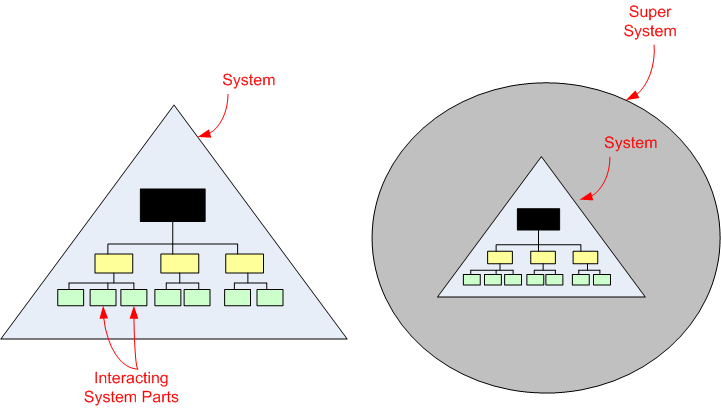
Viewing a system of interest from multiple viewpoints provides the viewer with a more holistic understanding of the system’s what, how, and why. Problem diagnosis and improvement ideas are vastly increased when time is taken to diligently look at a system from multiple viewpoints. Sadly, due to how we are educated, the inculcated tendency of most people is to look at a system from a single, parochial viewpoint: “what’s in it for me?“.
Interdisciplinary Team Effort
Where are the clowns? Send in the clowns. – Shirley Bassey
Messmatiques And Empathic Creators
Assume that you have a wicked problem that needs fixing; a bonafide Ackoffian “mess” or Warfieldian “problematique” – a “messmatique“. Also assume (perhaps unrealistically) that a solution that is optimal in some sense is available:
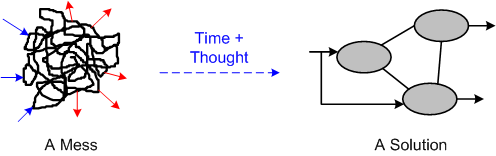
The graphic below shows two different social structures for developing the solution; individual-based and group-based.
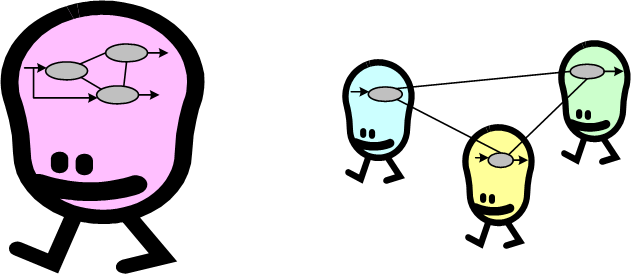
If the messmatique is small enough and well bounded, the individual-based “structure” can produce the ideal solution faster because intra-cranial communication occurs at the speed of thought and there is no need to get group members aligned and on the same page.
Group efforts to solve a messmatique often end up producing a half-assed, design-by-committee solution (at best) or an amplified messmatique (at worst). D’oh!
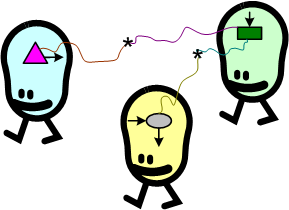
Alas, the individual, genius-based, problem solving structure is not scalable. At a certain level of complexity and size, a singular, intra-cranial created solution can produce the same bogus result as an unaligned group structure.
So, how to resolve the dilemma when a messmatique exceeds the capacity of an individual to cope with the beast? How about this hybrid individual+group structure:
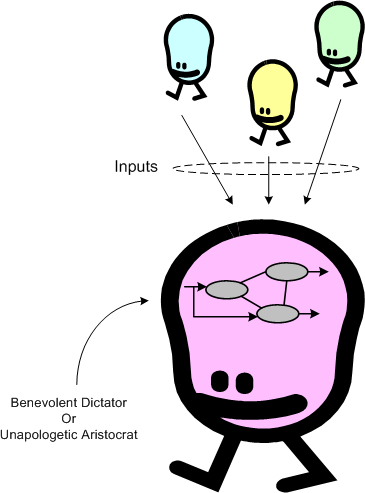
Note: The Brooksian BD/UA is not a “facilitator” (catalyst) or a hot shot “manager” (decider). He/she is both of those and, most importantly, an empathic creator.
Composing a problem resolution social structure is necessary but not sufficient for “success“. A process for converging onto the solution is also required. So, with a hybrid individual+group social structure in place, what would the “ideal” solution development process look like? Is there one?
From Within, From Without
With exceptions (and there are always exceptions) everyone knows that the view “from within” is different than the view “from without“.
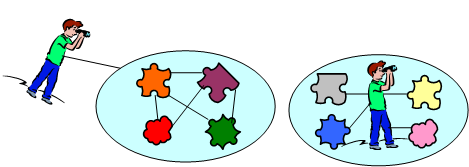
While viewing “from without“, there is typically less emotional attachment of the viewer to the viewed. The more one is attached to the view “from within“, the more difficult it is to extricate oneself from that view and form a secondary view “from without“.
On product development projects, it’s much easier for a project team member to step outside of the intricate details “from within” to form a view “from without” than it is for an “outsider” to form a view “from within“. But just because it’s easier, it doesn’t mean that it’s done often.
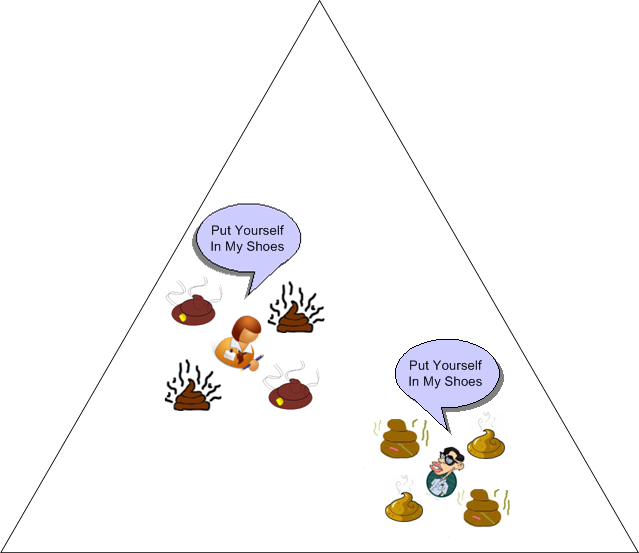
This “from within” and “from without” crap is simply a twist on the old “put yourself in someone else’s shoes” advice…..
Process Delays And Variety Suppression
Even though it’s unrealistically ideal and unworkable, I give you this zero-overhead value and wealth creation system as a point of reference:

For speculative comparison to the idealized design, I give you this system “enhancement“:

For the ultimate delay-inducing, variety-suppressing, and assimilating borg, I give you this “optimal” design:

Over time, as an org unconsciously but almost assuredly morphs into a borg, the existing delay-inducing “value-added overhead processes” grow bigger, and more of them are inserted into the pipeline for sincere but misguided performance-increasing reasons. To add insult to injury, more and thicker variety-suppression control channels are imposed on the pipeline from above. If this rings a bell with you, then it’s pure coincidence, because like all other delusionary BD00 posts, it’s totally made up.
Frag City
As the accumulation of knowledge in a disciplinary domain advances, the knowledge base naturally starts fragmenting into sub-disciplines and turf battles break out all over: “my sub-discipline is more reflective of reality than yours, damn it!“.
In a bit of irony, the systems thinking discipline, which is all about holism, has followed the well worn yellow brick road that leads to frag city. For example, compare the disparate structures of two (terrific) books on systems thinking:
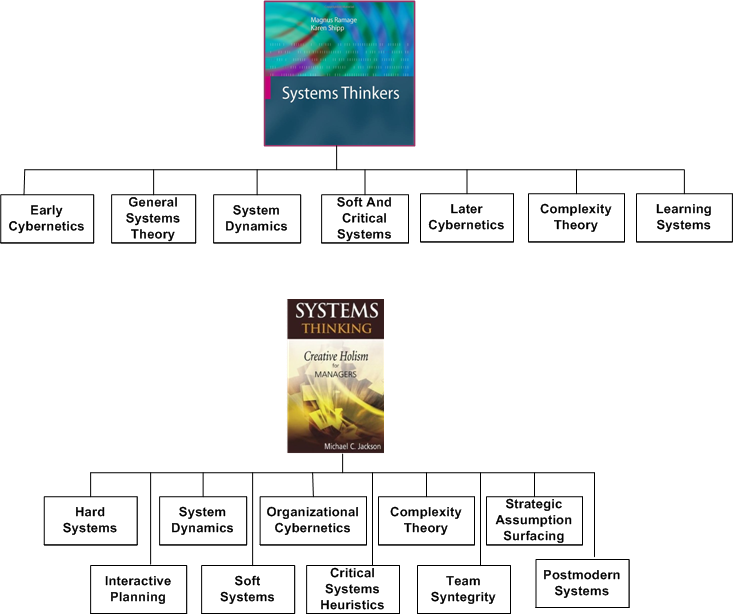
Thank Allah there is at least some overlap, but alas, it’s a natural law: with growth, comes a commensurate increase in complexity. Welcome to frag city…

Filtered And Delayed
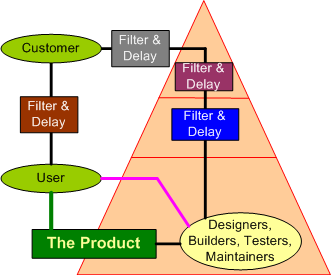
In the consumer products business, the customer and the user are one and the same – a “customoozer“. The figure below shows two system “designs” for a consumer products company. All other things equal, which one has the competitive advantage?

In industries like B2B and government contracting, where the customer and end user are separate entities with differing wants/needs/agendas, the typical institutional design structure is shown below:

It’s no wonder that most innovation occurs in the consumer products industry.
If it could be pulled off, do you think that the subversive system enhancement below could provide a competitive advantage?

Why am I here?
WTF?
Meh!
D'oh!

My BTC Address



 Bulldozer00's Blog