Archive
World Class Help
I’m currently transitioning from one software project to another. After two years of working on a product from the ground up, I will be adding enhancements to a legacy system for an existing customer.
The table below shows the software technologies embedded within each of the products. Note that the only common attribute in the table is C++, which, thank god, I’m very proficient at. Since ACE, CORBA, and MFC have big, complicated, “funky” APIs with steep learning curves, it’s a good thing that “training” time is covered in the schedule as required by our people-centric process. 🙂
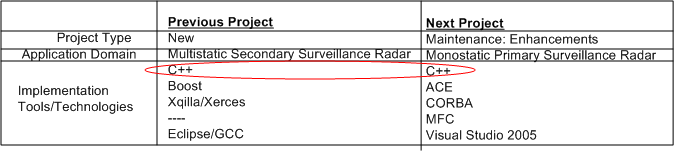
I’m not too thrilled or motivated at having to spin up and learn ACE and CORBA, which (IMHO) have had their 15 minutes of fame and have faded into history, but hey, all businesses require maintenance of old technologies until product replacement or retirement.
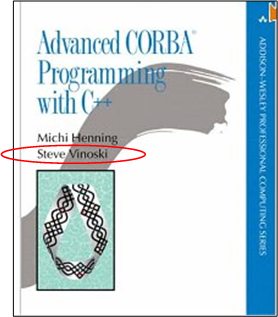
I am, however, delighted to have limited e-access to LinkedIn connection Steve Vinoski. Steve is a world class expert in CORBA know-how who’s co-authored (with Michi Henning) the most popular C++ CORBA programming book on the planet:
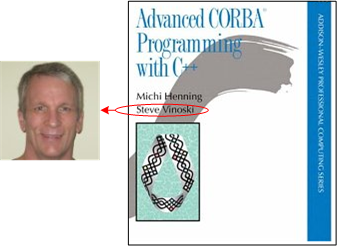
Even though Steve has moved on (C++ -> Erlang, CORBA -> REST), he’s been gracious enough to answer some basic beginner CORBA questions from me without requiring a consulting contract 🙂 Thanks for your generosity Steve!
The Expense Of Defense
The following “borrowed” snippet from a recent Steve Vinoski QCon talk describes the well worn technique of defensive programming:

Steve is right, no? He goes on to deftly point out the expenses of defensive programming:
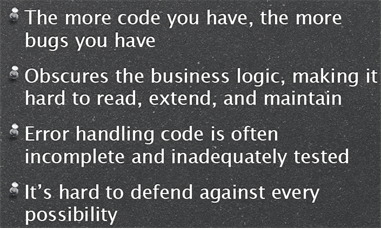
Steve is right on the money again, no?
Erlang and the (utterly misnamed) Open Telecom Platform (OTP) were designed to obviate the need for the defensive programming “idiom” style of error detection and handling. The following Erlang/OTP features force programmers to address the unglamorous error detection/handling aspect of a design up front, instead of at the tail end of the project where it’s often considered a nuisance and a second class citizen:
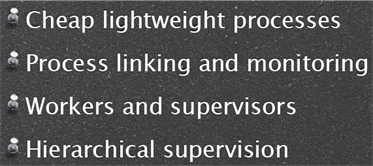
Even in applications where error detection and handling is taken seriously upfront (safety-critical and high availability apps), the time to architect, design, code, and test the equivalent “homegrown” capabilities can equal or exceed the time to develop the app’s “fun” functionality. That is, unless you use Erlang.
A Role Model For Change
In the comments section of the Horse And Buggy post, Steve Vinoski was gracious enough to provide links to four IEEE Computer Society columns that he wrote a few years ago on the topic of distributed software systems. For your viewing pleasure, I’ve re-listed them here:
http://steve.vinoski.net/pdf/IEEE-Serendipitous Reuse.pdf
http://steve.vinoski.net/pdf/IEEE-Demystifying_RESTful_Data_Coupling.pdf
http://steve.vinoski.net/pdf/IEEE-Convenience_Over_Correctness.pdf
http://steve.vinoski.net/pdf/IEEE-RPC_and_REST_Dilemma_Disruption_and_Displacement.pdf
Of course, being a Vinoski fan, I read them all. If you choose to read them, and you’re not an RPC (Remote Procedure Call) zealot, I think you’ll enjoy them as much as I did. To view and learn more about distributed software system design from a bunch of Steve Vinoski video interviews, check out the collection of them at InfoQ.com.
I really admire Steve because he made a major leap out of his comfort zone into a brave new world. He transitioned from being a top notch CORBA and C++ proponent to being a REST and Erlang advocate. I think what he did is admirable because it’s tough, especially as one gets older, to radically switch mindsets after investing a lot of time acquiring deep expertise in any technical arena (the tendency is to dig one’s heels in). Add to that the fact that he worked for big gun CORBA vendor Iona Technologies (which no longer exists as an independent company) during the time of his epiphany, and you’ve got a bona fide role model for change, no?

Horse And Buggy
Werner Vogels is Amazon.com’s Chief Technology Officer and author of the blog “All Things Distributed – Building Scalable And Robust Distributed Systems“. I just couldn’t stop myself from laughing when he announced that fellow distributed-systems guru Steve Vinoski had just joined Twitter:

Specifically, the last sentence put me in stitches. As you can see from the book cover below, Steve is a CORBA expert and way back in the dark ages he was a CORBA advocate. However, he’s moved into the 21st century and left that horse and buggy behind – unlike others who cling to their horse whips and ostracize those who point out the obvious.

Why am I here?
WTF?
Meh!
D'oh!

My BTC Address



 Bulldozer00's Blog