Archive
Taking Stock
Every once in awhile, it’s good to step back and take stock of your team’s accomplishments over a finite stretch of time. I did this recently, and here’s the marketing hype that I concocted:
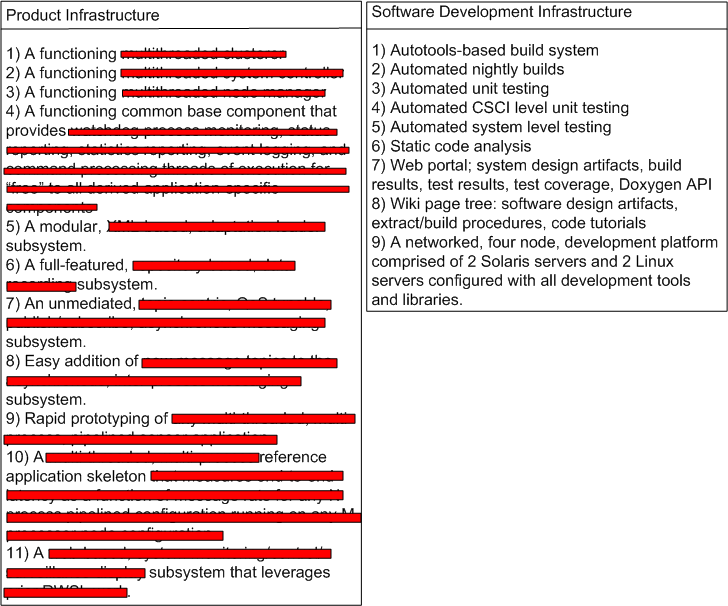
I like to think of myself as a pretty open dude, but I don’t think I’m (that) stupid. The product infrastructure features have been redacted just in case one of the three regular readers of this blasphemous blog happens to be an evil competitor who is intent on raping and pillaging my company.
The team that I’m very grateful to be working on did all this “stuff” in X months – starting virtually from scratch. Over the course of those X months, we had an average of M developers working full time on the project. At an average cost of C dollars per developer-month, it cost roughly X * M * C = $ to arrive at this waypoint. Of course, I (roughly) know what X, M, C, and $ are, but as further evidence that I’m not too much of a frigtard (<- kudos to Joel Spolsky for adding this term of endearment to my vocabulary!), I ain’t tellin’.
So, what about you? What has your team accomplished over a finite period of time? What did it cost? If you don’t know, then why not? Does anyone in your group/org know?
Mangled Model
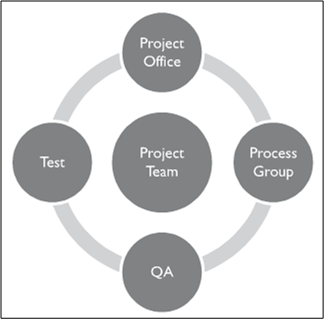
In their book, “Leadership, Teamwork, and Trust: Building a Competitive Software Capability“, Watts Humphrey and James Over model a typical software project system via the diagram below (note that they have separate Quality Assurance and Test groups and they put the “project office” on top).
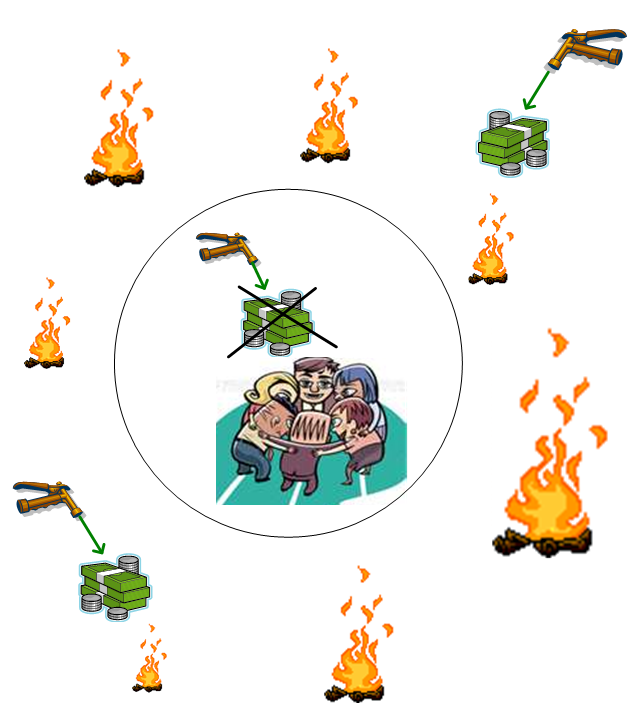
Bulldozer00 would have modeled the typical project system like this:

Of course, the immature and childish BD00 model would be “inappropriate” for inclusion into a serious book that assumes impeccable, business-like behavior and maturity emanating from each sub-group. Oh, and the book wouldn’t sell many copies to the deep pocketed audience that it targets. D’oh!
When The Spigot Runs Dry
It was recently hinted to me that, for a legitimate business reason, the fun and exciting distributed systems IR&D (Internal Research and Development) software project that I’m working on might get canned. I sadly agree that if there are no customers for a product, and day-to-day fires are burning all over the place, it’s most definitely a legitimate business reason to turn off the financial spigot.
In addition to the “hint“, several important technical people have been reassigned to other maintenance projects. Bummer, but shite happens.
Apples And Oranges
In “Leadership, Teamwork, and Trust“, Watts Humphrey and James Over build a case against the classic “Test To Remove Defects” mindset (see the left portion of the figure below). They assert that testing alone is not enough to ensure quality – especially as software systems grow larger and commensurately more complex. Their solution to the problem (shown on the right of the figure below) calls for more reviews and inspections, but I’m confused as to when they’re supposed to occur: before, after, or interwoven with design/coding?
If you compare the left and right hand sides of the figure, you may have come to the same conclusion as I have: it seems like an apples to oranges comparison? The left portion seems more “concrete” than the right portion, no? Since they’re not enumerated on the right, are the “concrete” design and code/build tasks shown on the left subsumed within the more generic “Product Development” box on the right?
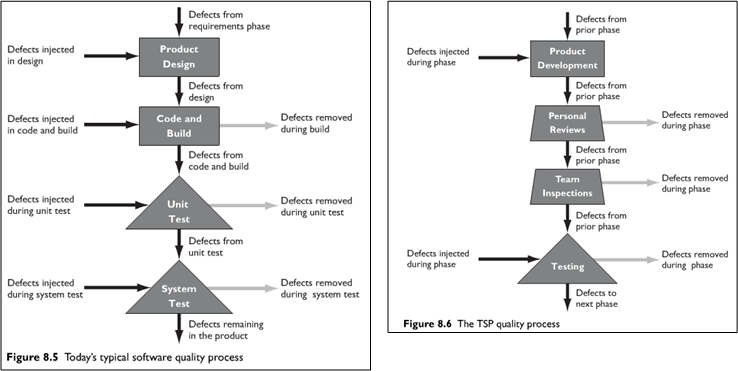
In order to un-confuse myself, I generated the equivalent of the Humphrey/Over TSP (Team Software Process) quality process diagram on the right using the diagram on the left as the starting reference point. Here’s the resulting apples-to-apples comparison:
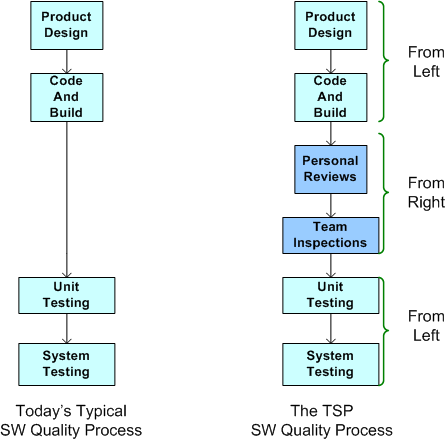 If this is what Humphrey and Over meant, then I’m no longer confused. Their TSP approach to software quality is to supplement unit and system testing with reviews and inspections before testing occurs. I wish they said that in the first place. Maybe they did, but I missed it.
I’ll Have A Double, Please
When you’re given a customer problem:
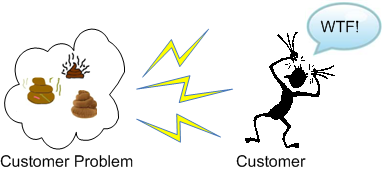
do you create a solution like this:
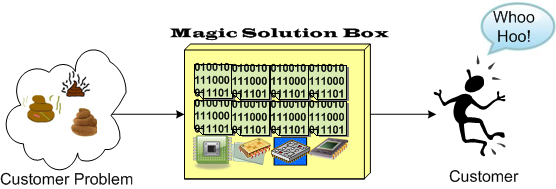
or this:
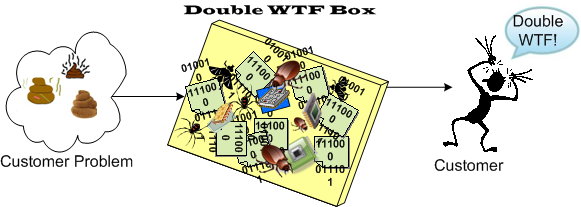
An Answer 10 Years Later
I’ve always questioned why one of my mentors from afar, Steve Mellor, was one of the original signatories of the “Agile Manifesto” 10 years ago. He’s always been a “model-based” guy and his fellow pioneer agile dudes were obsessed with the idea that source code was the only truth – to hell with bogus models and camouflage documents. Even Grady Booch, another guy I admire, tempered the agilist obsession with code by stating something like this: “the code is the truth, but not the whole truth“.
Stephen recently sated my 10 year old curiosity in this InfoQ interview: “A Personal Reflection on Agile Ten Years On“. Here’s Steve’s answer to the question that haunted me fer 10 ears:
The other signatories were kind enough, back in 2001, to write the manifesto using the word “software” (which can include executable models), not “code” (which is more specific.) As such I felt able, in good conscience, to become a signatory to the Manifesto while continuing to promote executable modeling. Ten years on we have a standard action language for agile modeling. – Stephen J. Mellor
The reason I have great respect for Stephen (and his cohort Paul Ward) is this brilliant trilogy they wrote waaaayy back in the mid 80s:
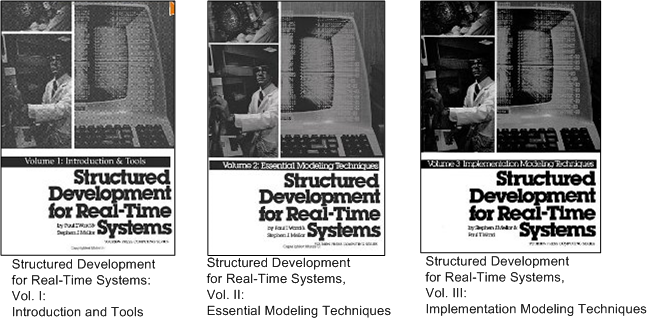
Despite the dorky book covers and the dates they were written, I think the info in these short tomes is timeless and still relevant to real-time systems builders today. Of course, they were created before the object-oriented and multi-core revolutions occurred, but these books, using simple DeMarco/Plauger structured analysis modeling notation (before UML), nail it. By “it”, I mean the thinking, tools, techniques, idioms, and heuristics required to specify, design, and build concurrent, distributed, real-time systems that work. Buy em, read em, decide for yourself, bookmark this post, and please report your thoughts back to me.
Ego And Apathy
The other day, my teammates and I had a short e-discussion on how much ego we should each personally invest in our code base. On the one hand, “no ego” can lead to apathy and a crappy, untended, code base. On the other hand, too much ego can trigger too many confrontational ego-battles and lead to a crappy, colliding styles, code base. We decided that there’s some sweet spot in the middle, but we don’t know what the freak it is. D’oh!
Historically, my personal style has been investing “too much ego“; which manifests as both offensive and defensive behavior. Being a devilishly clever (but certainly not smart) bloke, I’ve spent way more time offending than defending – cuz offense is much more fun to the ego. On the bright side, I think I have been slooowly getting betting over time, but it doesn’t really matter what I think.
How about you? Are you too apathetic? Too ego-dominated? Do you care?

Ammunition Depot
In preparation for a debate, both sides usually spend some time amassing evidence that supports their distorted view of the issue. Well, this post is intended to serve as a repository for my distorted side of an ongoing debate.
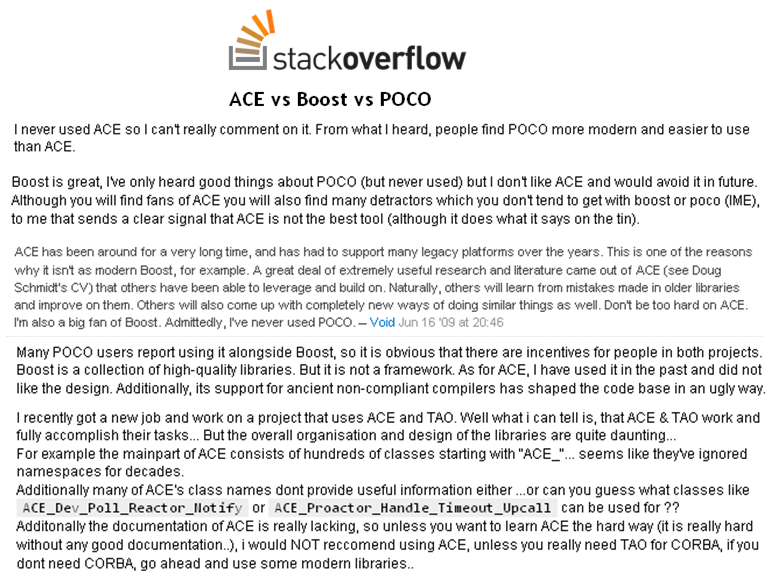
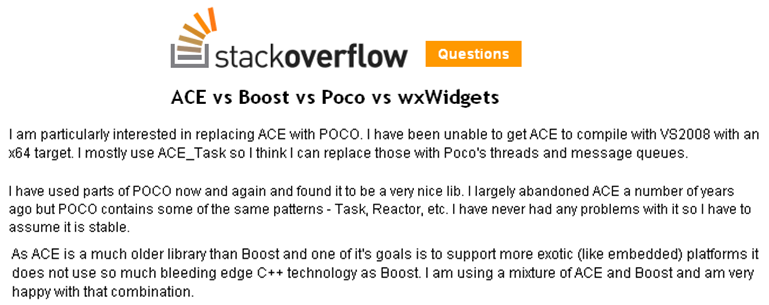
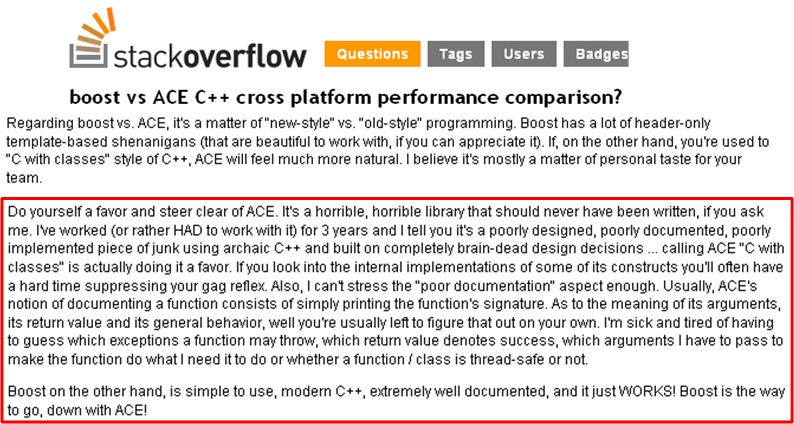
All the above snippets were strategically and carefully culled from various discussions posted on the wonderful Joel Spolsky and Jeff Atwood site: Stackoverflow.com.
Patron Saints
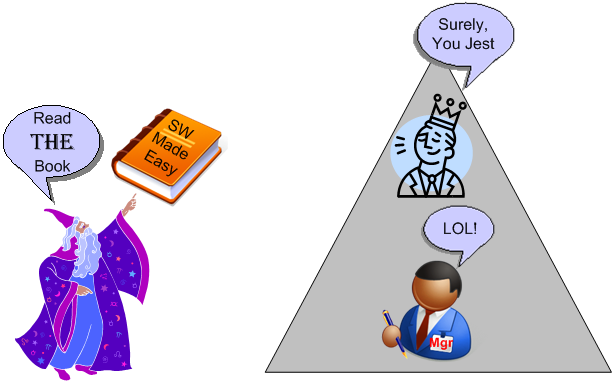
I’m not too fond of books written by experts in a know-it-all, patronizing voice. Check out this blurb from a famous and multi-decorated software management guru:

Besides being targeted at other patronizing know-it-alls by a fellow patronizing know-it-all, one hidden assumption in these words is that “senior executives and managers” actually care about understanding and trying to solve the nasty socio-technical problems that are weaved into the fabric of every large software development project. Another unspoken assumption is that “senior executives and managers“, with their five minute attention spans and disdain for immersive and sustained thinking, would read a whole book – let alone a tome promoting yet another “successful” software development process.
I wish I could follow the sales chart for this book and the hierarchical rankings of those who bought it.

Why am I here?
WTF?
Meh!
D'oh!

My BTC Address



 Bulldozer00's Blog