Archive
Fudge Factors
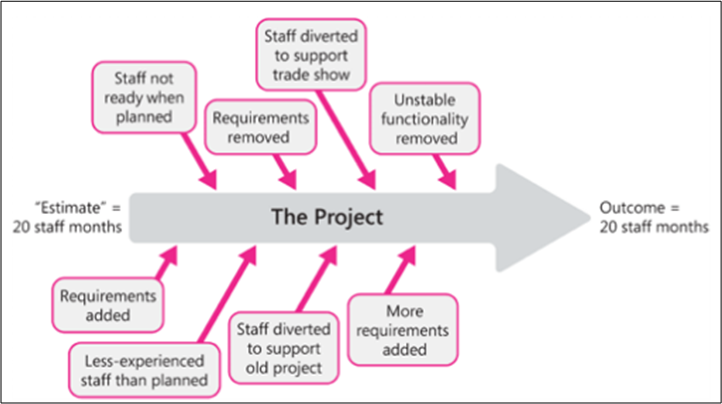
This graphic from Steve McConnell‘s “Software Estimation” shows some of the fudge factors that should be included in project cost estimates. Of course, they never are included, right?
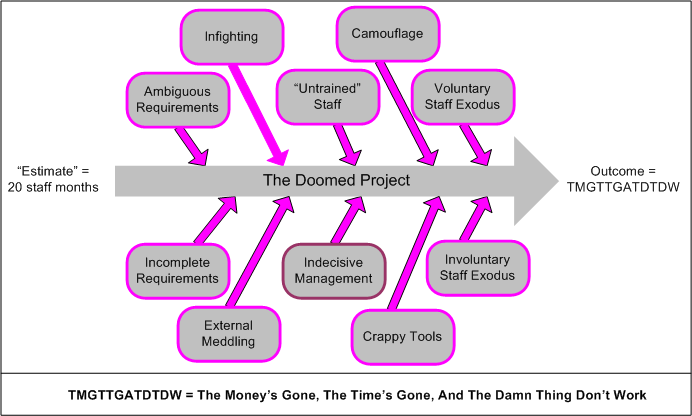
Holy cow, what a coincidence! I happened to stumble upon this mangled version of Mr. McConnell’s graphic somewhere online. D’oh!
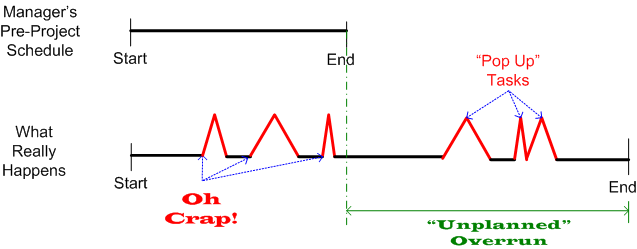
What Really Happens…..
Obsolete, Or Timeless?
Waaay back in 1992, before “agile” and before all the glorious CMM incarnations and before the highly esteemed “PSP/TSP”, NASA’s Software Engineering Laboratory issued revision #3 of their “Recommended Approach To Software Development“. As you can see below, the table of contents clearly implies a “waterfall” stank to their analysis.

But wait! In section 10 of this well organized and well written “artifact“, the members of the writing team summarize what they think were the keys to successful on time and on budget software project success:

What do you think about this summary? Is the advice outdated and obsolete and applicable only to “waterfall” framed projects? Is the advice timeless wisdom? Are some recommendations obsolete and others timeless nuggets wisdom?
Focus And Curiosity
I like using tweets as a source of blog posts. This one by Tom Peters captured my imagination:

Too much vertical focus and there’s no growth or development. Too much horizontal curiosity and there’s no accomplishment. However, the right mix of focus and curiosity provides for both personal growth and accomplishment. As the state transition diagram below illustrates, I always start a new software project in the curious state of “not knowing“. I then transition into the focused state and cycle between the two states until I’m “done“. Don’t ask me how I decide when to transition from one state to the other because I don’t have a good answer. It’s a metaphysical type of thingy.

I start off in the curious state to gain an understanding of the context, scope, and boundaries of my responsibilities and what needs to be done before diving into the focused state. I’ve learned that when I dive right into the focused state without passing through the curious state first, I make a ton of mistakes that always come back to haunt me in the form of unnecessary rework. I make fewer and less serious mistakes when I enter the curious state at “bootup“. How about you?
Since bozo managers in CCH CLORGS are paid to get projects done through others, they implicitly or explicitly assume that there is no need for a curious state and they exert pressure on their people to start right right out in the focused state – and never leave it.
Good managers, of course, don’t do this because they understand the need for the curious state and that dwelling in it from time to time reduces schedule and increases end product quality. Great managers not only are clued into the fact that the curious state is needed at startup and from time to time post-startup, they actually roll up their sleeves and directly help to establish the context, scope, and boundaries of what needs to be done for each and every person on the project. How many of these good and great managers do you know?
“If I had an hour to save the world, I would spend 59 minutes defining the problem and one minute finding solutions” – Albert Einstein
Don’t you think Mr. Einstein spent a lot of time in the curious state?
Formal Review Chain
On big, multi-year, multi-million dollar software development projects, a series of “high-ceremony” formal reviews are almost always required to be held by contract. The figure below shows the typical, sequential, waterfall review lineup for a behemoth project.
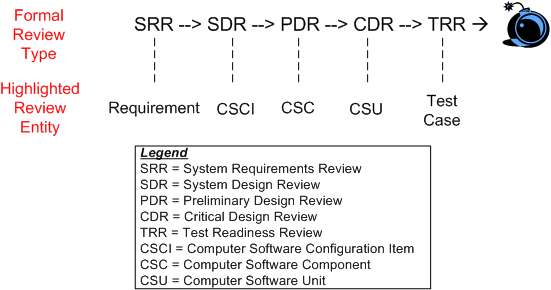
The entity below each high ceremony review milestone is “supposedly” the big star of the review. For example, at SDR, the structure and behavior of the system in terms of the set of CSCIs that comprise the “whole” are “supposedly” reviewed and approved by the attendees (most of whom are there for R&R and social schmoozing). It’s been empirically proven that the ratio of those “involved” to those “responsible” at reviews in big projects is typically 5 to 1 and the ratio of those who understand the technical content to those who don’t is 1 to 10. Hasn’t that been the case in your experience?
The figure below shows a more focused view of the growth in system artifacts as the project supposedly progresses forward in the fantasy world of behemoth waterfall disasters, uh, I mean projects. Of course, in psychedelic waterfall-land, the artifacts of any given stage are rigorously traceable back to those that were “designed” in the previous stage. Hasn’t that been the case in your experience?

In big waterfall projects that are planned and executed according to the standard waterfall framework outlined in this post, the outcome of each dog-and-pony review is always deemed a great success by both the contractee and contractor. Backs are patted, high fives are exchanged, and congratulatory e-mails are broadcast across the land. Hasn’t that been the case in your experience?
No Man’s Land
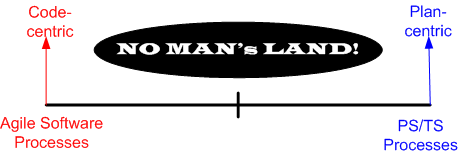
Having recently just read my umpteenth Watts Humphrey book on his PSP/TSP (Personal Software Process/Team Software Process) methodology, I find myself struggling, yet again, to reconcile his right wing thinking with the left wing “Agile” software methodologies that have sprouted up over the last 10 years as a backlash against waterfall-like methodologies. This diagram models the situational tension in my hollow head:

It’s not hard to deduce that prescriptive, plan-centric processes are favored by managers (at least those who understand the business of software) and demonstrative, code-centric processes are favored by developers. Duh!
Advocates of both the right and the left have documented ample evidence that their approach is successful, but neither side (unsurprisingly) willingly publicizes their failures much. When the subject of failure is surfaced, both sides always attribute messes to bad “implementations” – which of course is true. IMHO, given a crack team of developers, project managers, testers, and financial sponsors, ANY disciplined methodology can be successful – those on the left, those on the right, or those toiling in NO MAN’s LAND.
l’ve been the anointed software “lead” on two, < 10 person, software teams in the past. Both as a lead and an induhvidual contributor, the approach I’ve always intuitively taken toward software development can be classified as falling into “no man’s land“. It’s basically an informal, but well-known, Brooksian, architecture-centric, strategy that I’d characterize as slightly right-leaning:
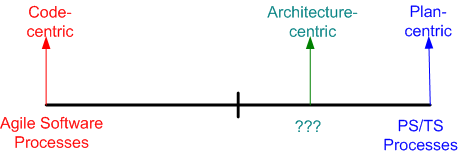
As far as I know, there’s no funky, consensus-backed, label like “semi-agile” or “lean planning” to capture the essence of architecture-centric development. There certainly aren’t any “certification” training courses or famous promoters of the approach. This book, which I discovered and read after I’d been designing/developing in this mundane way for years, sort of covers the process that I repeatedly use.
In my tortured mind (and you definitely don’t want to go there!), architecture-centricity simply means “centered on high level blueprints“. Early on, before the horses are let out of the barn and massive, fragmented, project effort starts churning under continuous pressure from management for “status“, a frantic iterative/sketching/bounding/synthesis activity takes place. With a visible “rev X” architecture in hand (one that enumerates the structural elements, their connectivity, and the macro behavior that the system must manifest) for guidance, people can then be assigned to the sparsely defined, but bounded, system elements so that they can create reasonable “Rev 0” estimates and plans. The keys are that only one or two or three people record the lay of the land. Subsequently, the element assignees produce their own “Rev 0” estimates – prior to igniting the frenetic project activity that is sure to follow.
In a nutshell, what I just described is the front-end of the architecture-centric approach as I practice it; either overtly or covertly. The subsequent construction activities that take place after a reasonably solid, lightweight, “rev X”, architecture (or equivalent design artifact for smaller scale projects) has been recorded and disseminated are just details. Of course, I’m just joking in that last sentence, but unless the macro front end is secured and repeatedly used as the “go to bible” shortly after T==start, all is lost – regardless of the micro-detailed practices (TDD, automated unit tests, continuous integration, continuous delivery, yada yada yada) that will follow. But hey, the content of this post is just Bulldozer00’s uncredentialed and non-expert opinion, so don’t believe a word of it.
Mangled Mess
“Too much documentation can be just as bad as no documentation” – Unknown
Assume that a big software project has chosen to use the three types of databases below to store and maintain technical information about a product under development: planning artifacts, trade studies, requirements artifacts, design artifacts, test cases & results, source code, installation instructions, developer guidance, user guidance.

Unless one is careful in defining and disseminating to the team the “what goes where” criteria, a fragmented and ambiguously duplicitous mass of confusion can emerge quicker than you can say “WTF?“.

Ambivalence
Prominent and presidentially decorated software process guru Watts Humphrey passed away last year. Over the years, I’ve read a lot of his work and I’ve always been ambivalent towards his ideas and methods. On the one hand, I think he’s got it right when he says Peter-Drucker-derived things like:
Since managers don’t and can’t know what knowledge workers do, they can’t manage knowledge workers. Thus, knowledge workers must manage themselves.
On the other hand, I’m turned off when he starts promoting his arcane and overly-pedantic TSP–PSP methodology. To me, his heavy, right wing measurement and prescriptive planning methods are an accountant’s dream and an undue burden on left leaning software development teams. Also, in at least his final two books, he targets his expert TSP-PSP way at “executives, senior managers, coaches and team leaders” while implying that knowledge workers are “them” in the familiar, dysfunctional “us vs. them” binary mindset (that I suffer from too).
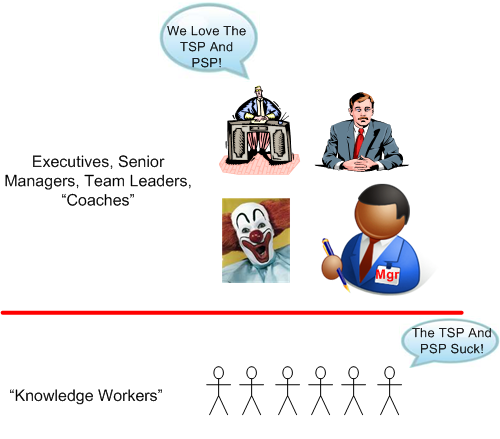 I really want to like Watts and his CMMI, TSP-PSP babies, but I just can’t – at least at the moment. How about you? It would be kool if I received a bunch of answers from a mixture of managers and “knowledge workers“. However, since this blog is read by about 10 people and I have no idea whether they’re knowledge workers or managers or if they even heard of TSP-PSP or Watts Humphrey, I most likely won’t get any. 🙂
Defect Diaries
Once again, I’ve stolen a graphic from Watts Humphrey and James Over’s book, “Leadership, Teamwork, and Trust“:
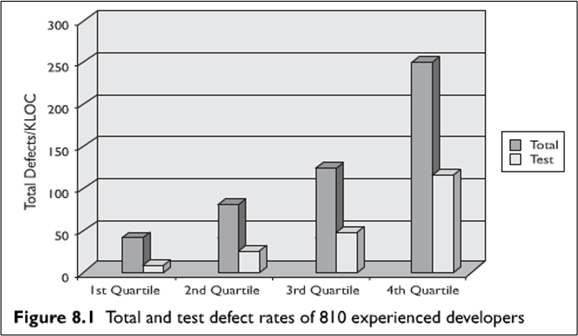
According to this performance chart, the best software developers (those in the first quartile of the distribution) “injected” on average less than 50 bugs (Watts calls them defects) per 1000 lines of code over the entire development effort and less than 10 per 1000 lines of code during testing. Assuming that the numbers objectively and fairly represent “reality“, the difference in quality between the top 25% and bottom 25% of this specific developer sample is approximately a factor of 250/50 = 5.
What I’d like to know, and Humphrey/Over don’t explicitly say in the book (unless I missed it), is how these numbers were measured/reported and how disruptive it was to the development process and team? I’d also like to know what the results were used for; what decisions were made by management based on the data. Let’s speculate…
I picture developers working away, designing/coding/compiling/testing against some requirements and architecture artifacts that they may or may not have had hand in producing. Upon encountering each compiler, linker and runtime error, each developer logs the nature of the error in his/her personal “demerit diary” and fixes it. During independent testing: the testers log and report each error they find; the development team localizes the bug to a module; and the specific developer who injected the defect fixes it and records it in his/her demerit diary.
What’s wrong with this picture? Could it be that developers wouldn’t be the slightest bit motivated to measure and record their “bug injection rates” in personal demerit diaries – and then top it off by periodically submitting their report cards lovingly to their trustworthy management “superiors“? Don’t laugh, because there’s quite a body of evidence that shows that Mr. Humphrey’s PSP/TSP process, which requires institutionalization of this “defection injection rate recording and reporting” practice, is in operation at several (many?) financially successful institutions. If you’re currently working in one of these PSP/TSP institutions, please share your experience with me. I’m curious to hear personal stories directly from PSP/TSP developers – not just from Mr. Humphrey and the CMU SEI.
Procedural, Object-Oriented, Functional
In this interesting blog post, Dr Dobbs – Whither F#?, Andrew Binstock explores why he thinks “functional” programming hasn’t displaced “object-oriented” programming in the same way that object-oriented programming started slowly displacing “procedural” programming in the nineties. In a nutshell, Andrew thinks that the Return On Investment (ROI) may not be worth the climb:
“F# intrigued a few programmers who kicked the tires and then went back to their regular work. This is rather like what Haskell did a year earlier, when it was the dernier cri on Reddit and other programming community boards before sinking back into its previous status as an unusual curio. The year before that, Erlang underwent much the same cycle.”
“functional programming is just too much of a divergence from regular programming. ”
“it’s the lack of demonstrable benefit for business solutions — which is where most of us live and work. Erlang, which is probably the closest to showing business benefits across a wide swath of business domains, is still a mostly server-side solution. And most server-side developers know and understand the problems they face.”
So, what do you think? What will eventually usurp the object-oriented way of thinking for programmers and designers in the future? The universe is constantly in flux and nothing stays the same, so the status quo loop modeled by option C below will be broken sometime, somewhere, and somehow. No?


Why am I here?
WTF?
Meh!
D'oh!

My BTC Address



 Bulldozer00's Blog