Archive
The Missing Role
Quick, quick! What role is missing from the classic Scrum 1.0 team configuration of developers, product owner, and scrum master?

Ooh, ooh, I know what’s missing….

Me thinks version 2.0 of the Scrum guide should include, and formally recognize, the glorious role of Agile Coach, no?
Since the Scrum Master has waaaaaaay to much to do already (running the daily 15 minute meeting and removing all those bazillions of impediments that the whiny developers willingly disclose every day), she can’t possibly fulfill the crucial role of agile coach. In addition to formal recognition, the Scrum Alliance should create a program where aspiring coaches can dole out some $$$$ to get certified.
Planet Agile
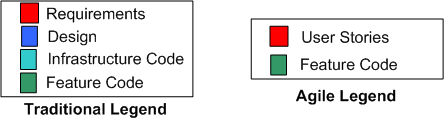
Because methodologists need an “enemy” to make their pet process look good, Agilistas use Traditional methods as their whipping boy. In this post, I’m gonna turn the tables by arguing as a Traditionalista (yet again) and using the exalted Agile methodology as my whipping boy. First, let’s start with two legends:
Requirements And User Stories
As you can see, the Agile legend is much simpler than the Traditional legend. On planet Agile, there aren’t any formal requirements artifacts that specify system capabilities, application functions, subsystems, inter-subsystem interfaces/interactions, components, or inter-component interfaces/interactions. There are only lightweight, independent, orthogonal, bite-sized “user stories“. Conformant Agile citizens either pooh-pooh away any inter-feature couplings or they simply ignore them, assuming they will resolve themselves during construction via the magical process of “emergence“.
Infrastructure Code And Feature Code
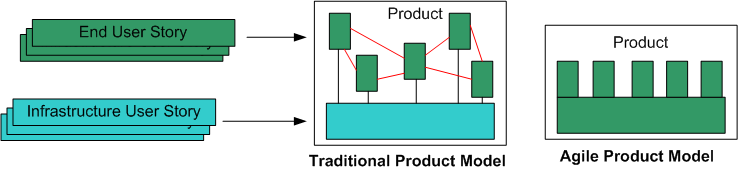
Unlike in the traditional world, in the Agile world there is no distinction between application-specific Infrastructure Code and Feature Code. Hell, it’s all feature code on planet Agile. Infrastructure Code is assumed as a given. However, since developers (and not external product users) write and use infrastructure code, utilizing “User Stories” to specify infrastructure code doesn’t cut it. Perhaps the Agilencia should rethink how they recommend capturing requirements and define two types of “stories“: “End User Stories” and “Infrastructure User Stories“.
Non-Existent Design
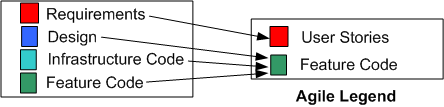
Regarding the process of “Design“, on planet Agile, thanks to TDD, the code is the design and the design is the code. There is no need to conceptually partition the code (which is THE one and only important artifact on planet Agile) beforehand into easily digestible, visually inspect-able, critique-able, levels of abstraction. To do so would be to steal precious coding time and introduce “waste” into the process. With the exception of the short, bookend events in a sprint (the planning & review/retrospective events), all non-coding activities are “valueless” in the mind of citizen Agile.
No Front End
When asked about “What happens before sprint 0?”, one agile expert told me on Twitter that “agile only covers software development activities“.
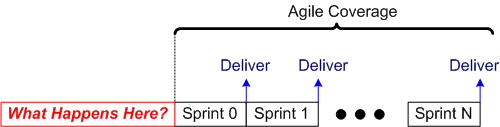
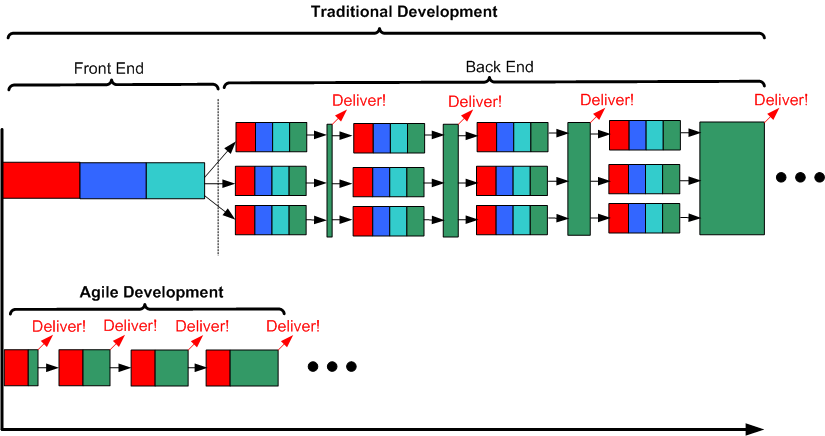
As the process timeline template below shows, there is no Sprint -1, otherwise known as “the Front End phase“, on planet Agile. Since the Agile leadership doesn’t recognize infrastructure code, or the separation of design from code, and no feature code is produced during its execution, there is no need for any investment in any Front End work. But hey, as you can plainly see, deliveries start popping out of an Agile process way before a Traditional process. In the specific example below, the nimble Agile team has popped out 4 deliveries of working software before the sluggish Traditional team has even hatched its first iteration. It’s just like planet Agile’s supreme leader asserts in his latest book – a 4X productivity improvement (twice the work in half the time).
Process Scalability
The flexible, dare I say “agile“, aspect of the Traditional development template is that it scales down. If the software system to be developed is small enough, or it’s an existing system that simply needs new features added to it, the “Front End” phase can indeed be entirely skipped. If so, then voila, the traditional development template reduces to a parallel series of incremental, evolutionary, sprints – just like the planet Agile template – except for the fact that infrastructure code development and integration testing are shown as first class citizens in the Traditional template.
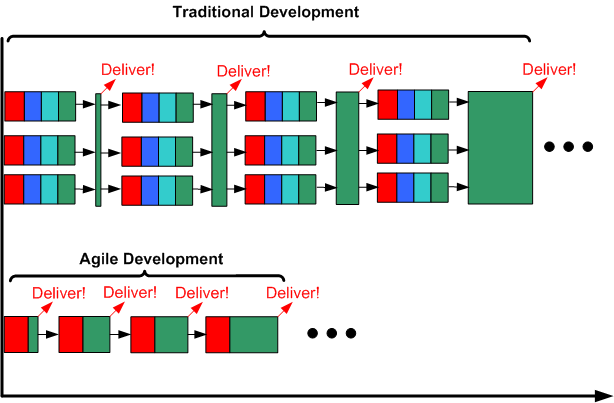
On the other hand, the planet Agile template does not scale up. Since there is no such concept as a “Front End” phase on planet Agile, as a bona fide Agilista, you wouldn’t dare to plan and execute that phase even if you intuited that it would reduce long term development and maintenance costs for: you, your current and future fellow developers, and your company. To hell with the future. Damn it, your place on planet Agile is to get working software out the door as soon as possible. To do otherwise would be to put a target on your back and invite the wrath of the planet Agile politburo.
The Big Distortion
When comparing Agile with Traditional methods, the leadership on planet Agile always simplifies and distorts the Traditional development process. It is presented as a rigid, inflexible monster to be slain:
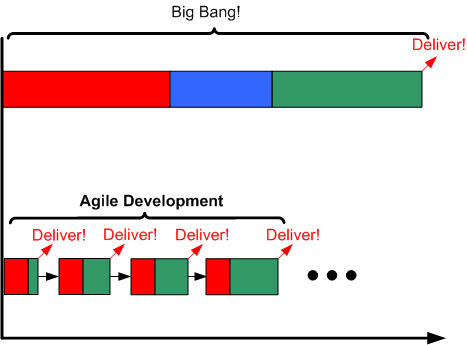
In the mind of citizen Agile, simply mentioning the word “Traditional” conjures up scary images of Niagara Falls, endless BRUF (Big Requirements Up Front), BDUF (Big Design Up Front), Big Bang Integration (BBI), and late, or non-existent, deliveries of working software. Of course, as the citizenry on planet Agile (and planet Traditional) knows, many Traditional endeavors have indeed resulted in failed outcomes. But for an Agile citizen to acknowledge Agile failures, let alone attribute some of those failures to the lack of performing any Front End due diligence, is to violate the Agile constitution and again place herself under the watchful eye of the Agile certification bureaucracy.
The Most Important Question
You may be wondering, since I’ve taken on the role of an unapologetic Traditionalista in this post, if I am an “Agile-hater” intent on eradicating planet Agile from the universe. No, I’m not. I try my best to not be an Absolutist about anything. Both planet Agile and planet Traditional deserve their places in the universe.
Perhaps the first, and most important, question to ask on each new software development endeavor is: “Do we need any Front End work, and if so, how much do we need?”
Ill Served
You’ve been ill served by the software industry for 40 years – not purposely, but inextricably. We want to restore the partnership. – Ken Schwaber

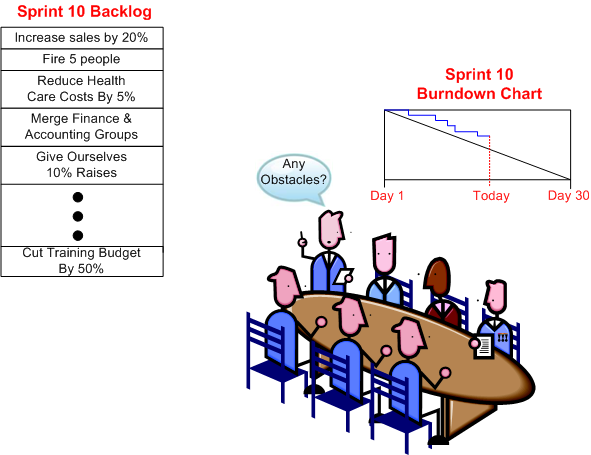
Scrumming For The Corner Office
Note1: This bogus post was inspired by Bertrand Meyer’s book: “Agile!“. Specifically, the juice is squeezed from chapter 2: “Deconstructing Agile Texts“.
Business gurus love to fabricate crises and instill fear in their deep-pocketed C-level executive clients so they can pitch their latest idea (at $2000/day plus expenses) to “reinvent management!”
Steve Denning is a big-league business management guru, ala Gary Hamel, Tom Peters, Ken Blanchard, Bob Sutton, etc. Even though Mr. Denning has no software background, he somehow got into Jeff Sutherland’s refrigerator and managed to drink a whole pitcher of “agile” koolaid with nary a burp.
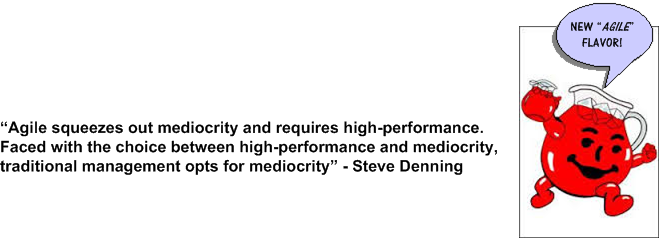
In a brilliant marketing move to distance himself from his peers, Steve has jumped on the “agile” bandwagon. He’s been busy advocating the migration of Scrum out of the software development trenches; up the ladder and into the corner office we go. I can visualize it: CEO as Certified Product Owner, COO as Certified Scrum Master, and the rest of the C-suite as second-class, uncertified, “developers“. (Why is there no certification program for developers?)
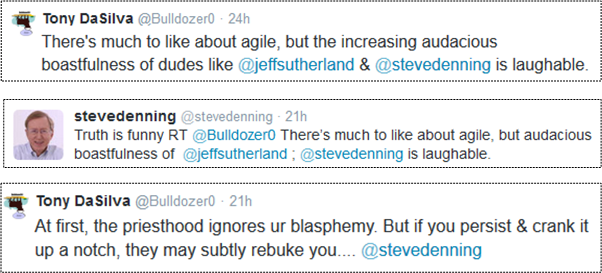
In closing out this post, I’d like to share with you this brief twitter exchange between Mr. Denning and the lowly BD00 :
Note2: I actually like many of Steve’s ideas: “Who’s Left Standing?“, “Salesmen And Accountants“.
The Five Secrets
Here’s your miserable predicament:

Here’s what Scrum can give you:

All ya gotta do to transform your 20th century horse and buggy into a 21st century Ferrari is hire a gaggle of agile coaches, agile scalers, and agile adoption experts to facilitate the much-heralded transformation:
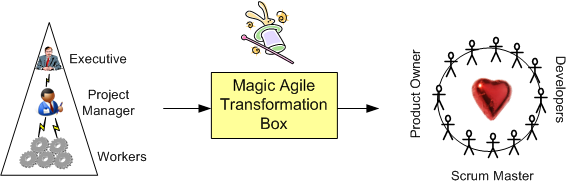
So, what’s in da magic box? Shhhhhhh! BD00 knows. That scoundrel signed an NDA and successfully bribed some well-known, high profile, agile transformers into disclosing their 5 process secrets. Four of them consist of the following parallel micro-transformations:

The fifth transformation process component is the most important and well-guarded secret of the lot. BD00 had to pay an extra premium before it was disclosed. It is hoodwinking the eager sponsor into believing that the transformation was an astounding success:
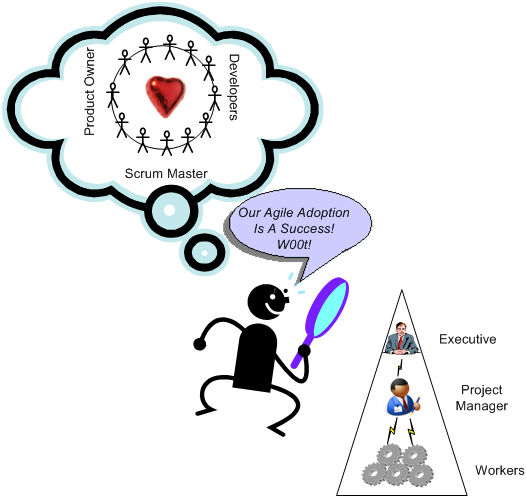
After all was said and done, more was said than done.
Four Days And $2000
I get e-mails like this all the time:

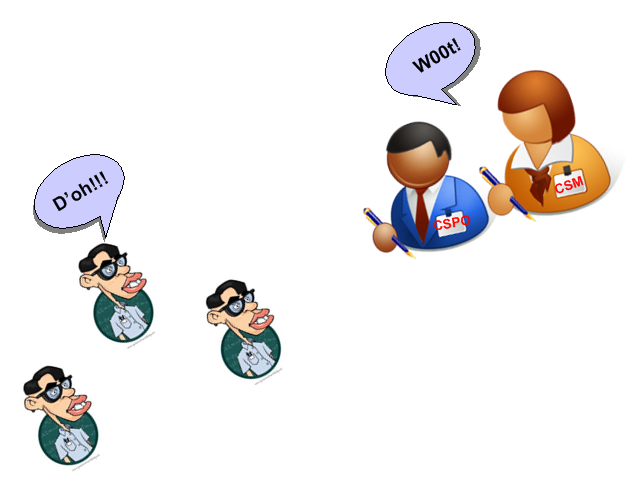
In four fun-filled days, and for a measly $2000, you too can become a full fledged, CERTIFIED Scrum Master AND Scrum Product Owner. That’s all it takes to catapult you to the top of the software development world. W00t!
Why spend weeks or months struggling to learn a new language, API, framework, technology, or tool when you can nail this trifecta: leapfrog over your programmer peers, break into the highly coveted guild of management, and prefix a big fat “C” to your title? Quick, quick, jump on the bandwagon before it’s too late. Don’t get left behind!
The Last Retrospective
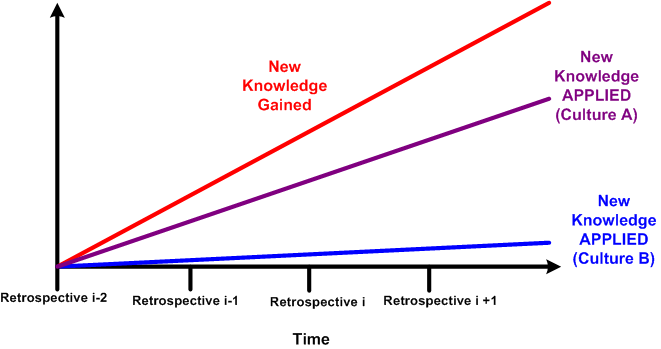
In an ongoing agile endeavor, the practice for eliciting and applying freshly learned knowledge going forward is the periodic “retrospective” (aka periodic post-mortem to the “traditional” old fogeys). Theoretically, retrospectives are temporary way points where individuals: stop, step back, cerebrally inspect what they’ve accomplished and how they’ve accomplished it, share their learning experiences, suggest new process/product improvements, and evaluate previously implemented improvements.
As the figure below depicts, the fraction of newly acquired knowledge applied going forward is a function of group culture. In macho, command and control hierarchies like culture B, the application of lessons learned is suppressed relative to more flexible cultures like A due to the hierarchical importance of opinions.
Regardless of culture type, during schedule-challenged projects with a fixed, do-or-don’t-get-paid deadline (yes, those projects do indeed still exist), this may happen:
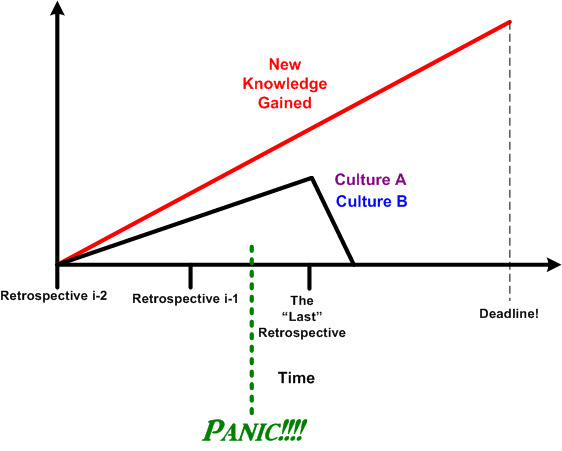
When the elites upstairs magically determine that a panic point has appeared (sometimes seemingly out of nowhere): retrospectives get jettisoned, the daily standup morphs into the daily inquisition, corner-cutting “practices” become best practices, and the application of newly acquired knowledge stops cold. Humans being humans, learning still naturally occurs and new knowledge is accrued. However, it is not likely the type of knowledge that will help on future projects.
Importance Of Opinion
Regardless of whether a project is managed as an agile or traditional endeavor, it is well known that the execution team learns and acquires new knowledge as the project lurches forward. It is also well known that individual team members learn and formulate opinions that may be at odds with each other.
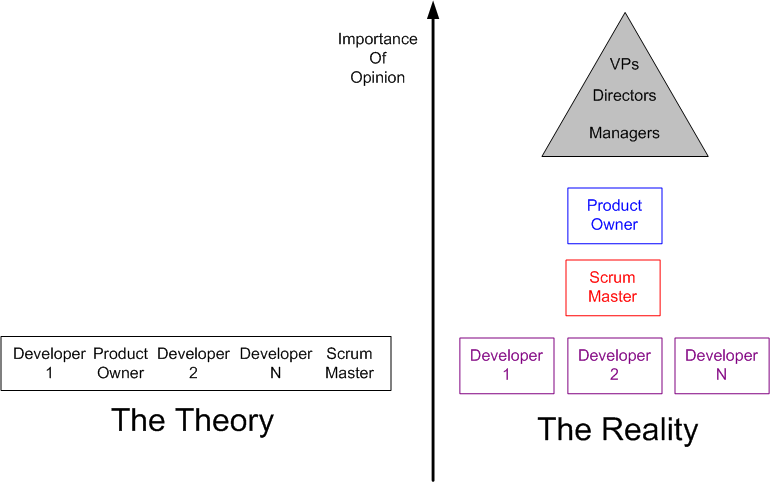
In spite of the “we’re all (equal)” scrum mantra, some individual opinions will always be “more important” than others in a hierarchy… because that’s what a social hierarchy does (POSIWID). The taller the hierarchy, the larger the gap of importance between opinions. And the larger the gap of importance between opinions, the lesser the chance that a diverse subset of newly acquired knowledge will be applied to future project activities.
The figure below shows two concepts of “Importance Of Opinion“. On the left, we have the Scrum ideal – we’re all one and all opinions carry the same weight. On the right, we have the reality. The opinions within the pyramid of elite titles strongly influence/skew/suppress the PO’s opinions, the PO does the same to the SM, and the SM does the same to the group of DEVs. Even within the so-called flat structure of the DEVs, all opinions are not created equal.
Variable Sized MWs
Rewritten in “old school” terminology, the five Scrum process events can be expressed as follows:
- Sprint Planning = Requirements definition and capture
- Sprint = Requirements analysis, design, coding, unit testing, integration testing, code review
- Daily Stand Up = Daily status meeting
- Sprint Review = Post-mortem
- Sprint Retrospective = Continuous process improvement
So, someone with an intentionally warped mind like BD00 may interpret a series of Scrum sprints as nothing more than a series of camouflaged Mini-Waterfalls (MW).
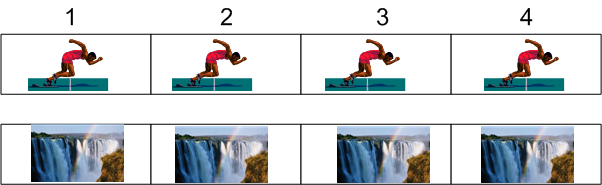
But ya know what? Executing a project as a series of MWs may be a good thing – as long as an arbitrary, fixed-size, time-box is not imposed on the team. After all, since everything else is allowed to dynamically change during a Scrum project, why not the size of the Sprint too?

Instead of estimating what features can be done in the next 30 days, why not simply estimate how many days will be needed to complete the set of features that marks the transition into the next MW? If, during the MW, it is learned that the goal won’t be achieved, then in addition to cancelling the MW outright, two other options can be contemplated:
- Extend the length of the MW
- Postpone the completion of one or more of the features currently being worked on
Scrummin’ For The Ilities
Whoo hoo! The product owner has funded our project and we’ve spring-loaded our backlog with user stories. We’re off struttin’ and scrummin’ our way to success:
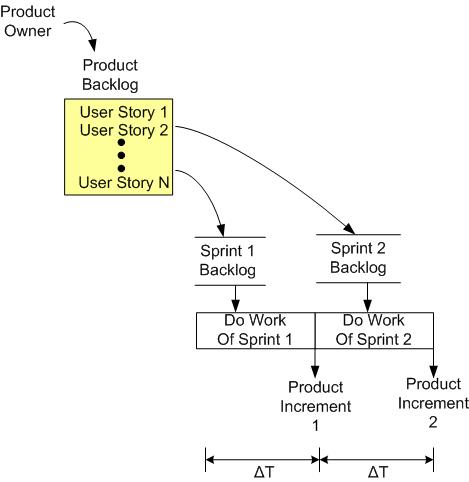
But wait! Where are the “ilities” and the other non-functional product requirements? They’re not in your backlog?
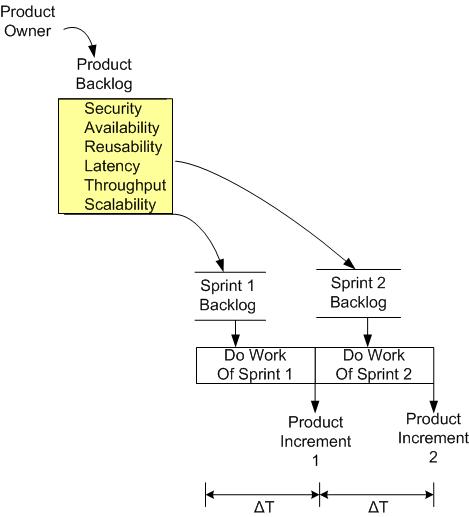
Uh, we don’t do “ilities“. It’s not agile, it’s BDUF (Big Design Up Front). We no need no stinkin’ arkitects cuz we’re all arkitects. Don’t worry. These “ilities” thingies will gloriously emerge from the future as we implement our user stories and deliver working increments every two weeks – until they stop working.

Why am I here?
WTF?
Meh!
D'oh!

My BTC Address



 Bulldozer00's Blog