Archive
Schedule Policy

Just about every corpo mediocracy in the world has a proverbial “Quality Policy” that it proudly displays all over the place. The inspirational words of wisdom, that hierarchs profess staunch adherence to, are inscribed on framed posters, and/or cute little magnetic sheets. These false idols are distributed far and wide within the cathedral walls for everyone to worship.
However, everyone down in the boiler room knows that the true corpo allegiance is to schedule. How do the serfs know this? It’s easy, and it doesn’t require an Einsteinian intellect to figure it out. Just walk around the cubicle farm and count the number of times you hear managers mention the word “quality”. Then count the number of times that you hear “schedule”. Voila, you then have your answer, and it doesn’t involve rocket science math. Companies that have higher schedule to quality ratios are much more likely to fill the ranks of the average and boring herd.
Schedule worship, at whatever the human and organizational cost, is one of those issues that Chris Argyris calls “undiscussable”. Anyone who points out the fact that the quality policy is actually a lame attempt to camouflage the true and unconditional allegiance to schedule, gets beheaded in true shoot-the-messenger form. Nobody in their right mind “discusses” the quality versus schedule irony because, well, it’s “undiscussable”. 🙂
I propose that all companies develop, distribute, and display their very own authentic schedule policy. One could go something like this:
“The Duefiss corporation is proudly dedicated to meeting schedule. Our allegiance is unconditional. At Duefiss Inc., we will aggressively cut every corner and apply any amount of pressure to our human resources to meet any schedule. It doesn’t matter how laughable or unrealistic any given schedule is. We will commit our minions to it, no matter what the consequences to them, their families, our product quality, or our long term credibility and profitability. When we fall behind the hallowed schedule, we guarantee to turn up the heat on those responsible for the slip, and increase the frequency of status meetings to reinforce our commitment.”
What would your schedule policy be?
A Rigged System
Based on observation and personal experience, here’s my assessment of how the system nominally executes:
- A customer issues a Request For Proposal (RFP) or a Request For Quote (RFQ) for a product that meets a perceived need.
- The competitors respond with a proposal that contains a solution, a price, and a schedule.
- An organization wins (kudos and high-fives all around)!
- A program team is formed in the winning organization.
- The program team inherits the proposal schedule.
- The proposal is communicated to the product development group (PDG).
- The PDG forms a product development process (PDP) team.
- The PDP team analyzes the proposal and constructs a PDP schedule.
- The PDP team executes the PDP.
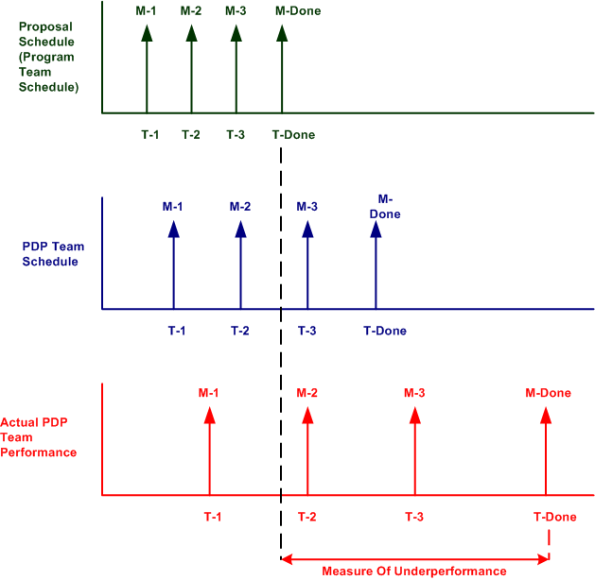
- The PDP team performance doesn’t *match* its own schedule OR the original proposal schedule – sometimes by a large amount.
- The customer, the organization, the program team, and the PDP team suffer the consequences.
- Go to step one for the next effort.
The figure below illustrates the nominal system operation, where M = Milestone.
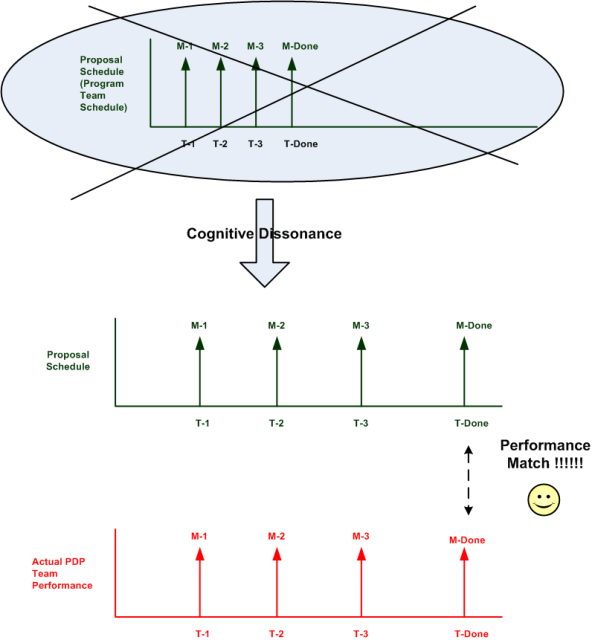
Sometimes, but not always, the developer organization “forgets” the original proposal schedule and, via the magic of cognitive dissonance, praises the PDP team at the end of the effort for being on schedule and under budget. Sometimes, even the customer conveniently “forgets” original proposal schedule, but the customer’s financial sponsor usually doesn’t.
Do you agree with the assessment of the system’s nominal operation? If you agree with it, then consider these follow on questions:
For each of the participants in the system, where do you think the suffering starts?
Do all participants suffer equally? If not, which participant do you think suffers the most?
Is anyone at fault, or are the unintended consequences a byproduct of the system’s behavior?
What management techniques can be employed to drive “the measure of underperformance” to zero, or ideally, to a negative value?
Are there some management techniques that, if applied, will cause greater underperformance?
If you don’t agree with the assessment, then please tell me why, and what your experience has been.
Do you think the cognitive dissonance scenario exists?
If so, have you experienced the cognitive dissonance scenario?
In the cognitive dissonance scenario, even though the outcome is falsely deemed a rousing success, do you think there is any suffering by one or more participant groups during execution?

Why am I here?
WTF?
Meh!
D'oh!

My BTC Address



 Bulldozer00's Blog