Archive
One Chart Summary
While flipping through Herb Sutter’s “C++ And Beyond” keynote speech charts, I stumbled upon this fabulous one chart summary of all (almost all?) the new features available in C++11.
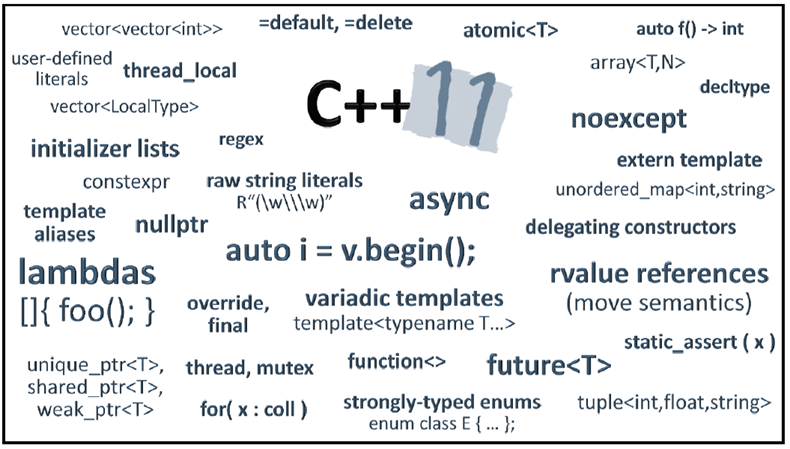
Pretty intimidating, but cool, eh?
Doing Double Duty
In the industry I work in, domain analysts are called system engineers. The best system engineers, who mostly have electrical engineering backgrounds, know how to read code. Specifically, they know how to read C code because they learned it as a secondary subject in conjunction with hard core engineering courses (I actually learned FORTRAN in engineering school – because C hadn’t taken over the world yet).
Since the best engineers continuously move forward and grow, they often take on the challenge of moving from C to C++. One of the features that tends to trip them up is the dual use of the “&” token in C++ for “address of” and “reference to“. In C, there are no “references”, and hence, the “&” serves 1 purpose: it serves as the “address of” operator when applied to an identifier.
The code snippet and its associated output below show the classic, single purpose use of the “&” operator in C to obtain the “address of” an integer type identified by “x”.

In C++, the “&” token serves two purposes. The first one is the same as in C; when applied to an identifier, it returns the “address of” the object represented by the identifier. As the code below illustrates, the second C++ use is when it is applied to a type; it represents a “reference to” (a.k.a “alias to”) an object.
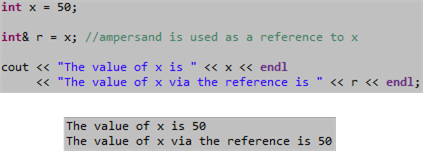
So, what good is a reference when C++ already has pointers? References are safer than pointers. When defining a pointer, C++ (like C) doesn’t require that it be initialized (as the first code fragment shows) to a valid address value immediately. Thus, if the code that initializes the pointer’s value to a valid address is far away from it’s definition, there’s a danger of mistakingly using it before the valid address has been assigned to it – as shown below. D’oh!
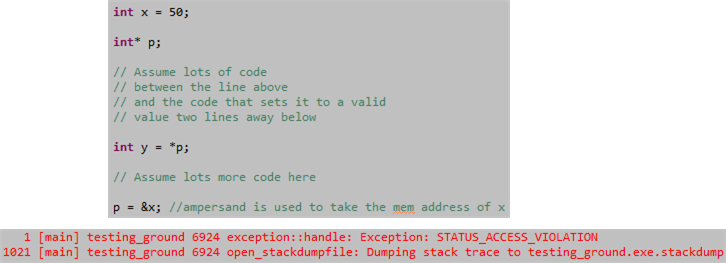
Since C++ requires a reference type to be initialized at its point of definition, there’s no chance of it ever being used in an invalid state. C++ compilers won’t allow it:

Another reason for “preferring” references over pointers in C++ is the notational convenience it provides for accessing class members:
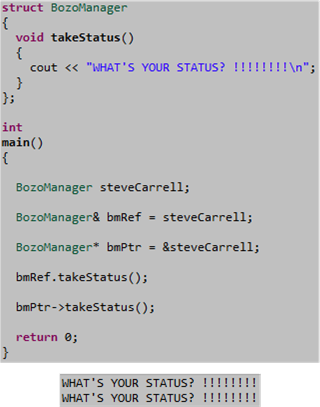
It may be arguable, but besides saving one keystroke, using the “.” method of access instead of the “->” symbol provides for cleaner code, no?
So there you have it. If you’re a system engineer that is struggling to learn C++ for self-growth or code reviews, or a programmer trying to move from C onward toward C++ proficiency, hopefully this blog post helps. I know that expert C++ book authors can do a better job of the “what, how, and why” of references, but I wanted to take a shot at it myself. How did I do?
Note: I used Eclipse/cygwin/gcc over Win Vista for the code in this post. Do you see those annoying turd characters that surround the “r” in the pink compiler error output above? I’ve been trying to find out how to get rid of those pesky critters for weeks. As you can see, I’ve been unsuccessful. Can you help me out here?
Just As Fast, But Easier To Write
I love watching Herb Sutter videos on C++. His passion and enthusiasm for the language is infectious. Like Scott Meyers, Herb always explains the “why” and “how” of a language feature in addition to the academically dry “what” .
In this talk, “Writing modern C++ code: how C++ has evolved over the years“, Herb exhibits several side by side code snippets that clearly show much easier it is to write code in C++11 (relative to C++98) without sacrificing efficiency.
Here’s an example (which I hope isn’t too blurry) in which the C++11 code is shorter and obsoletes the need for writing an infamous”new/delete” pair.
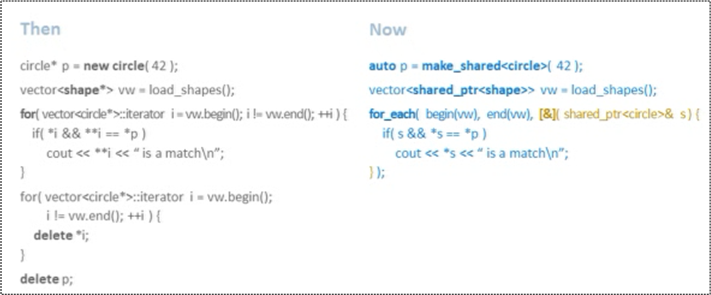
Note how Herb uses the new auto, std::make_shared, std::shared_ptr, and anonymous lambda function features of C++11 to shorten the code and minimize the chance of making mistakes. In addition, Herb’s benchmarking tests showed that the C++11 code is actually faster than the C++98 equivalent. I don’t know about you, but I think this is pretty w00t!
I love paradoxes because they twist the logical mind into submission to the cosmos. Thus, I’m gonna leave you with this applicable quote (snipped from Herb’s presentation) by C++ expert and D language co-creator Andrei Alexandrescu:

Note: As a side bonus of watching the video, I found out that the Microsoft Parallel Patterns Library is now available for Linux (via Intel).

Biased Comparison
Let me preface this post by saying what lots of level-headed people (rightly) say: “choose the right tool for the right job“. Ok, having said that, take a quick glance again at the first word in this post’s title, and then let’s move on….
Take a look at the diagram below in terms of flexibility and performance. C++ provides developers with several programming style choices to solve the problem at hand and Java (Smalltalk, Eiffel) “handcuffs” programmers with no choice (in BD00’s twisted mind, Java Generics are clumsy and they destroy the OO purity of Java, and thus, don’t count).
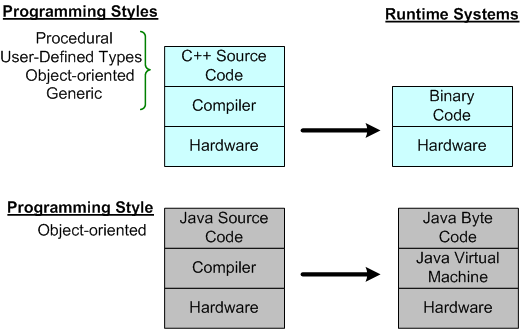
Regarding program performance (<- ya gotta check this interactive site out), there’s “virtually” no way that a Java program running on top of an overhead “middleman” virtual machine can be faster than native code running on the same CPU hardware. Of course, there can be the rare exception where a crappy C++ compiler is pitted against a highly optimized (and over-hyped), “JIT” Java compiler .
Nevertheless, a price has to be paid for increased power and flexibility. And that price is complexity. The “learnability” of C++ is way more time consuming than Java. In addition, although it’s easy to create abominations in any language, it’s far easier to “blow your leg off” using C++ than using Java (or just about any other language except assembler).
Having spewed all this chit, I’d like to return to the quote in this post’s first paragraph: “choose the right tool for the right job“. Seriously consider using C++ for jobs like device drivers, embedded real-time systems, operating systems, virtual machines, and other code that needs to use hardware directly. Use Java, or even simpler languages, for web sites and enterprise IT systems.
The main weakness of OOP is that too many people try to force too many problems into a hierarchical mould. Not every program should be object-oriented. As alternatives, consider plain classes, generic programming, and free-standing functions (as in math, C, and Fortran). – Bjarne Stroustrup
Constrained Evolution
In general, I’m not a fan of committee “output“. However, I do appreciate the work of the C++ ISO committee. In “Evolving a language in and for the real world”, Bjarne Stroustrup articulates the constraints under which the C++ committee operates:
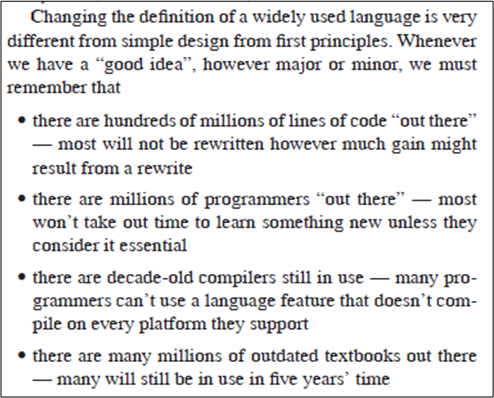
Bjarne goes on to describe how, if the committee operated with reckless disregard for the past, C++ would fade into obscurity (some would argue that it already has):
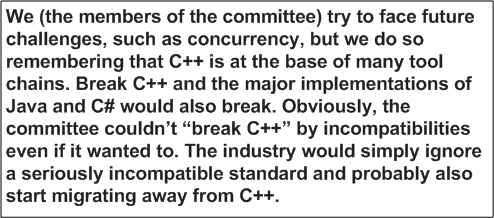
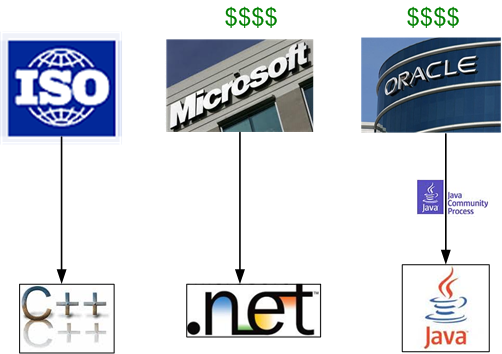
Personally, I like the fact that the evolution of C++ (slow as it is) is guided by a group of volunteers in a non-profit organization. Unlike for-profit Oracle, which controls Java through the veil of the “Java Community Process“, and for-profit Microsoft, which controls the .Net family of languages, I can be sure that the ISO C++ committee is working in the interest of the C++ user base. Language governance for the people, by the people. What a concept.
Vector Performance
std::vector, or built-in array, THAT is the question – Unshakenspeare
In C++, all post-beginner programmers know about the performance vs. maintainability tradeoff regarding std::vector and built-in arrays. Because they’re less abstract and closer to the “metal“, read/write operations on arrays are faster. However, unlike a std::vector container, which stores its size cohesively with its contents, every time an array is passed around via function calls, the size of the array must also be explicitly passed with the “pointer” – lest the callees loop themselves into never never land cuz they don’t know how many elements reside within the array (I hate when that happens!).

To decide which type to use in the critical execution path on the project that I’m currently working on, I whipped up a little test program (available here) to measure the vector/array performance difference on the gcc/linux/intel platform that we’re developing on. Here are the results – which consistently show a 60% degradation in performance when a std:vector is used instead of a built-in array. I thought it would be lower. Bummer.

But wait! I ain’t done yet. After discovering that I was compiling with the optimizer turned off (-O0), I rebuilt and re-ran with -O3. Here are the results:

Unlike the -O0 test runs, in which the measured performance difference was virtually independent of the number of elements stored within the container, the performance degradation of std::vector decreases as the container size increases. Hell, for the 10K element, 1M loop run, the performance of std::vector was actually 2% higher than the plain ole array. I’ve deduced that std::vector::operator[] is inlined, but when the optimizer is turned “off“, the inlining isn’t performed and the function call overhead is incurred for each elemental access.
If you’re so inclined, please try this experiment at home and report your results back here.
Something’s Uh Foot?

It’s my understanding that the financial crisis was precipitated by the concoction of exotic investment instruments like derivatives and derivatives of derivatives that not even quantum physicists could understand.
Well, it looks like the shenanigans may not be over. Take a look at this sampling of astronomically high paying jobs from LinkedIn.com for C++ programmers:

Did the financial industry learn a lesson from the global debacle, or was it back to business as usual when the dust settled? Hell, I don’t know. That’s why I’m askin’ you.
Psychopaths And Bozeltines
As I sat down to write my next post, I was staring at the blank page when this quote came to mind:
Always code as if the guy who ends up maintaining your code will be a violent psychopath who knows where you live. – Damian Conway
D’oh!
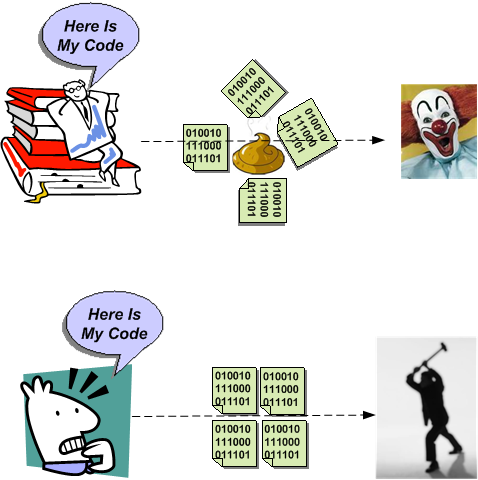
I really do try to take Damian’s message to heart. How about you? Do you buy into it? Do you buy into this instead:
Always code as if the maintainers of your code will be bozeltines who won’t have a freakin’ clue about what it does, how it works, or how to modify it – and so that they’ll be in awe of how much smarter you are than them.
The Parallel Patterns Library
Kate Gregory doesn’t work for Microsoft, but she’s a certified MVP for C++. In her talk at Tech Ed North America, “Modern Native C++ Development for Maximum Productivity”, she introduced the Parallel Patterns Library (PPL) and the concurrency runtime provided in Microsoft Visual C++ 2010.
The graphic below shows how a C++ developer interfaces with the concurrency runtime via the facilities provided in the PPL. Casting aside the fact that the stack only runs on Windows platforms, it’s the best of both worlds – parallelism and concurrency.

Note that although they are provided via the “synchronization types” facilities in the PPL, writing multi-threaded programs doesn’t require programmers to use error-prone locks. The messaging primitives (for inter-process communication) and concurrent collections (for intra-process communication) provide easy-to-use abstractions over sockets and locks programming. The messy, high-maintenance details are buried out of programmer sight inside the concurrency runtime.
I don’t develop for Microsoft platforms, but if I did, it would be cool to use the PPL. It would be nice if the PPL + runtime stack was platform independent. But the way Microsoft does business, I don’t think we’ll ever see linux or RTOS versions of the stack. Bummer.
A Costly Mistake For Many
In “Learning Standard C++ as a New Language“, Bjarne Stroustrup gives a slightly different take on the waterfall method of software-intensive system development:
“… treating programming as merely the handmaiden of analysis and design doesn’t work either. The approach of postponing actual discussion of code until every high-level and engineering topic has been thoroughly presented has been a costly mistake for many. That approach drives people away from programming and leads many to seriously underestimate the intellectual challenge in the creation of production-quality code.“
If your company implicitly treats software engineers like “code monkeys” and great engineers strive to “rise” into coveted management positions ASAP because the unspoken ethos is that “coders” are interchangeable cogs, then your company most likely has made costly mistakes in the past and it will most likely do so again in the future.


Why am I here?
WTF?
Meh!
D'oh!

My BTC Address



 Bulldozer00's Blog