Archive
Monkey Mind
For ego-dominated people like me, “I-thoughts” run rampant through the mind. Buddhists call this malady the “monkey mind“, with thoughts jumping randomly to and fro in chaotic happenstance.

Psychological discord arises because, as one wise man has said, “we can’t bear to sit still with ourselves for one minute“.
Watch And Learn List
After watching Red Hat CEO Jim Whitehurst talk about “cultivating trust” in this refreshing 5 minute MIX video, I put him on my “watch and learn list“. Here are some priceless sound bytes from Jim’s passionate schpeel:
- You truly have to have no consequences.
- Says easy, does hard.
- The biggest insult is to have somebody throw out a comment or idea, and have nobody respond to it.
- Meritocracy does not equal democracy.
- Being called an idiot is not a bad thing. I encourage it and I celebrate it.
- If the senior leadership team isn’t posting on the site, isn’t responding to comments that are being made, then it’s nothing more than an “HR program“.

So, who’s on your watch and learn list?
Asynchronous Evolution
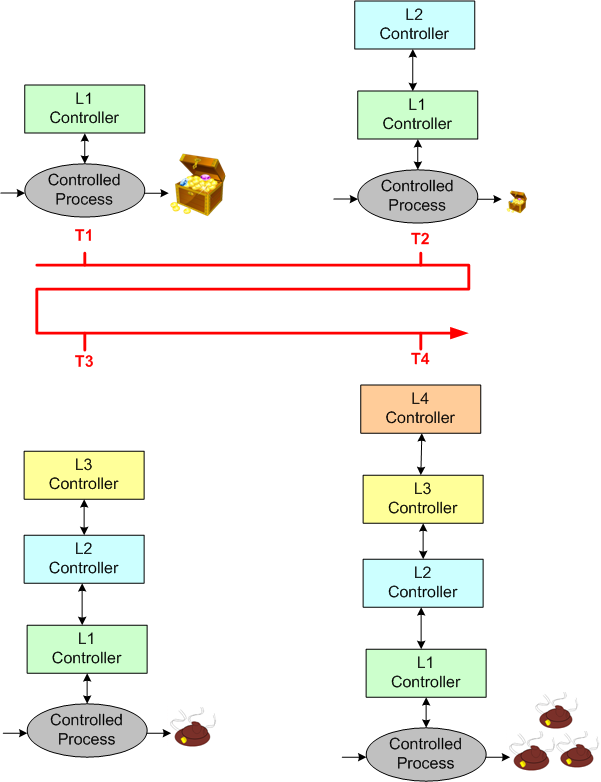
In “Engineering A Safer World“, Nancy Leveson asserts that “asynchronous evolution” is a major contributor to costly accidents in socio-technical systems. Asynchronous evolution occurs when one or more parts in a system evolve faster than other parts – causing internal functional and interface mismatches between the parts. As an example, in a friendly fire accident where a pair of F-15 fighters shot down a pair of black hawk helicopters, the copter and fighter pilots didn’t communicate by voice because they had different radio technologies on board.
As another example, consider the graphic below. It shows a project team comprised of domain analysts and software developers along with two possible paths of evolution.

Happenstance asynchronous evolution is corrosive to product excellence and org productivity. It underpins much misunderstanding, ambiguity, error, and needless rework. Org controllers that diligently ensure synchronous evolution of the tools/techniques/processes amongst the disciplines that create and build its revenue generating products own a competitive advantage over those that don’t, no?
Inner Work Life
The premise behind Theresa Amabile’s “The Progress Principle” is that individual performance in the work place is a function of the quality of one’s “Inner Work Life” (IWL). In addition, the greatest effector of a positive IWL is “continuing progress on meaningful work“.
To set the context for her subsequent findings, at the beginning of the book Ms. Amabile describes her research protocol:
“We recruited 238 people in 26 project teams in 7 companies in 3 industries. Some of the companies were small start-ups; some were well established, with marquee names. But all of the teams had one thing in common: they were composed primarily of knowledge workers, professionals whose work required them to solve complex problems creatively. Most of the teams participated in our study throughout the course of a particular project—on average, about four months. Every workday, we e-mailed everyone on the team a diary form that included several questions about that day. Most of those questions asked for numerical ratings about their inner work lives—their perceptions, emotions, and motivations during that day. The most important question allowed our respondents free rein: “Briefly describe one event from today that stands out in your mind. Amazingly, 75 percent of these e-mailed forms came back completed within twenty-four hours, yielding nearly 12,000 individual diary reports.”
The figure below shows the three tightly integrated and inseparable components of IWL and four major external forces that act upon it.
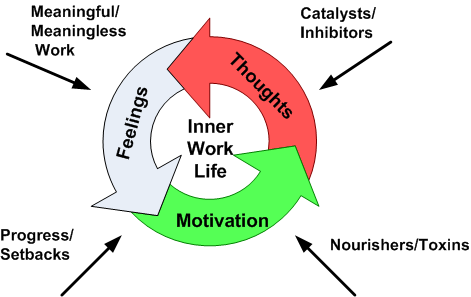
Of course, the quality of IWL can vary from month-to-month, day-to-day, and even hour-to-hour, depending on the presence and magnitude of the external forces acting upon it and the person-specific thoughts/feelings/motivation regarding said forces.
Contributors to an increase in IWL are catalysts, nourishers, meaningful work, and especially, progress on that meaningful work. Detractors are meaningless work, inhibitors, toxins, and setbacks to progress.
In orgs that are setup (either intentionally or unintentionally) as internally competitive command and control hierarchies where “me” is king, inhibitors, toxins, and setbacks abound. In great orgs, which can be structured as collaborative hierarchies or as any other pattern, catalysts, nourishers, and progress are pervasive up and down and across the structure.
Of course, the best parts of Ms. Amabile book are when she exhibits many of the heartfelt entries written by real people from her massive stash of 12,000 diary entries. Read it and weep, or read it and leap for joy, or read it and “meh“.

Related articles
The Law Of Diminishing Returns…
Different Perceptions
In the spirit of reducing costs through the holy grail of “reuse“, this post leverages the (so-called) work done in the recent “One Of Four” post….
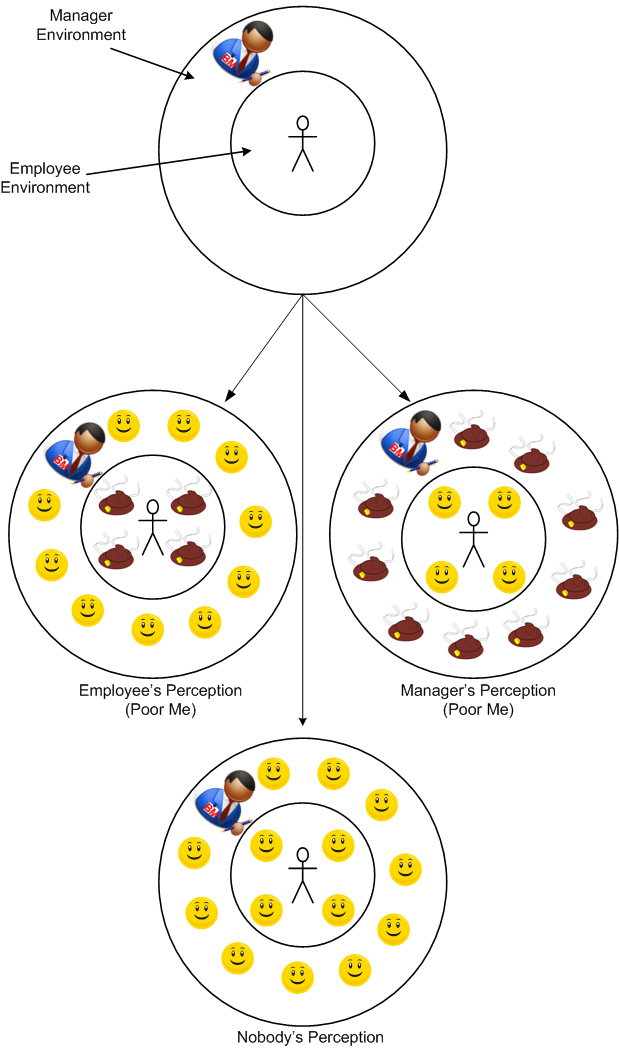
In DYSCOs and CLORGs, this is everybody’s perception:
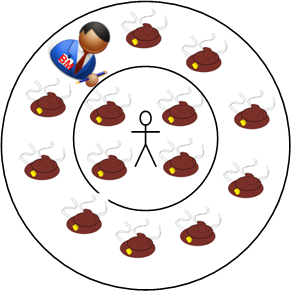
Man, I wish I could cure myself of the addiction to use grumpies in my e-drawings. The practice is unprofessional and childish, but I deploy the putrid piles for the following purposes: 1) to ratchet up the impact, 2) as a differentiating “branding” gimmick, and 3) to coverup the lack of substance in the accompanying words. The acerbic words and sophomoric readme.txt acronyms may already do the trick though, no?
What do you think, dear reader? Should BD00 dispense with all the crap? Do you think BD00 is capable of, and willing to, step into the alien world of respectable discourse?
Ideologues
This may sound hypocritical to some, but I find it frustratingly difficult to deal with ideologues. An ideologue is a closed-minded, binary, absolutist when it comes to “beliefs” that he/she is passionate about.
Experts don’t think, they know (just like BD00).
As soon as you start to question assertions from an ideologue or suggest an alternative idea/concept/belief, in the blink of an eye you automatically become an enemy to be annihilated. The rhetoric starts ratcheting up and personal attacks may start spewing forth. Unless you’re the Buddha, it’s incredibly easy to get sucked into the vortex and start playing the ISTY game with an ideologue. On the up side, if you deal with ideologues often, with a little self-awareness, you can get better and better at handling interactions with them more gracefully.
Being a passionate person myself on topics that are near and dear to me, I can definitely empathize with ideologues. I “believe” that if you’re not passionate about something, then you’re living an incredibly boring and unfulfilled life. But hey… it’s just a BD00 “belief“.

I believe that there is such a thing as objective truth, but a lot of people have an objective truth that differs from mine. – Cynthia Tucker
TDD Overhype
There is much to like about unit-level testing and its extreme cousin, Test Driven Design (TDD). However, like with any tool/technique/methodology, beware of overhyping by snake oil salesman.
Cédric Beust is the author of the book, “Next Generation Java Testing“. He is also the founder and lead developer of TestNG, the most widely used Java testing framework outside of JUnit. In a Dr. Dobb’s guest post titled “Breaking Away From The Unit Test Group Think”, I found it refreshing that a renowned unit testing expert, Mr. Beust, wrote about the down side of the current obsession with unit testing:
- Unit tests are a luxury. Sometimes, you can afford a luxury; and sometimes, you should just wait for a better time and focus on something more essential — such as writing a functional test.
- There are two specific excesses regarding code coverage: focusing on an arbitrary percentage and adding useless tests.
- TDD code also tends to focus on the very small picture: relentlessly testing individual methods instead of thinking in terms of classes and how they interact with each other. This goal is further crippled by another precept called YAGNI, (You Aren’t Going to Need It), which suggests not preparing code for features that you don’t immediately need.
- Obsessing over numbers in the absence of context leads developers to write tests for trivial pieces of their code in order to increase this percentage with very little benefit to the end user (for example, testing getters).
Being a designer and developer of real-time, multi-threaded code that runs 24 X 7, I’ve found that unit testing is not nearly as cost effective as functional testing. As soon as I can, I get a skeletal instance of the (non-client-server) system that I’m writing up and running and I pump deterministic, canned data streams through the system from end-to-end to find out how the beast is behaving. As I add functionality to the code base, I rerun the data streams through the system again and again and I:
- try to verify that the new functionality inserted into the threading structure works as expected
- try to ensure that threads don’t die,
- try to verify that there are no deadlocks or data races in the quagmire
If someone can show me how unit testing helps with these issues, I’m all ears. No blow hard pontificating, please.

One Of Four

Basement Garden
After concocting yesterday’s irreverent post, the universe whispered in my ear:
Put a visual to the saying: DYSCOs often treat their “associates” like mushrooms: Down in the basement and well fed with chit.
Since I don’t want to piss the universe off, here t’is:


Why am I here?
WTF?
Meh!
D'oh!

My BTC Address



 Bulldozer00's Blog