Archive
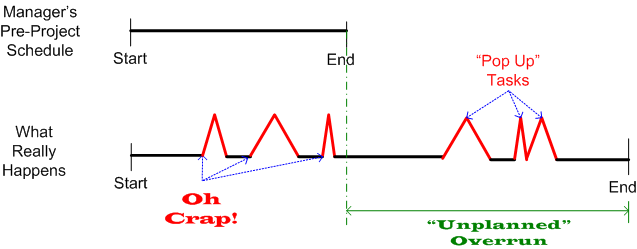
What Really Happens…..
Montessori School
While reading Steven Levy‘s riveting “In The Plex“, I discovered the Maria Montessori teaching method:
“It’s really ingrained in their personalities,” she said. “To ask their own questions, do their own things. To disrespect authority. Do something because it makes sense, not because some authority figure told you. In Montessori school you go paint because you have something to express or you just want to do it that afternoon, not because the teacher said so. This is really baked into how Larry (Page) and Sergey (Brin) approach problems. They’re always asking ‘Why should it be like that?’ It’s the way their brains were programmed early on.”
“Discipline must come through liberty…. We do not consider an individual disciplined only when he has been rendered as artificially silent as a mute and as immovable as a paralytic. He is an individual annihilated, not disciplined. We call an individual disciplined when he is master of himself.”
To the non-managers out there: Have you been “rendered artificially silent as a mute and as immovable as a paralytic“…….. without being aware of it?

A Role Model For Change
In the comments section of the Horse And Buggy post, Steve Vinoski was gracious enough to provide links to four IEEE Computer Society columns that he wrote a few years ago on the topic of distributed software systems. For your viewing pleasure, I’ve re-listed them here:
http://steve.vinoski.net/pdf/IEEE-Serendipitous Reuse.pdf
http://steve.vinoski.net/pdf/IEEE-Demystifying_RESTful_Data_Coupling.pdf
http://steve.vinoski.net/pdf/IEEE-Convenience_Over_Correctness.pdf
http://steve.vinoski.net/pdf/IEEE-RPC_and_REST_Dilemma_Disruption_and_Displacement.pdf
Of course, being a Vinoski fan, I read them all. If you choose to read them, and you’re not an RPC (Remote Procedure Call) zealot, I think you’ll enjoy them as much as I did. To view and learn more about distributed software system design from a bunch of Steve Vinoski video interviews, check out the collection of them at InfoQ.com.
I really admire Steve because he made a major leap out of his comfort zone into a brave new world. He transitioned from being a top notch CORBA and C++ proponent to being a REST and Erlang advocate. I think what he did is admirable because it’s tough, especially as one gets older, to radically switch mindsets after investing a lot of time acquiring deep expertise in any technical arena (the tendency is to dig one’s heels in). Add to that the fact that he worked for big gun CORBA vendor Iona Technologies (which no longer exists as an independent company) during the time of his epiphany, and you’ve got a bona fide role model for change, no?

My Accomplishments
Here’s an idea. The next time you’re being formally evaluated for performance by a “superior” and he/she opines that your written accomplishments are vague, ask him/her for a copy of his/her latest accomplishments sheet – for guidance on how to do it right, of course.

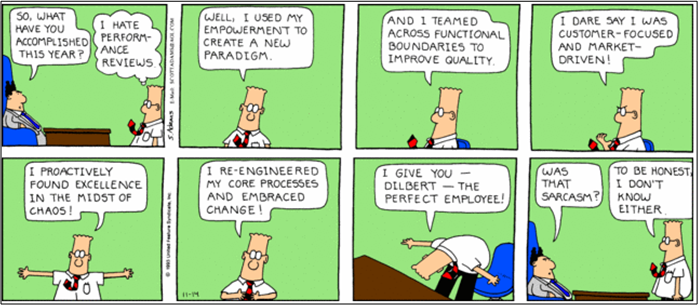
Note: Thanks to Fish-dude for finding the matching Dilbert strip.
UCB Reinforcement
Oh crap! I’ve done it again. I’ve scanned the horizon and found more evidence to further cement my Unshakable Cognitive Burden. I’ve started reading the classic “Human Side Of Enterprise“. It’s a classic because it was written in 1960 by Douglas McGregor and much of it remains relevant today – over 50 years later.
At the beginning of the book, Mr. McGregor asks his targeted audience, corporate managers, to truly “tune in” the next time they’re at a policy making meeting. By “tune in“, he means “listen to what hidden, implicit assumptions about human behavior are embedded within the discussions“.
Mr. McGregor asserts that the probability is high that policy discussions will be based on the assumption that those who will be affected by the policy are stupid, lazy, and not-to-be-trusted people. Has your personal experience indicated that he was, and still is, right?

Creating One Way Dependencies
Assume that you were totally free; an island unto yourself, independent of all other people and able to do whatever you wanted and whenever you wanted. In order to survive, you’d have to become: responsible for building your shelter, growing and hunting your food, making your clothes, and securing yourself from attacks by “other” people and animals. D’oh, that would suck!
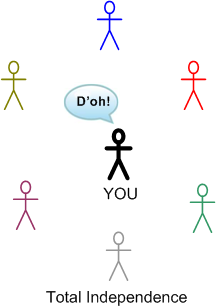
Now assume that you wanted to be free, but you didn’t want to do all of the primitive “hunting and gathering” work required to survive. You’d have to become dependent on the skills and talents of a bunch of other people who can do the things you don’t want to do. How would you pull that off? You’d have to somehow make other people dependent on you, no?
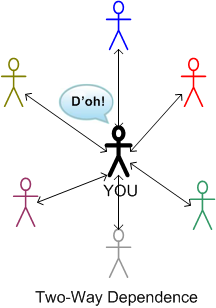
The way I see it, there are at least three ways to become free while minimizing the effort you’re required to expend to survive:
- you’d have to develop a skill of your own that is needed or wanted by others so that they willingly supply you with the basics for your survival.
- you’d have to physically force others into supplying the basics for your survival.
- you’d have to psychologically force others into supplying the basics for your survival.
Numbers 2 and 3 introduce a one way dependency into your self-centric “system” – with other people depending on you, but not vice versa. Whoo Hoo! Compared to number 1, no hard work on your part is required. You receive without giving anything in return – a pure consumer.
Now, assume that you pull off the one-way dependency trick via clever application of number 2 or 3. As the left hand side of the figure below shows, a star topology with you smack in the center of the one-way dependency system quickly becomes unscalable as the number of people you desire to be dependent on you grows. You’d have to use more and more of your time maintaining your physical and/or psychological control over the growing number of people who are continuously fulfilling your needs. D’oh!

One answer to the scalability problem is to recursively apply your physical and/or psychological coercion expertise to impose a hierarchical structure on your system – with you at the top, of course. A hierarchical structure would cut down the number of people you need to physically and/or psychologically track and coerce into satisfying your needs without expecting anything in return. Hence, the proliferation of hierarchies throughout the course of human history.
Unfathomable Vault
Via work breakdown structures, time cards, and other management tools, most orgs track the time its people spend on projects. Thus, over time, a significant database of historical cost and time data that can be reused to estimate the cost and schedule of future projects gets accumulated. Alas, BD00’s opinion is that most org controllers don’t leverage their treasure troves of information to get reasonable “rev 0” estimates of future efforts. Either :
- they don’t want to know the truth – because they’ll cringe at how much time it really takes to execute an average project
- their tracking systems are so fragmented, un-integrated, and unnavigable that they can’t reuse the info – even if they wanted to
- both 1 and 2 above
It’s ironic how an average org’s controllers demand detailed planning and certainty from their teams but fail to demand the same standards for themselves, no? The next time you’re asked for a project estimate, try retorting with “what does the historical performance data in our unfathomable vault say about similar projects?“. Awe come on, you can do it – even though I can’t 🙂

Generalizations
To function semi-sanely in this world, we all have to make generalizations so that we can make sense of the world and to at least try to be able to predict future outcomes that result from our actions. It’s OK to make them as long as one realizes that there are exceptions to every generalization. There are very few, if any, absolutes in the world. Assuming that one’s personally concocted generalizations are absolutely 100% true all of the time invites “suffering“, no?
Take the mercurial CEO of Apple, Steve Jobs, for example. He seems to be at least one exception to my personal generalization that “dictator” bosses can’t be successful in the long term (Oracle CEO Larry Ellison is another exception). Check out these blurbs that I pulled from cyberspace:

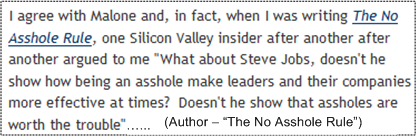
I think that one reason why Jobs and Apple achieve the stellar product and financial success that they do is because, even at the lofty CEO level, Mr. Jobs gets his hands dirty – and that endears him to the technical and creative talent that he does retain at the company. Contrast this to a Stalinist brute like “chainsaw” Al Dunlap, who lived in a separate world “above” his people.
How about you? Do you think that my “dictators can’t be successful leaders in the long run” generalization is valid in most cases? What’s your equivalent generalization?
Three Bottom Lines
“Management measures what’s easy, not what’s important.” – Unknown
“You can only measure 3% of what matters.” – W. E. Deming
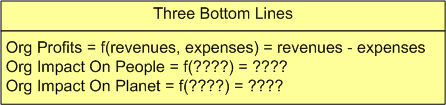
I don’t recall where, but I remember seeing the idea of “three bottom lines” being proposed somewhere in an online article. The three bottom lines are “profits, people, and planet“.
As in quantum physics, the hurdle to overcome is “the measurement problem“. Unlike profits, which are simple to measure and track, how do you come up with standard, objective measures of an org’s effect on its people and on the planet?
Transparent And Unpretentious
“A censor is a man who knows more than he thinks you ought to.” – Granville Hicks
While reading Hugh MacLeod’s “Evil Plans: Having Fun on the Road to World Domination“, this passage rang my bell:
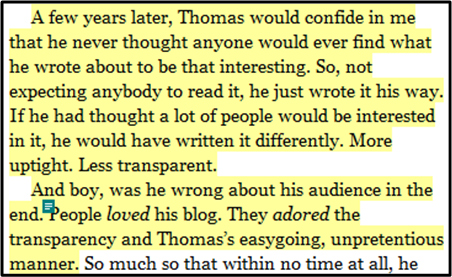
As the number of daily hits on this blog has grown from a paltry 5 to a massive 10+ people per day (LOL!), I’m finding that I’m asking myself these kinds of questions more often:
- “Should I write about this?”,
- “Should I say that?”,
- “What if this comes back to haunt me?”,
- “Should I take the sting out of the words?”
- “Should I renounce the usage of my stereotype acronyms?”
- “Am I pissing off everybody who stops by?”
At the end of each of these internal mini-battles, in most cases I come to my senses and say: “Suck it up you wuss and keep blabbing away. What if Darwin, Galileo, Jesus, etc, kept their traps shut out of fear?“. Hell, I don’t have any delusions about changing the world like those dudes – but I would if I had the source code (and it was written in C++).
“I don’t know the key to success, but the key to failure is trying to please everybody.” – Bill Cosby
“I don’t know the key to success, but another key to failure is trying to piss everybody off.” – Bulldozer00


Why am I here?
WTF?
Meh!
D'oh!

My BTC Address



 Bulldozer00's Blog