Archive
A Life Changing Experience?
The article “Undercover Boss’ role opens Republic Airways CEO’s eyes” describes what Republic Airways CEO Bryan Bedford learned while participating on the show “Undercover Boss“. In the show, CEOs go undercover and work on the front lines as a DORK in disguise.

Here’s one thing Mr. Bedford said of his experience:
“What was eye-opening, the most noticeable thing was just the disconnect and (poor) communication between the management team and front-line employees,” Bedford said.
I don’t know what was so eye opening about it. As usual, I just don’t get it. Do you? Do you now understand the meaning of one of the profanely endearing acronyms, CGH, that I often use in this boisterous blog?
Moving on, here’s some more unsurprising (at least to me) commentary :
While working in different roles for the company — including cleaning aircraft, checking baggage, dumping aircraft toilets and standing at the ticket counter — he asked fellow employees why they didn’t take their complaints to management to implore change. The same response came time and time again: “No, I’ve talked to management about this stuff, and they never listen,” Bedford said.
Wow. Huge surprise, no? Why won’t the BMs, BUTTs, and CCRATs in the fatty middle org layers listen to, and act on, DICforce inputs? Because it would require hard work and it could make them look bad. You know, their image of being infallibly in charge might suffer: “Damn the org, it’s all about me and my success“.
“Are you here to build a career or to build an organization?” – Peter Block
I’m almost done with this rant, so bear with me just a couple of more sentences. Summing up his experience, Mr. Bedford relates his epiphany:
When you are actually working side by side and hearing about their struggles, it’s very personal. It’s life-changing. You can never go back to thinking of them as anything other than family.
So, six months from now, after returning to the same-old, same-old business as usual (operating off spreadsheets and powerpoints, communicating solely with his hand picked yes-men junta, caving to pressure from Wall St. and shareholders) do you think Bryan will remember what he said? I hope so, but I doubt it. He’s human just like you and (maybe) me.
How about you? Even if he/she wanted to, would your CEO, or even your immediate manager, be capable of doing your job in order to experience your frustrations at the inefficiency, dysfunction, and red tape that engulfs you?
Strategic And Cautious
At nights and on weekends we cry out for human rights and freedom of speech, and then we go to work and become strategic and cautious about our every word for fear we will be seen as disloyal or uncommitted. – Peter Block
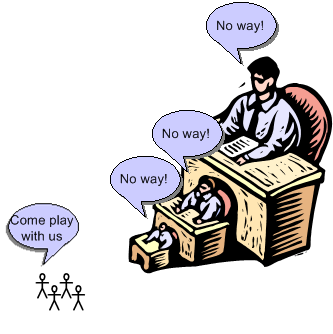
The above quote reminds me of many meetings that I’ve attended. In one of these watch-out-what-you-say-or you’ll-be-in-deep-shit group fear fests, the topic of a long time dedicated and highly productive employee leaving the company popped up. The frustrating and sad thing about the experience was that even though virtually everyone knew who the person was, no one spoke his name – including wimpy me. It was like an unwritten taboo, as hinted by Block’s quote above. At the time, I thought of getting up and yelling:
“Damn it! His name is XXXX. Why can’t anyone freakin’ speak it? Even though I think most of you know who we’re talking about, what harm would befall us if we spoke his name to the ones who don’t know? Why so much fear and secrecy?”
Of course, I only thought the thought and I didn’t say squat….. preferring to remain strategic and cautious.

Stewardship
In “Stewardship: Choosing Service Over Self-Interest“, Peter Block logically and unemotionally exposes the warts of patriarchical management and promotes the concept of stewardship as a much needed replacement for it. Check out these gems:
The antidote to self-interest is to commit and to find cause. To commit to something outside of ourselves. To be part of creating something we care about so we can endure the sacrifice, risk, and adventure that commitment entails. This is the deeper meaning of service.
When patriarchy asks its own organization to be more entrepreneurial and empowered, it is asking people to break the rules that patriarchy itself created and enforces.
Stewardship is the willingness to hold power, without using reward and punishment and directive authority, to get things done.
Many managers open the door to their employees, and no one walks through it. (BMs love when no one from below confronts them).
At the heart of entitlement is the belief that my needs are more important than the business and that the business exists for my own sake. (BMs always think this way).
At some point each of us has to discover that our self-interest is better served by doing good work than getting good things.
“Are you here to build a career or to build an organization?” has to be clear and without hesitation…we are here first to build the organization.
“You are teaching revolution to the ruling class.” The phrase stayed with me. There is something both unsettling and very true about it. The truth is that we are, in fact, talking about a revolution. Revolution means a turning. Changing direction. The act of revolving. It means the change required is significant, obvious even to the casual observer. Obvious, for example, even to customers. It is more comforting to talk about evolutionary change. Evolutionary change means that everything is planned, under control, and reasonably predictable.
Getting better at patriarchy is self-defeating. Having one group manage and one group execute is the death knell of the entrepreneurial spirit. (BMs ignore this).
The notion of management prerogatives disappears. There is no privileged class of people. Everyone does work that brings value to the marketplace. And everyone should do some of the core work of the organization part of the time. (BMs have no idea how to perform core work).
Measure business results and real outcomes, stop measuring people’s behavior and style in getting there.
The trick here is to be accountable without being controlling. Patriarchy has always justified control on the basis of accountability.
Overhead costs are an interesting one. We are very verbal about the costs of direct labor. There is much less information on the cost of field overhead or, especially, home office overhead charges and what they consist of. (BMs think they are worth every overhead penny that they consume).
We have been swinging between centralization and decentralization for decades, with our patriarchal method of governance remaining unscathed.
Systems are usually designed to control people, not to give those close to the customer information to make good decisions for the business.
Groups that invent, design, produce, market, sell, and deliver the product or service are the line functions. The line functions are what are referred to in this book as the core work teams or core workers. (These are the DICs).
The main limitation of a functional structure is that it does not react well to the customer’s need for quick and whole-system oriented solutions.
If you insist on having an appraisal process, let people be appraised by their customers. This means bosses will be appraised by their subordinates. (BMs think subordinates have no right to appraise them).
Everyone likes the idea of pay for performance, but most of us have rarely experienced it. We most often get paid on the basis of how our boss evaluates us. This is more accurately called “pay for compliance.”
A demand for measurement is an expression of doubt and lack of faith.
Middle managers who made a living planning, organizing, and controlling are no longer needed and, in fact, get in the way. If they cannot now answer the question of what real value they add to their unit, then perhaps they are no longer needed. (LOL!)
Victims are strong believers in patriarchy, they are just angry that they are not the patriarchs. (Victims = DICs like you and me).
We replace coercion and persuasion with invitation.
At nights and on weekends we cry out for human rights and freedom of speech, and then we go to work and become strategic and cautious about our every word for fear we will be seen as disloyal or uncommitted.
Of course, since Block’s views align closely with my own, reading the book got me all juiced up. I found myself rooting for him and constantly saying to myself: “Wow, I wish I’d thought of that!”.

Making A Living
In “Stewardship: Choosing Service Over Self-Interest“, Peter Block comically states:
No one should be able to make a living simply planning, watching, controlling, or evaluating the actions of others.
If corpo granite heads everywhere took that statement to heart (which they can’t, and thus won’t), they’d eliminate themselves and all the layers below them in an instant – poof! Alas, that ain’t gonna happen cuz someone’s gotta look pretty, run the show, and suck up the dough. Seriously, someone really does have to run the show to keep the CCF viable.
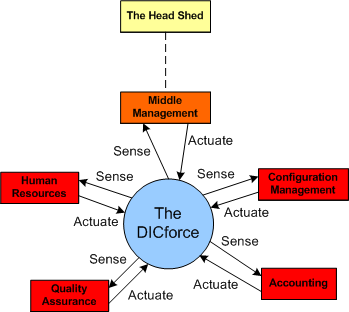
Actually, the dudes in the penthouse have others do the PWCE dirty work for them. The thugs in middle management and the pure overhead departments like Human Resources, Quality Assurance, Configuration Management, and Accounting serve nicely as the lower level sensors, alarm detectors, and actuators in the system. Because of this sleight of hand, the DICforce often targets their ire at those “support” functions and not where it rightfully ought to be targeted – the high priests living it up in the self-congratulatory head shed.

Why am I here?
WTF?
Meh!
D'oh!

My BTC Address



 Bulldozer00's Blog