Archive
Distributed Vs. Centralized Control
The figure below models two different configurations of a globally controlled, purposeful system of components. In the top half of the figure, the system controller keeps the producers aligned with the goal of producing high quality value stream outputs by periodically sampling status and issuing individualized, producer-specific, commands. This type of system configuration may work fine as long as:
- the producer status reports are truthful
- the controller understands what the status reports mean so that effective command guidance can be issued when problems manifest.
If the producer status reports aren’t truthful (politics, culture of fear, etc.), then the command guidance issued by the controller will not be effective. If the controller is clueless, then it doesn’t matter if the status reports are truthful. The system will become “hosed”, because the inevitable production problems that arise over time won’t get solved. As you might guess, when the status reports aren’t truthful and the controller is clueless, all is lost. Bummer.

The system configuration in the bottom half of the figure is designed to implement the “trust but verify” policy. In this design, the global controller directly receives samples of the value streams in addition to the producer status reports. The integration of value stream samples to the information cache available to the controller takes care of the “untruthful status report” risk. Again, if the controller is clueless, the system will get hosed. In fact, there is no system configuration that will work when the controller is incompetent.
How many system controllers do you know that actually sample and evaluate value stream outputs? For those that don’t, why do you think they don’t?
The system design below says “syonara dude” to the global omnipotent and omniscient controller. Each producer cell has its own local, closely coupled, and knowledgeable controller. Each local controller has a much smaller scope and workload than the previous two monolithic global controller designs. In addition, a single clueless local controller may be compensated for if the collective controller group has put into place a well defined, fair, and transparent set of criteria for replacement.

What types of systems does your organization have in place? Centrally controlled types, distributed control types, a mixture of both, hybrids? Which ones work well? How do you see yourself in your org? Are you a producer, a local controller, both a local controller and a producer, an overconfident global controller, a narcissistic controller of global controllers, a supreme controller of controllers who control other controllers who control yet other controllers? Do you sample and evaluate the value stream?
Lesson Unlearned
Whoo hoo! We finally said screw it, we overcame our fears, and we mustered enough courage and determination to say “hasta la vista baby” to the stifling corpo citadels that we were shackled to. We huddled together, we created a flexible plan, we busted the cuffs, we scaled the prison wall, and holy crap; we actually freakin’ succeeded. We started our own company. And it’s growing. And our people feel useful and appreciated. And life is good. Ahhhhhhh!
Well duh, of course we need to track and manage revenues and costs, but in our company, unlike the herd we left behind (mooo!), those two obviously important metrics will always take a back seat to taking care of, and leading the people who create, develop, build, and sustain our product portfolio. Because we’ve personally experienced living in the quagmire, we’ve learned our lesson. We get “it” and we’ll never forget “it”. There’s no way, we mean no way, that we’re not gonna end up like our previous corpo hierarchs, who managed to turn it all backasswards – numbers first and people second (even though they innocently espoused the opposite).
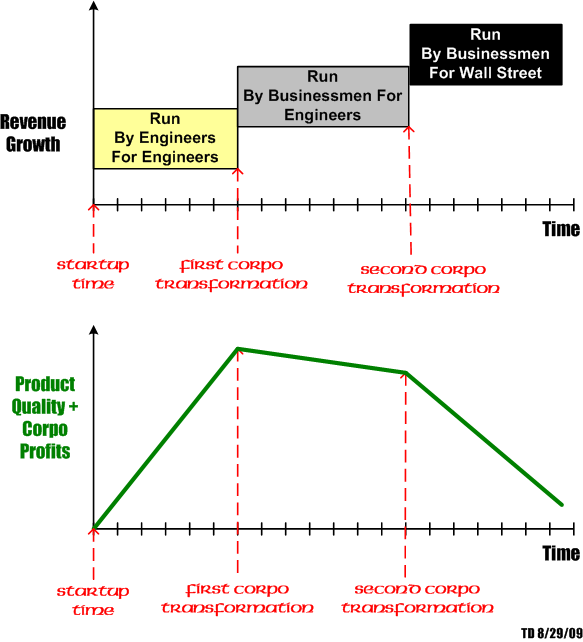
Ummmm, yeah…… right. Check out the two parallel timelines below that purport to track the growth and maturity of a hypothetical startup company in the technology industry. I honestly don’t know squat, but I assert that the story reflected by the graphical depiction below is pervasive and ubiquitous, especially throughout the western world. If you could possibly be delirious enough to resonate with the content of this blarticle, then you may interpret the situation as a hopelessly sad state of affairs. Believe it or not, I interpret the situation as neither good nor bad. It just is what it is.
Dweeb In the Cellar
Check out the figure below and please heed the advice it dispenses. If you’re a Dweeb In the Cellar (DIC), don’t piss off the people in the highlighted boxes above you. As a DIC, you can (almost) safely piss off anyone else in the corpo caste system. However, each cookie cutter corpo command & control hierarchy is slightly, just slightly, different. For example, if your direct boss and one of his level 1 peers are great friends, you can’t piss the friend off either. As you might guess, it’s usually OK to piss your fellow DICs off, but again, each corpo org is slightly different.

Right, Right, Right.
Great leaders get the right info to the right people at the right time. They don’t hide behind the “it’s not my job” cliche. They don’t just “delegate this” and “delegate that” like a card dealer at a casino. They don’t just sit back in their throne, get manicures, and “review and approve”. They don’t just passively collect “status and schedule” information. They don’t set ambiguous and indecipherable direction, and then change it at will whenever it suits their personal agenda. They don’t mandate the latest management “technique” after they read about it in a 2 page Harvard Business Review article.
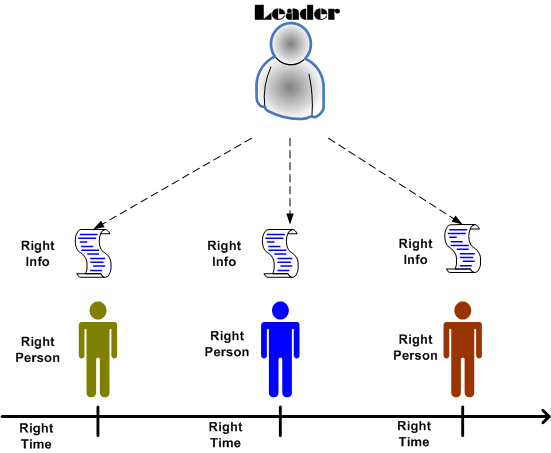
If getting the right info to the right people at the right time requires a leader to generate some of the information him/herself, then they do it.
Delegating only works when the delegator works too. – Robert Half
Hierarchical Growth
I’m currently in the process of reading Donella Meadows’s Thinking In Systems. Donella says that successful hierarchical systems grow from the bottom up, one layer at a time.
 In the case of a human-made system of humans, as an assembled group of people becomes successful at what it does, it starts growing horizontally. The group finds a way to extract what it needs to sustain and grow itself (like money in exchange for products and services) from its surrounding environment.

In order to keep the group aligned and coordinated, the next higher level is formed from a small sub-group within the first level. Both levels feed each other in a mutually beneficial relationship and the organization keeps growing sideways. At a certain point, the second level becomes wide enough to require a third level to keep it synchronized with the group’s overall organizational goals. As growth continues, more and more layers are needed to keep the overall system from diverging from its true purpose.
At some unpredictable point in time, a strange and seemingly irrational inversion starts taking place as growth continues. The smaller, but higher layers in the hierarchy start consuming a more disproportionate share of the fruits of the organizational effort. The original, mutually beneficial, two way relationship transforms into an unbalanced one way relationship that is strangely accepted and taken for granted by everyone at all levels.

As a result of the imbalance, the bottom layers begin to atrophy from a lack of nourishment. As the one way upward flow of nourishment continues, the weight of the top layers increases and the strength of the lower layers decreases. In the worst case, the organization loses its balance and comes crashing to earth in a disintegrated mess.

In the early stages of growth, everyone in the organization fully understands that each successive layer is put in place to take care of the layer below it, and vice versa. When this understanding gets lost, all is lost. It’s just a matter of time until disaster strikes. Can the process be reversed? Sure it can, by restoring the balance and never losing sight of why the upper layers were created in the first place.
Who’s That Masked Man?
I’m very skeptical of management consultants, but the dudes at VitalSmarts are really good. They are responsible for the wonderful “crucial” pair of books:
I’ve read both of these along with Influencer. They’re all very “down to earth” and highly accessible tomes that detail what works and what doesn’t work in terms of leading organizations of people. Their simple and “executable” advice is backed by academic research and, most importantly, their direct experiences from interacting with lots and lots (thousands) of real people in working organizations around the globe.
The following snippet from their latest e-newsletter caught my eye:
“People are excellent at masking ability problems.”
Man, ain’t that the truth! Along with you, I ‘ve put the “mask ” on many times, both willingly and unwillingly. The question is: “what would cause people to do this?”.
I think the main reason why people try to feign expertise is because they are stuck working in archaic corpo CCHs (Command & Control Hierarchies). All CCH orgs unquestioningly assume that everyone within the pyramid walls is supremely competent, regardless of whether they are or not. In a CCH, anyone who dares to persistently point out “ability” problems is excommunicated, regardless of how much evidence is presented to prove the case so that a beneficial change can be made. Heaven forbid the case where a lower level masked associate points to the huge masks being worn by one or more of the obviously infallible managers entrenched in an upper echelon. Retribution is swift and unambiguous.

Forgive Me

If you have read many of my posts, you may have formed the opinion that I’m rabidly against bozo managers who are members of a hierarchically structured organization. That’s not quite right. I’m not against them as individual persons. I’m against the behaviors that they are compelled to manifest and the decisions that they have to make because of the archaic structure that they are an integral part of. It doesn’t matter who the particular individuals are in a command & control hierarchy. Unless they are enlightened (and very few are), they will auto-behave in ways that are detrimental in the long term to customers, owners, and employees. Not detrimental to themselves and their brethren, of course.
A colleague who dogmatically worships at the alter of corpo-man recently told me that I was jealous of hierarchs. He said that I wanted to be “just like them”. Hmmm, interesting opinion, no? Since nothing is impossible, I guess that could be true. Deep down I just may be an imposter and a fraud 🙂 . In Thorstein Veblen‘s “theory of the leisure class“, he proposes that the middle class in “developed” countries doesn’t hold hierarchs accountable for the havoc they wreak because the middle class wants to be “just like them”.
I’ve often thought of what I would do if I was offered to be knighted by a hierarchical corpo king. Whenever I think of that possibility, it reminds me of the Galileo and Pope Urban story. Galileo, as you probably know, subscribed to the Copernican theory that the earth was NOT the center of the universe. In the all powerful eyes of the hierarchical church and its rabid followers, any such thinking was sacrilegious blasphemy – curiosity was a sin. Before Urban was given the papal throne, he was a friend of Galileo’s. Urban was intrigued by Galileo’s logic and compelling evidence that the earth revolved around the sun. Bingo, as soon as he became pope, Urban instantaneously flipped into a corpo droid incapable of independent thought. He gave Galileo a tour of the torture chambers and placed him under house arrest for the last years of his life. Uh, so much for friendship.
Ironically, in a standard command and control corpo hierarchy, the only way anyone has any chance of changing things for the better is if he/she secures a corpo title from the sitting politburo. Since I think I could possibly make a positive difference, I’d actually be tempted to take on an institutional title and become a corpo man. Alas, I don’t think I’d do it because I don’t have the psychological strength to withstand the corpo peer pressure to flip – just like pope Urban didn’t have. Bummer 😦
Collapsing The Wavefunction
I’m in the process of reading a third book on quantum physics. It’s called “The Self-Aware Universe”, and it is written by physicist Amit Gotswami. According to Q-physics, no localized object exists until a conscious observation is made. The universe is comprised of non-localized, infinitely distributed “waves” described by Schrodinger’s wave function equation. The wave function equation characterizes the “waviness” of matter and it displaces Newton’s F=ma as the universal law of motion. Even though Newton has been convincingly dethroned as the king of “materialistic reality”, Q-physics is consistent with Newton’s classical physics for “big” objects, which are all comprised of quantum waves. Thus, for (almost) all practical purposes, Newton’s laws can be leveraged in the macro world to “control” and enhance our environment to some extent.
When a subjective and conscious observation is made and discrete objects are “detected” at a point in space and time, the instantaneous collapse of the wave function occurs. The figure below woefully attempts to graphically depict this mysterious and miraculous process. On the left, we have “no”-things, just an infinite collection of waves. On the right, we have a bunch of (supposedly) independent “some”-things after the collapse. If, as most rational and educated people think, conscious observation is subjective and person specific, then why is there so much consensus on the post-collapse appearance of the world? In other words, why do most people see the same set of objects after they each independently and subjectively collapse the wave function? If you’re thinking that I have an answer for this subjective vs. consensus enigma, then you’re mistaken. I’m dumbfounded but enamored with the mystery of it all. How about you?

Suppose that you and I separately “collapse the wave function” and (miraculously?) agree on the appearance of the external world the engulfs us. Referring to the example above, assume that we transcend the first communication barrier between us and we agree that a post-collapse triangle exists, a rectangle exists, a pair of ellipses exist, etc.
Now assume that the group of objects that we’ve manifested (created ?) is comprised of people and some type of observable behavior emanating from that group is “bothering” us. Also, assume that we want to influence the group to change it’s behavior so that we are less distressed. What do we do? We consciously form a personal System-Of-Interest (SOI) and we try to understand what’s causing us the distress. We try to make sense of the dynamic interactions taking place between those people encircled in our own personal SOI and then we act to change it. Here’s where our original consensus starts to diverge. Since, as the figure below illustrates, our personally created SOIs will most likely be different, our interpretation of who and what is causing us our distress will be different. Thus, our ideas and thoughts regarding corrective actions will be different.
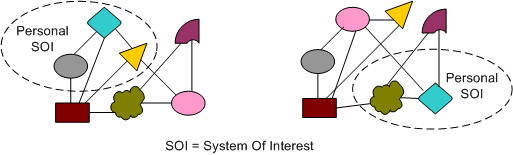
Note that even though we initially agreed on the number and types of objects=people present in our collapsed wave function worlds, the number and nature of the connections between those people are likely to be different for you and me. In the SOI example above, my SOI on the left contains three people and yours on the right only contains two. My SOI on the left doesn’t include the pink ellipse in the “problem” sub-group but yours on the right does. Your SOI doesn’t include an interface ‘tween the gray ellipse and blue diamond but mine does. Thus, our interpretations of what ails us will most likely differ. Add a third, fourth, fifth, etc., SOI to the mix and all kinds of diverging interpretations will emerge.
Now, apply this example to a work environment. If I’m the “boss” and you disagree with my interpretation of the problem situation, but are “afraid” of speaking truth to power because of standard stifling corpo culture norms, then you may just go along with my interpretation even though you’re pretty sure that your interpretation and solution is “right”. Since I’m the boss, all knowing and all powerful, I’m always “right” – even if I’m not. 🙂
Netflix Culture
I’m constantly scouring the landscape for companies with cultures that stand apart from the herd (moooo!). Via my e-friend Byron Davies’ discovery, I’ve just added another gem to my list: Netflix. Here’s the link that triggered the addition: Netflix Culture. It’s a simple, unadorned (content over format), behemoth 128 page presentation, but it’s so authentically different and norm-busting that it’ll stir your emotions (yuk, can’t have emotions in business, right?) if you’re a culture hound like me. Just in case you’re curious, but short on time, here are some zingers that rang my bell:
- The real company values, as opposed to the nice sounding values, are shown by who gets rewarded, promoted, or let go.
- We particularly value these nine skills and behaviors: judgment, communication, impact, curiosity, innovation, courage, passion, honesty, selflessness.
- You focus on results and not process.
- You challenge prevailing assumptions when warranted, and suggest better approaches.
- You say what you think, even if it’s controversial.
- You question actions inconsistent with our values.
- You only say things about fellow employees you will say to their face.
- You share information openly and proactively.
- It’s about effectiveness, not effort or hard work.
- Responsible people thrive on freedom and are worthy of freedom.
- Most companies curtail freedom as they grow bigger and to avoid errors, thus, we try to increase freedom.
- Process-focus drives talent to leave.
- The key to managing growth and complexity is to increase talent density; not to institute more freedom-constraining processes.
- We value simplicity, not the simplistic.
- Freedom is not absolute, a few basic and common sense rules are needed.
- In environments that demand creativity, fixing errors is cheaper than (fruitlessly) trying to prevent them via religious process adherence.
- Regularly scheduled strategy and context meetings.
- Flexibility is more important than efficiency in the long term.
- Set the context for your people instead of trying to control them.
- Highly aligned and loosely coupled as opposed to monolithic or siloed.
- Goal: fast, flexible AND big.
- Titles are not very helpful (all major league pitchers aren’t major league talents).
- No centrally administered “raise pools” every year.
- Whether Netflix is prospering or floundering, we pay at the top of the market.
- It’s a healthy idea, not a traitorous one, to understand what other firms would pay you, by interviewing and talking to peers at other companies.
- No bonuses, just include in salary. No free stock options – just big salary; and let people decide where to invest it.
- Rapid innovation AND excellent execution, creativity AND discipline, are required for continuous growth.
Here is my number one zinger:
- Netflix vacation and tracking policy: there is no vacation policy or tracking.
You read it right. One day, an employee pointed out that “we don’t track hours worked per day, night, or on weekends, so why do we track vacation days?“. The Netflix leadership responded to the challenge by removing the “N days per year” vacation rule. Pretty rad, removing rules instead of continuously piling them on, no?
Even if you’re extremely skeptical and can’t believe the Netflix leadership “walks the talk”, you gotta at least give them credit for writing down, in detail and with underlying rationale, the culture that they’re trying to build – so that they could be held accountable. No?

No Good Deed
Let’s say that the system engineering culture at your hierarchically structured corpo org is such that virtually all work products handed off (down?) to hardware, software and test engineers are incomplete, inconsistent, fragmented, and filled with incomprehensible ambiguity. Another word that describes this type of low quality work is “camouflage”. Since it is baked into the “culture”, camouflage is expected, it’s taken for granted, and it’s burned into everyone’s mind that “that’s the way it is and that’s the way it always will be”.
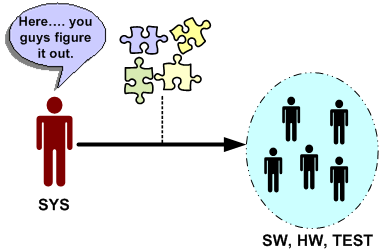
Now, assume that someone comes along and breaks from the herd. He/she produces coherent, understandable, and directly usable outputs for the SW and HW and TEST engineers to make rapid downstream progress. How do you think the maverick system engineer would be treated by his/her peers? If you guessed: “with open arms”, then you are wrong. Statements like “that’s too much detail”, “it took too much time”, “you’re not supposed to do that”, “that’s not what our process says we should do”, etc, will reign down on the maverick. No good deed goes unpunished. Sic.
Why would this seemingly irrational and dysfunctional behavior occur? Because hirearchical corpo cultures don’t accept “change” without a fight, regardless of whether the change is good or bad. By embracing change, the changees have to first acknowledge the fact that what they were doing before the change wasn’t working. For engineers, or non-engineers with an engineering mindset of infallibility, this level of self-awareness doesn’t exist. If a maverick can’t handle the psychological peer pressure to return to the norm and produce shoddy work products, then the status quo will remain entrenched. Sadly but surely, this is what everyone wants, including management, and even more outrageously, the HW, SW, and TEST engineers. Bummer.

Why am I here?
WTF?
Meh!
D'oh!

My BTC Address



 Bulldozer00's Blog