Archive
Z6
In case you were wondering, Z6 stands for Zappos core value number 6:

I’m a huge Zappos fan and a VIP member (which means free overnight shipping for any purchase!). Thus, I get daily e-mails from zappos.com on special deals. The snippet you see above appeared at the bottom of one of those e-mails.
The joyful reason for this post is that Zappos is (rightfully) tenacious about promoting their 10 core values both internally and externally. CEO Tony Hsieh and his merry band truly understand how difficult it is to sustain and maintain a culture of joy and excellence – which is a pre-requisite to both financial and emotional success. Thus, with every chance they get, which includes the daily e-mail, they spread the word.
How about your company? Do you even know what their core values are, let alone “walk the talk“? Nah, an approach like Zappos’s won’t work there, right? It’s simply auto-assumed that writing down some inarguable altruisms and pontificating about them from time to time does the trick. There are more important issues to tend to, no?
Inner Work Life
The premise behind Theresa Amabile’s “The Progress Principle” is that individual performance in the work place is a function of the quality of one’s “Inner Work Life” (IWL). In addition, the greatest effector of a positive IWL is “continuing progress on meaningful work“.
To set the context for her subsequent findings, at the beginning of the book Ms. Amabile describes her research protocol:
“We recruited 238 people in 26 project teams in 7 companies in 3 industries. Some of the companies were small start-ups; some were well established, with marquee names. But all of the teams had one thing in common: they were composed primarily of knowledge workers, professionals whose work required them to solve complex problems creatively. Most of the teams participated in our study throughout the course of a particular project—on average, about four months. Every workday, we e-mailed everyone on the team a diary form that included several questions about that day. Most of those questions asked for numerical ratings about their inner work lives—their perceptions, emotions, and motivations during that day. The most important question allowed our respondents free rein: “Briefly describe one event from today that stands out in your mind. Amazingly, 75 percent of these e-mailed forms came back completed within twenty-four hours, yielding nearly 12,000 individual diary reports.”
The figure below shows the three tightly integrated and inseparable components of IWL and four major external forces that act upon it.
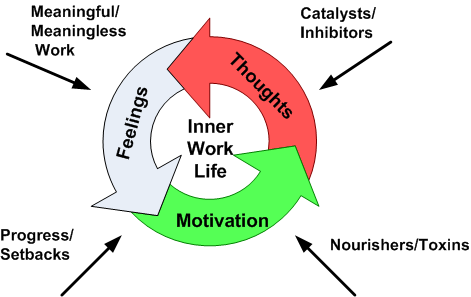
Of course, the quality of IWL can vary from month-to-month, day-to-day, and even hour-to-hour, depending on the presence and magnitude of the external forces acting upon it and the person-specific thoughts/feelings/motivation regarding said forces.
Contributors to an increase in IWL are catalysts, nourishers, meaningful work, and especially, progress on that meaningful work. Detractors are meaningless work, inhibitors, toxins, and setbacks to progress.
In orgs that are setup (either intentionally or unintentionally) as internally competitive command and control hierarchies where “me” is king, inhibitors, toxins, and setbacks abound. In great orgs, which can be structured as collaborative hierarchies or as any other pattern, catalysts, nourishers, and progress are pervasive up and down and across the structure.
Of course, the best parts of Ms. Amabile book are when she exhibits many of the heartfelt entries written by real people from her massive stash of 12,000 diary entries. Read it and weep, or read it and leap for joy, or read it and “meh“.

Related articles
Different Perceptions
In the spirit of reducing costs through the holy grail of “reuse“, this post leverages the (so-called) work done in the recent “One Of Four” post….
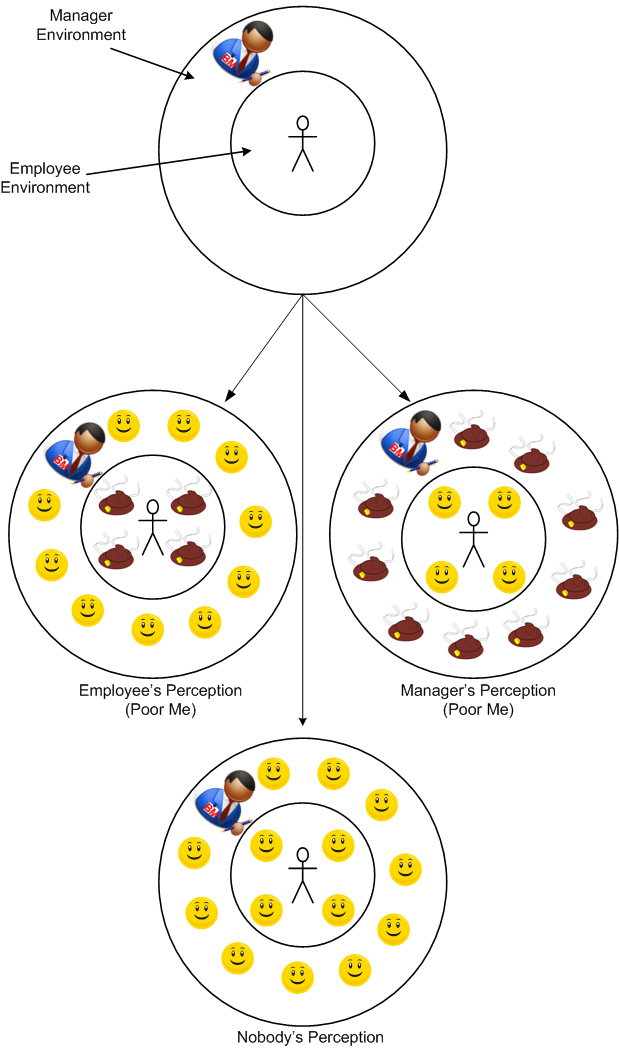
In DYSCOs and CLORGs, this is everybody’s perception:
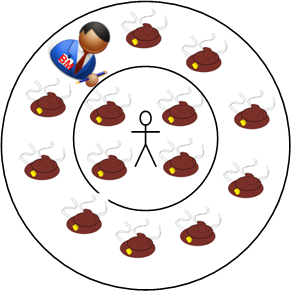
Man, I wish I could cure myself of the addiction to use grumpies in my e-drawings. The practice is unprofessional and childish, but I deploy the putrid piles for the following purposes: 1) to ratchet up the impact, 2) as a differentiating “branding” gimmick, and 3) to coverup the lack of substance in the accompanying words. The acerbic words and sophomoric readme.txt acronyms may already do the trick though, no?
What do you think, dear reader? Should BD00 dispense with all the crap? Do you think BD00 is capable of, and willing to, step into the alien world of respectable discourse?
One Of Four

Basement Garden
After concocting yesterday’s irreverent post, the universe whispered in my ear:
Put a visual to the saying: DYSCOs often treat their “associates” like mushrooms: Down in the basement and well fed with chit.
Since I don’t want to piss the universe off, here t’is:

Toxic Fungus
Unless due diligence is performed on the part of an org’s leadership junta/cabal/politburo, fragmentation of responsibility and unessential specialization can easily creep into “the system” – triggering a bloat in costs and increased operational rigidity. Like a toxic fungus, not only is it tough to prevent, it’s tough to eradicate. D’oh! I hate when that happens.
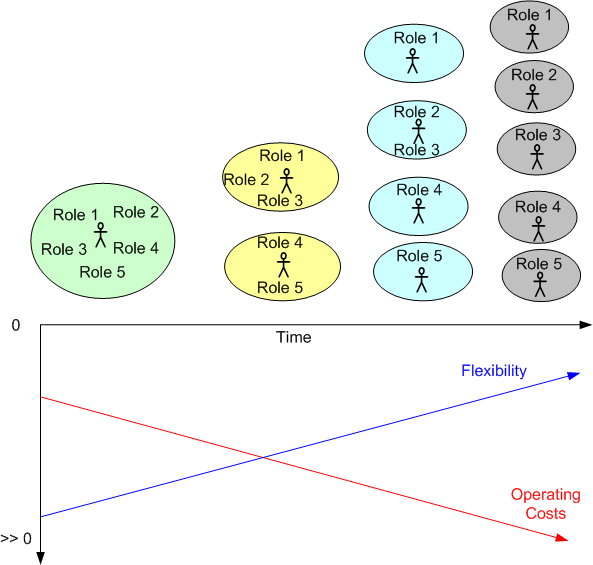
Unfriendly Fire
In Nancy Leveson’s new book, “Engineering A Safer World“, she analyzes (in excruciating detail) all the little screw-ups that occurred during an accident in Iraq where two F-15 fighters shot down two friendly black hawk helicopters – killing all aboard. To set the stage for dispassionately explaining the tragedy, Ms. Leveson provides the following hierarchical command and control model of the “system” at the time of the fiasco:
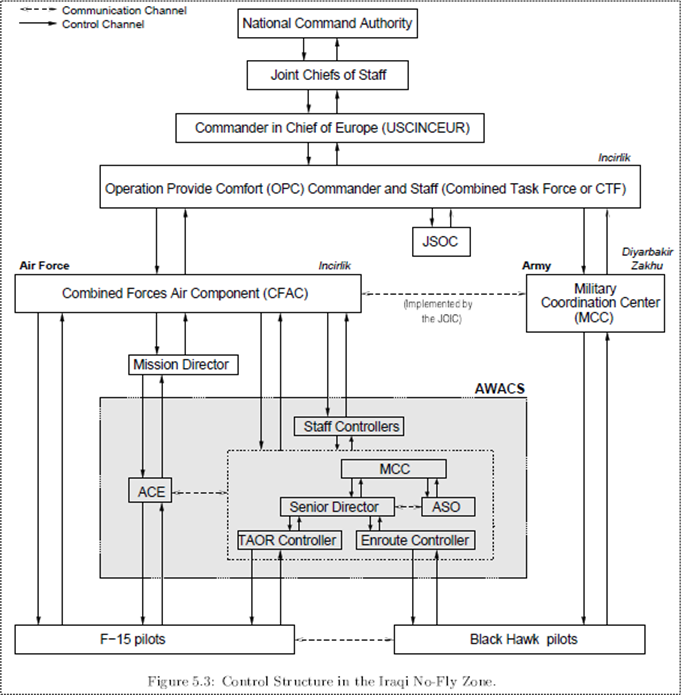
Holy shite! That’s a lot of levels of “approval required“, no?
In typical BD00 fashion, the dorky figure below dumbs down and utterly oversimplifies the situation so that he can misunderstand it and jam-fit it into his flawed UCB mental model. Holy shite! That’s still a lot of levels of “ask me for permission before you pick your nose“, no?
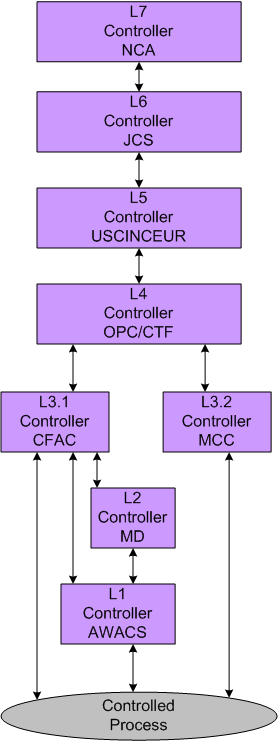
So, what’s the point here? It’s that every swingin’ dick wants to be an esteemed controller and not a low level controlleee. Why? Because….
“Work is of two kinds: first, altering the position of matter at or near the earth’s surface relatively to other such matter; second, telling other people to do so. The first kind is unpleasant and ill paid; the second is pleasant and highly paid.” – Bertrand Russell
People who do either kind of work can be (but perhaps shouldn’t be) judged as bozos, or non-bozos. The bozo to non-bozo ratio in the “pleasant” form of work is much higher than the “unpleasant” form of work. – BD00
House Of Cards
Wanna play cards?

Borgbot
I’m not sure you should worry much about the effect your behavior has on the organization overall, because there’s lots of data that suggests the organization doesn’t care much about you. – Jeffrey Pfeffer
That quote by Stanford University’s Jeffrey Pfeffer can be found in The Purpose of Power. From one systems point of view, a corpricracy as a whole is an inflexible and conscienceless borgbot with a single purpose – to make as much money it can, in any way it can. If the borgbot needs to chop off its nose or sell its mother into slavery or bankrupt millions of people outside its walls to fulfill its mission, it will.
The fascinating thing about borgbot behavior is that it ingeniously guilts its members into compliance (“aren’t you a team player?“, “if you don’t do it, you’re selfish and you’ll hurt the company“, “how dare you question management decisions“, “you’re a disloyal ingrate for speaking out“, yada-yada-yada) and rationalizes any unethical behavior away without blinking an eye.
Like most of us, Pfeffer wishes large-scale organizations were paragons of meritocracy where competence and influence are always perfectly correlated, but he knows that’s not the case – Gary Hamel
Notice the usage of the term “large-scale organizations” in Mr. Hamel’s quote. It implies that there’s hope – in small scale organizations. It makes self-righteous BD00 wonder why borgbots are obsessed with growth. Oh, I almost forgot; to make as much money as they can in any way they can.

Hindsight Bias
In Nancy Leveson‘s forthcoming book, “Engineering A Safer World“, she provides the following attributes of Hindsight Bias (a.k.a “hindsight is always 20-20“):

So THAT’s why Bulldozer00 is always 100% right!
I find that the text in the blue ellipse is very insightful. If one switches his/her analysis slant from “what they did wrong” to “why it made sense at the time“, one’s emotional reaction will soften toward “those who are responsible for the mess“.
BD00’s attitude toward FUBAR situations, which used to be anger and frustration, has changed to wonder and curiosity. At some serendipitous point along the line, BD00 finally came to the realization that since borgs exhibit emergent behavior that can’t be traced back to a single source, tis better to laugh than cry.
Organizations often behave worse than any member would – Fred Brooks

Why am I here?
WTF?
Meh!
D'oh!

My BTC Address



 Bulldozer00's Blog