Archive
Centralized, Federated, Decentralized
1 Prelude
A colleague on LinkedIn.com pointed me toward this Doug Schmidt, et al, paper: “Evaluating Technologies for Tactical Information Management in Net-Centric Systems“. In it, Doug and crew qualitatively (scalability, availability, configurability) and quantitatively (latency, jitter) evaluate three different architectural implementations of the Object Management Group‘s (OMG) Data Distribution Service (DDS): centralized, federated, and decentralized.
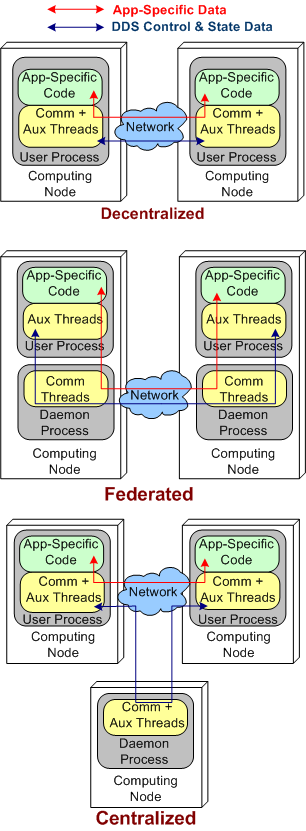
The stacked trio of figures below model the three DDS architecture types. They’re slightly enhanced renderings of the sketches in the paper.
2 Quantitative Comparisons
DDS was specifically designed to meet the demanding latency and jitter (the standard deviation of latency) performance attributes that are characteristic of streaming, Distributed Real-Time Event (DRE) systems like defense and air traffic control radars. Unlike most client-server, request-response systems, if data required for human or computer decision-making is not made available in a timely fashion, people could die. It’s as simple and potentially horrible as that.
Applying the systems thinking idiom of “purposeful, selective ignorance“, the pics below abstract away the unimportant details of the pics above so that the architecture types can be compared in terms of latency and jitter performance.
By inspecting the figures, it’s a no brainer, right? The steady-state latency and jitter performance of the decentralized and centralized architectures should exceed that of the federated architecture. There is no “middleman“, a daemon, for application layer data messages to pass through.
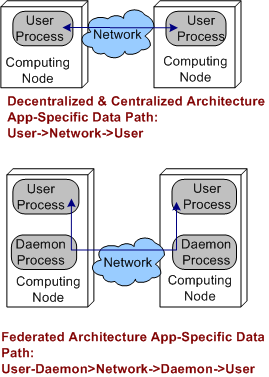
Sure enough, on their two node test fixture (I don’t know why they even bothered with the one node fixture since that really isn’t a “distributed” system in my mind) , the Schmidt et al measurements indicate that the latency/jitter performance of the decentralized and centralized architectures exceed that of the federated architecture. The performance difference that they measured was on the order of 2X.
3 Qualitative Comparisons
In all distributed systems, both DRE and Client-Server types, achieving high operational availability is a huge challenge. Hell, when the system goes bust, fuggedaboud the timeliness of the data, no freakin’ work can get done and panic can and usually does set in. D’oh!
With that scary aspect in mind, let’s look at each of the three architectures in terms of their ability to withstand faults.
3.1 Decentralized Architecture Availability
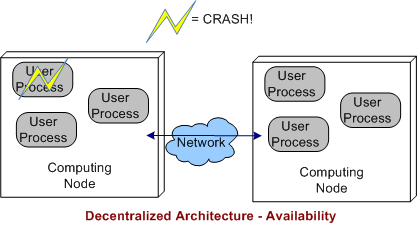
In a decentralized architecture, there are no invasive daemons that “leak” into the application plane so we can’t talk about daemon crashes. Thus, right off the bat we can “arguably” say that a decentralized architecture is more resistant to faults than the federated or centralized architectures.
As the picture below shows, when a user application layer process dies, the others can continue to communicate with each other. Depending on what the specific application is required to do during operation, at least some work may be able to still get accomplished even though one or more app components go kaput.
3.2 Federated Architecture Availability
In a federated architecture, when a daemon process dies, a whole node and all the subscriber application user processes running on it are severed from communicating with the user processes running on the other nodes (see the sketch below) in the system. Thus, the federated architecture is “arguably” less fault tolerant than the decentralized and (as we’ll see) centralized architectures. However, through judicious “allocation” of user processes to nodes (the fewer the better – which sort of defeats the purpose of choosing a federation for per node intra-communication performance optimization), some work still may be able to get accomplished when a node’s daemon crashes.
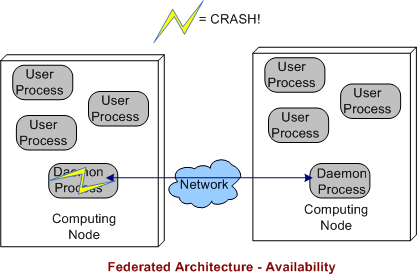
If the node daemons stay viable but a user application dies, then the behavior of a federated architecture, DDS-based system is the same as that of a decentralized architecture
3.3 Centralized Architecture Availability
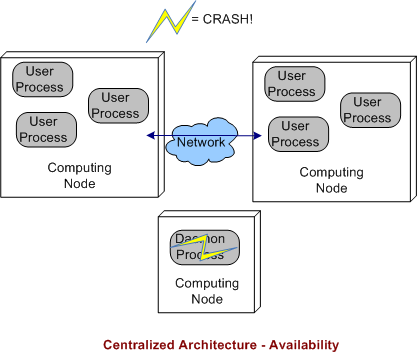
Finally, we come to the robustness of a centralized DDS architecture. As shown below, since the single daemon overlord in the system is not (or should not be) involved in inter-process application layer data communications, if it crashes, then the system can continue to do its full workload. When a user process crashes instead of, or in addition to, the daemon, then the system’s behavior is the same as a decentralized architecture.
4 BD00 Commentary
Because he works on data streaming DRE radar systems, Jimmy likes, I mean BD00 likes, the DDS pub-sub architectural style over broker-based, distributed communication technologies like C/S CORBA and JMS queues. It should be obvious that the latter technologies are not a good match for high availability and low latency DRE applications. Thus, trying to jam fit a new DRE application into a CORBA or JMS communication platform “just because we have one” is a dumb-ass thing to do and is sure to lead to high downstream maintenance costs and a quicker route to archeosclerosis.
Within the DDS space, BD00 prefers the decentralized architecture over the federated and centralized styles because of the semi-objective conclusions arrived at and documented in this post.
New DDS Vendors
Since I’m a fan of the DDS (Data Distribution Service) inter-process communication infrastructure for distributed systems, I try to keep up with developments in the DDS space. Via an Angelo Corsaro slideshare presentation, I discovered two relatively new commercial vendors of the high performance, low latency, OMG! messaging standard: Twin Oaks Computing and Gallium Visual Systems. I don’t know how long the newcomers have been pitching their DDS implementations or how mature their products are, but I’ll be learning more about them in the weeks to come.
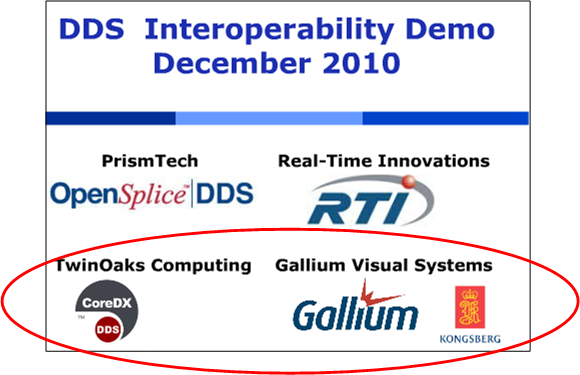
Last week, the four DDS vendors got together at the OMG DDS meeting in CA and they collaboratively executed 9 distributed system test scenarios to highlight the interoperability of the vendors’ products. The Angelo Corsaro slide snippets below show the conceptual context and the goals of the event.
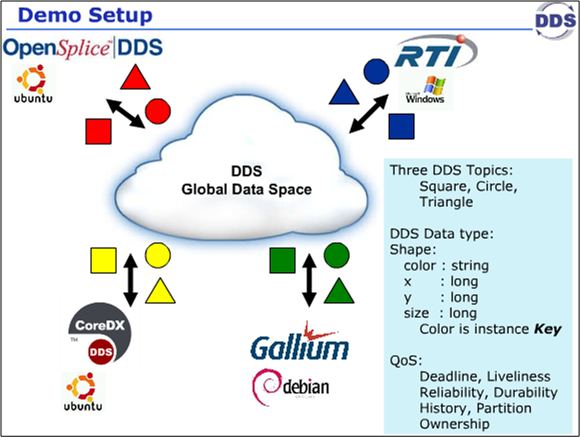
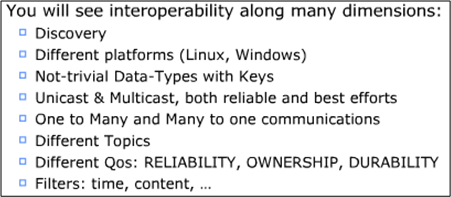
The VP of marketing at RTI, Dave Barnett, published a short video showing that the demo was a success: DDS Interoperability Demo. Since I’m a distributed, real-time software developer geek, this stuff makes me giddy with enthusiasm. Sad, no?
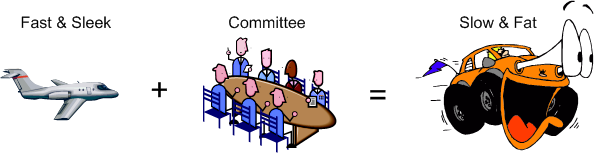
OMG! Design By Committee
In Federico Biancuzzi’s terrific “Masterminds Of Programming“, Federico interviews the three Amigo co-creators of UML. In discussing the “advancement” of the UML after the Amigos freely donated their work to the OMG for further development, Jim Rumbaugh had this to say:
The OMG (Object Management Group) is a case study in how political meddling can damage any good idea. The first version of UML was simple enough, because people didn’t have time to add a lot of clutter. Its main fault was an inconsistent viewpoint—some things were pretty high-level and others were closely aligned to particular programming languages. That’s what the second version should have cleared up. Unfortunately, a lot of people who were jealous of our initial success got involved in the second version. – Jim Rumbaugh
LOL! Following up, Jim landed a second blow:
The OMG process allowed all kinds of special interests to stuff things into UML 2.0, and since the process is mainly based on consensus, it is almost impossible to kill bad ideas. So UML 2.0 became a bloated monstrosity, with far too much dubious content, and still no consistent viewpoint and no way to define one. – Jim Rumbaugh
Double LOL!
Another UML co-creator, Grady Booch, says essentially the same thing but without specifically mentioning the OMG cabal:
UML 2.0 to some degree, and I’ll say this a little bit harshly, suffered a bit of a second system effect in that there were great opportunities and special interest groups, if you will, clamoring for certain specific features which added to the bloat of UML 2.0. – Grady Booch
Triple LOL!
Mitchi Henning, a key player during the CORBA era, rants about the OMG in this controversial “The Rise And Fall Of CORBA” article. Mitchi enraged the corbaholic community by lambasting both CORBA and the dysfunctional OMG politburo that maintains it:
Over the span of a few years, CORBA moved from being a successful middleware that was hailed as the Internet’s next-generation e-commerce infrastructure to being an obscure niche technology that is all but forgotten. This rapid decline is surprising. How can a technology that was produced by the world’s largest software consortium fall from grace so quickly? Many of the reasons are technical: poor architecture, complex APIs, and lack of essential features all contributed to CORBA’s downfall. However, such technical shortcomings are a symptom rather than a cause. Ultimately, CORBA failed because its standardization process virtually guarantees poor technical quality. Seeing that other standards consortia use a process that is very similar, this does not bode well for the viability of other technologies produced in this fashion. – Mitchi Henning
Maybe the kings and queens of the OMG should add an exclamation point to the end of their acronym: OMG!
The reason the OMG! junta interests me is because I’ve been working hands-on with RTI‘s implementation of the OMG Data Distribution Service (DDS) standard to design and build the infrastructure for a distributed sensor data processing server that will be embedded in a safety-critical supersystem. At this point in time, since DDS was co-designed, tested, and fielded by two commercial companies and it wasn’t designed from scratch by a big OMG committee, I think it’s a terrific standard. Particularly, I think RTI’s version is spectacular relative to the other two implementations that I know about. I hope the OMG! doesn’t transform DDS into an abomination………

Why am I here?
WTF?
Meh!
D'oh!

My BTC Address



 Bulldozer00's Blog