Archive
My C++11 “Move” Notes
Being a slow learner, BD00 finds it easier to learn a new topic by researching the writings from multiple sources of authority. BD00 then integrates his findings into his bug-riddled brain as “the truth as he sees it” (not the absolute truth – which is unknowable). The different viewpoints offered up by several experts on a subject tend to fill in holes of understanding that would otherwise go unaddressed. Thus, since BD00 wanted to learn more about how C++11’s new “move” and “rvalue reference” features work, he gathered several snippets on the subject and hoisted them here.
Why Move?
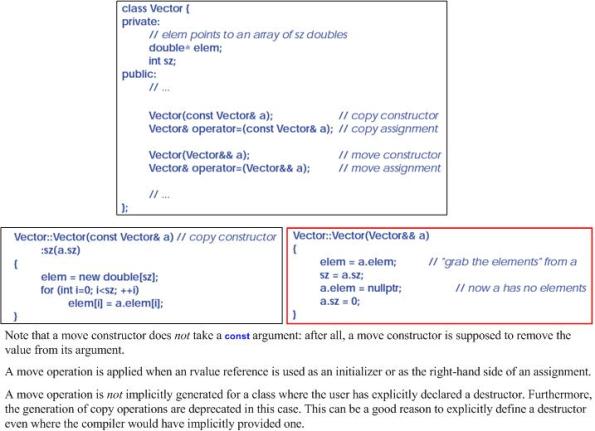
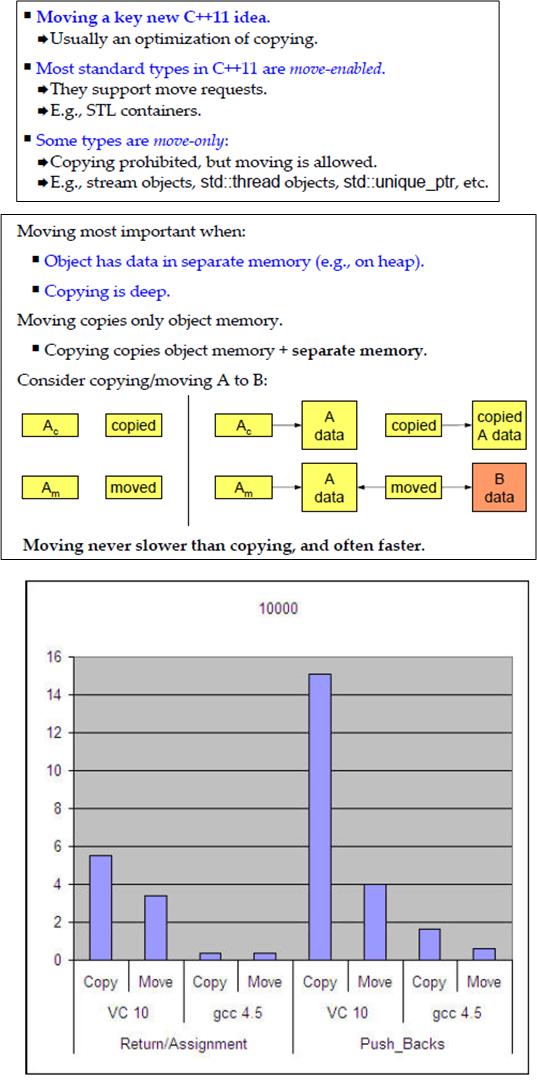
The motivation for adding “rvalue” references and “move” semantics to C++11 to complement its native “copy” semantics was to dramatically improve performance when large amounts of heap-based data need to be transferred from one class object to another AND it is known that preserving the “from” class object’s data is unnecessary (e.g. returning a non-static local object from a function). Rather than laboriously copying each of a million objects from one object to another, one can now simply “move” them.
Unlike its state after a “copy“, a moved-from object’s data is no longer present for further use downstream in the program. It’s like when I give you my phone. I don’t make a copy of it and hand it over to you. After I “move” it to you, I’m sh*t outta luck if I want to call my shrink – until I get a new phone.
Chapter 13 – C++ Primary, Fifth Edition, Lippman, Lajoie, Moo

Chapter 3 – The C++ Programming Language, 4th Edition, Bjarne Stroustrup
Chapter 3 – The C++ Standard Library, 2nd Edition, Nicolai M. Josuttis
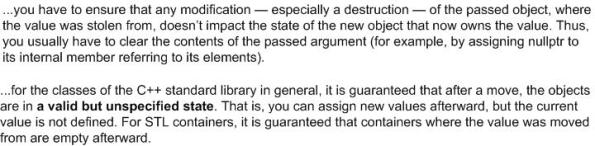
Overview Of The New C++ (C++11), Scott Meyers
Milliseconds Since The Epoch 2
Over a year ago, I hoisted some C++ code on the “Milliseconds Since The Epoch” post for those who were looking for a way to generate timestamps for message tagging and/or event logging and/or code performance measurements. That code was based on the Boost.Date_Time library. However, with the addition of the <chrono> library to C++11, the code to generate millisecond (or microsecond or nanosecond) precision timestamps is not only simpler, it’s now standard:
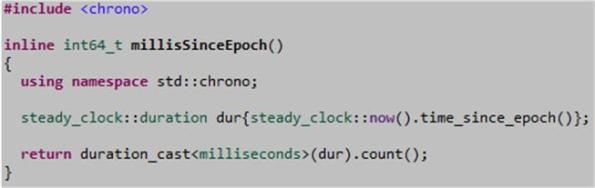
Here’s how it works:
- steady_clock::now() returns a timepoint object relative to the epoch of the steady_clock (which may or may not be the same as the Unix epoch of 1/1/1970).
- steady_clock::timepoint::time_since_epoch() returns a steady_clock::duration object that contains the number of tick-counts that have elapsed between the epoch and the occurrence of the “now” timepoint.
- The duration_cast<T> function template converts the steady_clock::duration tick-counts from whatever internal time units they represent (e.g. seconds, microseconds, nanoseconds, etc) into time units of milliseconds. The millisecond count is then retrieved and returned to the caller via the duration::count() function.
I concocted this code from the excellent tutorial on clocks/timepoints/durations in Nicolai Josuttis’s “The Standard C++ Library (2nd Edition)“. Specifically, “5.7. Clocks and Timers“.
The C++11 standard library provides three clocks:
- system_clock
- high_resolution_clock
- steady_clock
I used the steady_clock in the code because it’s the only clock that’s guaranteed to never be “adjusted” by some external system action (user change, NTP update). Thus, the timepoints obtained from it via the now() member function never decrease as real-time marches forward.
Note: If you need microsecond resolution timestamps, here’s the equivalent code:
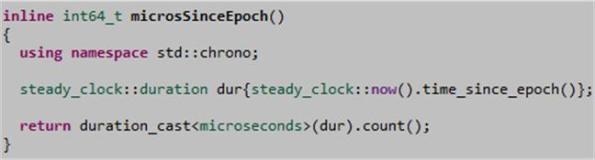
So, what about “rollover“, you ask. As the highlight below from Nicolai’s book shows, the number of bits required by C++11 library implementers increases with increased resolution. Assuming each clock ticks along relative to the Unix epoch time, rollover won’t occur for a very, very, very, very long time; no matter which resolution you use.

Of course, the “real” resolution you actually get depends on the underlying hardware of your platform. Nicolai provides source code to discover what these real, platform-specific resolutions and epochs are for each of the three C++11 clock types. Buy the book if you want to build and run that code on your hardware.

Why am I here?
WTF?
Meh!
D'oh!

My BTC Address



 Bulldozer00's Blog