Archive
Aligned On A Misalignment
After recently tweeting this:

Chris Chapman tweeted this link to me: “Understanding Misalignments in SoftwareDevelopment Projects“. Lo and behold, the third “misalignment” on the page reads:
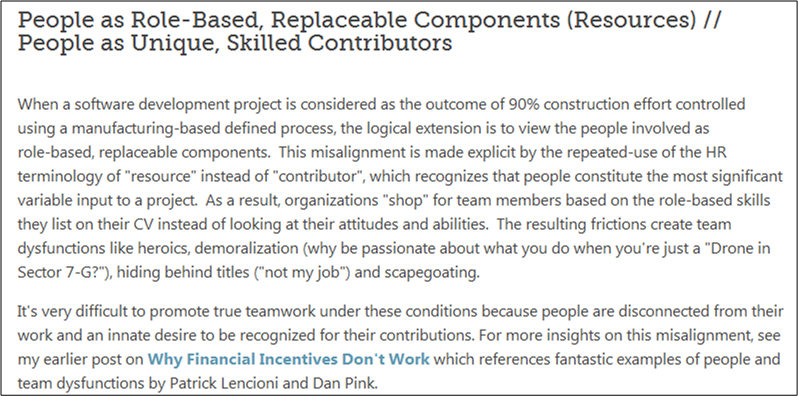
Chris and I seem to be aligned on this misalignment.
Nickels And Dimes
In mediocre 20th century orgs, some ambitious managers are always trying to get something out of their DICs for nothing so that their personal project performance metrics “look good” to the chieftains in the head shed. Nickle and diming “human resources” by:
- calling pre-work, lunchtime, or post-work meetings,
- texting for status on nights/weekends,
- adding work in the middle of a project without extending schedule or budget,
- expecting sustained, long term overtime without offering to pay for it,
- not acknowledging overtime hours,
- “stopping” by often to see “how you’re doing” without asking if they can help
does not go unnoticed. Well, it doesn’t go unnoticed by the supposed dumbos in the DICforce, but it does conveniently go unnoticed and unquestioned by the dudes in the head shed.
What other “nickel and dime practices” for getting something for nothing can you conjure up?
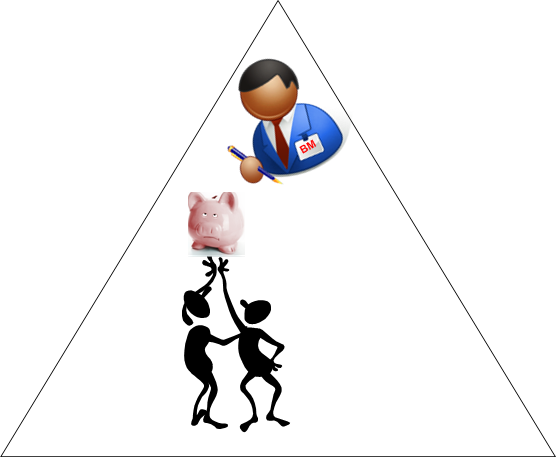
Your Fork, Sir
To that dumbass BD00 simpleton, it’s simple and clear cut. People don’t like to be told how to do their work by people who’ve never done the work themselves and, thus, don’t understand what it takes. Orgs that insist on maintaining groups whose sole purpose is to insert extra tasks/processes/meetings/forms/checklists of dubious “added-value” into the workpath foster mistrust, grudging compliance, blown schedules, and unnecessary cost incursion. It certainly doesn’t bring out the best in their people, dontcha think?

You would think that presenting “certified” obstacle-inserters with real industry-based data implicating the cost-inefficiency of their imposed requirements on value-creation teams might cause them to pause and rethink their position, right? Fuggedaboud it. All it does, no matter how gently you break the news, is cause them to dig in their heels; because it threatens the perceived importance of their livelihood.
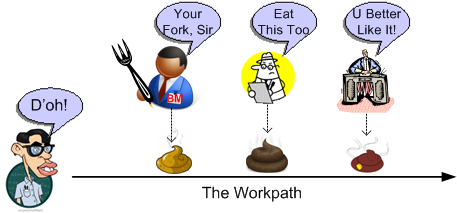
Of course, this post, like all others on this bogus blawg, is a delusional distortion of so-called reality. No?
Opaque, Transparent, Closed, Open
All other things being equal (and they never are), which type of org would you expect to flourish?

Quality Living
It’s one thing to have a high falutin’ written quality policy (and it’s standard fare for all commercial enterprises to have one enshrined in magnets, buttons, key chains, and strategically placed posters), but it’s another thing to live it. If DICsters joke about the “quality” policy frequently and managers never utter the word “quality” during the real-time execution of projects, then neither side is living it, no?
How could you know whether your company is living up to your quality policy? Do your customers and users frequently tell you – unsolicited? Do your earned value metrics tell you? Are your people unabashedly and vocally proud of what they build?
Thank god that at most companies, the management group is a true champion of quality and those “few” trench dwellers who cynically joke about it are simply deemed as a handful of miserable and disgruntled blokes who must be marginalized or ex-communicated.

Empty Lifeline
Check out this “bent” pair of UML sequence diagrams:
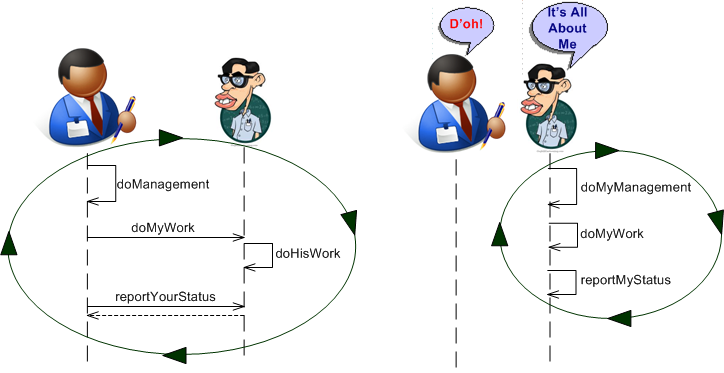
The system on the right is pretty loosely coupled, no?
Where Did The Soldiers Go?
If you’re a leader (anointed or otherwise) and the only access to you is communicated via the classic “my door is always open” and “suggestion box” yawners, then you won’t have to mind-wrestle with this vexing Poppercornism:
The day soldiers stop bringing you their problems is the day you have stopped leading them. They have either lost confidence that you can help or concluded that you don’t care. Either case is a failure of leadership. – Karl Popper

Unstated, But Deeply Rooted
Maturity is a state that most companies eventually reach. To break out of – or avoid – maturity, innovation is required: new products or services, new marketing or markets, more of what is different, not more of the same. – Russell Ackoff
Not only is “maturity” reached by most orgs, it is actively pursued in order to fulfill an unstated, but deeply rooted amygdalayian desire to transition from org to borg. The hilarity of the situation is that while a “maturing” org’s behaviors and processes unceasingly and silently nudge it toward rigid borgdom, the esteemed leadership continuously cries out for innovation. Do as I say, not as I do. D’oh!

Behind The Scenes
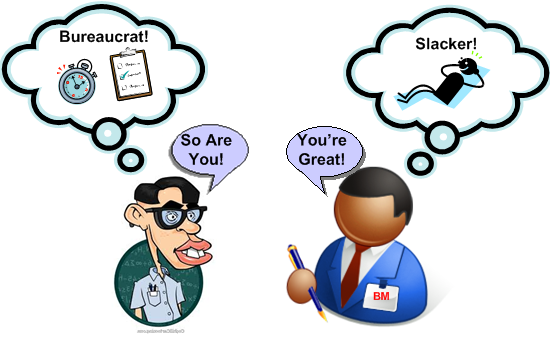
In really dysfunctional orgs, do you think much of this goes on……?
Lacking Smarts
Check out the title of this article and have a LOL with (or at) BD00: “People Aren’t Smart Enough for Democracy to Flourish, Scientists Say“.
The research, led by David Dunning, a psychologist at Cornell University, shows that incompetent people are inherently unable to judge the competence of other people, or the quality of those people’s ideas.
D’oh! Too stupid to judge. That’s BD00 in a nutshell when he attempts to unfairly scald the guild of management and its continued, often subtle, application of Tayloristic techniques in the 21st century.
…democracies rarely or never elect the best leaders. Their advantage over dictatorships or other forms of government is merely that they effectively prevent lower-than-average candidates from becoming leaders.
If that’s “merely” true for democracies, then un-democracies must merely suck. How well do you think undemocratic boards of directors do in choosing executives and how well undemocratic executives do in anointing subordinate managers and how well undemocratic managers do in hiring DICsters and how well DICs do in….? Oops, I almost forgot that DICs aren’t allowed to choose or anoint.
Of course, this research on incompetence doesn’t apply to the elites who run institutions because boards of directors, executives, and managers are infallibly competent in their profession.
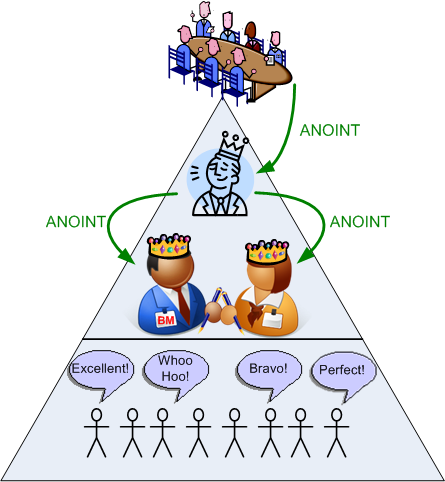
Ya gotta love this Wikipedia definition of anointment:
To anoint is to pour or smear with perfumed oil, milk, water, melted butter or other substances, a process employed ritually by many religions. People and things are anointed to symbolize the introduction of a sacramental or divine influence, a holy emanation, spirit, power or God.
At my anointment, I want to be smeared with… peanut butter and melted Godiva chocolate. How about you? What’s your substance of choice – assuming you have a choice?

Why am I here?
WTF?
Meh!
D'oh!

My BTC Address



 Bulldozer00's Blog