Archive
Stakeholders
The figure below shows the major stakeholders associated with a profit making institution. Except for the environment, which ironically but generously supplies the raw resources from which all value and profit are extracted, everyone wants the biggest piece of the profit pie they can get. 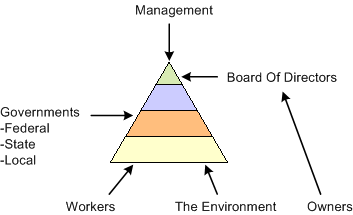
Since management is the biggest influencer of org performance, the dudes in charge feel the greatest pressure to generate profits for themselves and all the other stakeholders. In order to relieve themselves of this pressure and provide themselves with the largest share of the treasury, unscrupulous executive “leadership” teams (and not all of them are so self absorbed) do everything they can to distance themselves from the “other” stakeholders:
- They hire lawyers and lobbyists to fend off taxes and regulations imposed by governments to keep their behavior in check
- They hand pick a group of yes men/women for their board of directors to keep the greedy owners one level removed from themselves
- They keep their workers in check via classic, subtle fear inducing tactics
- They ignore the environment – because it unselfishly makes no direct demands upon them
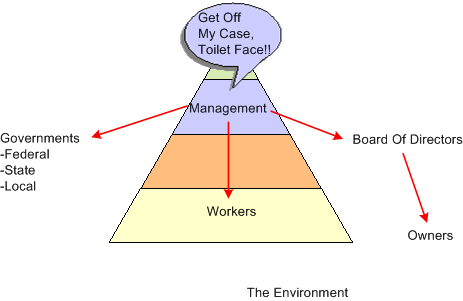
Great leadership teams don’t spend all their waking hours playing defense against the “others” and justifying their exorbitant compensation. They think systemicly and make compassionate decisions that balance the needs of all those involved in the enterprise.
And now, as a preview to next week’s self-righteous do-as-I-say-and-not-as-I-do sermon………………
Multividual Contributor
The most politically correct (a.k.a. least offensive) way to ensure that employees take note of the fact that they are a notch below them, managers love to use the term “individual contributor” to DICs. Managers use this term repeatedly during annual performance reviews to subtly pre-empt any discontent over the measly 2% raises almost all non-managers get every year. The unspoken but unambiguous top-down message is: “You shouldn’t expect more because you’re only an individual contributor. I, on the other hand, am a manager – a multi-vidual contributor.”

Say what? Aren’t managers individuals? Aren’t managers (well, at least the non-BMs amongst them) contributors? Individual + contributor = individual contributor, no? Is it time to come up with a new, creative, and clever replacement term that will continue to promote the false impression that all managers are more important than all DICs? How about “limited influencer” or “lesser contributor”? Nah, these are not politically correct enough. Got any suggestions?
Managers And Leaders
Naturally, everyone has their own personal opinion regarding the difference between a leader and a manager. Of course, I have one too:
Manager = Status Taker and Schedule Jockey (STSJ)
Leader = People Helper and Obstacle Remover (PHOR) first, and STSJ second
Of course, the STSJ function is necessary (but not sufficient) to stay in business, but the PHOR function is required to increase profitability, instill trust, and build a joyful workplace. In order to grow into a PHOR, a candidate for leadership has got to communicate, and frequently. Hell, if a leadership candidate doesn’t communicate with his/her people, how’s he/she going to know what they need and what socio-technical obstacles must be removed for them to excel? All non-communicators are STSJs – which means the number of STSJs (a.k.a BMs) pervading corpo America is HUGE-UH.
If you have more managers than leaders in your organization, then you’re most likely not having any fun during your daily stint within the halls of your institution. If you have zero leaders in your organization, then your work life is probably horrific. If you have all leaders in your organization then you’re most likely in heaven.
If any organism fails to fulfill its potentialities, it becomes sick. – William James
What’s the Manager-To-Leader ratio (MTL) in your organization? If you’re “in charge” of a group of people, are you a manager or a leader according to my unscientific, concocted (I like to make stuff up) criteria ?

Line, Dot, Cone
My friend and mentor from afar (if you’ve looked around your local environment, there’s an incredible dearth of mentors from a-near), William L. Livingston, is about to hatch his fourth book: “Design For Prevention“. I’m happy to say that I’ve served as a reviewer and a source of feedback for D4P. I’m sad to say that it won’t become a New York Times bestseller because it’s one of those blasphemous books that goes against the grain and will be rejected/ignored by those it could help the most – institutional leaders.
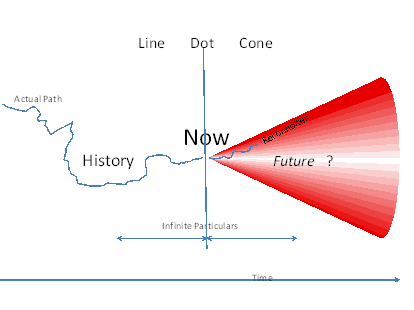
One of the graphics in DfP that I’ve fixated on is the “Line Dot Cone” drawing. As shown below, the path to “now” is not smooth and deterministic. It’s non-linear and quite haphazard. Likewise, the future holds an infinite cone of possibilities. The only way to narrow the cone of future uncertainty is to perform continuous reconnaissance via sensing/probing/simulating and then intelligently acting upon the knowledge gained from the effort, where intelligence = appropriate selection (W. Ross Ashby) and not academic knowlege.
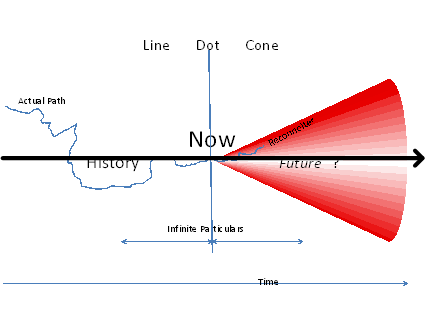
CCH corpocracies don’t acknowledge the existence of the Line-Dot-Cone reality. It would undermine the carefully crafted illusion that the dudes in the penthouse have projected about their ability to make the future happen. In their fat heads, as the overlay below shows, progress always occurs linearly in accordance with their infallible control actions. Thus, no reconnaissance is needed and all will be well for as long as they rule the roost.
Loyal, Or Disloyal?
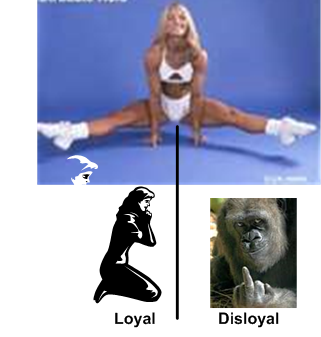
In virtually every organization comprised of a large group of human beings, one individual or sub-group always holds absolute “power over” the members who hold the “power to” get things done. Because of the innate primal human desire to retain power and remain in control, there’s a dangerous fine line that every “power to” member should be acutely aware of.
On one side of the line is “loyalty”. On the other side is “disloyalty”. Those in charge, of course, are the ultimate arbiters of where you stand in relation to line. I like to straddle the line (see below), but it’s not within my power to judge where I stand.
Note: I borrowed the “power over” and “power to” concepts from Russell Ackoff, a true management genius – that everyone in the mainstream ignores, of course.
Troubleshooter
Assume that your company is cruising along and creating high quality products, happy customers, and making money. The drawing below shows this situational bliss – a well oiled machine.
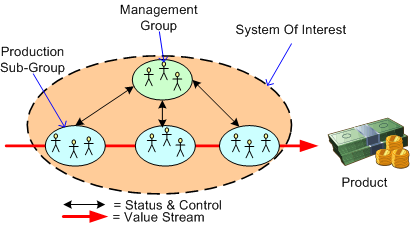
Now assume that something in your previously flawless system has gone bad. Your product quality has tanked, your customers are angry, and your profitability has shrunk. The lightning bolts in the figure below show places of potential dysfunction that are causing and contributing to the mess.
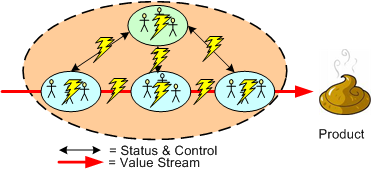
So, how do you figure out what’s gone wrong so that you can fix the stank? Of course, if you’re in the management group, you’ll automatically discard yourself and your brethren as a source of the problem(s). Since you have an agenda to look good and an unshakable self-image of infallibility, you’ll go poking around in all areas and cross-group interfaces except your own.
Since almost all corpo performance problems are the result of bozo management actions and a lack of leadership, one effective way of diagnosing and fixing what ails you is to bring in an objective outside troubleshooter who will tell you the unabashed truth. Alas, since you’ll be sourcing the income for any outside troubleshooter, he/she will most likely milk the job and tell you what you want to hear: you’re not the problem.

Oppose A Thing
“Men often oppose a thing merely because they have had no agency in planning it, or because it may have been planned by those whom they dislike.” – Alexander Hamilton
If you buy into Hamilton’s quote, then you’ll realize that it explains all kinds of irrational behavior at work by those in charge. Another ditty that explains counterproductive behavior and ludicrous decision-making in mediocracies is:
“It’s not what you say, it’s how you say it.”
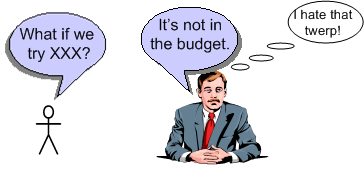
When someone is disliked by, or is brutally honest to those in power, even the best ideas offered up by the perceived villain will be rejected. It doesn’t matter if an idea could potentially save the corpocracy tons of money or bring in new business, the idea will be killed in the cradle. Of course, many kinds of clever camouflage and pseudo-rational reasons will be given for the rejection, but the underlying truth is what Mr. Hamilton stated hundreds of years ago.
Who says that business isn’t personal?
Buffer Gone Awry
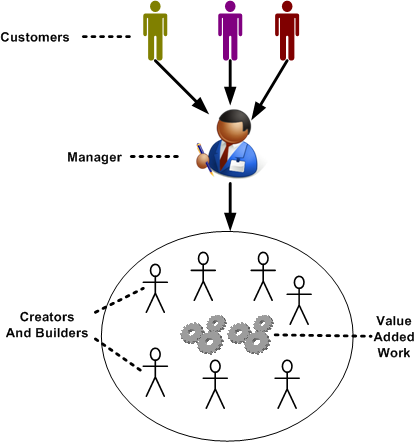
Assume that you’re a manager enveloped within the predicament below. On a daily basis, you’re trying to coordinate bug fixes and new feature additions to your product while simultaneously getting hammered by internal and external customers with problem reports and new feature requests.
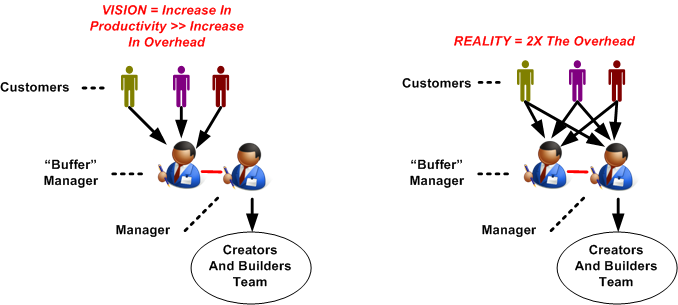
In order to reduce your workload and increase productivity, your meta-manager decides to add a “buffer” manager to filter and smooth out the customer interface side of your job. As the left side of the figure below shows, the hope is that the team’s increased productivity will offset the doubling of overhead costs associated with adding a second manager to the mix. However, when your customers find out that they now have two managers to voice their problems and needs to, the situation on the right develops: your workload remains the same; you now have an additional interface with the buffer manager (who has less of a workload than you); the overhead cost to the org doubles. Bummer.
Appliablity
In the “good ole’ days”, products, along with the development and production processes to create them, were much simpler. Modern day knowledge-intensive products require both deep and broad know-what and know-how to be successful in the marketplace. Accordingly, in the “good ole’ days” many front line and second tier managers were skilled enough to man the production lines when workers went on strike. In knowledge-intensive industries like software development, that’s no longer true – even if the manager was an engineer just prior to promotion. It’s especially true in today’s fast moving environment where skills become obsolete as soon as they’re mastered. D’oh!
Another way of expressing the idea above is in the corpo lingo of “appliability”. For the most part, managers don’t have the skills to be appliable anymore. They’re a pure overhead expense to the orgs they work for. Thus, unless they’re PHORs, they’re a drain on profits. The next time a non-PHOR manager tells you that “you’re expensive to employ” retort back “at least I’m appliable” – if you dare.

Iteration Frequency
Obviously, even the most iterative agile development process marches forward in time. Thus, at least to a small extent, every process exhibits some properties of the classic and much maligned waterfall metaphor. On big projects, the schedule is necessarily partitioned into sequential time phases. The figure below (Reqs. = requirements, Freq. = frequency, HW = hardware, SW = software) attempts to model both forward progress and iteration as a function of time.
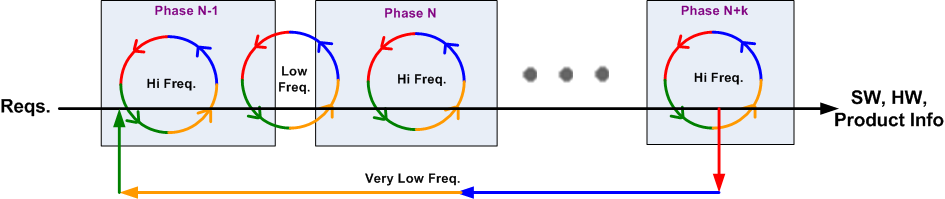
If the phases are designed to be internally cohesive, externally loosely coupled , and the project is managed correctly, the frequency of iteration triggered by the natural process of human learning and fixing mistakes is:
- high within a given project phase
- low between adjacent project phases
- very low between non-adjacent project phases
Of course, if managed stupidly by explicitly or implicitly “disallowing” any iterative learning loops in order to meet equally stupid and “aggressive” schedules handed down from the heavens, errors and mistakes will accumulate and weave themselves undetected into the product fabric – until the customer starts using the contraption. D’oh!

Why am I here?
WTF?
Meh!
D'oh!

My BTC Address



 Bulldozer00's Blog