Archive
Watching Closely
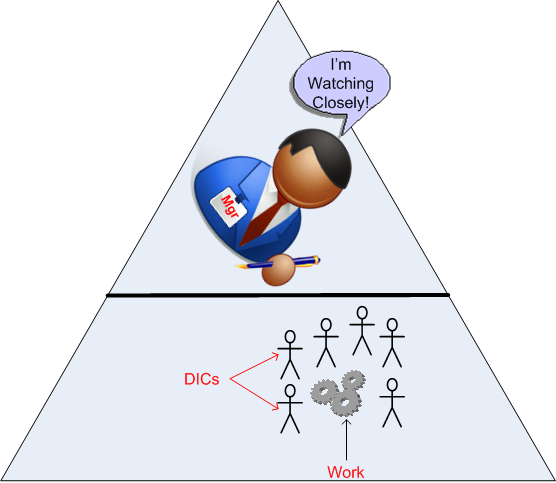
Please tell me what type of manager broadcasts statements like this one:
“Since there were no major accomplishments reported on this task last week, I’ll be watching this task closely.”
When I see or hear comic statements like this, I privately think to myself (but never publicly speak, of course):
- What are you gonna do to help if reported status is not up to your lofty but unarticulated expectations next week?
- Are you gonna issue more pointed and specific threats to the DICs assigned to the task?
- Are you gonna ratchet up the pressure even more so?
- Are you gonna roll up your sleeves, dive in and find out what is halting progress so you can directly or indirectly help?
What would you ask yourself?
Crisis?, What Crisis?
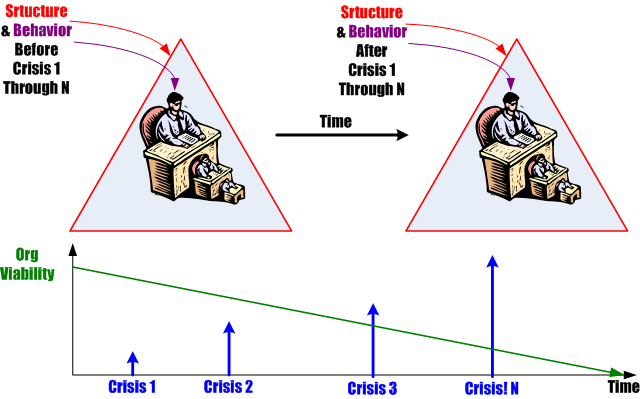
The other day, I heard a song on Pandora from one of my fave albums of the 70s (yes, they were called albums back then); Supertramp‘s “Crisis?, What Crisis“. The album title reminded me of orgs that emotionally panic “under the covers” when a crisis occurs, but outwardly behave as if there is no crisis. By “behaving like no crisis is occurring“, I mean that the SCOLs in charge apply whatever band aids they can in the short term to get through the crisis but don’t do anything of substance to stave off, or better handle, future crises.
When the crisis at hand passes, the heroes are congratulated and: the org structure stays the same, the people in the top roles stay the same, the operational business processes remain the same, and most ominously, the patriarchal CCH mindsets stay the same. It’s back to the same-old, same-old, business as usual.
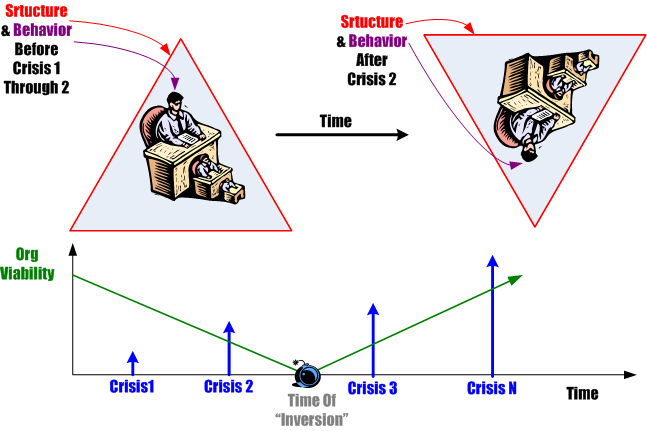
The figure below shows what maybe should happen when crises occur and learning takes place? Someone or some group willingly steps up to positively change the structures and behaviors so that the org can smoothly navigate through, and even thrive within, future crises. In the example below, it took 2 crises to stave off self destruction, right the course, and excel in the future. Alas, the problem with the previous sentence is the “someone or some group” phrase at the beginning.
Hurd Joins The Herd
I was considering writing a blog post about the downfall of Hewlett Packard’s CEO Mark Hurd, but I decided to back off. I figured that all the credentialed and highly respected tech columnists and bloggers have covered this horror story from all angles.
So, instead of my usual rag, rag, rag…… whine, whine, whine….. toll-u-so, toll-u-so, toll-u-sow verbage, I’ve written an empty husk of a blog post. The accompanying picture sux too….
 Nevertheless, I’ll be back on my high horse and raging against the machine soon.
Us And Them
Poor org leaders, or SCOLs, either maintain a stratified “Us And Them” (UAT) line in their orgs or worse – they purposefully create one. By hiring clones of themselves, multiple UAT lines of demarcation appear; choking off open, honest, inter-layer communication and breeding mistrust and disrespect.

Great leaders, or PHORs, skillfully obliterate UAT lines where they exist, or they heroically prevent UAT lines from arising in the first place. Of course, that’s what makes them great leaders.


Compensation Compression
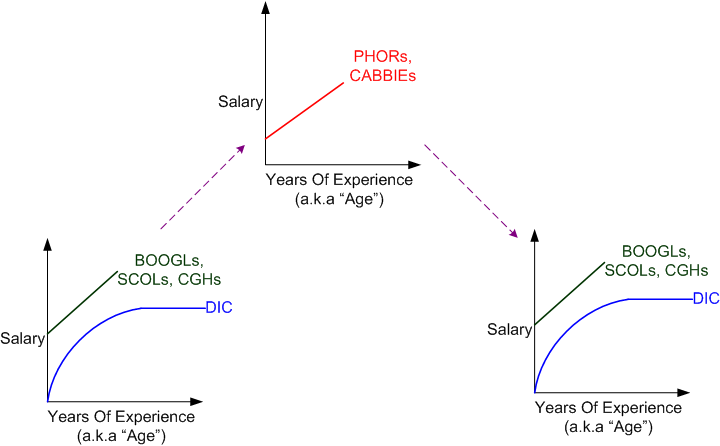
The figure below shows the salary trends for a typical corpricracy comprised of DICs, BOOGLs, SCOLs, and CGHs. Notice that the sky’s the limit for manager types and compression occurs for the DICforce. Is that the way it should be? In theory, probably yes. In practice, most likely no.
 The most frequent reason given by the mainstream management guild for rationalizing the curve is that managers have more responsibility and greater impact on an org than any “induhvidual contributor” DIC. That is true, but are they fulfilling their responsibility? Is their impact positive or negative? Oh sure, every viable org has at least a handful of PHOR managers that fulfill their responsibilities and positively impact the org, but all mediocracies are filled with BOOGLs, SCOLs, and CGHs who don’t fulfill their responsibility and negatively impact the corpricracy.
When the inequity in compensation becomes blatantly obvious and intolerable, a handful of underappreciated DICs usually break off and form their own startup where everyone starts out as either a CABBIE or PHOR. Ironically, as the startup grows and allegedly matures:
- The majority of PHORs transform into BOOGLs, SCOLs, and CGHs while retaining the mindset that they’re still PHORs.
- The BOOGLs, SCOLs, and CGHs start perceiving the CABBIEs as DICs; a cost to be minimized.
Unconscious, Conscious, Bozo, Helper
The following sparsely “bent” UML class diagram (see the end of this post for a quick and dorky tutorial for interpreting the diagram) exposes Bulldozer00’s internal hierarchy of manager types. Yours may be different, especially if you’re a manager.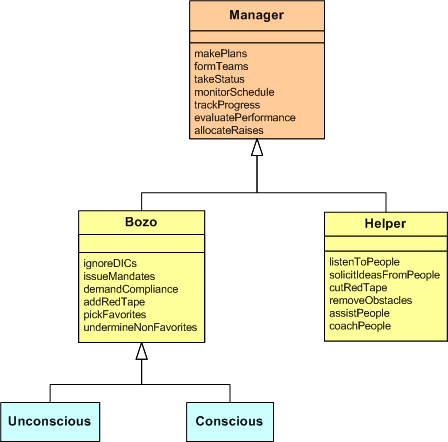
The Base Class
The hierarchy’s Manager base class supplies all the mundane operations that sub-classed managers inherit and perform. For example, all managers in this particular inheritance tree make project plans, track project progress, and monitor progress against the plans. The frequency at which these behaviors are performed, along with the exact details of how they’re executed, is both manager-specific and project-specific. For example, during performance of the “takeStatus” operation, one manager may require project members to write out detailed weekly status reports whilst another may just require informal verbal status.
The Sub-Classes
The second level in Bulldozer00’s morbid and disturbing manager class hierarchy is more interesting. There are two polar opposite sub-types; Bozo and Helper. In addition to inheriting the boring, mechanical, and necessary responsibilities of the Manager base class, these subclasses provide radically different sets of behaviors. For instance, the Bozo subclass provides an “ignoreDICs” behavior whilst the Helper subclass provides “listenToPeople” and “solicitIdeas” behaviors. Comparing the behavior sets between the two subclasses and then against your own manager(s), how would you classify your manager(s)?
As the diagram shows, there are two Bozo Manager subtypes: Conscious and Unconscious. There’s no equivalent subdivision for the Helper Manager type because all Helper Manager “instantiations” are fully conscious. Hell, since all the behaviors that Helper Managers exhibit are so extraordinarily rare, productive, and against-the-grain, there is no way they can be unconscious and not know what they’re doing.
In Bulldozer00’s experience, most Bozo Managers are of the Unconscious ilk. They continuously execute the counterproductive behaviors forwarded on to them via their Bozo inheritance, but they don’t realize how detrimental their actions and words are to the orgs they’re responsible for growing and developing. Since virtually all their fellow clique members behave the same way, they’re oblivious to alternatives and they can’t connect poor org performance to their own dysfunctional behaviors.
Forgive them, for they know not what they do. – Jesus
Lastly, we come to the Conscious Bozo Manager class. Beware of these dudes, of which there are few (thank god), because they are hell on wheels. These guys/gals know fully well that their behaviors/actions are both locally and globally destructive. But why, you ask, would they behave this way? Well, because they’re out to inflate their heads and wallets and there are no boundaries they wouldn’t cross to achieve their goals.
Advice
If you choose to embrace, internalize, and use Bulldozer00’s class hierarchy to evaluate and “privately” judge your managers, you might want to take these suggestions into consideration:
- Run like hell from the Conscious Bozo types.
- Do your best to bring consciousness to the legions of well meaning, but sleepwalking, Unconscious Bozo types
- Attach yourself like a lamprey to the Helper type
But why the hell would you want to “buy into” Bulldozer00’s manager taxonomy? Great freakin’ question!
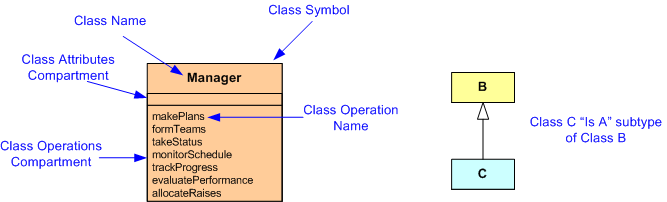
Appendix: Mini Class Diagram Graphic Tutorial
A Key Ingredient
As Tony Hsieh states in “Delivering Happiness“,
A key ingredient in strong (business) relationships is to develop emotional connections. – Tony Hsieh
In my fantasy world, I find this extremely ironic because, in “business”, most corpricracies only anoint those who can cleverly camouflage their emotions to exalted and coveted leadership positions. And yet, here is Mr. Chez, the CEO of a profitable billion dollar company in the cutthroat shoe retail industry, “nicely” flipping the finger at mainstream American business and the esteemed B-school advice they rode in on.
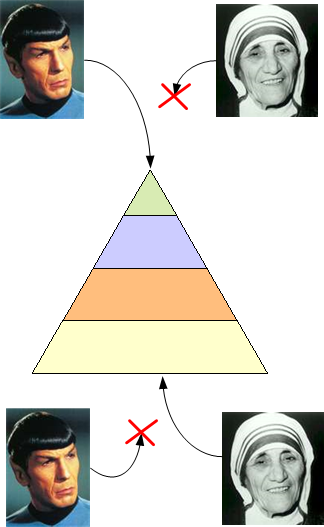
It’s funny how “passion”, which can be defined as a “strong emotion“, is demanded of the DICforce, but Spock-like emotional control is required by SCOLs and BOOGLs for ascension to the throne.
Why Do You Guys Suck?
In this Gary Hamel post, Extreme Management Makeover, Mr. Hamel tells the story of HCL Technologies CEO Vineet Nayar’s passionate effort to turn his company’s culture upside down. Read the article to discover the slew of wildly unorthodox actions that Vineet executed to achieve his goal. As a sampling of Mr. Nayer’s courage and determination to buck the status quo, check this one out:
HCLT employees are able to rate the performance of any manager whose decisions impact their work lives, and to do so anonymously. These ratings are published online and can be viewed by anyone who has submitted a review. This visibility challenges managers to be more responsive and exercise their authority judiciously. The number and organizational scope of the reviews a manager receives are also a good indicator of an individual’s zone of influence—is he or she adding value across a wide swath of the company, or only within a narrow sphere? Importantly, this “feedforward” process isn’t connected to compensation and promotion decisions. It is purely developmental. Nevertheless, there aren’t many hiding places left at HCLT for mediocre managers.
Want another zinger?
Early on, Vineet and his leadership team set up an online forum and encouraged employees to ask tough questions and offer honest feedback. Nothing was censored on the “U&I” site; every post, however virulent, was displayed for the entire company to see. Vineet recalls that in the beginning, “virtually 100% of the questions were dirty questions. ‘Why do you guys suck?’ ‘Why does your strategy suck?’ ‘Why aren’t you living up to your values?’’ While some managers bemoaned the fact that all of the company’s soiled laundry was now online, employees lauded the forum as a symbol of HCLT’s commitment to transparency and as another way to hold top management accountable. The U&I portal had another value: it was also an early warning system for critical issues facing the company.
Does your company even have a DICforce-to-management U&I portal? If you’re lucky enough to have one, is it anonymous and uncensored so that the submitted questions are more than just cream puffs?
 If Vineet was in any position other than the CEO, do you think his idea of “employees first, customers second” would have any chance at all of being heard, let alone being placed into execution? Do you think managers in general explore the landscape for innovative management practices and weird, heretical companies like HCLT, Zappos.com, SAS Institute, SEMCO, et al?
Layoffs
If you”re familiar with the Zappos.com business success story, you might think that it’s the perfect company. Unlimited growth, unlimited profits, enthusiastic employees, all good and no bad. But did you know that the company had to lay off some of their workforce not once, but twice? The first layoff, which came in the early startup years when they were struggling to survive month to month, was much more understandable than the second layoff, which occurred in 2008 while they were profitable.
When 2008 started, Zappos.com exceeded sales and profit expectations for 2007, so CEO Tony Hsieh and his leadership team decided to dole out a surprise, 10% bonus, to all Zapponians. Incredibly, eight months later he was hatching an e-mail stating that Zappos would be laying off 8% of the workforce. WTF, you ask?
2008 was a whirlwind year. The stock market crashed, the housing market crashed, hundreds of thousands of people were thrown out of work, and businesses everywhere, including Zappos, started reeling from lower sales. Since Zappos was growing like mad up to that point, they discovered that they were overhiring. Even though they weren’t losing money, the Zappos leadership team decided that they had to cut their workforce to better align their costs with decreasing revenues. In Tony’s words from his book “Delivering Happiness“;
Rather than trying to spin the story as a “strategic restructuring” as many other corporations were doing, we stuck by our core values and remained open and honest, not only with our employees, but with the press as well. – Tony Hsieh, CEO, Zappos.com
In November of 2008, Tony sent an e-mail announcing the cuts to all employees and the publicly visible Zappos.com blogs. After the bloodletting was over, he sent a followup e-mail. The full text of both e-mails is in the book, so buy it if you’re curious about what he said to the world.

Extended Business Model
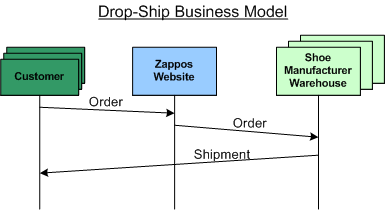
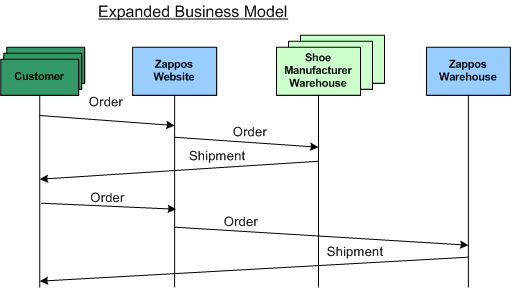
In Zappos.com CEO Tony Hsieh’s new book: “Delivering Happiness“, Tony describes the original Zappos.com business model as “drop-ship”. As the UML sequence diagram below shows, a customer would place an order at the Zappos.com website, Zappos would relay the order directly to the shoe manufacturer’s warehouse, and the order would be fulfilled and shipped directly from ground zero. It was a low cost model for Zappos, but it limited sales growth since many shoe manufacturers didn’t have the information systems in place to execute their end of the model. In addition, sales were limited to the inventory that warehouses held in storage, not necessarily what Zappos’ customers wanted.
During the initial stage of growth, Zappos.com was often short on cash (surprise!) and often just a month or two away from goin’ kaput (surprise, again!). The Zapponians needed to increase sales in order to increase cash flow. During a brainstorming session in a local bar (not in a committee of BMs, CCRATS, BOOGLs, consultants, and other self-important dudes) they came up with the idea of extending their existing business model.
Man creates by projection, nature creates by extension – Unknown
The sequence diagram below shows the extended business model that Tony “chez” et al decided to move toward. In a nutshell, Zappos would purchase or lease a warehouse and stock its own inventory based on trend information extracted from its website. As simple as it looks, the devil is in the details. Buy and read the book to learn how they pulled it off – despite being cash poor and close to going tits-up.
If changing our business model is what’s going to save us, then we need to embrace and drive change. – Tony Hsieh
How many times have you heard or spoken the “embrace change” words above but never experienced or executed any follow through?

Why am I here?
WTF?
Meh!
D'oh!

My BTC Address



 Bulldozer00's Blog