Archive
Loyal, Or Disloyal?
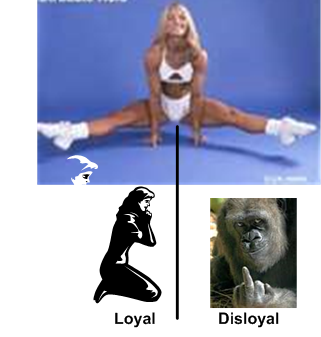
In virtually every organization comprised of a large group of human beings, one individual or sub-group always holds absolute “power over” the members who hold the “power to” get things done. Because of the innate primal human desire to retain power and remain in control, there’s a dangerous fine line that every “power to” member should be acutely aware of.
On one side of the line is “loyalty”. On the other side is “disloyalty”. Those in charge, of course, are the ultimate arbiters of where you stand in relation to line. I like to straddle the line (see below), but it’s not within my power to judge where I stand.
Note: I borrowed the “power over” and “power to” concepts from Russell Ackoff, a true management genius – that everyone in the mainstream ignores, of course.
Console And Files First, GUI And Database Last
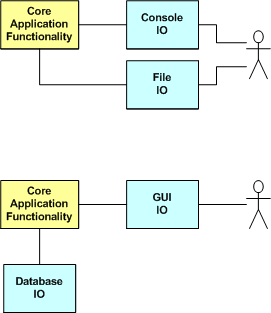
Adding Database IO and GUI IO to a program ratchets up it’s complexity, and hence development time, immensely. In “Programming: Principles and Practice Using C++“, Bjarne Stroustrup recommends designing and writing your program to do IO over the console and filesystem first, and then adding GUI IO and database IO later. And only if you have to.
Eliminating, or at least delaying, GUI and database IO forces you to focus on getting the internal application design right early. It also helps to keep you from tangling the GUI IO and database IO code with your application code and creating an unmaintainable ball of mud. Thirdly, the practice also makes testing much simpler than trying to write and debug the whole quagmire at once. Good advice?
Full Redundancy
2 lungs, 2 kidneys, 2 arms, 2 legs, 2 ears, 2 eyes, 2 nose holes. 1 brain, 1 heart, 1 liver, 1 pancreas, 1 output-only port (mostly). Why didn’t nature provide us with full redundancy for all vital body parts? Why create a semi fault-tolerant system with multiple single points of failure?

SAS Still Rocks
Everyone loves to be number one. According to Fortune mag, SAS is the Best Company to Work For in 2010. This rare gem of a company has been on my list of faves for many years and it amazingly continues to thrive in a rapidly moving industry that’s under constant pressure from competitors like Google, IBM, Microsoft, and open source software organizations.
SAS (pronounced sass) has been on Fortune’s list of Best Companies to Work For every one of the 13 years we’ve been keeping score. But this is the first time SAS is in the No. 1 slot.
CEO Jim Goodnight’s motives aren’t charitable but entirely utilitarian, even a bit Machiavellian. The average tenure at SAS is 10 years; 300 employees have worked 25 or more. Annual turnover was 2% in 2009, compared with the average in the software industry of about 22%. Women make up 45% of its U.S. workforce, which has an average age of 45.
Goodnight says the “wonder” isn’t that his company is so generous, but why other presumably rational corporations are not. Academicians confirm that his policies augment creativity, reduce distraction, and foster intense loyalty — even though SAS isn’t known for paying the highest salaries in its field and even though there are no stock options.
The notion of easy living frustrates those on the inside. “Some may think that because SAS is family-friendly and has great benefits that we don’t work hard,” says Bev Brown, who’s in external communications. “But people do work hard here, because they’re motivated to take care of a company that takes care of them.”
With a “billion dollars in the bank” and another big building going up on campus, Goodnight is continuing to invest. In a company of elite quantitative analysts, he devotes more than a fifth of revenue to R&D. For 33 straight years, SAS’s revenues have gone up — reaching $2.3 billion in 2009, nearly doubling in seven years.
The company that I work for, Sensis Inc., is pretty damn good to its employees too. Just because I’m on a diet doesn’t mean I can’t look at the menu.

Make Vs Create
After overcoming the religious specificity in which “A Course In Miracles” is written, I’m finding that it is a deeply moving piece of spiritual work. One of the profound and simple (being a simpleton, I love profound and simple) insights communicated to me is the difference ‘tween making and creating. According to the ACIM authors, human beings “make” out of necessity (to get paid, to solve a problem, etc) but “create” out of love (art, music, children, etc). Before this discovery, I thought that “making” and “creating” were cut from the same cloth.
The story behind the making of ACIM is remarkable:
A Course in Miracles began with the sudden decision of two people to join in a common goal. Their names were Helen Schucman and William Thetford, Professors of Medical Psychology at Columbia University’s College of Physicians and Surgeons in New York City. They were anything but spiritual. Their relationship with each other was difficult and often strained, and they were concerned with personal and professional acceptance and status. In general, they had considerable investment in the values of the world. Their lives were hardly in accord with anything that the Course advocates.
Schucman writes:
The head of my department unexpectedly announced that he was tired of the angry and aggressive feelings our attitudes reflected, and concluded that, ‘there must be another way.’ As if on cue I agreed to help him find it. Apparently this Course is the other way.
I was still very surprised when I wrote, “This is a course in miracles.” That was my introduction to the Voice. It made no sound, but seemed to be giving me a kind of rapid, inner dictation which I took down in a shorthand notebook. The writing was never automatic. It could be interrupted at any time and later picked up again. It made me very uncomfortable, but it never seriously occurred to me to stop. It seemed to be a special assignment I had somehow, somewhere agreed to complete.
I remember hearing Eckhart Tolle elaborate on how “The Power Of Now” came into existence. A former PhD student himself, Eckhart described the content as “coming through” him and not “from” him. Michael Jackson, when asked in an interview how he created his best work, stated that the music “came through” him.
I’d love for some creation that’s beneficial to mankind to “come through” me. How about you?

Troubleshooter
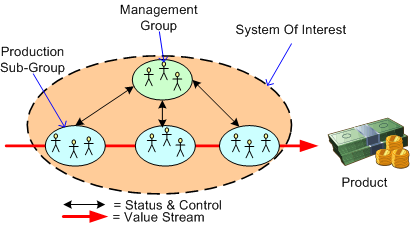
Assume that your company is cruising along and creating high quality products, happy customers, and making money. The drawing below shows this situational bliss – a well oiled machine.
Now assume that something in your previously flawless system has gone bad. Your product quality has tanked, your customers are angry, and your profitability has shrunk. The lightning bolts in the figure below show places of potential dysfunction that are causing and contributing to the mess.
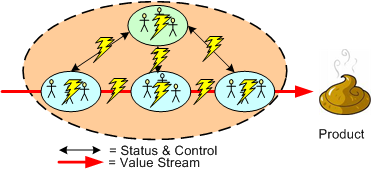
So, how do you figure out what’s gone wrong so that you can fix the stank? Of course, if you’re in the management group, you’ll automatically discard yourself and your brethren as a source of the problem(s). Since you have an agenda to look good and an unshakable self-image of infallibility, you’ll go poking around in all areas and cross-group interfaces except your own.
Since almost all corpo performance problems are the result of bozo management actions and a lack of leadership, one effective way of diagnosing and fixing what ails you is to bring in an objective outside troubleshooter who will tell you the unabashed truth. Alas, since you’ll be sourcing the income for any outside troubleshooter, he/she will most likely milk the job and tell you what you want to hear: you’re not the problem.

Oppose A Thing
“Men often oppose a thing merely because they have had no agency in planning it, or because it may have been planned by those whom they dislike.” – Alexander Hamilton
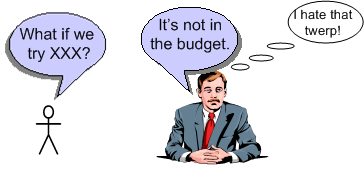
If you buy into Hamilton’s quote, then you’ll realize that it explains all kinds of irrational behavior at work by those in charge. Another ditty that explains counterproductive behavior and ludicrous decision-making in mediocracies is:
“It’s not what you say, it’s how you say it.”
When someone is disliked by, or is brutally honest to those in power, even the best ideas offered up by the perceived villain will be rejected. It doesn’t matter if an idea could potentially save the corpocracy tons of money or bring in new business, the idea will be killed in the cradle. Of course, many kinds of clever camouflage and pseudo-rational reasons will be given for the rejection, but the underlying truth is what Mr. Hamilton stated hundreds of years ago.
Who says that business isn’t personal?
Continuous Husbandry
One definition of a system is “a collection of interacting elements designed to fulfill a purpose“. A well known rule of thumb for designing robust and efficient social, technical, and socio-technical systems is:
Keep your system elements Loosely Coupled and Internally Cohesive (LCIC)
The opposite of this golden rule is to design a system that has Tightly Coupled and Internally Fragmented (TCIF) elements. TCIF systems are rigid, inflexible, and tough to troubleshoot when the system malfunctions.
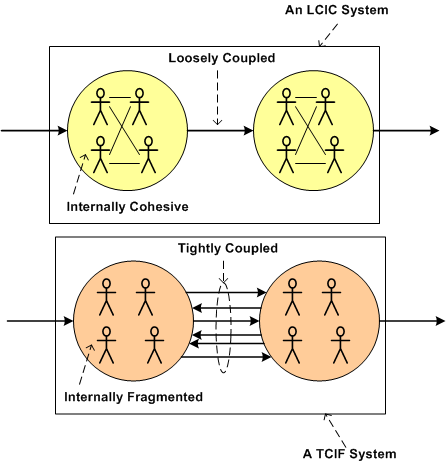
Designing, building, testing, and deploying LCIC systems is not enough to ensure that the system’s purpose will be fulfilled over long periods of time. Because of the relentless increase in entropy dictated by the second law of thermodynamics, continuous husbandry (as my friend W. L. Livingston often says) is required to arrest the growth in entropy. Without husbandry, LCIC systems (like startup companies) morph into TCIF systems (like corpocracies). The transformation can be so slooow that it is undetectable – until it’s too late. In subtle LCIC-to-TCIF transformations, it takes a crisis to shake the system architect(s) into reality. In a sudden jolt of awareness, they realize that their cute and lovable baby has turned into an uncontrollable ogre capable of massive stakeholder destruction. Bummer.
Layers Of Value Streams
An organization of people assembled for a purpose runs on all cylinders when every layer in its control structure creates a value stream that puts more into the org than it takes out. The higher you go up the pyramid of privilege, the less visible the added value, but the more the impact. In dysfunctional orgs, the upper layers don’t create any value and their impact is damaging to the whole. Like leeches, they suck the blood out of the org without contributing anything of substance.

It’s the responsibility (or, it should be) of each upper layer to sample the value stream produced by the lower layer(s) to ensure continuous excellence and improvement. Except for the DICforce (at rock bottom of course), each upper level can sample and measure any/all of the value streams below them.
In screwed up and inefficient corpocracies where the upper layers are too lazy or incompetent to sample the lower layer value streams, the only value stream samplers are the customers. This means that if crap makes it out the door, they’re the ones who discover and report it. At worst, they don’t report it and they silently blow off the org. They never buy anything from it again, and they tell all their peers to stay away from the crap factory. Meanwhile, everyone back at doo-doo ranch is asking each other; “Lucy, whuh hah-penned?”.
Buffer Gone Awry
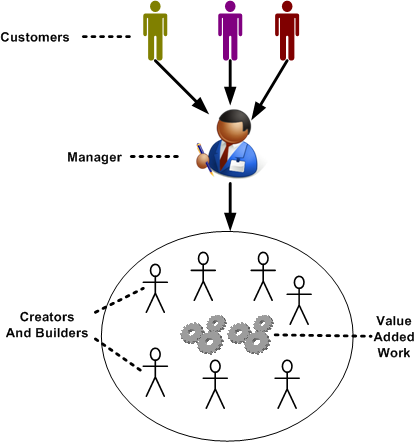
Assume that you’re a manager enveloped within the predicament below. On a daily basis, you’re trying to coordinate bug fixes and new feature additions to your product while simultaneously getting hammered by internal and external customers with problem reports and new feature requests.
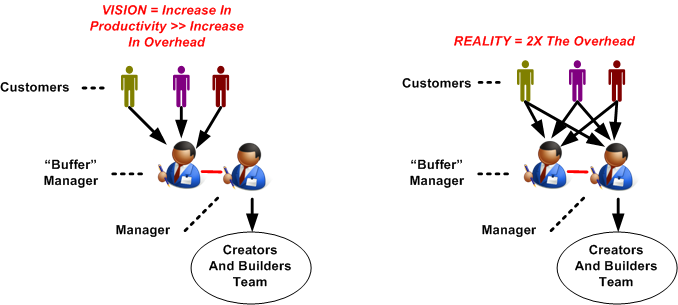
In order to reduce your workload and increase productivity, your meta-manager decides to add a “buffer” manager to filter and smooth out the customer interface side of your job. As the left side of the figure below shows, the hope is that the team’s increased productivity will offset the doubling of overhead costs associated with adding a second manager to the mix. However, when your customers find out that they now have two managers to voice their problems and needs to, the situation on the right develops: your workload remains the same; you now have an additional interface with the buffer manager (who has less of a workload than you); the overhead cost to the org doubles. Bummer.

Why am I here?
WTF?
Meh!
D'oh!

My BTC Address



 Bulldozer00's Blog