Archive
A Key Ingredient
As Tony Hsieh states in “Delivering Happiness“,
A key ingredient in strong (business) relationships is to develop emotional connections. – Tony Hsieh
In my fantasy world, I find this extremely ironic because, in “business”, most corpricracies only anoint those who can cleverly camouflage their emotions to exalted and coveted leadership positions. And yet, here is Mr. Chez, the CEO of a profitable billion dollar company in the cutthroat shoe retail industry, “nicely” flipping the finger at mainstream American business and the esteemed B-school advice they rode in on.
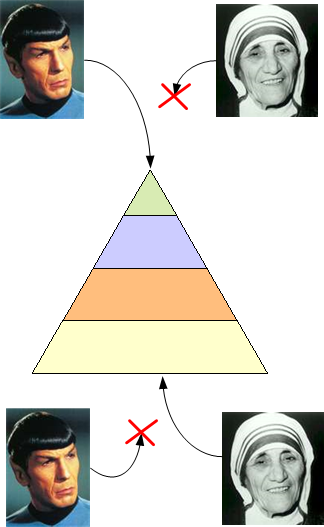
It’s funny how “passion”, which can be defined as a “strong emotion“, is demanded of the DICforce, but Spock-like emotional control is required by SCOLs and BOOGLs for ascension to the throne.
Why Do You Guys Suck?
In this Gary Hamel post, Extreme Management Makeover, Mr. Hamel tells the story of HCL Technologies CEO Vineet Nayar’s passionate effort to turn his company’s culture upside down. Read the article to discover the slew of wildly unorthodox actions that Vineet executed to achieve his goal. As a sampling of Mr. Nayer’s courage and determination to buck the status quo, check this one out:
HCLT employees are able to rate the performance of any manager whose decisions impact their work lives, and to do so anonymously. These ratings are published online and can be viewed by anyone who has submitted a review. This visibility challenges managers to be more responsive and exercise their authority judiciously. The number and organizational scope of the reviews a manager receives are also a good indicator of an individual’s zone of influence—is he or she adding value across a wide swath of the company, or only within a narrow sphere? Importantly, this “feedforward” process isn’t connected to compensation and promotion decisions. It is purely developmental. Nevertheless, there aren’t many hiding places left at HCLT for mediocre managers.
Want another zinger?
Early on, Vineet and his leadership team set up an online forum and encouraged employees to ask tough questions and offer honest feedback. Nothing was censored on the “U&I” site; every post, however virulent, was displayed for the entire company to see. Vineet recalls that in the beginning, “virtually 100% of the questions were dirty questions. ‘Why do you guys suck?’ ‘Why does your strategy suck?’ ‘Why aren’t you living up to your values?’’ While some managers bemoaned the fact that all of the company’s soiled laundry was now online, employees lauded the forum as a symbol of HCLT’s commitment to transparency and as another way to hold top management accountable. The U&I portal had another value: it was also an early warning system for critical issues facing the company.
Does your company even have a DICforce-to-management U&I portal? If you’re lucky enough to have one, is it anonymous and uncensored so that the submitted questions are more than just cream puffs?
 If Vineet was in any position other than the CEO, do you think his idea of “employees first, customers second” would have any chance at all of being heard, let alone being placed into execution? Do you think managers in general explore the landscape for innovative management practices and weird, heretical companies like HCLT, Zappos.com, SAS Institute, SEMCO, et al?
Much To Like
There’s much to like in Zappos.com CEO Tony Hsieh’s new book: “Delivering Happiness“. In addition to detailing the inspiring rags-to-riches Zappos.com story, Mr. “Chez” shares many nuggets of wisdom that he discovered along the way:
Don’t play games that you don’t understand, even if you see lots of other people making money from them.
It doesn’t matter how flawlessly a business is executed if it’s in the wrong business or if it’s in too small of a market.
Without conscious and deliberate effort, inertia always wins.
The presentation of the truth is as important as the truth.
Never outsource your core competency. If we were trying to be about customer service, we knew that we shouldn’t be outsourcing that (call center).
Without a separation of work and life, it’s remarkable how values can be exactly the same.
Don’t measure call times, don’t force employees to upsell, and don’t use scripts.
A key ingredient in strong relationships is to develop emotional connections.
It’s not what you say or do, but how you make people feel that matters the most.
For individuals, character is destiny. For organizations, culture is destiny.
As it turns out, many of the best ideas came about while having drinks at a local bar.

Layoffs
If you”re familiar with the Zappos.com business success story, you might think that it’s the perfect company. Unlimited growth, unlimited profits, enthusiastic employees, all good and no bad. But did you know that the company had to lay off some of their workforce not once, but twice? The first layoff, which came in the early startup years when they were struggling to survive month to month, was much more understandable than the second layoff, which occurred in 2008 while they were profitable.
When 2008 started, Zappos.com exceeded sales and profit expectations for 2007, so CEO Tony Hsieh and his leadership team decided to dole out a surprise, 10% bonus, to all Zapponians. Incredibly, eight months later he was hatching an e-mail stating that Zappos would be laying off 8% of the workforce. WTF, you ask?
2008 was a whirlwind year. The stock market crashed, the housing market crashed, hundreds of thousands of people were thrown out of work, and businesses everywhere, including Zappos, started reeling from lower sales. Since Zappos was growing like mad up to that point, they discovered that they were overhiring. Even though they weren’t losing money, the Zappos leadership team decided that they had to cut their workforce to better align their costs with decreasing revenues. In Tony’s words from his book “Delivering Happiness“;
Rather than trying to spin the story as a “strategic restructuring” as many other corporations were doing, we stuck by our core values and remained open and honest, not only with our employees, but with the press as well. – Tony Hsieh, CEO, Zappos.com
In November of 2008, Tony sent an e-mail announcing the cuts to all employees and the publicly visible Zappos.com blogs. After the bloodletting was over, he sent a followup e-mail. The full text of both e-mails is in the book, so buy it if you’re curious about what he said to the world.

A Blessing And A Curse
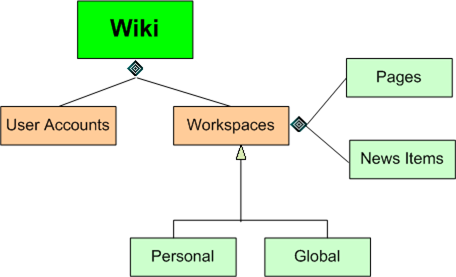
The figure below depicts a UML class diagram model of the static structure of a typical Wiki system. A Wiki may be comprised of many personally controlled and/or global workspaces. Each logical workspace is composed of user created work pages and news items (a.k.a. blog posts). Lastly, a Wiki contains many user accounts that are either created by the users themselves or, in a more controlled environment, created by a gatekeeper system administrator. Without an account, a user cannot contribute content to the Wiki database.
Org Wikis are both a blessing and a curse. They’re a blessing for the DICforce in that they allow for close collaboration and rapid, real-time information exchange between and across teams. They also serve as an easily searchable and publicly visible record of org history.
In malevolent and stovepiped CCHs where SCOLs and BOOGLs rarely communicate horizontally and, even more rarely, downward to the DICforce, Wikis are a curse because….
Networks make organizational culture and politics explicit. – Michael Schrage
BOOGLs and SCOLs that preside over malevolent CCHs don’t like having their day-to-day operational behavior exposed to the light of day. If a malevolent CCH org is liberal enough to “approve” of Wiki usage, chances are that none of the BOOGLs or SCOLs will contribute to its content. In the worse case, a Wiki police force may be established to enforce posting rules designed to keep politics and positioning behavior secret. Hell, without censorship, the DICforce might form the opinion that they are being led by a gang of thugs who are out for themselves instead of the lasting well being of the org.
Are you here to build a career or to build an organization? – Peter Block
Anomalously Huge Discrepancies
I’m currently having a blast working on the design and development of a distributed, multi-process, multi-threaded, real-time, software system with a small core group of seasoned developers. The system is being constructed and tested on both a Sparc-Solaris 10 server and an Intel-Ubuntu Linux 2.6.x server. As we add functionality and grow the system via an incremental, “chunked” development process, we’re finding anomalously huge discrepancies in system build times between the two platforms.
The table below quantifies what the team has been qualitatively experiencing over the past few months. Originally, our primary build and integration machine was the Solaris 10 server. However, we quickly switched over to the Linux server as soon as we started noticing the performance difference. Now, we only build and test on the Solaris 10 server when we absolutely have to.
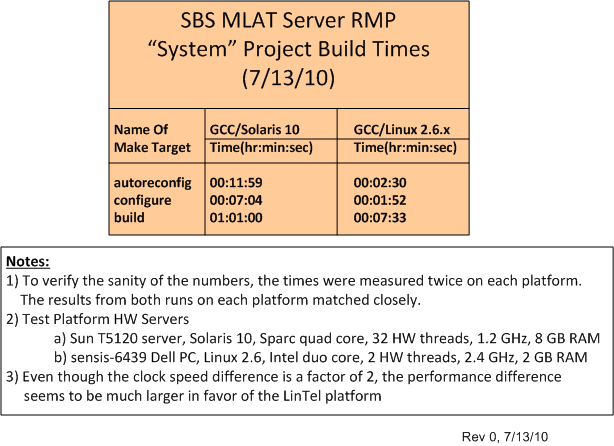
The baffling aspect of the situation is that even though the CPU core clock speed difference is only a factor of 2 between the servers, the build time difference is greater than a factor of 5 in favor of the ‘nix box. In addition, we’ve noticed big CPU loading performance differences when we run and test our multi-process, multi-threaded application on the servers – despite the fact that the Sun server has 32, 1.2 GHz, hardware threads to the ‘nix server’s 2, 2.4 GHz, hardware threads. I know there are many hidden hardware and software variables involved, but is Linux that much faster than Solaris? Got any ideas/answers to help me understand WTF is going on here?
Death By A Thousand Cuts
Zappos.com CEO Tony Hsieh has a new book out titled “Delivering Happiness“. Early in this heartwarming and wonderful little tome, he tells the story of the first real company he co-founded – LinkExchange. As LinkExchange grew and became more successful, he turned down offers of $1M (from BigFoot) and then $20M (from Yahoo!) to sell the company. He ended up selling out later for $265M to Microsoft. Tony’s personal take from the sale was a whopping $40M, of which $8M would be forfeited if he didn’t stay on for 1 year after the sale.
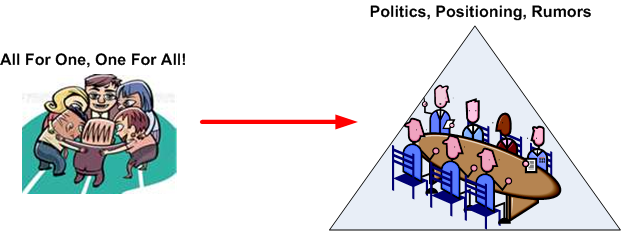
Before the sale of LinkExchange, he woke up one day wondering what happened to the company culture. Tony pondered how the day-to-day culture transformed from a joyous “one for all, and all for one” working environment into one that was dominated by “politics, positioning, and rumors“. He couldn’t put a finger on any one specific event or person(s) as the cause of the deterioration in culture, it was more like “death by a thousand cuts“; an insidious and undetectable rise in malady sustained by some unknown force.
After the sale of LinkExchange, Tony walked away from the company before his contracted year was up, leaving $8M on the table. His reasoning was that he already had plenty of money and his happiness was worth more than the extra $8M. The end of LinkExchange was the start of Zappos.com…..
I had decided to stop chasing the money, and start chasing the passion – Tony Hsieh
Highly Skilled
Be careful out there. If you acquire deep expertise and develop into a highly skilled worker in a narrow technical domain, you’re walking a tightrope.You may be highly valued by the marketplace today, but if your area of expertise becomes obsolete because of rapid technological change, your career may stall – or worse. On the other hand, if you luckily “choose” your narrow area of expertise correctly, your skillset may be in demand for life. It’s a classic textbook case of supply and demand.
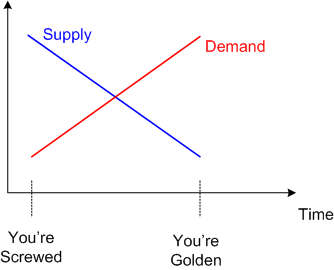
In the software development arena, consider the ancient COBOL and C programming languages. Hundreds of millions of lines of code written in these languages are embedded in thousands of mission-critical systems deployed out in the world. These systems need to be continuously maintained and extended in order to keep their owners in business. History has repeatedly shown that the cost, schedule, and technical risks of updating big software systems written in these languages (or any other language) are huge. Thus, because of the large numbers of systems deployed and the fact that most software engineers leave those languages behind (and stigmatize them), the supply-demand curve will be in your favor if you stick solely to COBOL or C programming out of fear of change. The tradeoff is that you’ll spend your whole career in maintenance, and you’ll rarely, if ever, experience the thrill of developing brand new systems with your old skillset.
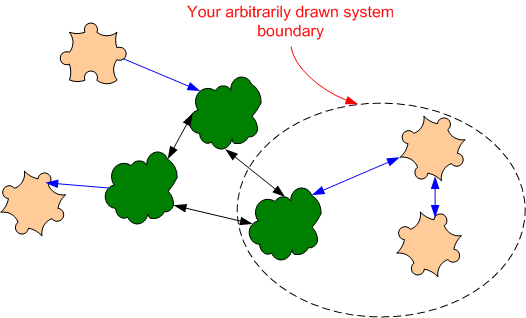
Arbitrary Boundaries
The Generic Template

My Arbitrarily Defined Boundary

Your Arbitrarily Defined Boundary
Crucial Skills: Choking Up
I’ve talked about the Vital Smarts dudes before, and they continue to impress. In this post, Crucial Skills: Choking Up, Vital Smarts principal Al Switzler gives some sound advice to a client regarding the phenomenon of unexpected and unwanted emotional seizure during a Crucial Conversation (CC).
When a conversation flips from”normal” to crucial, either or both participants will experience one or more of these symptoms:
1 Some people’s faces turn red.
2 Some people can feel their pulse—often in their temples.
3 Some people’s breathing changes—it speeds up, or lengthens.
4 People’s voices can increase or decrease in volume.
5 There may be churning in the gut or butterflies in the stomach.
In my case, numbers 3 and 4 rear their ugly heads when I find myself in the midst of an unexpected CC (how about you?). When the 3-4 duo instantaneously appears, I’ve learned to detect the change immediately. However, since I think “control” is overrated, over sought, and often an excuse to obscure truth, I often choose to let the truth, as I see it, fly via an unacceptable emotional rant 🙂 .
“Never apologize for showing feeling. When you do so, you apologize for the truth.” – Benjamin Disraeli
On the flip side, Al makes a lot of sense when he recommends switching over to proven CC skills upon detection of your changed physical state. When one succeeds at this, it defuses the situation and facilitates an exchange of understanding ‘tween the CC participants. First, he advises you to “step out of the content and rebuild safety” by calling a time out. Then, when the symptoms dissipate, re-enter the content and have a frank exchange of views. You do this by “starting with heart”, of course, to establish a collaborative and nurturing environment for progressing forward.


Why am I here?
WTF?
Meh!
D'oh!

My BTC Address



 Bulldozer00's Blog