Archive
Fighting With The Present Moment
Scott Kiloby is the most recent spiritual teacher that I’ve been listening to. In “Love’s Quiet Revolution“, he says that people spend the vast majority of, if not all, their psychological time in one of three states:
- Regretting the past,
- Worrying about the future,
- Resisting/fighting with the present.
I’ve heard of the first two states, but the third one was depressingly new to me. To test out this assertion, I googled my horrendously inadequate memory to dig up several instances where I “fought” with the present moment yesterday:
- I got pissed when the dumb bell weights I use in my workout routine were missing from their slots.
- I got pissed off when the shower water turned scalding hot after someone flushed the terlet.
- I got pissed off when I spilled my bottle of Brute in the gym.
And these events happened within the space of just one hour at the gym! If I tried to recall all my bouts with the present moment yesterday, I’d probably need several more pages to recount them. How about you? How many fights with the present moment were you in yesterday?

Innovation Types
In the beginning of Scott Berkun’s delightful and entertaining “Managing Breakthrough Projects” video, Scott talks about two supposed types of innovation: product and process. He (rightly) poo-pooze away process innovation as not being innovative at all. Remember the business process re-engineering craze of the 90’s, anyone? Sick-sigma? Oh, I forgot that sick-sigma works. So, I’m sorry if I offended all you esteemed, variously colored belt holders out there.
According to self-professed process innovators, the process innovations they conjure up reduce the time and/or cost of making a product or performing a service without, and here’s the rub, sacrificing quality. Actually, most of the process improvement gurus that I’ve been exposed to don’t ever mention the word “quality”. They promise to reduce time to market (via some newfangled glorious tool or methodology) or cost (via, duh, outsourcing). Some of these snake oil salesmen dudes actually profess that they can increase quality while decreasing time and cost.
The difference between a terrorist and a methodologist is that you can negotiate with a terrorist – Unknown
Most process improvement initiatives that I’ve been, uh, lucky(?) to be a part of didn’t improve anything. That’s because the “improvements” weren’t developed by those closest to the work. You know, those interchangeable, fungible people who actually understand what processes and methods need to be done to ensure high quality.All that those highly esteemed, title-holding, mini-Hitlers did was saddle the value makers and service providers down with extra steps and paperwork and impressive looking checklists that took away productive time formerly used to make products and provide services.
Process improvement is a high-minded, overblown way of saying “kill the goose that laid the golden egg before it lays another one“.
Be Humble
Zappos.com’s core value number 10 is: “Be Humble“. According to CEO Tony Hsieh via his book Delivering Happiness (DH), the “Be Humble” core value has probably had the most impact on hiring decisions at Zappos.com.
There are a lot of experienced, smart, and talented people we interview that we know can make an immediate impact on our top or bottom line. But a lot of them are also egotistical, so we end up not hiring them. At most companies, the hiring manager would probably argue that we should hire such a candidate because he or she will add a lot of value to the company, which is probably why most large corporations don’t have great cultures.
So, how can you weed out the BOOGLs, CGHs, CBMs, SCOLs, and determine whether a candidate fits well with your culture? Zappos.com requires each candidate-for-hire to go through two sets of interviews: one with the hiring group to evaluate skills fit, and the other with the Human Resources (HR) group to determine cultural fit. It’s the latter that sets Zappos.com apart from the herd (moooo!). They ask questions specifically derived from their set of 10 core values.
So much for being humble myself. If I was, this blog wouldn’t be soaked with acronyms like BOOGLs, CGHs, CBMs, SCOLs, and other childish terms from the readme.txt page 🙂

Note: Tony et al will be starting a book tour in August and they will be traveling around in a souped up DH bus. You can follow the happiness on Twitter at dhbus and dhbook and ceo@zappos.
The End Of An Era
I’m sad, very sad, to report the end of an era at my company. Because of the ominous near term business outlook in our industry, we’ve had to lay off 84 friends and colleagues after 25 years of no-reduction-in-workforce existence. In my mind, not having to lay off anyone in 25 years of operation is truly a remarkable achievement. Even the best make mistakes and go through tough times.
I feel very fortunate that up until now (and I’ve been around for a looooong time) I’ve never had to go through the experience of watching my employer shrink right before my eyes. But ultimately, ya gotta make money to stay in b’ness.

Us And Them
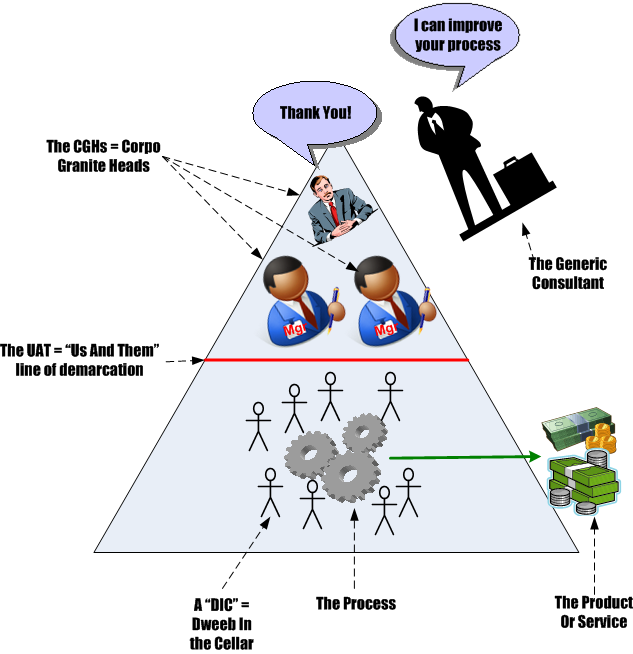
Poor org leaders, or SCOLs, either maintain a stratified “Us And Them” (UAT) line in their orgs or worse – they purposefully create one. By hiring clones of themselves, multiple UAT lines of demarcation appear; choking off open, honest, inter-layer communication and breeding mistrust and disrespect.

Great leaders, or PHORs, skillfully obliterate UAT lines where they exist, or they heroically prevent UAT lines from arising in the first place. Of course, that’s what makes them great leaders.


Google, Zappos, And Me
Check it out:

I was preparing to write a blog post about Zappos.com’s core value “Be Humble“, but I forgot what number it was. So, I decided to Google it, and the above picture is what appeared in my browser. WTF? Holy Shite!
If this doesn’t get me a free pass to Zappos Insights, I don’t know what will!!!!!
Note: I swear that the pic wasn’t photo-shopped. I ain’t no Bernie Madoff.
Continuous Turd Cleanup
Everyone knows that continuous refactoring of the source code is required to keep your code base clean. However, what about continuous cleanup of turd files? Do you iteratively do this unglamorous, janitorial task?
As you develop software and learn how to use one of the exotic new build systems like the autotools set, you will most likely find a bunch of project build files accumulating that are no longer needed. These files will clutter up your source control repository tree and frustrate project newcomers; starting them off with a “bad attitude” toward you and the other people who’ve “laid the groundwork” for them.

If you can’t find the time to diligently keep your source tree clean (“I am too busy!”), then you deserve what you get from your future team mates: disdain and disrespect.
WHAT WE HAVE DONE FOR OURSELVES ALONE DIES WITH US; WHAT WE HAVE DONE FOR OTHERS AND THE WORLD REMAINS AND IS IMMORTAL. – Dan Brown
Cleanliness And Understandability
While adding code to our component library framework yesterday, a colleague and myself concocted a 2 attribute quality system for evaluating source code:
 When subjectively evaluating the cleanliness attribute of a chunk of code, we pretty much agree on whether it is clean or dirty. The trouble is our difference in evaluating understandability. My obfuscated is his simple. Bummer.
Compensation Compression
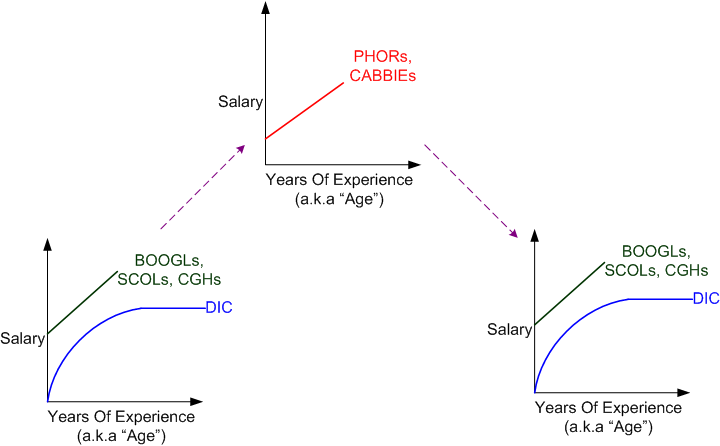
The figure below shows the salary trends for a typical corpricracy comprised of DICs, BOOGLs, SCOLs, and CGHs. Notice that the sky’s the limit for manager types and compression occurs for the DICforce. Is that the way it should be? In theory, probably yes. In practice, most likely no.
 The most frequent reason given by the mainstream management guild for rationalizing the curve is that managers have more responsibility and greater impact on an org than any “induhvidual contributor” DIC. That is true, but are they fulfilling their responsibility? Is their impact positive or negative? Oh sure, every viable org has at least a handful of PHOR managers that fulfill their responsibilities and positively impact the org, but all mediocracies are filled with BOOGLs, SCOLs, and CGHs who don’t fulfill their responsibility and negatively impact the corpricracy.
When the inequity in compensation becomes blatantly obvious and intolerable, a handful of underappreciated DICs usually break off and form their own startup where everyone starts out as either a CABBIE or PHOR. Ironically, as the startup grows and allegedly matures:
- The majority of PHORs transform into BOOGLs, SCOLs, and CGHs while retaining the mindset that they’re still PHORs.
- The BOOGLs, SCOLs, and CGHs start perceiving the CABBIEs as DICs; a cost to be minimized.
Unconscious, Conscious, Bozo, Helper
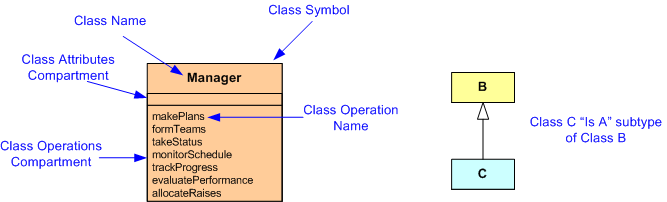
The following sparsely “bent” UML class diagram (see the end of this post for a quick and dorky tutorial for interpreting the diagram) exposes Bulldozer00’s internal hierarchy of manager types. Yours may be different, especially if you’re a manager.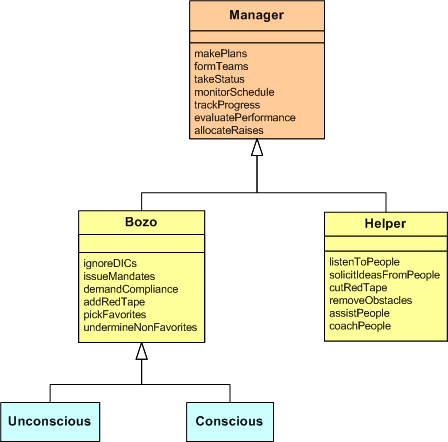
The Base Class
The hierarchy’s Manager base class supplies all the mundane operations that sub-classed managers inherit and perform. For example, all managers in this particular inheritance tree make project plans, track project progress, and monitor progress against the plans. The frequency at which these behaviors are performed, along with the exact details of how they’re executed, is both manager-specific and project-specific. For example, during performance of the “takeStatus” operation, one manager may require project members to write out detailed weekly status reports whilst another may just require informal verbal status.
The Sub-Classes
The second level in Bulldozer00’s morbid and disturbing manager class hierarchy is more interesting. There are two polar opposite sub-types; Bozo and Helper. In addition to inheriting the boring, mechanical, and necessary responsibilities of the Manager base class, these subclasses provide radically different sets of behaviors. For instance, the Bozo subclass provides an “ignoreDICs” behavior whilst the Helper subclass provides “listenToPeople” and “solicitIdeas” behaviors. Comparing the behavior sets between the two subclasses and then against your own manager(s), how would you classify your manager(s)?
As the diagram shows, there are two Bozo Manager subtypes: Conscious and Unconscious. There’s no equivalent subdivision for the Helper Manager type because all Helper Manager “instantiations” are fully conscious. Hell, since all the behaviors that Helper Managers exhibit are so extraordinarily rare, productive, and against-the-grain, there is no way they can be unconscious and not know what they’re doing.
In Bulldozer00’s experience, most Bozo Managers are of the Unconscious ilk. They continuously execute the counterproductive behaviors forwarded on to them via their Bozo inheritance, but they don’t realize how detrimental their actions and words are to the orgs they’re responsible for growing and developing. Since virtually all their fellow clique members behave the same way, they’re oblivious to alternatives and they can’t connect poor org performance to their own dysfunctional behaviors.
Forgive them, for they know not what they do. – Jesus
Lastly, we come to the Conscious Bozo Manager class. Beware of these dudes, of which there are few (thank god), because they are hell on wheels. These guys/gals know fully well that their behaviors/actions are both locally and globally destructive. But why, you ask, would they behave this way? Well, because they’re out to inflate their heads and wallets and there are no boundaries they wouldn’t cross to achieve their goals.
Advice
If you choose to embrace, internalize, and use Bulldozer00’s class hierarchy to evaluate and “privately” judge your managers, you might want to take these suggestions into consideration:
- Run like hell from the Conscious Bozo types.
- Do your best to bring consciousness to the legions of well meaning, but sleepwalking, Unconscious Bozo types
- Attach yourself like a lamprey to the Helper type
But why the hell would you want to “buy into” Bulldozer00’s manager taxonomy? Great freakin’ question!
Appendix: Mini Class Diagram Graphic Tutorial

Why am I here?
WTF?
Meh!
D'oh!

My BTC Address



 Bulldozer00's Blog