Archive
Great, But Weird And Slow
Damien Katz is the soft-spoken Couchbase CTO and creator of the Apache CouchDB (written in Erlang and C/C++). In this InfoQ presentation, “Erlang, the Language from the Future?“, Damien praises the Erlang programming language. But he also points out its turds: weirdness and slowness.
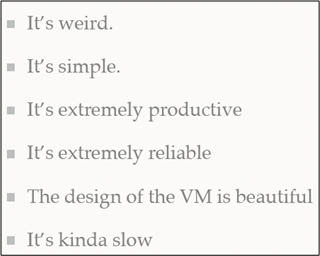
Damien says that Erlang’s weird Prolog-like syntax prevents massive adoption; which prevents lack of massive investment; which prevents massive VM performance improvement.

To prove his point, Mr. Katz uses Java as an example of “getting it right“. When Java arrived on the scene in the mid-90’s, it was dirt slow compared to C and C++. But because Java’s syntax was C-like and it didn’t suffer from the frustrating quirks and gotchas of C/C++, it was embraced quickly and massively by the software industry. This lead to massive investment, which lead to large JVM performance increases and a boatload of productivity-enhancing development tools.
I like Erlang a lot for the concurrent, distributed type of software I write. However, Damian hits the nail right on the head. What do you think?

Hurry! Hurry!
Lots of smart and sincere software development folks like Ron Jeffries, Jim Coplien, Scott Ambler, Bob Marshall, Adam Yuret, etc. have recently been lamenting the dumbing-down and commercialization of the “agile” brand. Since I get e-mails like the one below on a regular basis, I can deeply relate to their misery.

Hurry! Hurry! After just 2 days of effort and a measly 1300 beaners of “investment“, you’ll be fully prepared to lead your next software development project into the promised land of “under budget, on schedule, exceeds expectations“.
Whoo Hoo! My new SCRUM Master certificate is here! My new SCRUM Master certificate is here!

Scrum Cheat Sheet
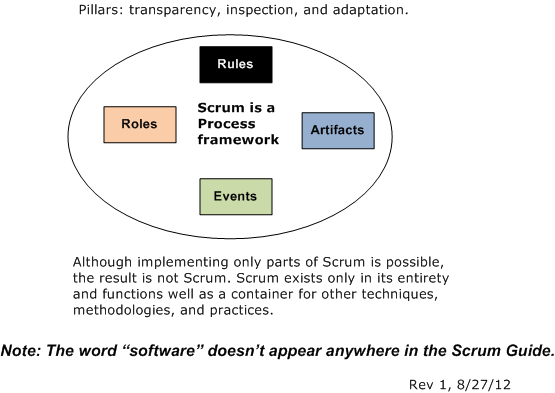
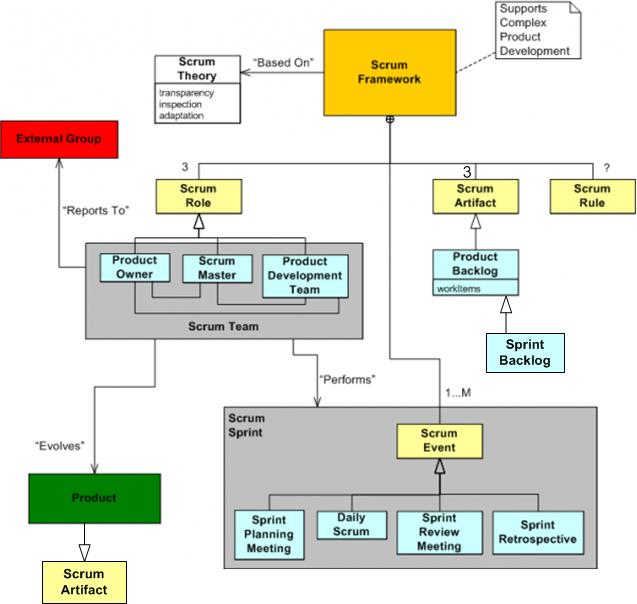
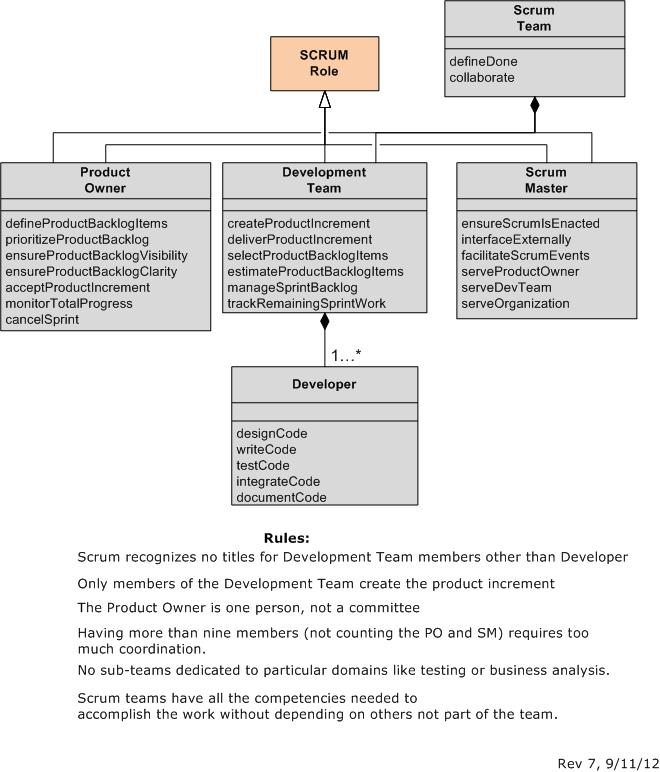
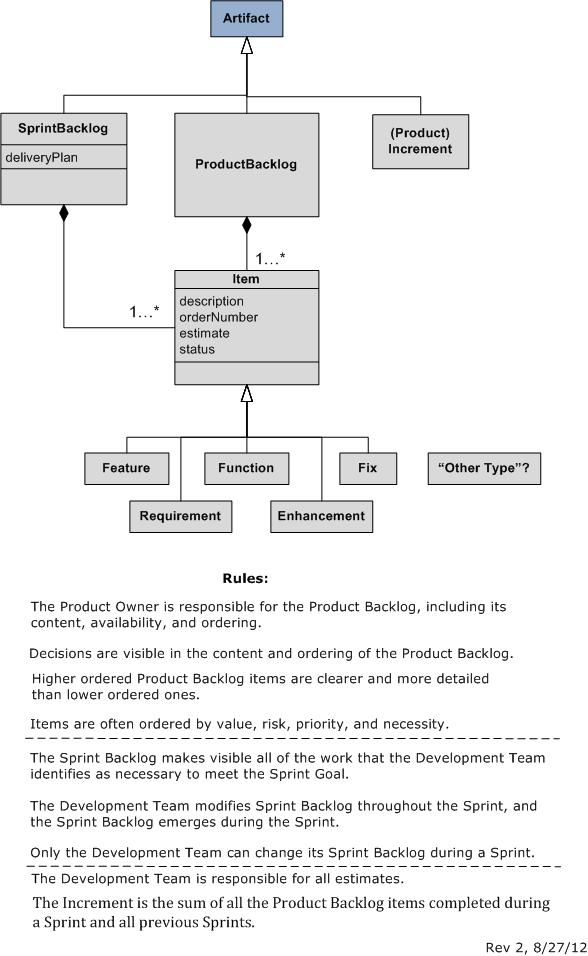
While reading Schwaber and Sutherland’s official Scrum Guide, I decided to concoct a graphical UML-heavy cheat sheet of the monstrously famous agile framework.
Scrum Framework Components
System Class Diagram
Scrum Roles
Scrum Events

Scrum Artifacts
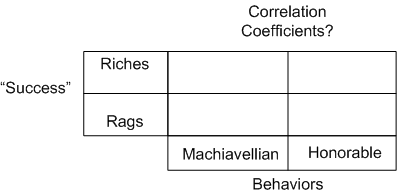
Correlation Coefficients
Please consider these well known, conflicting cliches:
- “Nice guys finish last”
- “What goes around comes around”
The first implies that in order to succeed, a ruthless, Machiavellian set of behaviors is required (Oracle? Bank Of America?). The second one-liner implies that those same behaviors will boomerang around and precipitate your downfall (Enron?, Lehmann Bros?). Do ya think there’s a strong correlation between org behaviors and financial success? Is there any correlation at all, or is it just a random crap shoot?
Please fill in the boxes below with a value ranging from -1.0 to 1.0 and place the sheet on the teacher’s desk on your way out of the classroom. The “right” answers, obtained from an impeccably executed and extensively peer-reviewed research study, will be disclosed at some random time in the future.
Unexplained Resurrections
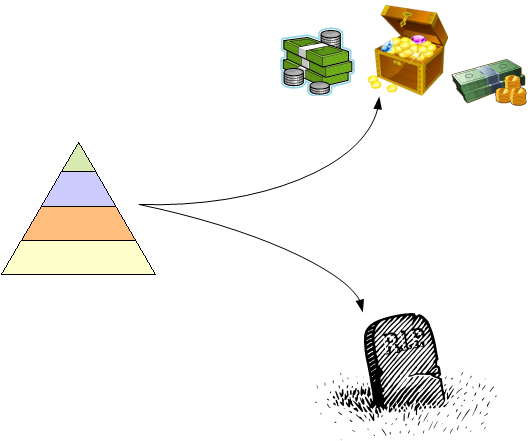
If you dive head first into the work of Bill Livingston and/or Rudy Starkermann, you’ll find it easy to either develop or maintain a doomsday mindset of a future increasingly dominated by bigger and more inhumane institutions. Their rigorously developed physics and control engineering-based theories of institutional behavior can seem ironclad and 100% irrefutable. BD00 has drunk the kool-aid, but not the whole glass.
According to BD00’s interpretation of Livingston’s D4P, once an established institution encounters a novel and identity-threatening situation, annihilation is sure to follow because it is incapable of learning and adapting at the expense of losing its identity. I think that to be true in general, but not in the absolute. There are too many counter-examples of resurrection in the real world that go unacknowledged in his work:
- IBM was on its deathbed stuck in a “mainframe hardware” mindset, but it recovered under cookie-man Lou Gerstner by transforming itself into a software services company.
- Apple was on its deathbed, but it recovered under Steve Jobs and a financial bailout from Microsoft (yes, Microsoft!).
- My company, which was consistently losing money, heavily in debt, and arguably on its deathbed, is now debt-free and making money in a wickedly brutal economic environment.
I’ve had the privilege of e-interacting with both Bill and Rudy over the past several years. Bill sends me his draft work regularly for feedback/review and he’s very inviting of criticisms and challenges. However, I’m not satisfied with his answers when I pose cases like those listed above to counter those examples in his books that promote his theories.
When all is said and done, Livingston and Starkermann are two genuine social science originals and much of what they say is true. I highly recommend delving into what they have to say.
Related articles
- Yin And Yang (bulldozer00.com)
- From The Ground Up (bulldozer00.com)
- Building The Perfect Beast (bulldozer00.com)
- Cross-Disciplinary Pariahs (bulldozer00.com)
Marginalizing The Middle
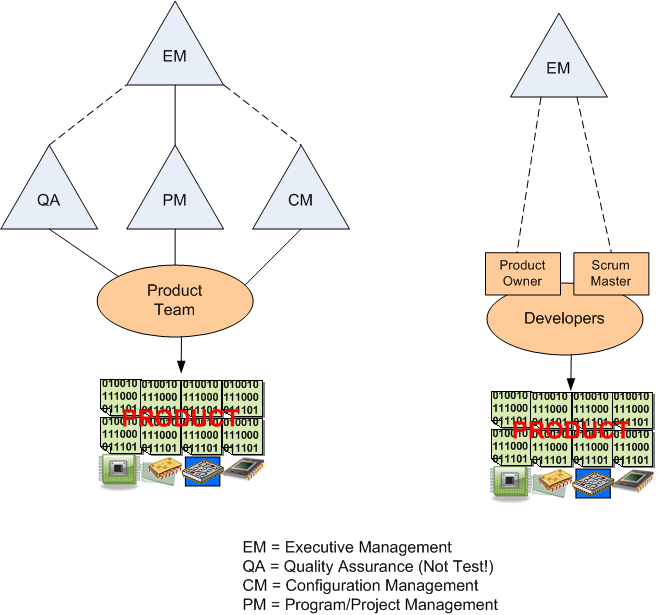
Because they unshackle development teams from heavyweight, risk-averse, plan-drenched, control-obsessed processes promoted by little PWCE Hitlers and they increase the degrees of freedom available to development teams, agile methods and mindsets are clearly appealing to the nerds in the trenches. However, in product domains that require the development of safety-critical, real-time systems composed of custom software AND custom hardware components, the risk of agile failure is much greater than traditional IT system development – from which “agile” was born. Thus, a boatload of questions come to mind and my head starts to hurt when I think of the org-wide social issues associated with attempting to apply agile methods in this foreign context:
Will the Quality Assurance and Configuration Management specialty groups, whose whole identity is invested in approving a myriad of documents through complicated submittal protocols and policing compliance to existing heavyweight policies/processes/procedures become fearful obstructionists because of their reduced importance?
Will penny-watching, untrusting executives who are used to scrutinizing planned-vs-actual schedules and costs in massive Microsoft Project and Excel files via EVM (Earned Value Management) feel a loss of importance and control?
Will rigorously trained, PMI-indoctrinated project managers feel marginalized by new, radically different roles like “Scrum Master“?
Note: I have not read the oxymoronic-titled “Integrating CMMI and Agile Development” book yet. If anyone has, does it address these ever so important, deep seated, social issues? Besides successes, does it present any case studies in failure?
… there is nothing more difficult to carry out, nor more doubtful of success, nor more dangerous to handle, than to initiate a new order of things. For the reformer makes enemies of all those who profit by the old order, and only lukewarm defenders in all those who would profit by the new order… – Niccolo Machiavelli
What’s Next?
I was browsing through some old powerpoint pitches and I cam across this potentially share-worthy graphic:
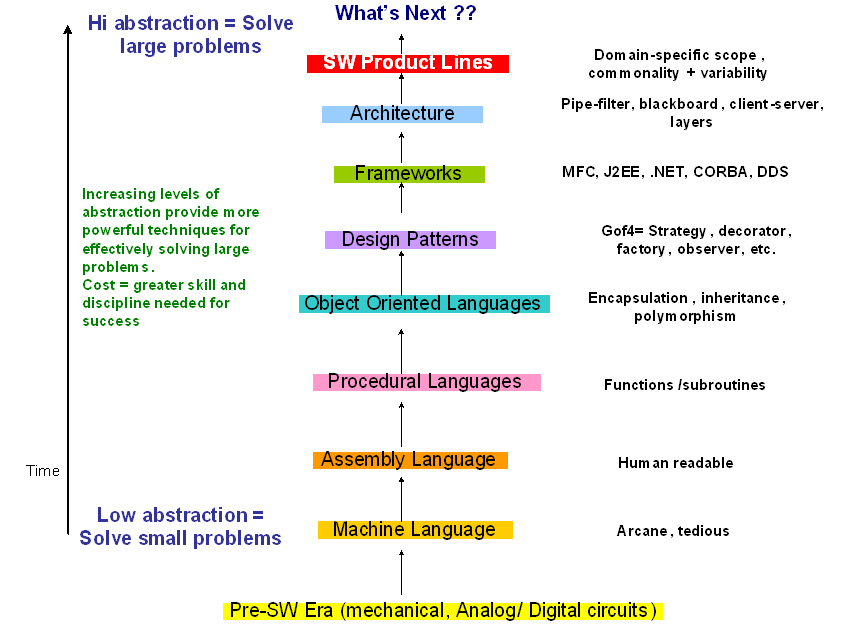
I’m sorry for the poor resolution. I was too lazy to spruce it up.
Command Vs. Control
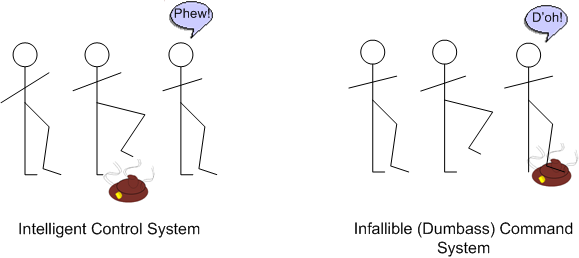
One of the acronyms in BD00’s evil glossary is “CCH“. It stands for “Command and Control Hierarchy” because BD00 thought that command and control were fused together like Forrest Gump‘s peas and carrots. However, In “Making Sense Of Behavior“, Bill Powers distinguishes between a command hierarchy and a control hierarchy in an interesting way.
In a command hierarchy, a command dictates a specific action (git ‘r done!). In a control hierarchy, a command is a reference signal that specifies the state in which a particular perception is desired to be at in a future point in time; a vision, if you will.
For example, a sequence controlling system doesn’t order the limbs to be in a particular configuration; it tells a lower level control system to perceive the limbs as being in a particular position, then another, then another. By receiving a less specific reference signal, the lower level position control system can compensate for unforeseen disturbances (wind, gravity, physical obstructions) without distracting the higher level control system from its purpose.
Yin And Yang
In Bill Livingston’s current incarnation of the D4P, the author distinguishes between two mutually exclusive types of orgs. For convenience of understanding, Bill arbitrarily labels them as Yin (short for “Yinstitution“) and Yang (short for “Yang Gang“):
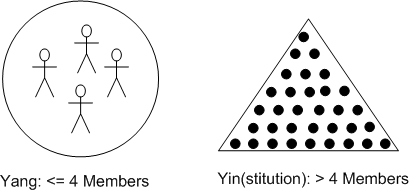
The critical number of “four” in Livingston’s thesis is called “the Starkermann bright line“. It’s based on decades of modeling and simulation of Starkermann’s control-theory-based approach to social unit behavior. According to the results, a group with greater than 4 members, when in a “mismatch” situation where Business As Usual (BAU) doesn’t apply to a novel problem that threatens the viability of the institution, is not so “bright” – despite what the patriarchs in the head shed espouse. Yinstitutions, in order to retain their identities, must, as dictated by natural laws (control theory, the 2nd law of thermodynamics, etc), be structured hierarchically and obey an ideology of “infallibility” over “intelligence” as their ideological MoA (Mechanism of Action).
According to Mr. Livingston, there is no such thing as a “mismatch” situation for a group of <= 4 capable members because they are unencumbered by a hierarchical class system. Yang Gangs don’t care about “impeccable identities” and thus, they expend no energy promoting or defending themselves as “infallible“. A Yang Gang’s structure is flat and its MoA is “intelligence rules, infallibility be damned“.
The accrual of intelligence, defined by Ross Ashby as simply “appropriate selection“, requires knowledge-building through modeling and rapid run-break-learn-fix simulation (RBLF). Yinstitutions don’t do RBLF because it requires humility, and the “L” part of the process is forbidden. After all, if one is infallible, there is no need to learn.
Bankrupt Models
In his paper, “The Dispute Over Control Theory“, Bill Powers tries to clarify how Perceptual Control Theory (PCT) differs from the two main causal approaches to psychology: stimulus-response and command-response. In order to gain a deeper understanding of PCT, I’m gonna try to reproduce Bill’s argument in this post with my own words and pictures.
The figure below represents a PCT unit of behavioral organization, the Feedback Control System (FCS). An FCS is a closed loop with not one independent input (e.g. stimulus or command), but two. One input, the reference signal, is sourced from the output function of a higher level control unit(s). The second input, an amalgam of environmental disturbances, “invades” the loop from outside the organism. Both inputs act on the closed loop as a whole and the purpose of the FCS is to continuously act on the environment (via muscular exertion) to maintain the perceptual signal as close to the reference signal as possible. As the reference changes, the behavior changes. As the disturbance changes, the behavior changes. Since action is behavior, the FCS exhibits behavior to control perception; behavior is the control of perception.
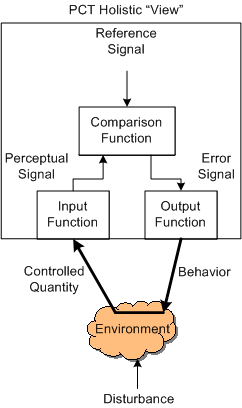
The figure below depicts models of the stimulus-response and command-response views in terms of the PCT FCS. The foremost feature to notice is that there is no loop in either model – it’s broken. The second major difference is that neither model has two inputs.
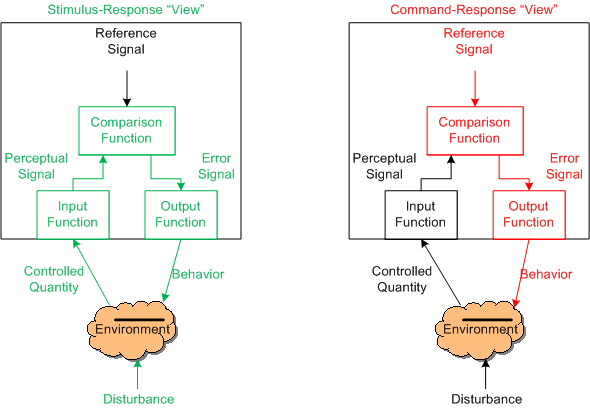
In the Stimulus-Response model, the linear, causal path of action is: Stimulus (a.k.a Disturbance) ->Organism->Behavior. In the Command-Response model, the linear, causal path of action is: Command (a.k.a Reference)->Organism->Behavior. Hence, the models can be reduced to these simple (and bankrupt) renderings of a dumb-ass organism totally under the control of “something in the external environment“:

So, you may ask: “How could our best and brightest minds in psychology and sociology gotten it so wrong for so long; and why don’t they embrace PCT to learn how living systems really tic?” It’s because they erroneously applied Newton’s linear cause-effect approach for the physics of inanimate objects to living beings and they’ve thoroughly crystallized their UCBs into cement bunkers.
When you push a rock, there is no internal resistance from the rock and Newton’s laws kick into action. When you push a human being, you’ll encounter internal resistance and Newton’s laws don’t apply – control theory applies.
Compounding the difficulty has been a surprising tendency for scientists who are normally careful to know what they are talking about to leap to intuitive conclusions about the properties and capabilities of control systems, without first having become personally acquainted with the existing state of theart. If any criticism is warranted, it is for promulgating statements with an authoritative air without having verified personally that they are justified. – Bill Powers
D’oh! BD00 takes major offense at Bill’s last sentence.
Related articles
- Normal, Slave, Almost Dead, Wimp, Unstable (bulldozer00.com)
- Nine Plus Levels (bulldozer00.com)
- Cross-Disciplinary Pariahs (bulldozer00.com)
- Extrapolation, Abstraction, Modeling (bulldozer00.com)
- Shall And Shall Not (bulldozer00.com)

Why am I here?
WTF?
Meh!
D'oh!

My BTC Address



 Bulldozer00's Blog