Archive
Cronies Need Not Apply
In great orgs, cronies need not apply for influential positions because there’s no chance of them getting appointed. In DYSCOs, CLORGs, and BOOGs, cronies need not apply because they’re guaranteed to get anointed.

Reckless Meritocracies
Being a staunch advocate of democratic meritocracy, when I stumbled across the title of this potentially UCB-loosening op-ed by Ross Douthat; “Our Reckless Meritocracy“, I dove right in. I was intrigued by the use of the word “reckless” in the title.
Ross commences his opinion piece by telling the rags-to-riches-to-rags story of Jon Corzine:
- Boy grows up in rural Illinois
- Boy’s grandfather was a farmer who lost everything in the great depression
- Boy graduates from Illinois state university
- Boy goes into Marine Corps
- Boy gets MBA
- Boy works for regional bank
- Boy works for Goldman Sachs
- Boy becomes Goldman Sachs CEO
- Boy serves in US senate
- Boy serves as governer of NJ
- Boy returns to Wall St. as CEO of MF Global
- MF Global files for bankruptcy after “mislaying” $600M
- Boy resigns in disgrace (but with plenty of dough in the bank)
Ross uses this lead-in to postulate that the US has “created what seems like the most capable, hardworking, high-I.Q. elite in all of human history – and we’ve watched this same elite lead us off a cliff“.
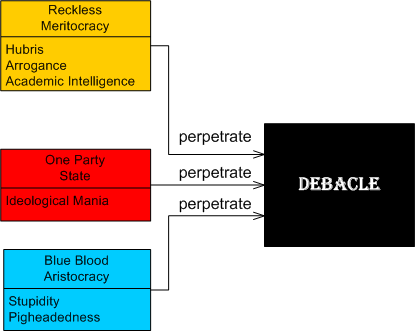
Ross then theorizes on how catastrophies are perpetrated by the rich and powerful in reckless meritocracies, hereditary aristocracies, and one-party states:
- Hereditary aristocracies: debacles caused by stupidity and pigheadedness
- One Party States: debacles caused by ideological mania
- Reckless Meritocracies: debacles caused by hubris
Relative to the other two forms of governance, at least scores of little people aren’t physically massacred in reckless meritocracies. They’re simply thrust into poverty. The real genius of reckless meritocracy is that when a meritocrat falls, he/she isn’t beheaded. At worst, he/she goes to jail. At best, he/she gets away with a huge bag of loot.
So, what’s a democratically run institution to do? Mr. Douthat rightly states that “it will do America no good to replace the arrogant with the ignorant, the overconfident with the incompetent“. (Didn’t you see the movie “Idiocracy“?)
We need intelligent leaders with a sense of their own limits, experienced people whose lives have taught them caution. We still need the best and brightest, but we need them to have somehow learned humility along the way. – Ross Douthat
If you made it thus far into this post, you may be wondering why BD00 is wasting your time by simply parroting Ross Douthat in yet another meta-blog post? It’s because BD00 wanted to display his fledgling UML skill again:
But wait! It may ironically be because of BD00’s own personal lack of humility and the fact that BD00 gets off on reading funny spammer comments like these:

An Array Of Vectors Of Tuples
Yepp, that’s what I concocted recently to implement an algorithm. Pretty fugly, no?

If I told you what the algorithm is, I’d have to dispatch a missile carrying drone to seek out and kill you.
The Universal Process Of Personal Experience
Yesterday’s post revealed to the world the static structure of the system in our head that brings personal experience to life. In the scoop of a lifetime (Geraldo Rivera eat your heart out), the system elements (mind, ego, thoughts, feelings) and the relationships between them were unmasked and exposed for all to marvel at. Woot!
Today, on the day we camp out at the feed trough and give thanks, we’ll explore the mysterious dynamics involved in this system design from the divine. Lo and behold… the universal process that creates personal experience from nothingness:
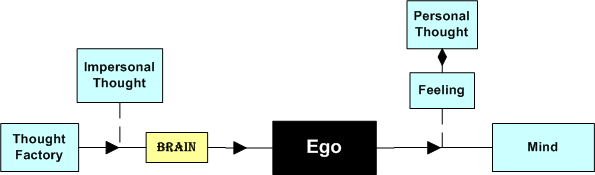
Via a yet undiscovered secret global WiMax communication system that uses quantum tunneling for zero latency source-to-sink transmission, impersonal thoughts (conjured up in the sole Thought Factory located in China) are manufactured and coupled to the ether. The mechanistic brain then serves as a receiver of thoughts and the source of fuel for the personal Ego.
Next up in the zero latency pipeline is the Ego (a.k.a the “little” me). The Ego analyzes, interprets, gives meaning to, and binds feelings to each received thought that it decides to accept. These “I” thoughts are then injected into the Mind and, voila, personal experience is manifest!
So that’s it folks. Rejoice! You don’t have to go to church anymore and you can call off the search for enlightenment . By using BD00 as a conduit from the unknown to the known, the universe has revealed all.
Spiritual UML
Because he is the chosen one, the universe spaketh to BD00 last night: “Go forth my son, and employ the UML to teach the masses the true nature of the mind!“. Fearful of being annihilated if he didn’t comply, BD00 sat down and waited for an infusion of cosmic power to infiltrate his being (to catalyze the process, BD00 primed the pump with a three olive dirty ‘tini and hoped the universe didn’t notice).
With mouse in trembling hand and an empty Visio canvas in front of him, BD00 waited…. and waited… and waited. Then suddenly, in mysterious Ouja board fashion, the mouse started moving and clicking away. Click, click, click, click.
After exactly 666 seconds, “revision 0” was 90% done. The secrets of the metaphysical that have eluded the best and brightest over the ages were captured and revealed in the realm of the physical! Lo and behold….. the ultimate UML class diagram:
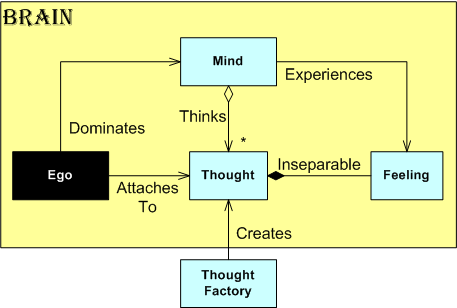
Of course, the “Thought Factory” class is located in China. It efficiently and continuously creates (at rock bottom labor costs) every thought that comes/stays/goes through each of the 7 billion living brains on earth.
Concealing Outrage
In “The Progress Principle: Using Small Wins to Ignite Joy, Engagement, and Creativity at Work“, Harvard B-school professor and researcher Theresa Amabile writes:

Did she say “most” orgs ? Thank Allah she didn’t say “all” orgs, no?
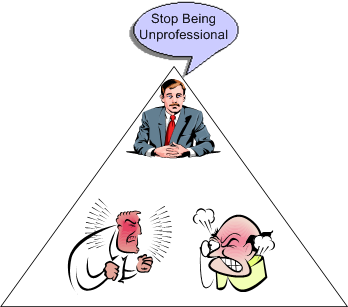
If you think Ms. Amabile’s assertion is true, why do you think it is true? Could it be that the culture at those orgs is unintentionally, but irreversibly, toxic? Could it be that “suppression of emotionally strong opinions” is an innate attribute of hierarchically structured orgs? What about your org? If you’ve never seen a test of Theresa’s assertion at your org, why is that? If you have directly seen, indirectly heard about, or have been a participator in a “strong emotional, strong opinion” situation, how did it turn out and how did you feel? What about the “loath to reveal themselves to superiors” assertion? Got any thoughts about that?
Misconceptions And Truths
In the modern world the stupid (like BD00) are cocksure while the intelligent are full of doubt. – Bertrand Russell
Thanks to multi-fish-name dude, I was introduced to the hilariously serious work of David McRaney. In his terrific book, “You Are Not So Smart“, David starts off each chapter with a pair of misconception-truth assertions. He then proceeds to make his case by skillfully citing and summarizing a multitude of psychological studies.
Here’s a sampling of several misconception-truth pairs that I hope will get you to consider helping David out and buying his book:
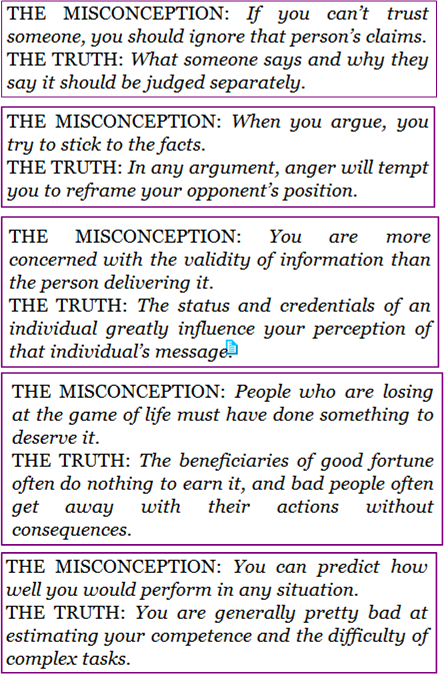
Of course, being the self-smug, smarty-pants, know-it-all that he is, BD00 held none of the misconceptions and knew all of the truths before buying the book. Mr. McRaney’s work simply added another layer of concrete to the sarcophagus that holds the BD00 UCB comfortably in place.
Full disclosure and hidden agenda: The real reason I’m promoting Dave’s work is because he’s got the funniest web site marquee on the planet:

So what d’ya think? Should I ask for permission to change the “meh” banner on this blog from this boring and bland image…..

to this YANSS derivative….

Death Wish
Over the span of many years, a handful of people have told me that they admire (lol) my courage for “speaking truth” to power. But it’s not like that. First, I speak my version of the so-called “truth“. Second, I don’t “speak to“, I “write about” power. Third, there’s absolutely no courage involved. The only way I can describe this so-called talent is that it’s a weird “death wish” type of affliction.

The feelings that rush forth when I spew potentially hurtful (but maybe indirectly helpful?) ideas and assertions are excitement, exhilaration, and aliveness. But wait, that’s not all. Feelings of guilt, isolation, and mostly, fear, also weave themselves into the witches brew. D’oh! I hate when that happens.

Even though it’s (always) about me, enough about me. What about you, dear reader? What’s your story? Do you write, speak, to, about, power? What’s your style, and do you think it’s effective? What feelings emerge in real-time when you skirt the edge of the prevailing power culture’s “appropriateness” threshold?
In addition to fellow DICsters, I’m especially interested in those readers, if any, who are actually in positions of power in a hierarchy. In your particular case, does power speak truth to power? There’s gotta be a couple of you out there willing to share, no?
The Expense Of Defense
The following “borrowed” snippet from a recent Steve Vinoski QCon talk describes the well worn technique of defensive programming:

Steve is right, no? He goes on to deftly point out the expenses of defensive programming:
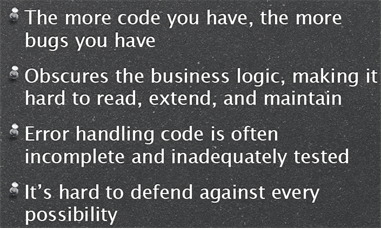
Steve is right on the money again, no?
Erlang and the (utterly misnamed) Open Telecom Platform (OTP) were designed to obviate the need for the defensive programming “idiom” style of error detection and handling. The following Erlang/OTP features force programmers to address the unglamorous error detection/handling aspect of a design up front, instead of at the tail end of the project where it’s often considered a nuisance and a second class citizen:
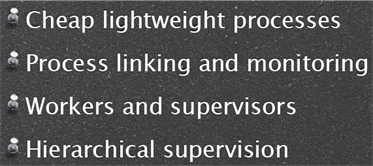
Even in applications where error detection and handling is taken seriously upfront (safety-critical and high availability apps), the time to architect, design, code, and test the equivalent “homegrown” capabilities can equal or exceed the time to develop the app’s “fun” functionality. That is, unless you use Erlang.
Ironic
It’s like ten thousand spoons when all you need is a knife – Alanis Morissette
I find it curiously ironic that despite what may be espoused, software developers are often placed on one of the lowest rungs of the ladder of stature and importance (but alas, the poor test engineers often rank lowest) in many corpricracies whose revenue is dominated by software-centric products. Yet, it seems that many front-line software project managers, software “leads“, and software “rocketects” are terrified of joining the fray by designing and writing a little code here and there to lead by example and occasionally help out. In mediocre corpo cultures, it’s considered a step “backward” for titled ones to cut some code.

Fuggedaboud writing some code, a lot of the self-pseudo-elite dudes are afraid of even reading code for quality. Hence, to justify their existence, they focus on being meticulous process, schedule, and status-taking wonks – which of course unquestioningly requires greater skill, talent, and dedicated effort than designing/coding/testing/integrating revenue generating code.


Why am I here?
WTF?
Meh!
D'oh!

My BTC Address



 Bulldozer00's Blog